
Home / Filter Press Products / Vertical Filter Press
STACKED CHAMBERS / TRAVELLING FILTER CLOTH / BLZG SERIES
Vertical Filter Press for Cake Washing & Dewatering
Combine pressure filtration, membrane squeezing and cake washing in a vertically stacked chamber arrangement. Compare BLZG models and evaluate the cloth-discharge cycle against your product-recovery, washing and cake-handling requirements.
Send the slurry, production requirement, wash target and desired cake condition.
Published filter area
6–168 m²22 BLZG models across three listed plate-size families.
Filtration pressure
0.3–0.6 MPaEquivalent to 3–6 bar; separate from the membrane-squeeze stage.
Published squeeze pressure
0.8–1.6 MPaEquivalent to 8–16 bar; labelled “Extruding pressure” in the source table.
Evaluate the Washing Result and the Complete Cycle
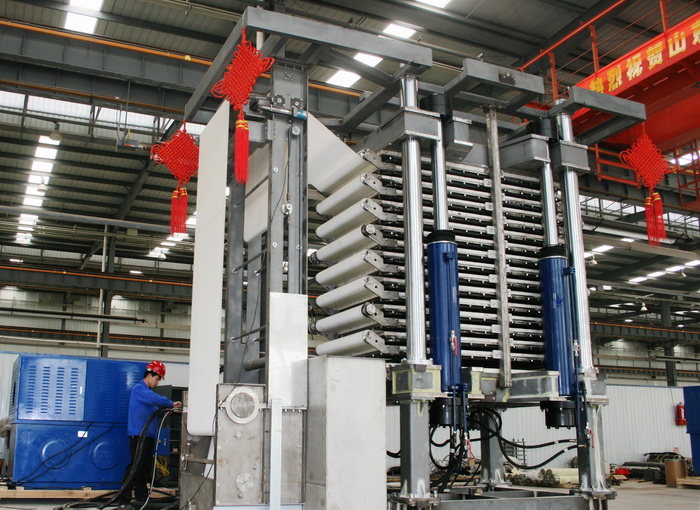
Horizontal filtration surfaces are arranged at different levels in a vertical stack. The supplier describes a travelling-cloth system for cake discharge and cloth cleaning. Evaluate these features against the actual slurry and process targets.
Cake washing & product recovery
Define residual mother liquor, impurity limits, valuable-material recovery and acceptable wash-liquid consumption. Use representative test results to establish the washing requirement.
Further mechanical dewatering
Compare filtration, membrane squeezing and compressed-air dewatering using measured cake moisture or solids. Confirm which stages improve the required downstream handling condition.
Layout & automated handling
Review the vertical installation, cloth travel and cake-discharge path. Compare floor area together with height, access, utilities and maintenance space.
BLZG Vertical Filter Press Specifications
Compare filter area, plate size, plate quantity and the two pressure ranges. Published capacity is a reference value; the source does not state the slurry, solids content or complete-cycle basis used to obtain it.
Two entries require confirmation: BLZG21/900×1750 is listed at 4.32 m³/h, the same as BLZG18. BLZG50/1200×2620 is listed with 50 plates. Both values are reproduced and highlighted below; no extrapolation or correction has been assumed.
900 × 1750 mm plate family
6 published models
| Model | Filter area (m²) | Plate size (mm) | Plate quantity (pcs)* | Filtration pressure (MPa) | Extruding / squeeze pressure (MPa) | Published capacity (m³/h)* |
|---|---|---|---|---|---|---|
| BLZG6/900×1750 | 6 | 900×1750 | 4 | 0.3~0.6 | 0.8~1.6 | 1.44 |
| BLZG9/900×1750 | 9 | 900×1750 | 6 | 0.3~0.6 | 0.8~1.6 | 2.16 |
| BLZG12/900×1750 | 12 | 900×1750 | 8 | 0.3~0.6 | 0.8~1.6 | 2.88 |
| BLZG15/900×1750 | 15 | 900×1750 | 10 | 0.3~0.6 | 0.8~1.6 | 3.6 |
| BLZG18/900×1750 | 18 | 900×1750 | 12 | 0.3~0.6 | 0.8~1.6 | 4.32 |
| BLZG21/900×1750 | 21 | 900×1750 | 14 | 0.3~0.6 | 0.8~1.6 | 4.32 |
1200 × 2620 mm plate family
6 published models
| Model | Filter area (m²) | Plate size (mm) | Plate quantity (pcs)* | Filtration pressure (MPa) | Extruding / squeeze pressure (MPa) | Published capacity (m³/h)* |
|---|---|---|---|---|---|---|
| BLZG25/1200×2620 | 25 | 1200×2620 | 10 | 0.3~0.6 | 0.8~1.6 | 6 |
| BLZG30/1200×2620 | 30 | 1200×2620 | 12 | 0.3~0.6 | 0.8~1.6 | 7.2 |
| BLZG35/1200×2620 | 35 | 1200×2620 | 14 | 0.3~0.6 | 0.8~1.6 | 8.4 |
| BLZG40/1200×2620 | 40 | 1200×2620 | 16 | 0.3~0.6 | 0.8~1.6 | 9.6 |
| BLZG45/1200×2620 | 45 | 1200×2620 | 18 | 0.3~0.6 | 0.8~1.6 | 10.8 |
| BLZG50/1200×2620 | 50 | 1200×2620 | 50 | 0.3~0.6 | 0.8~1.6 | 12 |
1500 × 4010 mm plate family
10 published models
| Model | Filter area (m²) | Plate size (mm) | Plate quantity (pcs)* | Filtration pressure (MPa) | Extruding / squeeze pressure (MPa) | Published capacity (m³/h)* |
|---|---|---|---|---|---|---|
| BLZG60/1500×4010 | 60 | 1500×4010 | 10 | 0.3~0.6 | 0.8~1.6 | 14.4 |
| BLZG72/1500×4010 | 72 | 1500×4010 | 12 | 0.3~0.6 | 0.8~1.6 | 17.28 |
| BLZG84/1500×4010 | 84 | 1500×4010 | 14 | 0.3~0.6 | 0.8~1.6 | 20.16 |
| BLZG96/1500×4010 | 96 | 1500×4010 | 16 | 0.3~0.6 | 0.8~1.6 | 23.04 |
| BLZG108/1500×4010 | 108 | 1500×4010 | 18 | 0.3~0.6 | 0.8~1.6 | 25.92 |
| BLZG120/1500×4010 | 120 | 1500×4010 | 20 | 0.3~0.6 | 0.8~1.6 | 28.8 |
| BLZG132/1500×4010 | 132 | 1500×4010 | 22 | 0.3~0.6 | 0.8~1.6 | 31.68 |
| BLZG144/1500×4010 | 144 | 1500×4010 | 24 | 0.3~0.6 | 0.8~1.6 | 34.56 |
| BLZG156/1500×4010 | 156 | 1500×4010 | 26 | 0.3~0.6 | 0.8~1.6 | 37.44 |
| BLZG168/1500×4010 | 168 | 1500×4010 | 28 | 0.3~0.6 | 0.8~1.6 | 40.32 |
*Capacity is reproduced in m³/h. The source summary separately uses “1–40 ton/hour” without defining the basis; these are not interchangeable ratings. Confirm feed composition, density where relevant, solids loading, cycle stages and acceptance conditions for the quoted duty.
Merged source cells have been expanded into each row. Filtration pressure, squeeze pressure, hydraulic closing requirements and compressed-air dewatering pressure are separate specifications. Confirm their limits and sequence for the selected plate pack. Swipe within the tables on a phone.
Reference: supplier vertical filter press product table, reviewed 30 September 2026.
Specify the Filtration, Washing and Discharge Functions
The supplier describes an automatically controlled cycle with functions that can be combined for the process. Confirm the selected stages, their order and operating endpoints; not every material needs the same washing or dewatering sequence.
01
Filtration
Feed slurry into the closed chambers. Liquid passes through the filter medium and retained solids form a cake.
02
Water-driven membrane squeeze
The supplier describes high-pressure water behind the membranes to compress the formed cake. Confirm the approved squeeze system and limits.
03
Cake washing
Pass the specified wash liquid through the cake to reduce retained mother liquor or impurities. Define the wash endpoint and collection routes.
04
Further squeezing
Include a further squeeze where the process requires it after or in combination with washing. Confirm the actual programmed sequence.
05
Compressed-air dewatering
The supplier describes compressed air passing through the cake to reduce residual liquid. Specify pressure, quality and consumption for this separate circuit.
06
Cloth travel & cake discharge
Release and verify process pressures before opening. Move the cloth to discharge cake and perform the specified cloth-cleaning and return sequence.
Compressed air through the cake is distinct from water behind the membrane. Do not substitute squeeze media or assume that air dewatering provides the same result as thermal drying. The press remains cyclic even though the cloth travels through the machine.
Allow for the Vertical Stack and the Cloth-Handling System
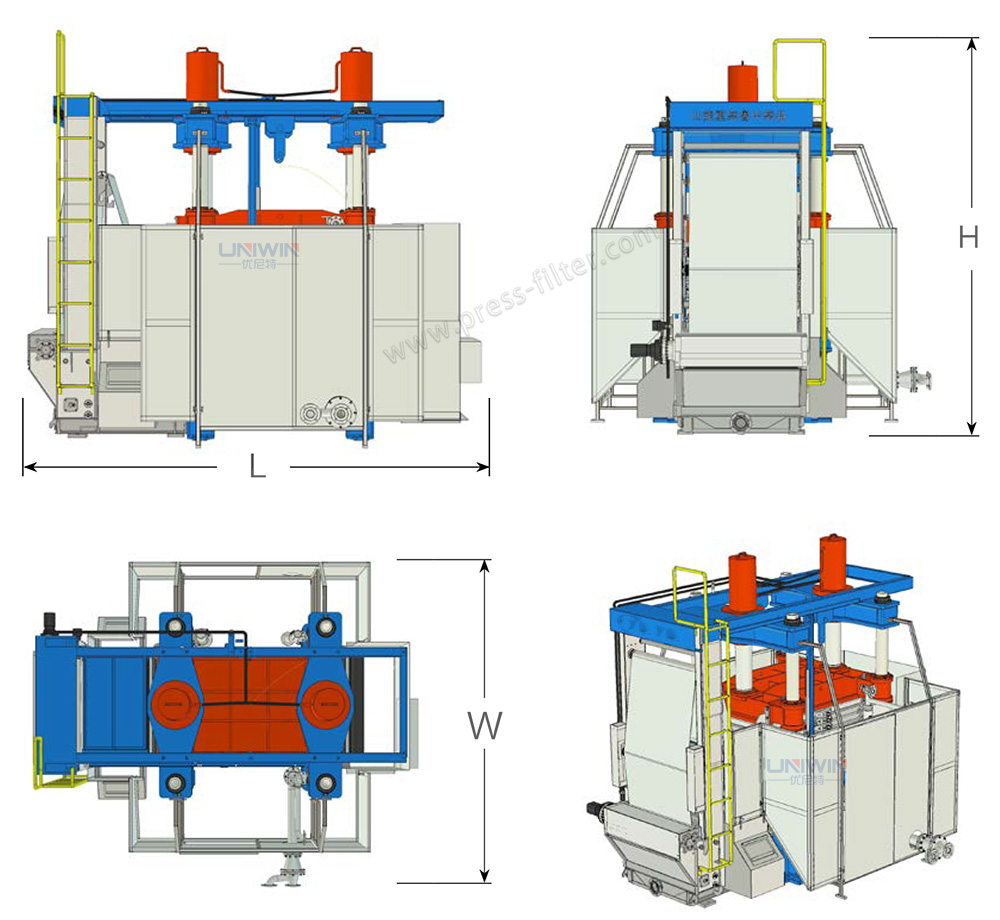
Supplier arrangement illustration with L, W and H markers. It gives no numeric dimensions for a selected BLZG model; obtain the current general-arrangement drawing.
Review height, access and the discharge route
The vertical format can reduce the length occupied by a plate stack, but the full layout must include the moving cloth, access platforms, maintenance and lifting space, cake collection and connected equipment.
Confirm the cloth drive, tracking and tensioning arrangement, wash system, drainage and replacement access. Check cake-release behavior with the actual material, especially where it is sticky or compressible.
The supplier describes PLC control with monitoring and alarms. Specify the actual sequence, interlocks, instruments, operator tasks and included auxiliary equipment in the proposal.
The supplier summary gives 5 tons and 5 × 2 × 2 m without identifying a model. These figures are not used as series-wide installation data. Request the selected machine’s operating weight, dimensions, support loads and service clearances.
Compare Vertical and Horizontal Press Arrangements
| Decision point | Vertical cloth-travel arrangement | Horizontal plate-stack arrangement |
|---|---|---|
| Layout | Horizontal filtration surfaces at successive levels; review height and cloth route. | Plate stack extends along the frame; review opening length and side access. |
| Washing and dewatering | Evaluate the selected filtration, wash, squeeze and air sequence using your material. | Review the actual chamber or membrane configuration and any washing provisions. |
| Discharge and maintenance | Travelling cloth carries cake out; confirm release, tracking and cleaning. | Plate opening and cake release depend on the selected shifting and discharge arrangement. |
| Selection evidence | Compare recovery, wash-liquid use, cake condition, total cycle and utilities. | Use the same test basis, production target and total installation scope. |
Process Duties to Discuss
Mineral and metallurgical products
For nickel-bearing fines, copper concentrate or zinc-process streams, define the solid and liquid products to recover, washing needs and acceptable retained liquor.
Chemical process solids
For zeolite, caustic sludge and other process solids, provide chemistry, particle behavior and the required impurity or wash endpoint.
Starch, enzymes and related processes
Define product quality, contact-material requirements, temperature and cleaning conditions. Equipment suitability and documentation depend on the particular process.
Vertical Filter Press FAQs
Does vertical mean the filtration surfaces are vertical?
For this arrangement, the filter cloth and filtering surfaces are horizontal and the chambers are stacked at successive levels. The term describes the overall stack rather than upright filtering faces.
What is the difference between filtration and squeeze pressure?
The table lists 0.3–0.6 MPa filtration pressure and 0.8–1.6 MPa extruding or squeeze pressure. The feed circuit, membrane circuit, closing system and compressed-air circuit have different duties and require separate confirmed limits.
Does it guarantee 99% impurity removal or cake moisture below 10%?
No universal result is established. Define impurity removal, recovery, residual liquor and cake moisture using agreed test methods. Performance depends on the material, cloth, washing sequence, pressure and complete cycle.
Can air be used instead of water behind the membrane?
The reference supplier describes high-pressure water for membrane squeezing and compressed air through the cake for final dewatering. Use only the medium and sequence approved for the supplied membrane and pressure system.
Will sticky cakes always discharge completely?
Travelling cloth assists discharge, but release depends on the material and cloth condition. Evaluate representative cake-release tests, cleaning needs and any additional operator or mechanical assistance.
Why are two model entries highlighted?
BLZG21 is published at the same 4.32 m³/h capacity as BLZG18, and BLZG50 lists 50 plates. These source entries need confirmation. The table retains them without assuming corrected values.
FILTRATION, WASHING & CLOTH DISCHARGE
Request a Vertical Filter Press Recommendation
Send the slurry composition, feed solids, temperature, throughput with units and required cake condition. Include the product or liquid you want to recover and any washing target.
Share the impurity or retained-liquor limit, acceptable wash-liquid use, current cycle data, available utilities and installation height. Mention a BLZG model if you have one in mind.
Agree final model data, process sequence, utilities and performance acceptance conditions in the quotation.