
Home / Filter Press Products / High Pressure Filter Press
ROUND PP PLATES / RFP SERIES
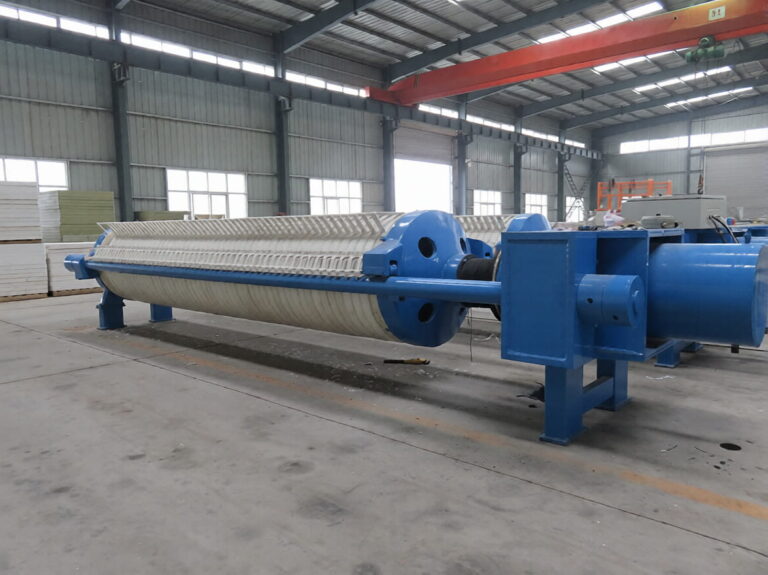
High Pressure Filter Press for Mineral Slurry Dewatering
Evaluate round-plate pressure filtration for stone-processing slurry, kaolin, ceramics and other process solids. Compare seven RFP models, then match the press and feed system to representative slurry data.
Send your feed solids, throughput with units, current cake moisture and the required handling condition.
Published filtration pressure
1.0–2.0 MPaEquivalent to 10–20 bar. Confirm the approved operating point for the complete system.
Detailed model-table range
20–80 m²Seven RFP configurations with listed chamber volumes of 255–1200 L.
Plate construction
Round PP platesSpecify the plate grade, geometry, cloth and temperature limits for the feed.
Use Slurry Results to Decide Whether Higher Feed Pressure Helps
Higher filtration pressure increases the pressure difference driving liquid through the cloth and cake. The useful result depends on the material: compressible cakes can become more resistant as pressure rises, so pressure alone does not establish throughput or final cake moisture.
Material response
Review particle size, solids content, viscosity, conditioning and any changes in feed. Compare trials under defined pressure and temperature conditions.
Complete-cycle production
Measure filling, filtration, depressurization, opening, cake discharge and cleaning. Compare dry-solids output over the available shift.
Cake and operating cost
Define a cake-handling or disposal target, then compare measured moisture, pump energy, cycle time and maintenance. Calculate savings from actual results and local costs.
RFP High Pressure Filter Press Specifications
The detailed supplier table lists seven round-plate models from 20 to 80 m². Its page summary separately mentions 20–100 m²; request confirmed model data if you need a size beyond the table below.
Weight requiring confirmation: RFP60/800-29 is published as 9710 kg, higher than the adjacent listed models. The value is retained and highlighted, without guessing a replacement. Confirm the current weight and installation drawing before ordering.
| Model | Filter area (m²) | Published plate size* | Cake thickness* | Plate quantity | Chamber volume (L) | Filtration pressure (MPa) | Dimensions (mm)** | Weight (kg) |
|---|---|---|---|---|---|---|---|---|
| RFP20/800-25 | 20 | Φ800 | 25 | 20 | 255 | 1.0-2.0 | 3300*1100*1060 | 3346 |
| RFP30/800-26 | 30 | Φ800 | 25 | 30 | 377 | 1.0-2.0 | 3780*1100*1060 | 3590 |
| RFP40/800-27 | 40 | Φ800 | 25 | 40 | 499 | 1.0-2.0 | 4300*1100*1060 | 4554 |
| RFP50/800-28 | 50 | Φ800 | 25 | 50 | 621 | 1.0-2.0 | 4820*1100*1060 | 5150 |
| RFP60/800-29 | 60 | Φ800 | 25 | 60 | 753 | 1.0-2.0 | 5340*1100*1060 | 9710 |
| RFP70/800-30 | 70 | Φ800 | 25 | 70 | 875 | 1.0-2.0 | 5860*1100*1060 | 5760 |
| RFP80/800-31 | 80 | Φ800 | 30 | 80 | 1200 | 1.0-2.0 | 6400*1100*1060 | 6860 |
*The source writes plate size as “Φ800” and cake thickness as “25” or “30” without units in those column headings. Confirm units and the plate/chamber drawing. Model suffixes are reproduced as published and are not used to infer cake thickness. **The dimension header specifies mm but does not identify axis order. Confirm the layout and service clearances.
The shared pressure cell has been expanded into every row. 1.0–2.0 MPa equals 10–20 bar and refers to filtration pressure, not hydraulic closing pressure or membrane squeezing pressure. Final ratings depend on the quoted configuration. Swipe within the table on a small screen.
Reference: supplier high-pressure filter press table, reviewed 30 September 2026.
Round Plates Matched to the Pressure and Temperature Duty
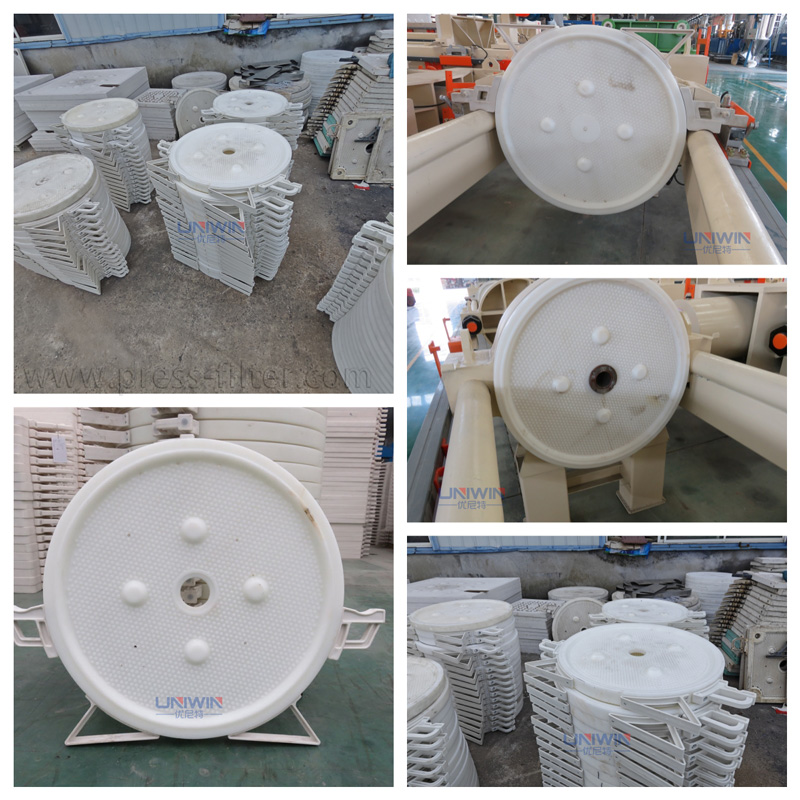
Supplier photo collage of round plate examples. Confirm the offered grade, drawing and rating; the photographs are not a dimensional or pressure certificate.
Review the complete plate pack
The reference RFP series uses round polypropylene filter plates. Specify the cloth, feed and drainage arrangement, plate support and closing requirements together with the permitted pressure and temperature.
The supplier describes its standard round plate body thickness as 60–70 mm. That is a different dimension from the cake-thickness column; confirm both against the selected plate and chamber drawings.
A round shape alone does not establish a safe pressure rating or guarantee a drier cake. The plate design, material, frame, closing system and connected feed circuit must all match the specified duty.
Specify the Feed Pump and Controls as Part of the System
Pump duty
Provide required flow, pressure profile, solids loading, particle size, abrasiveness, viscosity and temperature. Select a pump against the slurry duty and its operating curve.
Pressure-rated flow path
Confirm the working limits of plates, cloth, connections, piping, valves and instruments. Define the pressure-control and protection arrangement for the proposed system.
Closing and sequence
Specify the closing system and interlocks that support the filtration sequence. Confirm how operating pressures are released and verified before the plate pack opens.
A pump label alone does not establish suitability. A plunger, screw or centrifugal design must be assessed for the actual head, flow, solids and materials; do not assume a standard pump can be exchanged without reviewing the complete installation.
Separate Filtration, Closing and Membrane Squeezing
| Function | What it does | What to specify |
|---|---|---|
| High-pressure feeding | The feed pump creates the pressure difference used to filter slurry through the cloth and formed cake. | The RFP table lists 1.0–2.0 MPa filtration pressure. Confirm the approved feed profile and complete system limits. |
| Hydraulic closing | The closing system holds the plate pack together during filtration. | Cylinder pressure, effective piston area, required closing force and controls. MPa measures pressure, not force. |
| Membrane squeezing | A separate membrane stage compresses the cake after the required initial filtration condition. | Plate compatibility, approved squeeze medium, separate pressure limits and sequence. This stage is not established by the RFP table. |
Start with the Slurry and Its Required Cake Condition
Stone and ceramic slurry
For marble, granite, kaolin and ceramic feeds, review fine-particle behavior, abrasiveness, water recovery and the cake-handling requirement.
Mining and mineral processing
Specify the mineral stream, solids loading, particle-size distribution and feed variation. Compare complete cycles and filtrate recovery using representative samples.
Industrial and municipal sludge
Evaluate conditioning, compressibility, pressure response and disposal needs. Confirm results by testing; no fixed moisture level or chemical-free dewatering result is assumed.
High Pressure Filter Press FAQs
What is the published pressure range for these RFP models?
The supplier table lists 1.0–2.0 MPa, equivalent to 10–20 bar. A 25–30 bar filtration rating is not substantiated for this listed series. Confirm the permitted operating pressure for the complete proposed configuration.
Will higher pressure always produce a drier cake?
No. Results depend on the slurry, cake compressibility, conditioning, cloth and complete cycle. Measure cake moisture or solids using an agreed method and assess whether added pressure provides a useful improvement.
Is this the same as a membrane filter press?
No. Higher feed pressure comes from the slurry feed system. Membrane squeezing is a separate stage using a compatible membrane plate and pressurizing system. The RFP reference table does not establish that a squeeze system is included.
Are round plates always stronger than square plates?
Shape is only one factor. Material, thickness, reinforcement, dimensions, temperature and the complete machine design determine the permitted duty. Compare confirmed equipment ratings rather than treating plate shape as a universal rule.
Why is RFP60/800-29 listed at 9710 kg?
That is the value published in the source table, and it is higher than the adjacent models. It has been marked for confirmation. Request the current technical data and drawing; no corrected weight has been assumed.
How should I select a model and feed pump?
Provide slurry composition, particle characteristics, feed solids, throughput with units, temperature, required cake condition and available operating hours. Compare area and chamber volume, then select the feed system using representative filtration data and the specified pressure profile.
SLURRY TESTING & RFP MODEL SELECTION
Request a High Pressure Filter Press Recommendation
Send the slurry name, feed solids if known, temperature, throughput with units and required cake condition. Mention the RFP model if you are comparing a listed configuration.
Include current cycle times, pressure and cake-moisture measurements where available, plus conditioning, operating hours, utilities and project location.
Confirm final ratings, dimensions, feed equipment and performance acceptance conditions in the quotation.