
Home / Filter Press Products / Vibrating Filter Press
VIBRATION-ASSISTED CAKE RELEASE
Vibrating Filter Press for Assisted Cake Discharge
Help retained cake detach from the filter cloth during discharge. Review the vibration mechanism, plate compatibility and operating sequence around the material you need to filter.
Share the slurry type, cake condition and the manual cleaning currently required.
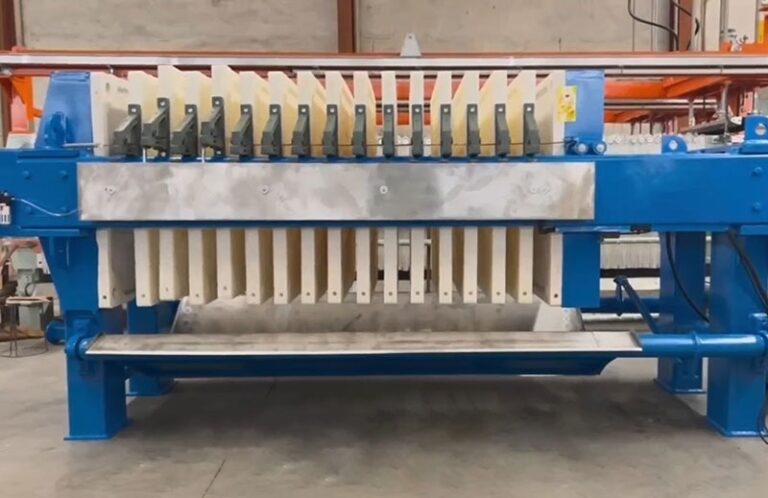
Primary function
Cake releaseMechanical vibration assists detachment during discharge.
Mechanism reference
Plate vibrationSupplier describes vibration transmitted through the plate-handle arrangement.
Evaluation basis
Actual materialCake adhesion, cloth condition and discharge behavior determine suitability.
A Vibration Device to Assist Cake Detachment
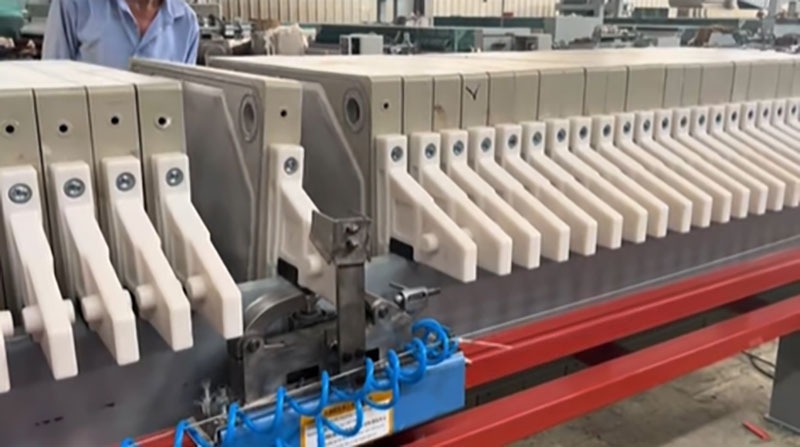
Supplier photograph of the vibration arrangement at the plate pack.
How the device helps release retained cake
The supplier describes mechanical vibration applied through the filter-plate handle arrangement. Its supporting article also describes periodic vibration or impact after the plates are pulled apart, helping adhering cake loosen and fall away.
Confirm the exact contact point, movement and sequence for the equipment offered. Vibration-assisted release is different from simply opening the plate pack faster.
Address cake adhesion
Evaluate the aid when cake remains attached after plate opening and requires repeated manual removal.
Reduce repeated scraping
Successful release assistance can reduce the need to strip cake with tools. The benefit depends on the cloth, cake condition and actual operating duty.
Coordinate the discharge system
Match plate movement, the vibration step and downstream cake collection so that one part of the system does not hold up the others.
Technical Configuration & Quotation Checklist
Specify the base press and the vibration-assisted discharge arrangement together. Model-specific filter area, chamber volume, pressure ratings, vibration settings, power and dimensions are confirmed in the technical proposal.
| Item | Selection basis | Confirm in the quotation |
|---|---|---|
| Vibration arrangement | Force application and motion | Device location, contact with the plate or handle, vibration method and compatibility with the plate pack. |
| Filter plates & cloth | Materials and cake release | Plate design, handles, cloth installation, chemical compatibility and cleaning requirements. |
| Base press sizing | Filtration duty | Filter area, chamber volume, plate count, pressure ratings and the complete cycle for the actual slurry. |
| Controls & discharge sequence | Coordinated operation | Plate opening, vibration initiation and stop conditions, sensors, interlocks and operator tasks. |
| Electrical & installation | Site requirements | Motor or actuator duties, utilities, machine dimensions, access, noise requirements and cake collection. |
| Acceptance & maintenance | Demonstrated operating result | Representative material, residual cake, discharge time, manual assistance, inspection and service responsibilities. |
Agree what a successful release test means: the remaining cake, manual assistance required and discharge time under stated feed and cake conditions. Equipment movement alone is not a complete performance test.
Configuration reference: supplier vibrating filter press product information and its automatic vibration explanation, reviewed 29 September 2026.
Vibration Belongs in the Controlled Discharge Sequence
The press still separates solids and liquid through a batch filtration cycle. The vibration aid addresses cake removal after filtration; it is not a separate dewatering or drying stage.
01
Complete filtration
Form the cake using the selected press configuration. Complete any agreed washing, squeezing or air-blow steps where fitted.
02
Depressurize & open
Verify the required depressurization and follow the approved plate-opening sequence before the discharge-assistance step.
03
Assist release & inspect
Operate the vibration device as specified, collect the cake and assess remaining deposits. Clean or service as required before the next cycle.
The actual equipment instructions govern sequencing, settings and isolation. Do not approach or clean moving components during automatic discharge.
Check the Cake Before Adding More Automation
Cake still adheres after opening
Look at whether cake hangs on the cloth or remains on the plate surface, and how often an operator has to intervene.
Cloth and feed are understood
Review cloth suitability, cleanliness, feed changes and the actual cake condition. A vibration aid does not replace this process review.
The benefit can be measured
Compare residual deposits, manual cleaning and discharge time with representative material, then consider maintenance and downstream handling.
Evaluate the Actual Slurry and Cake
Chemical processing
For chemical slurries with adhering cake, review composition, temperature, filter media and any product-recovery requirement before selecting the device.
Wastewater & industrial sludge
Review sludge source, conditioning, feed solids and the cake produced by the existing cycle. Record the cleaning effort that the proposed system needs to reduce.
Mining, food and other duties can be discussed where cake adhesion is a problem. Material suitability, hygiene requirements and product quality must be assessed for the specific process.
Inspect the Device, Fasteners and Filter Medium
Vibration behavior
Inspect the device and movement against the equipment instructions. Investigate excessive, insufficient or irregular vibration rather than increasing settings without a review.
Fasteners & lubrication
Check attachment points and fasteners, and service lubrication points and moving parts according to the maintenance schedule.
Cloth & operating records
Keep the cloth clean, inspect for wear and damage, and record release problems, adjustments and replaced components to guide maintenance.
Vibration Assistance or Quick Opening?
Vibration assistance targets cake that remains attached. Quick opening targets movement of the plate pack. These solve different parts of discharge and should be selected around the observed bottleneck. Combining features requires confirmation of the actual machine and control sequence.
Questions Before Selecting a Vibrating Filter Press
Which part of the machine is vibrated?
The supplier product page describes mechanical vibration through the filter-plate handle. The detailed device and force-transfer path should be confirmed for the actual plate pack and equipment offered.
Will every cake fall off without manual cleaning?
That cannot be assumed for every slurry. Evaluate representative cake behavior and agree the acceptable residual cake, manual assistance and cleaning frequency.
Does vibration make the cake drier?
The described device assists cake release. Cake moisture is governed by the material and filtration process, including conditioning, filter media and any separate squeezing stage.
Can vibration damage plates or cloth?
Settings, compatibility, attachment points and condition all matter. Follow the specified operating limits and inspection requirements; do not assume unlimited vibration is harmless.
Can a vibration device be added to an existing press?
A retrofit requires an engineering review of plate handles, support structure, opening system, controls, access and required safeguards. Fit and performance are not established by mounting a motor alone.
What noise level should I expect?
Confirm noise data for the proposed equipment and operating conditions. Define the measurement method and location if an acoustic requirement is part of the project.
CAKE RELEASE & CONFIGURATION
Tell Us Where Cake Discharge Becomes Difficult
Share the material, throughput and units, current press and plate arrangement, cake condition and manual cleaning required. If available, include photographs or a video of the cake after opening.
Also state project location, available utilities, operating hours and any noise or automation requirements.
The proposed mechanism, included equipment and acceptance conditions are confirmed in the quotation.