Home / Filter Press Products / Laboratory Filter Press
SMALL-SCALE FILTRATION / FP SERIES
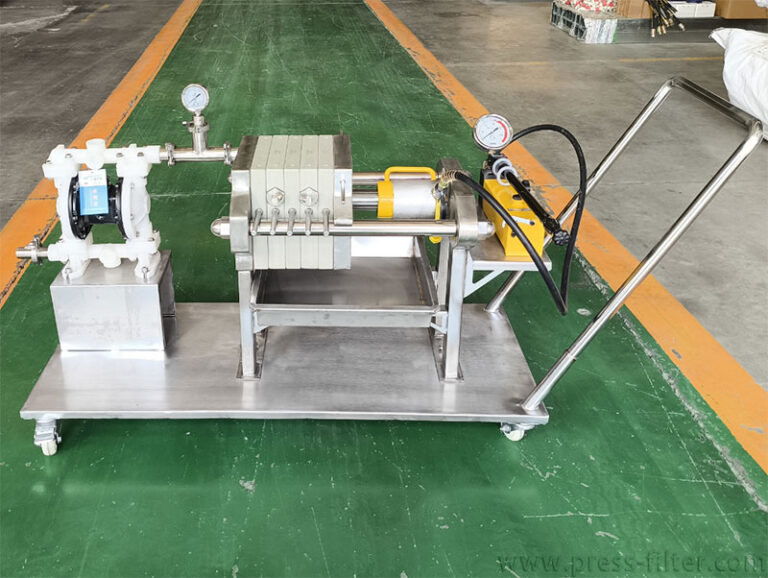
Laboratory Filter Press for Filtration Testing
Compare filter media, observe cake formation and collect data before selecting production equipment. Review compact FP configurations for small-scale solid–liquid separation, process development and repeatable quality checks.
Tell us what you need to learn, how much representative sample is available and the intended production process.
Published filter area
0.08–4 m²12 FP configurations in the supplier model table.
Model filtration pressure
0.15–0.3 MPaEquivalent to 1.5–3 bar; confirm the limit for the selected model and medium.
Testing focus
Media • Cake • FiltrateDefine the test method and record conditions as well as the result.
Use the Test to Answer a Specific Process Question
Compare filtration media
Evaluate compatible cloth, paper or other media using the same feed and operating method. Compare clarity, solids retention, resistance, product loss and cleaning requirements.
Understand cake formation
Observe filtration over time, cake build-up and release. Measure cake condition using a defined sampling and moisture or solids method.
Review a process change
Compare feed variation, conditioning or cleaning changes under controlled conditions. Record what changed and repeat trials where variability could affect the decision.
FP Laboratory Filter Press Specifications
Use the published table to compare area, plate quantity and listed equipment values. Choose a configuration that can reproduce the relevant test conditions and accommodate the available sample.
Confirm the plate-size and flow-rate headings. The source labels its plate-size column “Plate Size(m2)” but lists values of 100–400. It labels flow “T/H” without stating the feed or measurement basis. Values below are preserved; no unverified conversion to mm, L/h or m³/h has been applied.
FP100 / FP150 / FP200 models
3 published configurations
| Model | Plate quantity | Filter area (m²) | Published plate-size entry* | Filtration pressure (MPa) | Published flow (T/H)* | Listed power (kW) | Size (mm)** |
|---|---|---|---|---|---|---|---|
| FP100-10 | 10 | 0.08 | 100 | 0.15 | 0.8 | 0.55 | 600x300x600 |
| FP150-10 | 10 | 0.18 | 150 | 0.15 | 1.5 | 0.55 | 650x380x650 |
| FP200-10 | 10 | 0.3 | 200 | 0.15 | 2 | 0.55 | 650x400x700 |
FP300 models
3 published configurations
| Model | Plate quantity | Filter area (m²) | Published plate-size entry* | Filtration pressure (MPa) | Published flow (T/H)* | Listed power (kW) | Size (mm)** |
|---|---|---|---|---|---|---|---|
| FP300-10 | 10 | 0.7 | 300 | 0.2 | 4 | 1.1 | 700x500x800 |
| FP300-20 | 20 | 1.4 | 300 | 0.2 | 8 | 1.1 | 800x500x800 |
| FP300-30 | 30 | 2.1 | 300 | 0.2 | 10 | 1.1 | 900x600x1000 |
FP400 models
6 published configurations
| Model | Plate quantity | Filter area (m²) | Published plate-size entry* | Filtration pressure (MPa) | Published flow (T/H)* | Listed power (kW) | Size (mm)** |
|---|---|---|---|---|---|---|---|
| FP400-10 | 10 | 1.3 | 400 | 0.2 | 6 | 1.1 | 900x900x1000 |
| FP400-16 | 16 | 2 | 400 | 0.2 | 9 | 1.5 | 1000x600x1000 |
| FP400-20 | 20 | 2.5 | 400 | 0.2 | 10 | 1.5 | 1100x600x1000 |
| FP400-24 | 24 | 3 | 400 | 0.3 | 12 | 2.2 | 1200x600x1000 |
| FP400-30 | 30 | 3.8 | 400 | 0.3 | 15 | 2.2 | 1300x600x1000 |
| FP400-32 | 32 | 4 | 400 | 0.3 | 18 | 2.2 | 1320x600x1000 |
*Confirm the plate-size unit, geometry and drawing. Flow is reproduced with the supplier’s label “T/H”; it is not a verified slurry-throughput guarantee. The page summary separately states 10–1000 liter/hour, without mapping that range to these models or defining a comparable basis.
**The source labels size in mm but does not identify axis order. Confirm the installation drawing and access. Listed power is not a complete utility schedule; verify voltage, phase, pump duty and any additional equipment.
Reference: supplier laboratory filter press model table, reviewed 30 September 2026. Final model data and operating limits are confirmed in the quotation. Swipe within the tables on a phone.
Match the Materials, Filter Medium and Test Functions
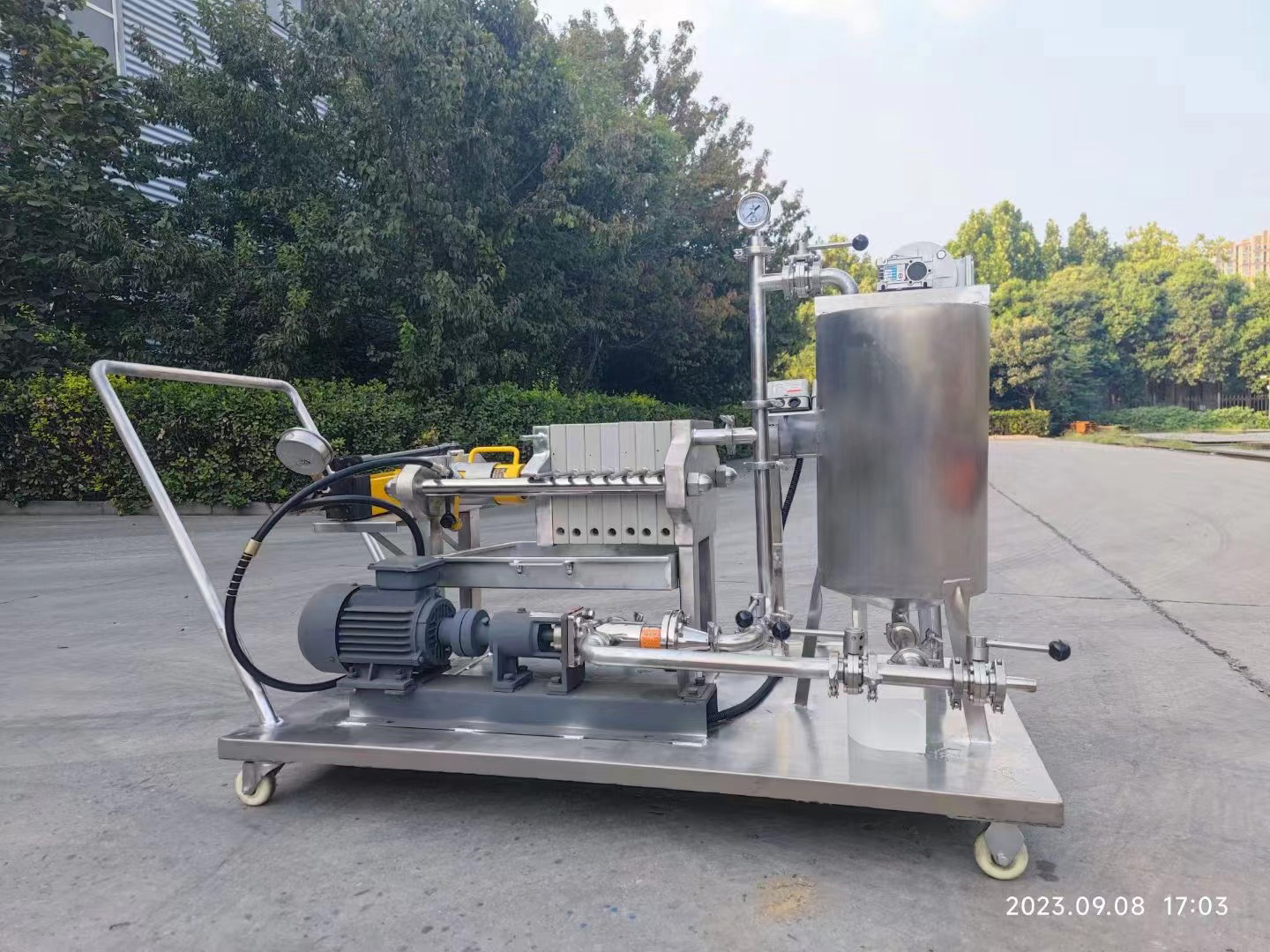
Supplier package example with pump, piping and a vertical vessel. Confirm the purpose and supply scope of each component; the image does not identify a standard package for every FP model.
Specify the configuration you need to test
The supplier describes PP or stainless laboratory designs, and separately describes a stainless configuration using SS304/316L and different filter media. Confirm which construction applies to the selected model and which parts contact the product.
For a suitable plate arrangement, the supplier mentions microporous membranes, filter paper, cloth and clarifying boards. Match the medium to the feed, pressure, required filtrate quality and cleaning method.
A microporous filtration membrane is a filter medium. It does not establish that the press has a membrane-squeezing stage. Specify any squeezing, cake-washing or other test function separately.
Wetted materials & seals
Provide chemistry, concentration, temperature and cleaning agents. Confirm the actual material grades and offered seal compound; a stainless or elastomer name alone is not a compatibility assessment.
Feed and closing equipment
The supplier describes integrated closing, feed-pump, valve, pipe and cake-tray arrangements. Confirm the selected package, pump type, controls and instrument ranges in the quotation.
Installation and utilities
Review dimensions, equipment weight, support, drainage, electrical supply and other required services. Wheels or a small footprint do not establish suitability for every laboratory bench.
Record Conditions as Carefully as the Filtration Result
| Record | Include | Why it matters |
|---|---|---|
| Feed and sample | Material identity, preparation, solids basis, temperature, particle information and sample volume. | Shows whether tests represent the actual process and whether changes in feed explain the result. |
| Equipment and method | Plate and chamber geometry, active area, medium, conditioning, pressure profile and timing. | Allows meaningful comparisons and identifies differences from the production configuration. |
| Separation result | Filtrate volume over time, quality measurements, cake mass, thickness and moisture or solids method. | Connects filtration behavior to the required cake and filtrate conditions. |
| Full cycle and repeatability | Opening, discharge, cleaning, product retained in the system and variation across repeated trials. | Avoids treating filtration time alone as complete production capacity. |
01
Define the test
Set the question, acceptance measurements and representative sample. Confirm that the selected equipment can reproduce the relevant operating conditions.
02
Run and measure
Prepare and operate the press within its approved limits. Record feed, pressure, filtrate and cake data using the agreed method.
03
Compare and review
Evaluate repeatability, release and cleaning as well as the measured result. Identify any further pilot work or design information needed for the next decision.
Use Laboratory Results to Inform Production Sizing
A laboratory trial can support feasibility and media selection, but its flow rate cannot simply be multiplied by a filter-area ratio to guarantee production output. Cake resistance, compressibility, geometry, feed delivery and handling can change at scale.
Match relevant conditions
Compare feed variability, medium, cake loading or thickness, temperature and the pressure sequence. Record differences that could change the filtration response.
Check the pressure range
The listed FP models operate at 0.15–0.3 MPa filtration pressure. If the production duty needs a different pressure or membrane squeezing, confirm an appropriate test configuration.
Review the complete duty
Use chamber volume, dry-solids load, cycle time, operating hours and utilities alongside trial results. Agree any additional pilot tests and performance acceptance conditions.
Laboratory and Process-Development Uses
Research and teaching
Observe pressure filtration, media performance and cake formation with a defined sample and repeatable method.
Process development
Assess compatible media, feed preparation and operating changes before progressing to a pilot or production review.
Quality and material checks
Compare incoming materials, product batches or process changes using controlled conditions and agreed measurements.
The supplier lists chemical, food, pharmaceutical and mineral-processing applications. Confirm contact materials, separation targets and documentation for the actual sample; an application label does not establish compliance or performance.
Laboratory Filter Press FAQs
How much sample do I need?
Sample volume depends on chamber capacity, feed solids, the target cake loading, liquid retained in the equipment and repeat tests. Provide the sample properties and objective so the requirement can be established for the selected model; no universal 5–10 L quantity is assumed.
Can I use the listed flow rate to size a production press?
The source provides no comparable feed or test basis for its T/H values. Use measured filtration data and a review of geometry, pressure, cake loading and the complete production cycle instead of direct extrapolation.
Does a microporous membrane mean the press can squeeze the cake?
No. A microporous membrane is a filtration medium. Membrane squeezing requires a suitable squeezing plate and pressure system, which are not established by the FP model table.
Can different filter media be tested?
The supplier describes different media for a suitable stainless configuration. Confirm plate support, sealing, feed arrangement, material compatibility and operating limits for each proposed medium and FP model.
Is a pump included and is the unit ready for my laboratory?
The supplier describes integrated packages with closing equipment, a feed pump, valves, pipes and a cake tray. Confirm the offered package, controls, utilities, dimensions, support and commissioning requirements before ordering.
Will it retain all activated carbon or produce sterile filtrate?
Neither result follows from the equipment name. Define particle retention, filtrate-quality and any validation requirements, then evaluate the selected medium, seals and operating method with representative material.
SAMPLE, TEST OBJECTIVE & EQUIPMENT SELECTION
Request a Laboratory Filter Press Recommendation
Send the sample identity, chemistry, solids content if known, temperature and available volume. Describe whether you need to compare media, measure cake moisture, check filtrate quality or support a production-sizing study.
Include the required test pressure, preferred materials, any additional process stages, laboratory utilities and location. Mention an FP model if you have shortlisted one.
Confirm model data, sample requirement, materials, included equipment and current delivery terms in the quotation.