
Home / Filter Press Types
TYPES & SELECTION
Filter Press Types: Designs and Configuration Choices
Compare how the main plate arrangements form and dewater a filter cake, then choose the automation, materials and layout that fit your process.
What are the main types?
Plate and frame, recessed chamber and membrane are three common plate arrangements. “Automatic,” “high-pressure,” “stainless steel,” “mobile” and “laboratory” describe other features, so one machine may fit several of these labels.
CLASSIFICATION MAP
Separate Plate Design from Equipment Features
The plate arrangement explains how the cake chamber is formed and whether a flexible face provides an additional squeezing stage. It does not specify every part of the machine.
For example, a membrane press can also have automatic plate shifting and a selected wetted-material specification. Those terms add information rather than identify three different machines.
This guide focuses on plate filter presses. Belt presses and screw presses use different mechanisms and should be compared separately.
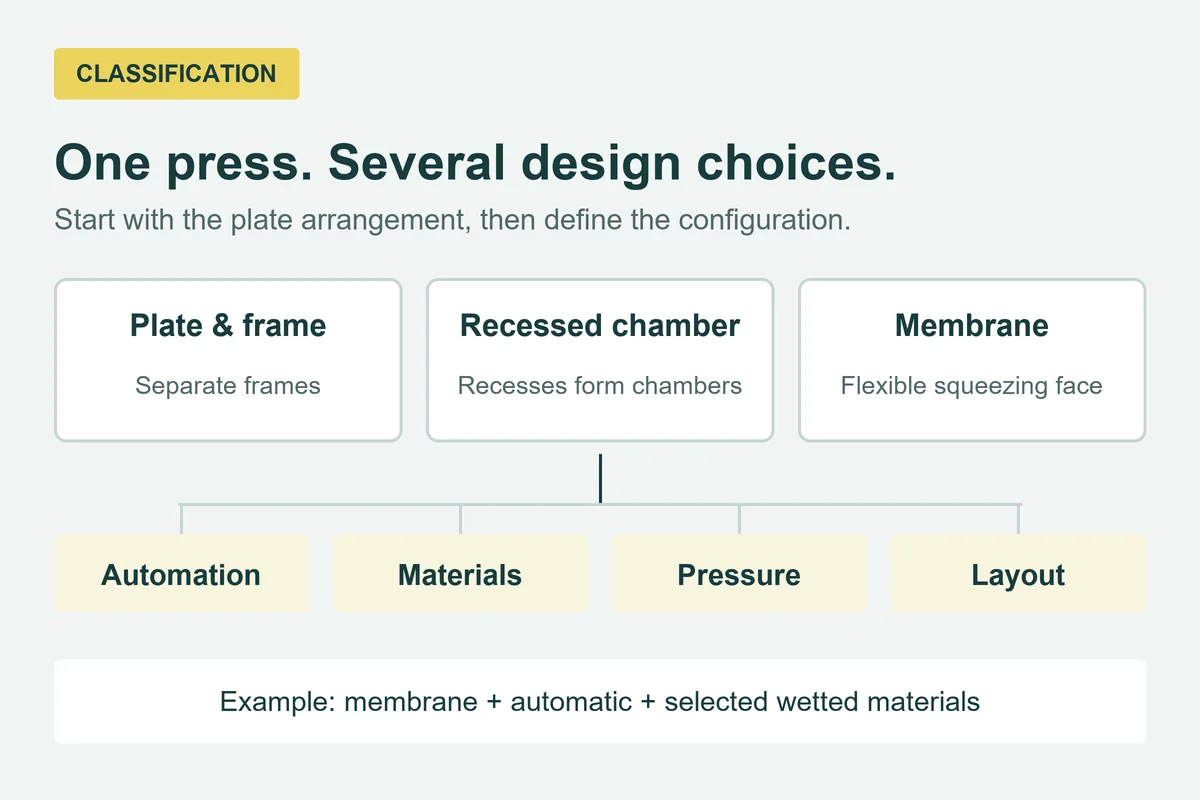
A machine can combine a plate arrangement with several configuration options.
01 / PLATE ARRANGEMENT
Plate and Frame Filter Press
Separate filter plates and hollow frames alternate in the plate pack. The frame defines the cake space; the cloth or other compatible medium covers the filtering surfaces.
When to evaluate it
Worth comparing when the chosen filter medium, frame depth, access for cleaning or a particular polishing duty favors this arrangement.
What to confirm
Frame thickness, media support, feed and filtrate routes, sealing arrangement and cake removal. Different frame thicknesses change chamber geometry; this does not make cake thickness continuously adjustable during a cycle.
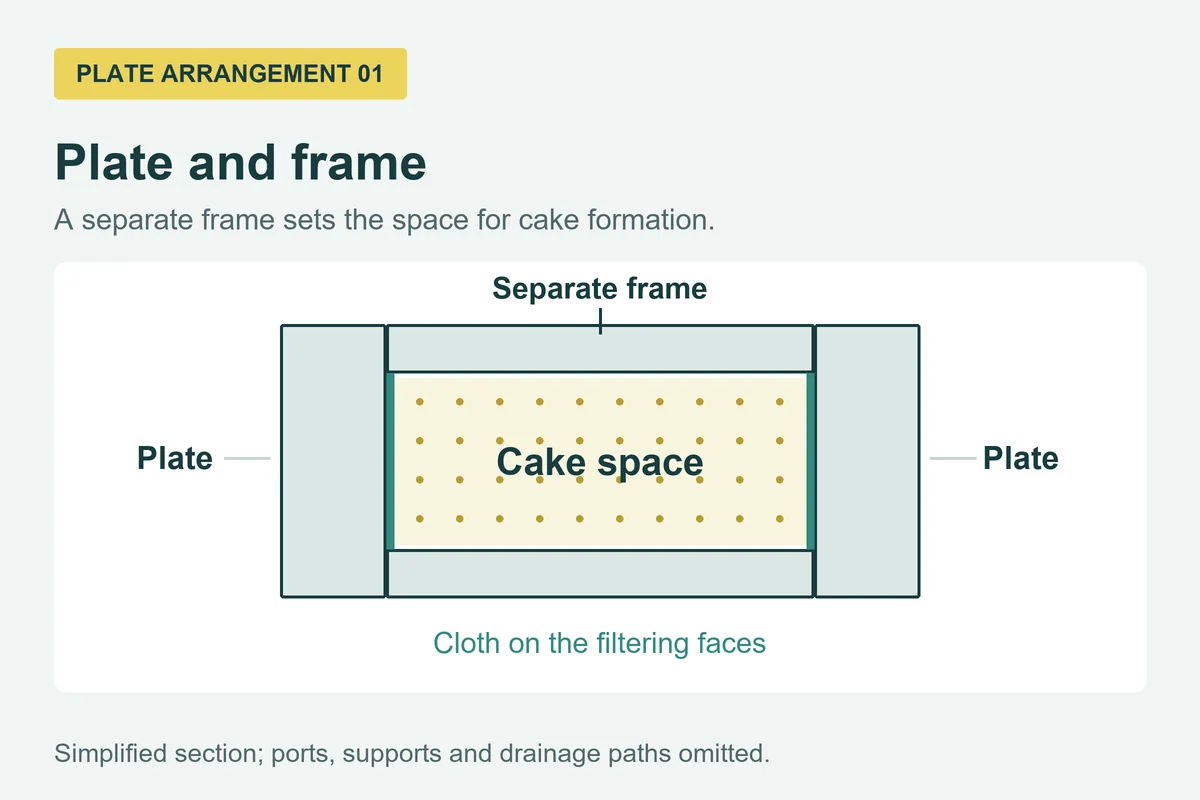
The separate frame forms the chamber. Diagram is simplified and not to scale.
02 / PLATE ARRANGEMENT
Recessed Chamber Filter Press
Recesses in opposing plate faces form the filtration chamber when the pack is closed. There is no separate frame between each pair of plates to establish that chamber.
When to evaluate it
A useful starting point for many cake-filtration duties when the required result can be achieved by the selected feed-filtration cycle without membrane squeezing.
What to confirm
Effective filter area, chamber volume, recess depth, cloth and discharge behavior. Gasketed CGR and non-gasketed designs are sealing variants, not separate basic separation principles.
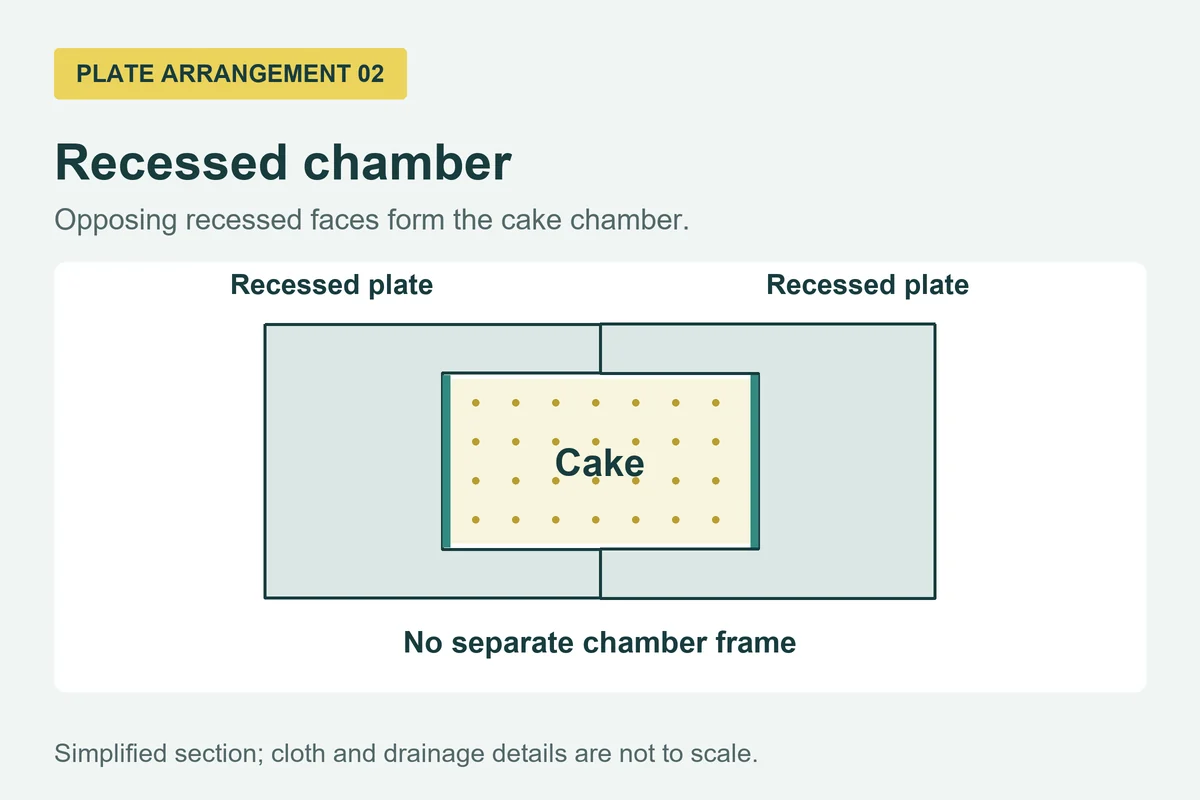
The recesses form the chamber when the plate pack is closed.
03 / PLATE ARRANGEMENT
Membrane Filter Press
A flexible membrane face moves into the chamber after initial cake formation. A suitable pressurizing medium behind the membrane compresses the cake and can expel additional liquid.
When to evaluate it
Worth evaluating when additional cake compression, a different cycle strategy or the washing duty offers a measurable process or operating-cost benefit.
What to confirm
Membrane material, squeeze medium, feed and squeeze pressure limits, cycle sequence and sample-test results. Plate packs may combine membrane plates with companion recessed plates or use other arrangements.
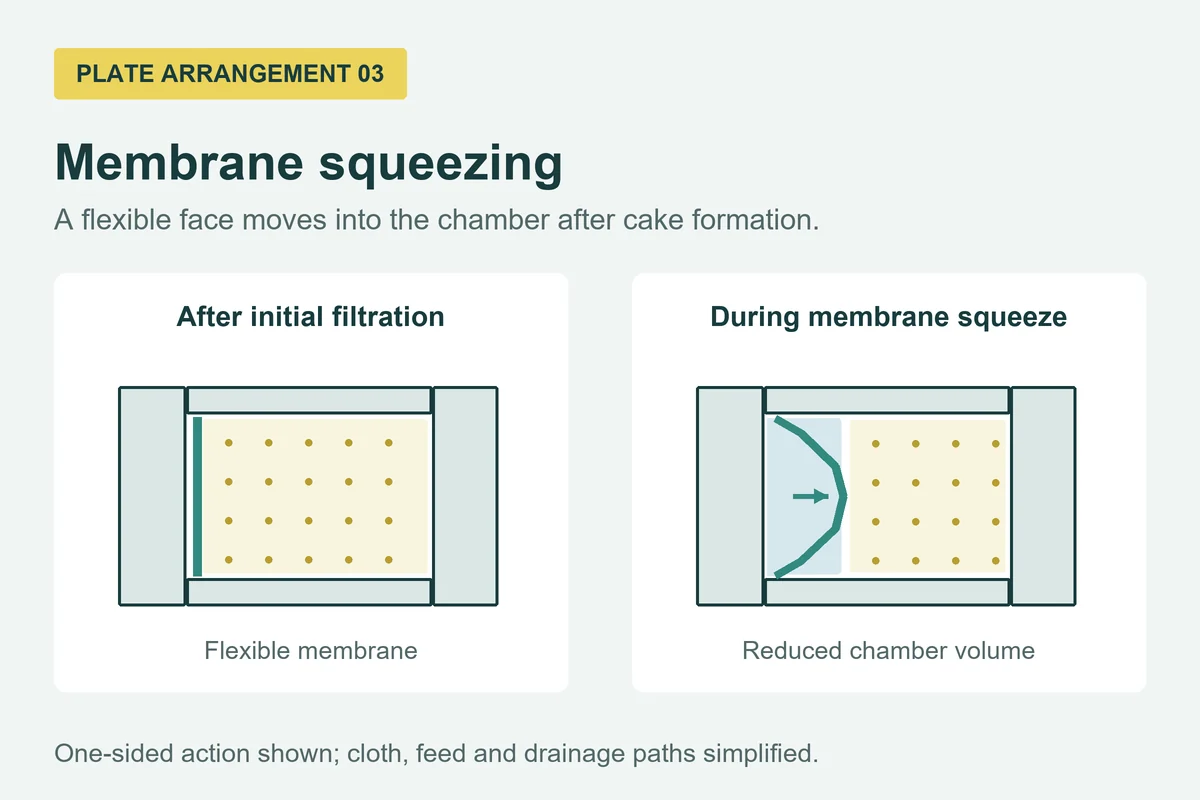
The membrane displaces chamber volume; the actual plate pack and cycle vary by design.
Compare the Three Plate Arrangements
| Design question | Plate & frame | Recessed chamber | Membrane |
|---|---|---|---|
| How the chamber forms | A separate frame between filter plates | Opposing recessed plate faces | Plate arrangement with a flexible membrane face |
| Additional membrane squeezing | Not part of the basic arrangement | Not part of the basic arrangement | An additional controlled stage |
| What sets the cake space | Frame geometry and thickness | Recess geometry and plate pack | Initial chamber geometry; volume changes during squeezing |
| A useful reason to evaluate it | Media flexibility, access or a specific filtration duty | A suitable conventional cake-filtration duty | A demonstrated benefit from additional cake compression |
| What the name does not establish | Final clarity or automatic discharge | A universal cake moisture or production rate | A guaranteed moisture reduction, shorter cycle or payback |
Compare cake moisture, clarity and production rate only with a defined feed and test method. Cake washing and automation depend on the equipment design and duty; they are not simple “high / medium / low” properties of a type name.
What the Other Type Names Describe
Use these terms to specify the equipment around the selected filtration arrangement.
Automation and discharge
Manual, semi-automatic and automatic describe which cycle tasks are mechanized. Specify plate closing, opening, cake release, cloth washing and controls separately. Quick opening and vibration-assisted discharge are additional mechanisms; an automatic plate press generally still operates in cycles.
Operating pressure
High-pressure describes a rated configuration, not a universal plate structure. Distinguish slurry feed pressure, membrane squeeze pressure and hydraulic closing pressure. The complete assembly and actual slurry must suit the proposed duty.
Materials and sealing
Stainless steel, cast iron and polymer specifications concern construction or wetted components. Identify which parts use each material. A stainless-clad frame does not make the whole wetted system stainless, and a gasketed plate does not alone establish solvent compatibility.
Layout, mobility and test scale
Vertical describes an equipment arrangement that should be checked against the specific design. Mobile describes installation or transport provisions. Laboratory describes scale and intended use. None of these terms, by itself, identifies the plate structure or the result a slurry will achieve.
Choose the Type from the Filtration Duty
An industry name or a target flow rate starts the discussion. It does not replace the material data needed to select equipment.
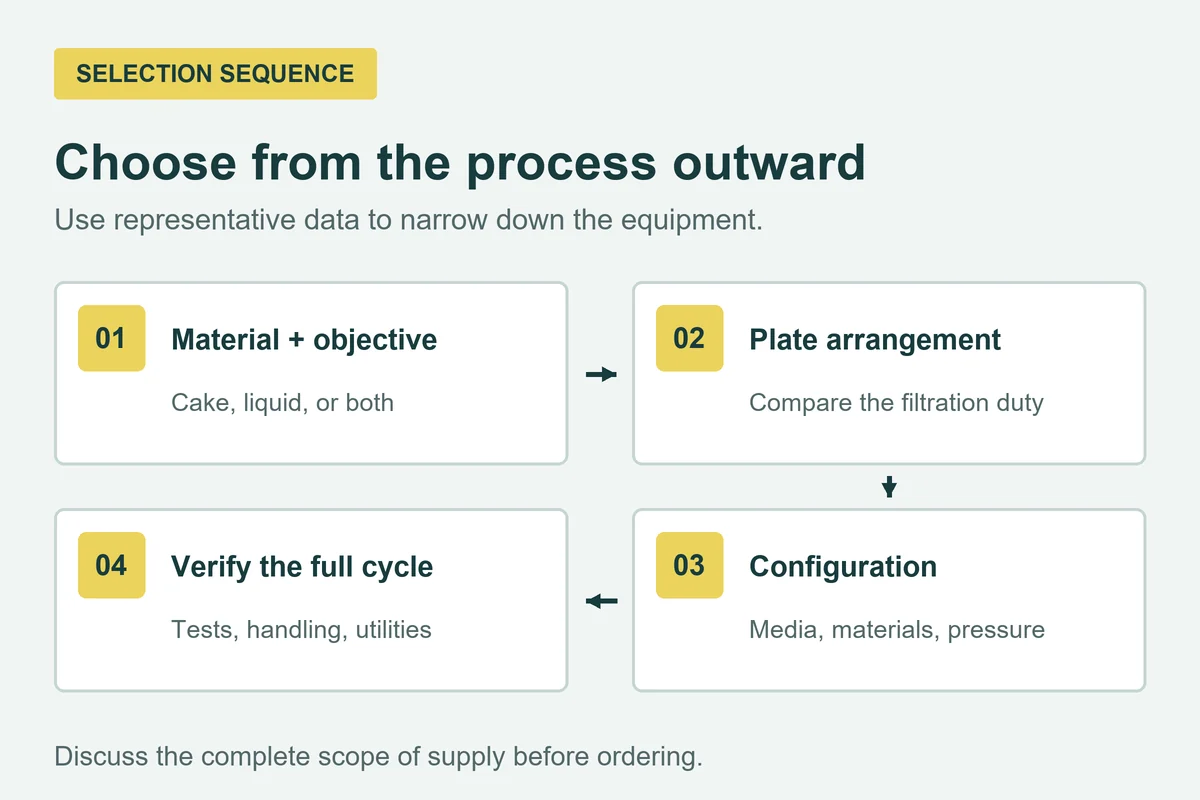
Start with material and process data, then confirm the configuration with suitable evidence.
1. Define the separation objective
Identify the material and whether the valuable output is cake, liquid or both. State feed concentration, chemistry, temperature, throughput with units and the required cake or filtrate condition.
2. Compare plate arrangements
Review whether conventional filtration meets the requirement, whether a frame-and-media arrangement has a process advantage, and whether membrane squeezing adds a useful benefit.
3. Specify the configuration
Match filter media, wetted materials, pressure ratings, automation and installation layout to the duty. Include washing, air blow or discharge equipment only where required.
4. Verify capacity and scope
Use representative tests where performance is uncertain. Check chamber volume, filtration area and the complete cycle against dry-solids loading, available hours, utilities and handling requirements.
How This Changes a Purchasing Decision
Sludge disposal duty
If the existing cake condition is acceptable, compare a suitable chamber press with the added equipment and possible benefit of membrane squeezing. Record the feed solids, conditioning and complete operating cycle.
Stone or mineral slurry
A high-solids mineral duty does not automatically require the highest pressure. Evaluate representative slurry behavior, plate ratings, feed consistency and the required cake or recovered-water condition.
These are selection examples, not customer case studies or performance guarantees.
Questions About Filter Press Types
What are the main types of filter press?
For comparing plate arrangements, three commonly discussed groups are plate and frame, recessed chamber and membrane. Other labels describe features such as automation, pressure, materials, layout or scale. This guide focuses on plate filter presses, not every dewatering technology with press in its name.
Is an automatic filter press a fourth structural type?
No. Automation describes the tasks performed by the equipment. A chamber or membrane press may include automatic closing, plate shifting, cloth washing or other functions. Ask which steps are automated and what operator work remains.
Does a membrane filter press always produce the driest cake?
Additional squeezing can improve dewatering for suitable materials, but the result depends on the slurry, conditioning, filter cloth, pressure and cycle. Compare test results for the same material and a stated measurement basis.
Is a plate-and-frame press the same as a chamber press?
The terms are sometimes used loosely in catalogues. In a structural comparison, a plate-and-frame pack uses separate frames, while recessed plates form their own chambers. Check the plate drawing and bill of materials rather than relying on the label alone.
Which type is best for wastewater or mining?
An industry name is a starting point, not a complete specification. Define the particular sludge or mineral slurry, the required output and the available operating cycle before selecting plates, media and auxiliary equipment.
Can a chamber press be converted to membrane squeezing?
Only after a design review. Frame and closing capacity, plate-pack compatibility, pressure ratings, squeeze supply and safety controls need to be checked. Treat a conversion as an engineered modification rather than a plate swap alone.
Continue with Products or Process Requirements
Technical references: Micronics: filter plate selection and mixed-pack membrane plates. Referenced for design terminology; their product ratings and performance claims are not specifications for equipment offered on this site.
SELECTION SUPPORT
Tell Us What You Need to Separate
Share your slurry, processing requirement, project location and target cake or filtrate condition. If you are comparing two configurations, tell us which decision you need help making.
Approximate values are enough to begin the discussion. Unknown measurements can be identified before the next selection or testing step.
Please include throughput units and whether solids concentration is measured by mass or by volume.