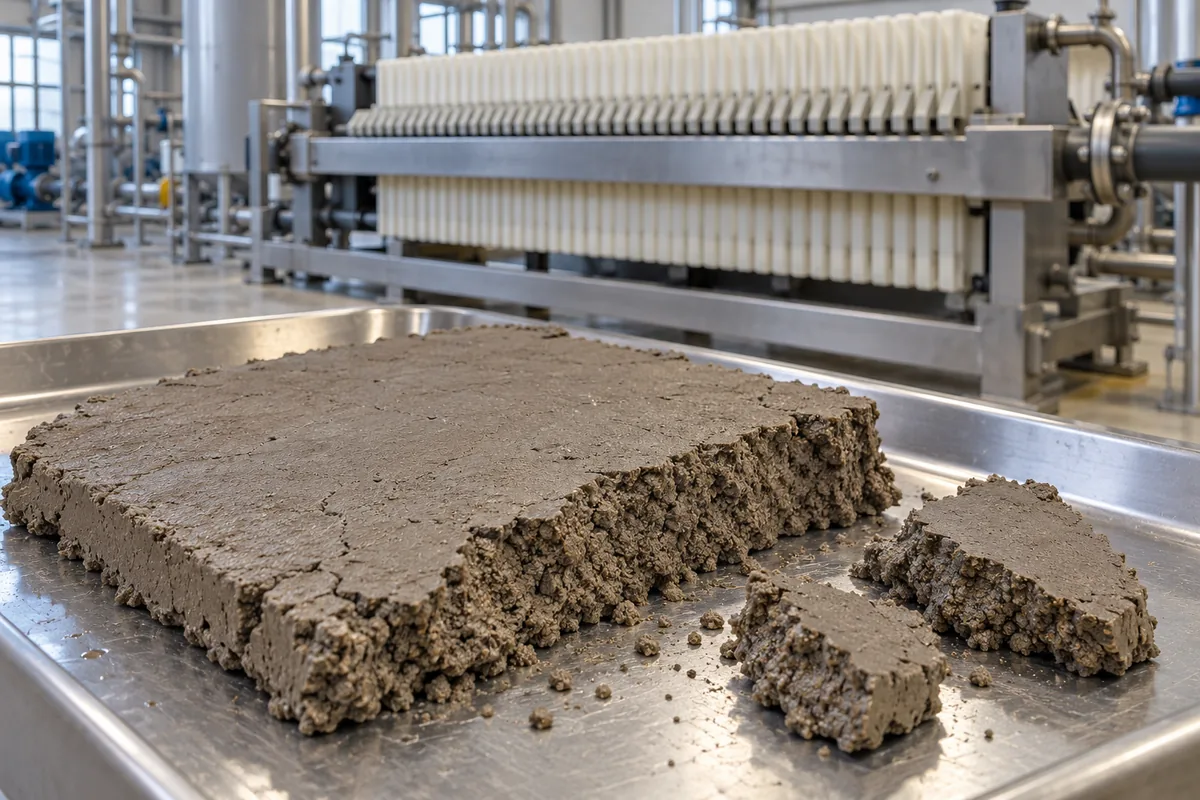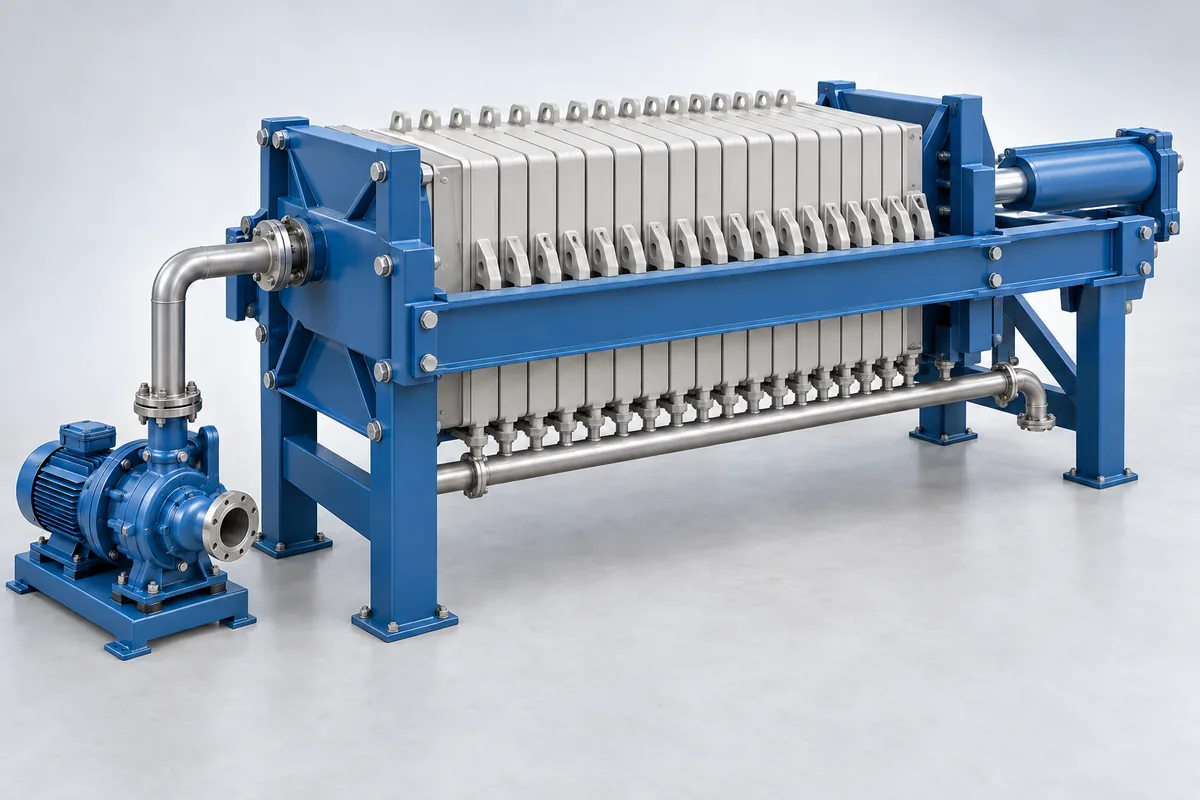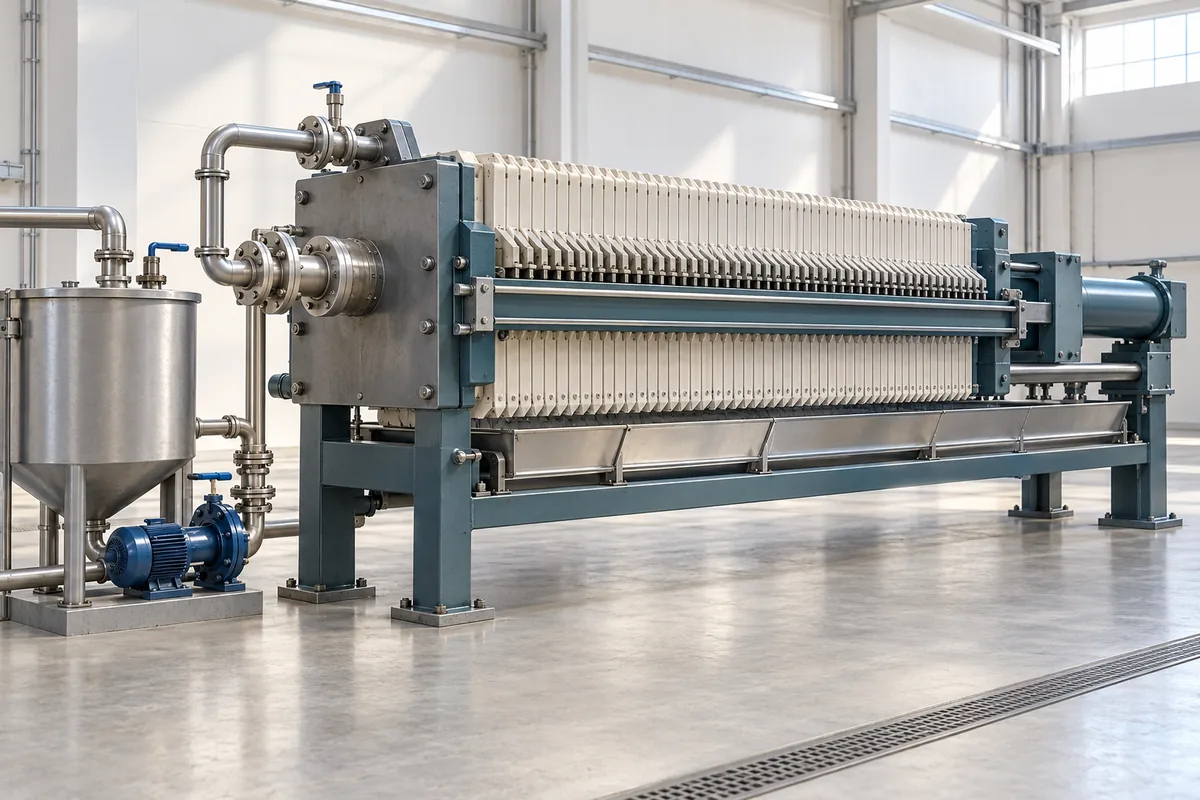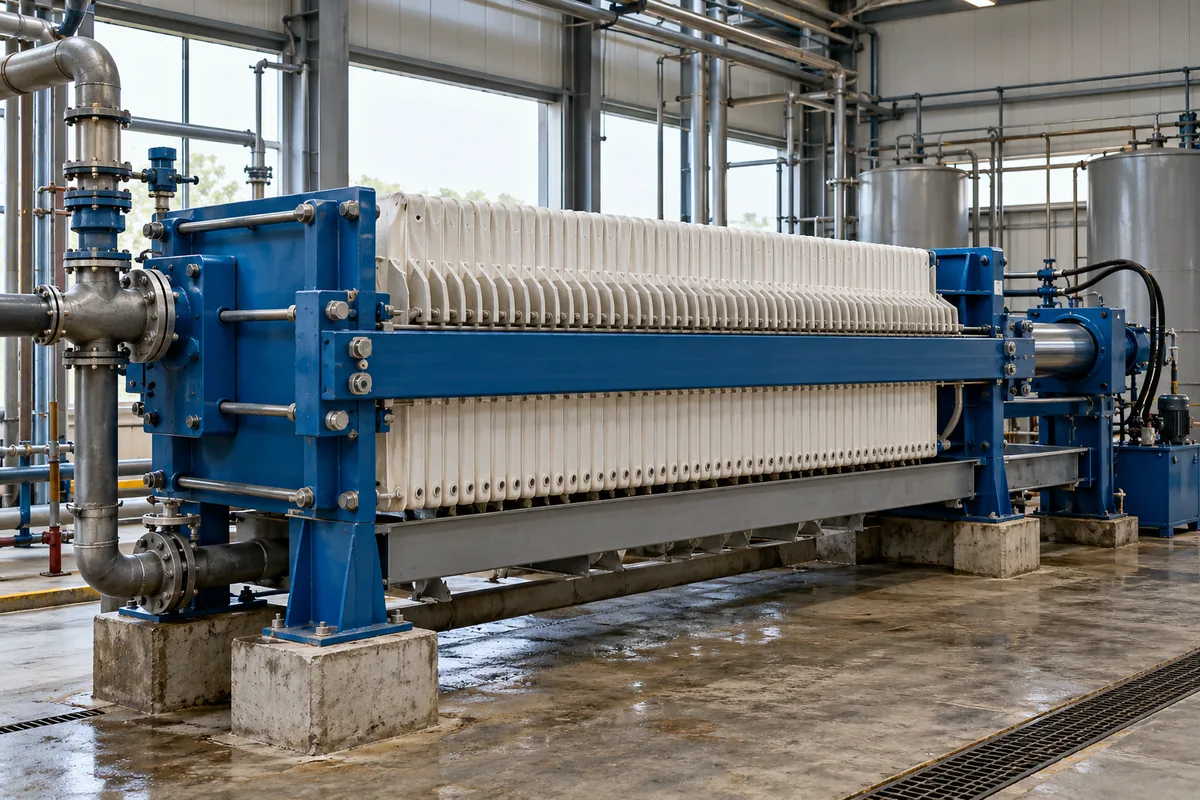
A membrane filter press is a machine that separates solids from liquids, then uses inflatable diaphragms to squeeze additional liquid from the collected solids, called the filter cake. That extra squeeze is the key to understanding membrane filter press and how it can improve industrial dewatering.
| Feature | What it means |
|---|---|
| Other name | Diaphragm filter press or membrane squeeze filter press |
| Operating mode | Batch solid-liquid separation |
| Main stages | Slurry feeding, cake formation, membrane squeezing, pressure release, and cake discharge |
| Squeeze medium | Water or compressed air, as specified for the equipment |
| Potential benefits | Drier cake, greater liquid recovery, and shorter cycles on suitable slurries |
| Key limitation | Final moisture and throughput depend on the material and validated operating conditions |
If your plant pays to transport wet sludge or waits too long for a press to finish, this distinction matters. Removing more liquid mechanically can change both the weight you handle and the capacity you get from each shift.
The useful question is how much improvement your slurry will actually deliver. Start with the process, then look at the numbers.
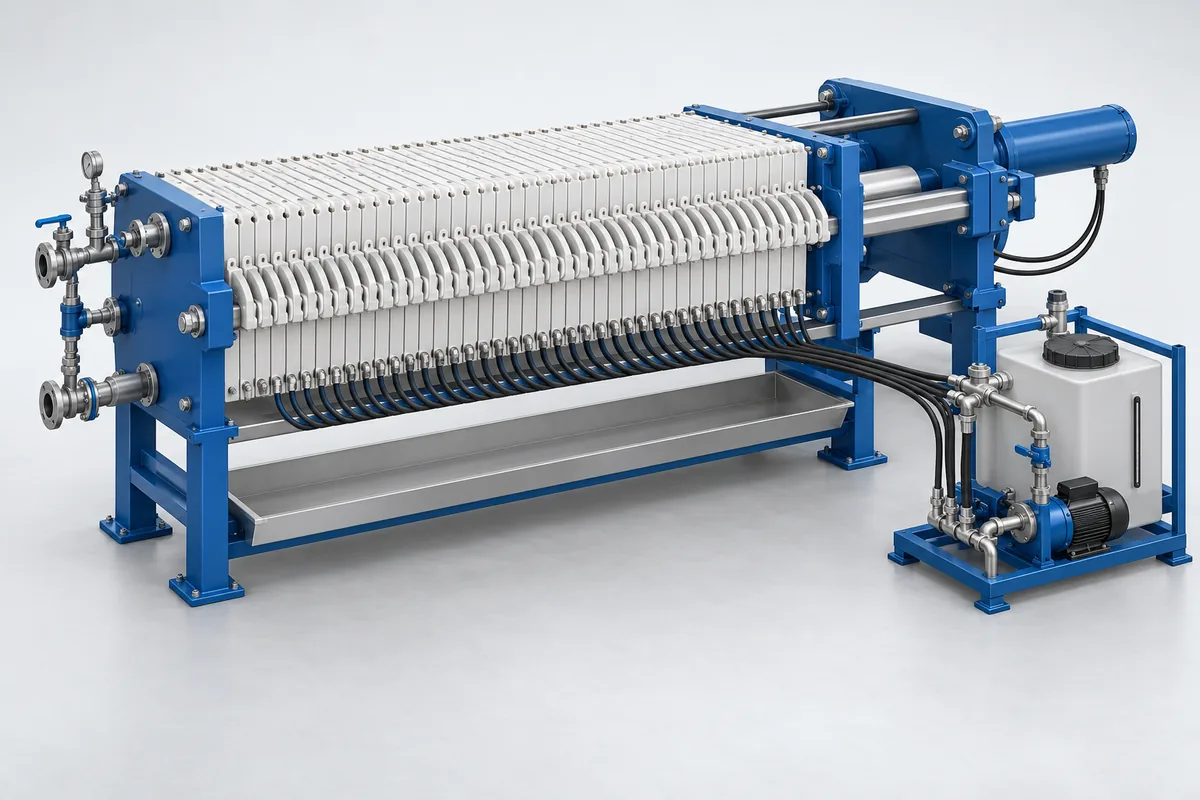
For available sizes and configuration options, review our membrane filter press models and specifications.
Membrane Filter Press Working Principle
A membrane filter press first uses feed pressure to build a filter cake, then applies a separate squeezing force through flexible plate surfaces. The liquid drains through filter cloths while the solids remain inside the chambers.
1. The Press Closes and Receives Slurry
The hydraulic closure system clamps the plate pack together, and a feed pump sends slurry into the chambers between the plates. Slurry is simply a mixture of liquid and suspended solids.
Think of mineral particles suspended in process water or solids collected during wastewater treatment. The press needs a feed system suited to that mixture’s concentration, viscosity, and abrasiveness.
The hydraulic cylinder keeps the plates closed. Its pressure reading is different from the pressure applied by the slurry feed pump.
2. Filter Cloths Retain Solids
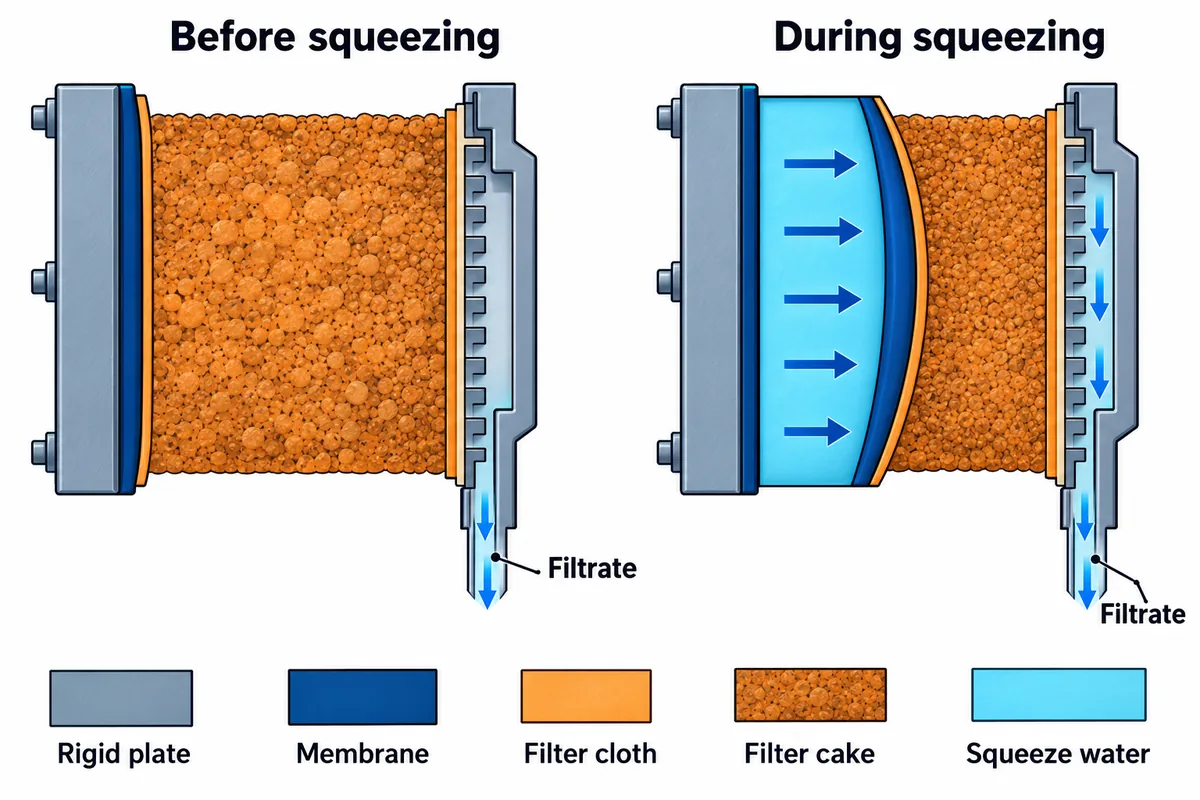
Liquid passes through the filter cloths and leaves through drainage channels, while retained particles build a filter cake. The separated liquid is called the filtrate.
As the cake thickens, it becomes harder for liquid to pass through. Filtrate flow often slows toward the end of the feeding stage.
That slow final stage creates an opportunity for membrane squeezing. A validated cycle can move to compression once enough cake has formed to support the membranes correctly.
3. Membranes Squeeze the Cake
Water or compressed air enters a sealed space behind the flexible membranes, causing them to expand into the filtration chambers. This reduces the available chamber volume and compresses the cake, pushing more liquid through the cloths.
The squeeze medium normally stays separated from the process material by the membrane. Its job is to transmit pressure.
The membrane itself is a flexible diaphragm. This equipment is different from reverse osmosis or ultrafiltration systems, where liquid passes through a selective membrane.
4. Optional Washing or Air Blowing Adds Treatment
Cake washing removes soluble material from the retained solids, while an air blow can displace additional liquid through the cake. These are optional operations that require suitable piping, valves, and controls.
For example, a chemical producer may wash a cake to reduce residual mother liquor, meaning the liquid left from the production process. The squeeze stage can then help remove retained wash liquid.
Air blowing through a cake and using air to inflate a membrane are separate operations. Their sequence depends on the application and the equipment design.
5. The Press Releases Pressure and Discharges Solids
The system releases process and squeeze pressure before opening the plate pack and discharging the cake. Plate shifting, cake release, and cloth cleaning may be manual or automated.
Drier cake can be easier to handle, but clean release is not guaranteed. Sticky material, unsuitable cloth, or uneven filling can still cause discharge problems.
Measure the complete cycle: closing, filling, filtration, squeezing, optional treatments, pressure release, opening, discharge, and cleaning. That is the time that determines useful production capacity.
Which Components Make the Difference?
Membrane plates, filter cloths, the feed pump, and the squeeze system work together to determine separation performance. Choosing a press by plate size alone leaves out much of what controls the result.
- Membrane plates: Provide the flexible surfaces that compress the cake. Some designs use permanently attached membranes; others use replaceable diaphragms.
- Filter cloths: Support particle retention and liquid drainage. Material, weave, and permeability affect clarity, flow, and cake release.
- Feed pump: Fills the chambers and supplies filtration pressure. Its selection must account for the slurry and the required operating range.
- Squeeze system: Supplies and controls the approved inflation medium, including pressure relief and drainage or venting.
- Frame and closure system: Hold the plate pack together against internal forces.
- Controls and interlocks: Coordinate the sequence and prevent incompatible operations, such as opening while pressure remains.
Many installations use a mixed plate pack, alternating membrane plates with recessed chamber plates.
Replaceable diaphragms can reduce the scope of a repair when a membrane fails. However, material compatibility and replacement cost should be checked for the actual plate design.
Polypropylene, thermoplastic elastomers, and selected rubbers serve different duties. Confirm suitability for the process liquid, operating temperature, and cleaning chemicals.
Membrane Filter Press vs. Chamber Filter Press
A membrane filter press adds mechanical cake compression to the filtration process, while a conventional recessed chamber press relies on feed pressure for cake formation and dewatering. Both can be useful; the better choice depends on your required result and total operating cost.
| Factor | Recessed chamber press | Membrane filter press |
|---|---|---|
| Chamber geometry | Fixed chamber volume | Volume decreases during membrane inflation |
| Dewatering method | Pressure supplied through slurry feeding | Feed filtration plus a separate squeeze stage |
| Cake moisture | Depends on slurry and cycle conditions | May be lower when the cake responds to compression |
| Cycle duration | May include a lengthy final feeding stage | May shorten that stage, while adding squeeze and release time |
| Equipment complexity | Generally fewer subsystems | Additional membranes, supply lines, valves, and controls |
| Buying decision | Often suitable when existing dryness and capacity meet the target | Worth evaluating when extra recovery or dewatering has measurable value |
For a fair comparison, test both configurations on representative slurry under comparable conditions. Record cake solids, filtrate quality, complete cycle time, and utilities consumed.
A shorter cycle is useful only if it produces enough acceptable material. Dry solids processed per hour is a more meaningful comparison than cycle time alone.
Our guide to filter press types explains how these plate arrangements compare with plate-and-frame designs and other configuration choices.
What Benefits Can You Realistically Expect?
The main potential benefits are lower cake moisture, increased liquid recovery, and higher throughput. Their size depends on cake structure, slurry preparation, and the point at which extra squeezing stops delivering worthwhile improvement.
Drier Cake Can Reduce Disposal Weight
Increasing cake solids reduces the amount of liquid transported with a fixed quantity of dry material. This can lower hauling and disposal costs when charges depend on wet weight.
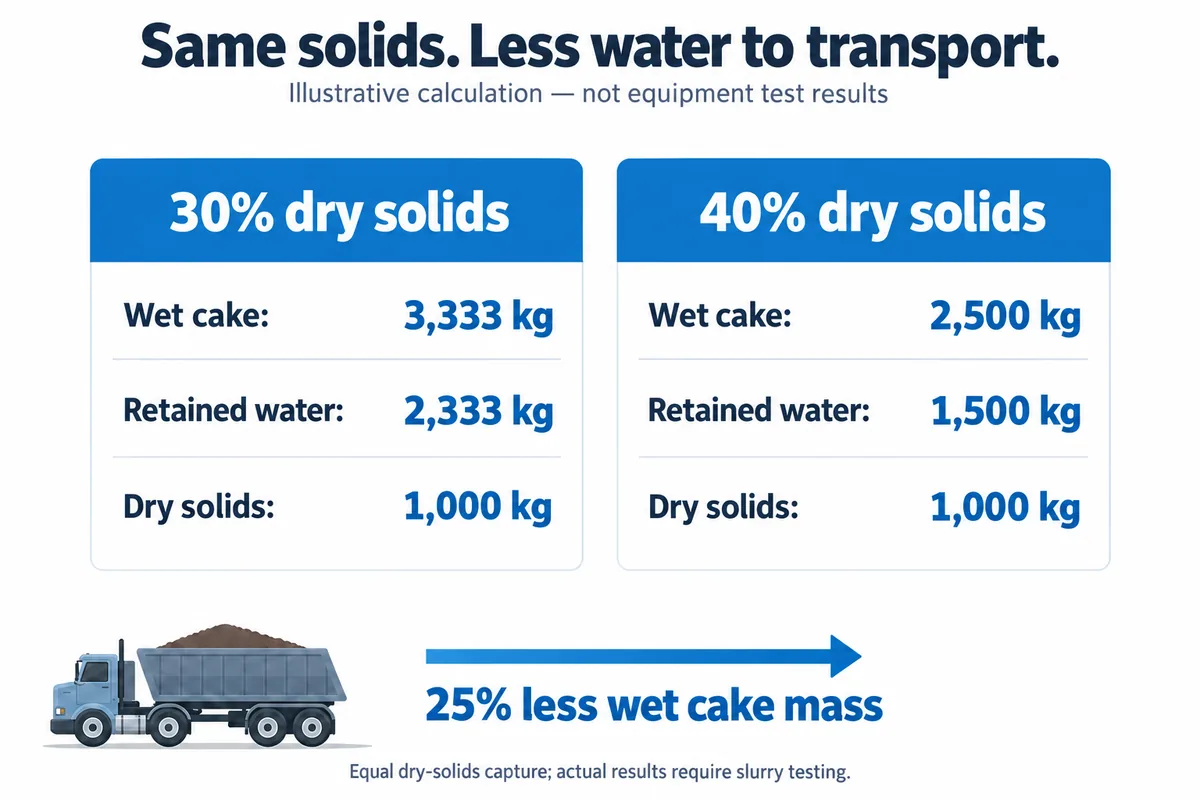
Consider this illustrative calculation, rather than a measured equipment result. Assume a plant captures 1,000 kilograms of dry solids each day and tests two possible cake solids levels.
| Measurement | 30% dry solids | 40% dry solids |
|---|---|---|
| Dry solids | 1,000 kg/day | 1,000 kg/day |
| Total wet cake | About 3,333 kg/day | 2,500 kg/day |
| Liquid retained in cake | About 2,333 kg/day | 1,500 kg/day |
| Wet cake reduction | Baseline | About 833 kg/day, or 25% |
The calculation is straightforward:
Wet cake mass = dry solids mass ÷ dry solids fraction.
At an assumed combined hauling and disposal charge of $100 per metric tonne, that difference would save about $83 per operating day before additional operating costs. Over 250 operating days, the gross saving would be about $20,833.
These assumptions explain the economics; they do not predict your plant’s performance. Replace them with test results and your actual disposal contract.
Also distinguish percentage points from percentages. Moving from 30% to 40% solids is a rise of 10 percentage points. On a wet-mass basis, the corresponding moisture falls from 70% to 60%.
Shorter Cycles Can Increase Capacity
Membrane squeezing can improve capacity when it replaces a slow final feeding period with more effective cake compression. The gain must be checked against any change in dry solids captured per batch.
The cycle reduction depends on the cake being compressible. Even then, results vary with permeability, particle size, conditioning, and chamber filling.
Avoid treating claims such as “50% faster” as a standard equipment rating. Ask for the test conditions, complete cycle timings, and dry-solids throughput behind the claim.
Additional Liquid Recovery Can Have Value
Recovering more filtrate may reduce product losses or return more liquid to a process. Removing liquid before thermal drying can also reduce the load on downstream drying equipment.
The actual energy saving depends on the dryer and its operating conditions. Include the squeeze pump or compressed-air demand in your comparison.
Filtrate clarity also needs verification. Clear-looking liquid can still contain dissolved contaminants, so suitability for reuse or discharge requires appropriate testing.
Where Are Membrane Filter Presses Used?
Membrane filter presses are used where the value of drier solids or recovered liquid can justify an additional squeezing stage. Common applications include sludge dewatering, mineral processing, chemical production, and selected food processes.
- Wastewater treatment: Municipal and industrial sludges may benefit from reduced wet cake mass. Sludge composition and conditioning strongly influence results.
- Mining and minerals: Tailings and concentrates may be filtered for water recovery and easier handling. Cake moisture alone does not establish suitability for dry stacking; geotechnical assessment remains necessary.
- Chemical and pharmaceutical production: Cake washing and liquid recovery may improve product processing. Material compatibility, cleanliness, and validated procedures are central to equipment selection.
- Food and beverage processing: Appropriate designs can support operations such as mash filtration or processing starch slurries. Food-contact suitability and hygienic cleaning must be specified for the application.
Industry labels are only a starting point. Two slurries from the same sector can behave very differently inside the same press.
Explore our filter press applications by industry for the material information and process priorities to review.
How Do You Choose the Right Membrane Filter Press?
Choose a membrane filter press using representative filtration tests and a defined production target. A quotation becomes much more useful when the supplier knows what must be achieved and under which conditions.
Define the Feed and the Required Output
The essential inputs are slurry composition, dry-solids load, operating schedule, and the required cake and filtrate quality. Include normal variation so the design reflects the feed your plant actually produces.
Prepare these details:
- Feed solids concentration and its expected range.
- Particle size, abrasiveness, pH, temperature, and chemical composition.
- Dry solids to process per day and available operating hours.
- Target cake solids, filtrate quality, and any washing requirement.
- Available utilities, installation space, and cake handling arrangements.
An unusually easy sample can produce an attractive test result and a disappointing installation. Include difficult but realistic feed conditions.
Ask for a Complete Test Report
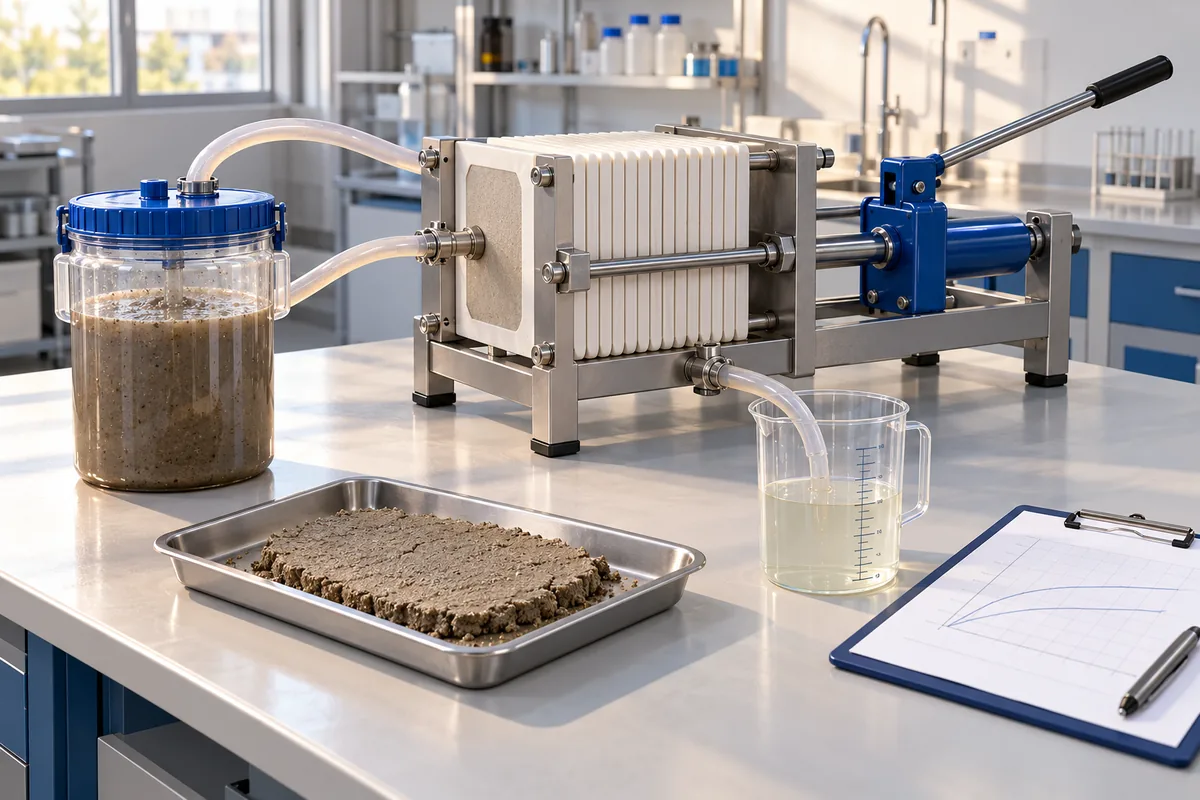
A useful test report links measured performance to the actual slurry, cloth, cake thickness, and cycle settings. It should show how the recommended process reached the proposed output.
Ask the supplier to document:
- Sample preparation and any chemical conditioning.
- Filter cloth specification and chamber or cake thickness.
- Feed pressure, squeeze pressure, and individual stage durations.
- Measured cake solids and the sampling method.
- Filtrate quality and dry-solids capture.
- Cake discharge behavior and cleaning requirements.
- The basis for scaling the results to the proposed production press.
This evidence is far more useful than a single photograph of a dry-looking cake.
Our laboratory filter press guide covers small-scale filtration equipment and test records. Confirm that the selected test arrangement can reproduce the relevant conditions, including membrane squeezing where needed.
Compare Total Cost per Tonne of Dry Solids
The strongest purchasing comparison includes equipment, utilities, consumables, labor, maintenance, and downstream handling costs. Divide the total by useful dry-solids output to compare systems on the same basis.
Include cloth replacement, membrane replacement, cleaning water, conditioning chemicals, and expected downtime. Add drying, transport, or disposal savings only where supported by your process data.
A conventional chamber press may remain the economical choice if it already meets the production target. Membrane technology earns its additional cost when the measured improvement has enough value.
What Maintenance and Safety Issues Matter?
Reliable operation depends on intact membranes, clean drainage paths, suitable cloths, and correctly functioning pressure controls. Maintenance also requires control of hydraulic, pneumatic, electrical, and other stored energy.
The operating manual must distinguish feed pressure, squeeze pressure, and hydraulic closure pressure. They describe different parts of the system and are not interchangeable settings.
Use the inflation medium and pressure limits approved by the equipment manufacturer. Water has much lower compressibility than air and generally stores less compression energy at comparable pressure and volume, but a pressurized water system still requires protective measures.
Routine checks should cover membrane condition, hoses, plate sealing surfaces, cloth damage, drainage blockages, and safety interlocks. Keep records so gradual changes in cycle time or moisture become visible.
For servicing, follow the site’s energy-isolation procedure. OSHA’s hazardous-energy guidance explains why unexpected startup and stored-energy release must be controlled during maintenance.
If performance deteriorates, investigate the cause before changing settings:
- Wet or uneven cake: Check feed consistency, filling distribution, cloth condition, and the validated squeeze sequence.
- Cloudy filtrate: Check cloth damage, sealing, particle retention, and whether the problem occurs throughout the cycle or only at startup.
- Slow filtration: Check slurry changes, cloth blinding, drainage restrictions, and pump performance.
- Poor cake release: Check cloth selection, cleaning, cake consistency, and the discharge mechanism.
Increasing pressure alone may not solve any of these problems. Stay within the approved operating limits while identifying what changed.
Frequently Asked Questions
Cake dryness, operating pressure, and suitability for existing equipment are all application-specific. These answers explain what you can establish from the technology and what needs testing or engineering review.
How Dry Can the Filter Cake Become?
There is no universal cake solids percentage for membrane filtration. Mineral cakes, biological sludges, and chemical precipitates retain liquid differently, even when processed at similar pressures.
Specify the required solids percentage and measurement method, then verify it on representative samples. Treat an advertised maximum as a result that needs context.
Does the Membrane Remove Dissolved Salts?
The squeeze membrane applies mechanical pressure; it does not provide selective desalination. Filter cloth and the developing cake retain suspended solids, while dissolved substances can remain in the filtrate or in liquid held by the cake.
Cake washing may remove some soluble material from the solids. Filtrate treatment is a separate process decision.
Can You Convert an Existing Chamber Press?
A conversion may be possible, but it requires an engineering assessment of the frame, closure force, plate dimensions, pressure ratings, piping, and controls. Adding membrane plates changes more than the plate pack.
Ask the original equipment manufacturer or a qualified filtration specialist to assess the complete system before committing to a retrofit.
Decide With Test Results
A membrane filter press is worth evaluating when additional cake compression can reduce your handling costs, recover useful liquid, or increase production capacity. The decision should rest on representative slurry tests and a clear comparison of total costs.
Start with your current cake solids and dry-solids throughput. Set the improvement you need, then ask suppliers to demonstrate it under documented conditions.
To discuss a configuration, send us your slurry details and production requirements, including throughput units, feed concentration, target cake condition, and project location.
That turns a basic definition into a practical purchasing decision and gives your team a useful answer to what is membrane filter press.