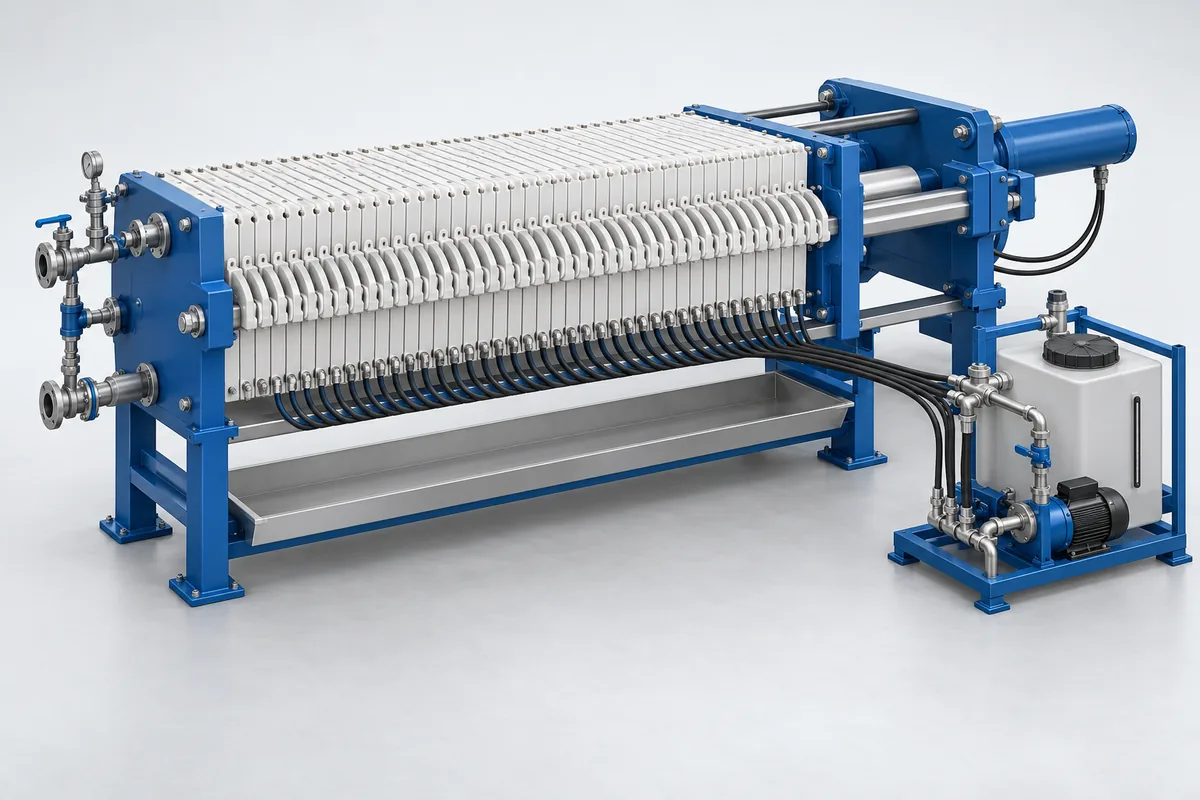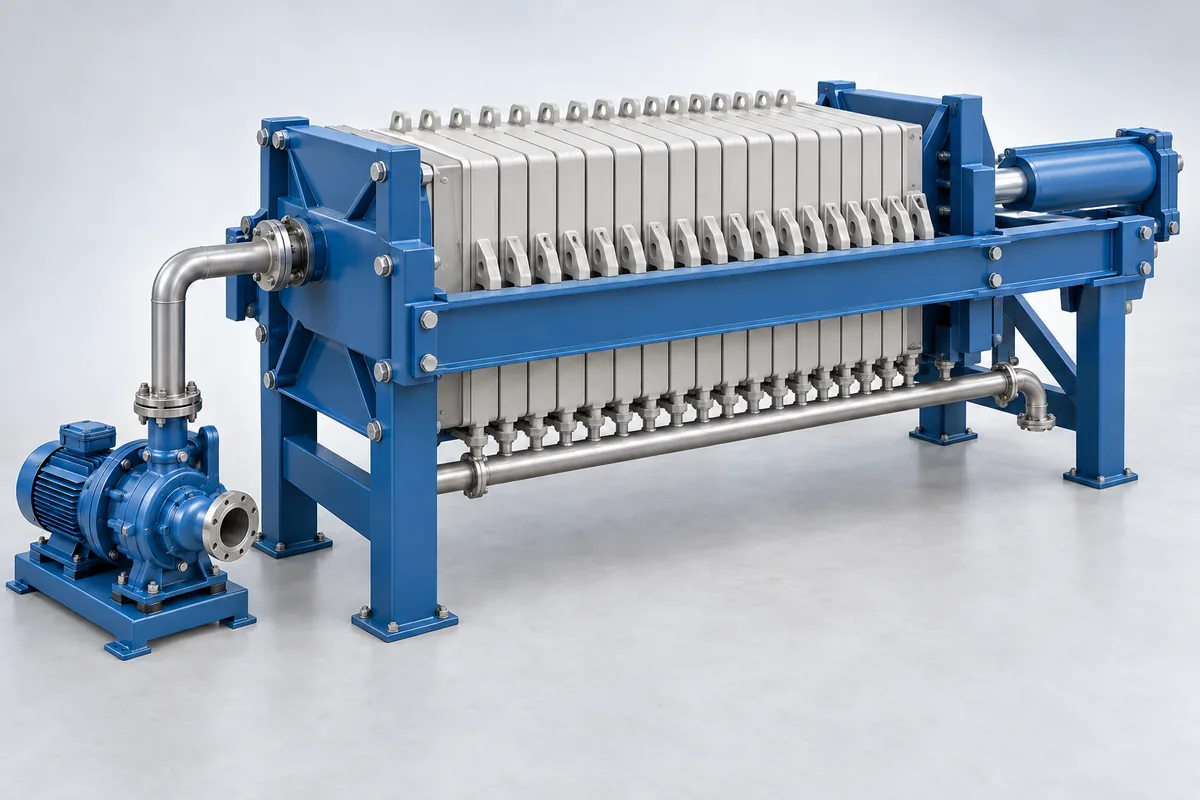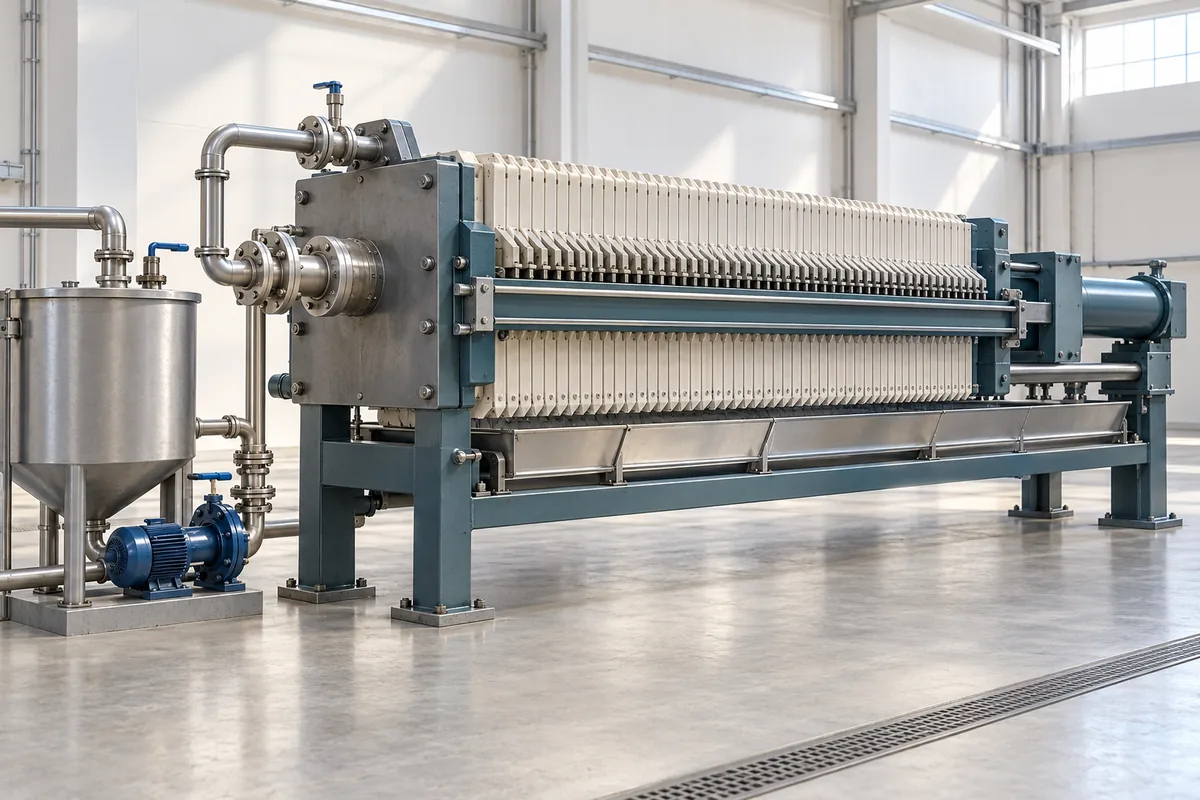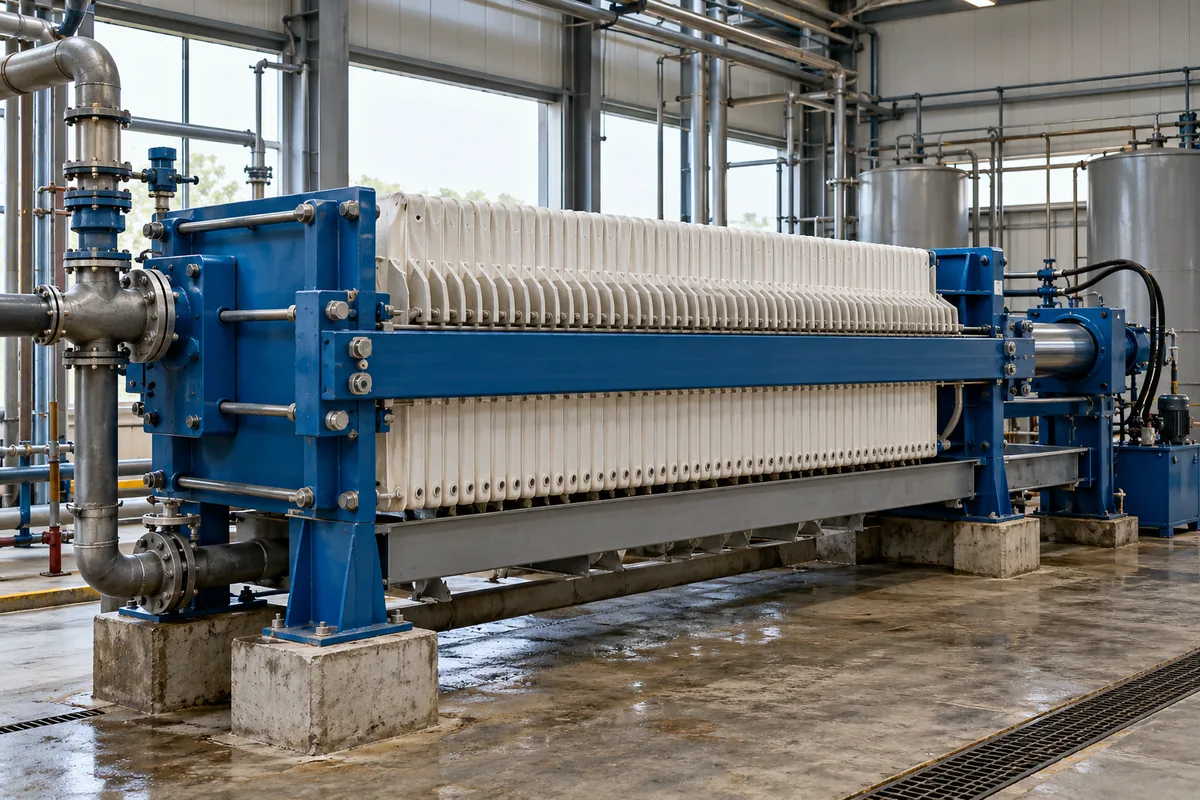
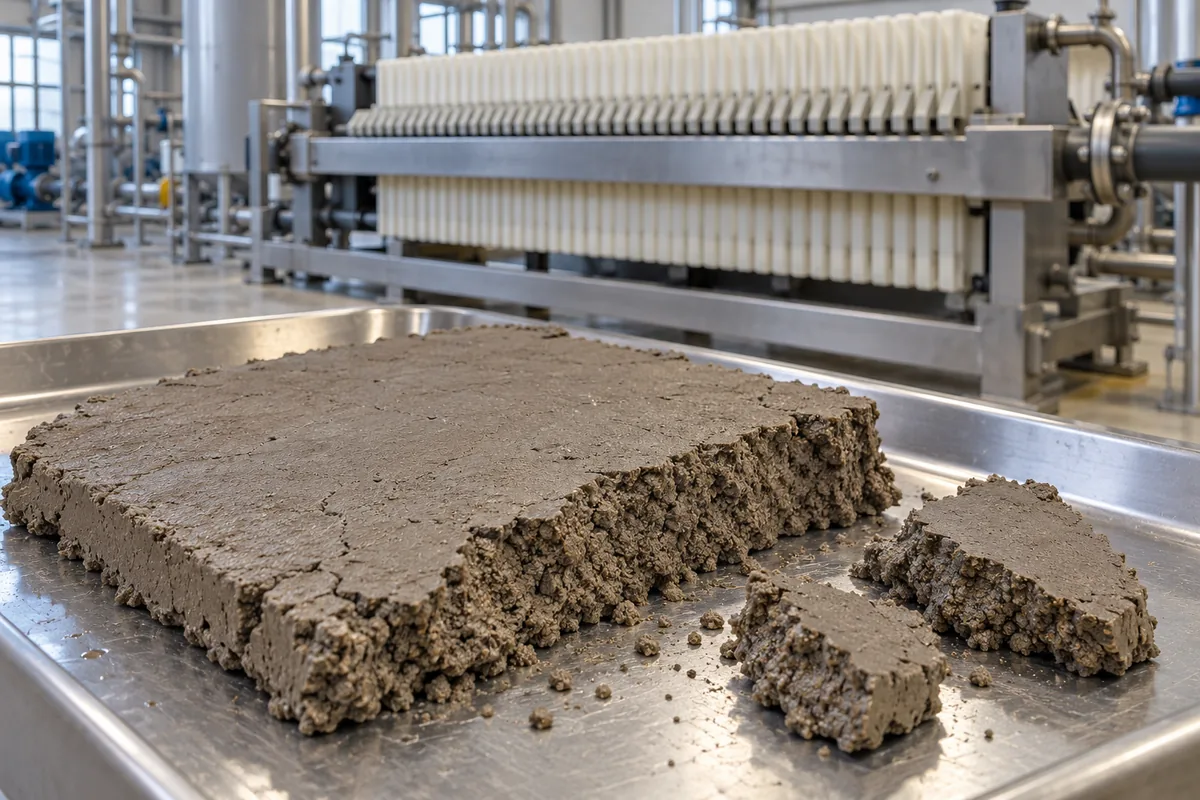
Filter press cake is the solid-rich material left inside a filter press after pressure separates liquid from a slurry. The answer to What Is Filter Press Cake includes one crucial detail: the cake still contains residual liquid, even when it looks dry.
| Property | What it means |
|---|---|
| Starting material | Slurry: solid particles suspended in a liquid |
| Where cake forms | On filter cloth, inside the chambers between filter plates |
| What cake contains | Retained solids, residual liquid, and any retained conditioning additives |
| Separated liquid | Filtrate, which leaves through the press drainage system |
| Main dryness measurement | Dry solids mass divided by wet cake mass, multiplied by 100 |
| Possible destination | Product recovery, further processing, approved reuse, or permitted disposal |
A cake might drop from the press as a firm slab, break into crumbs, or stay soft and sticky. That depends on the feed material and how the press runs.
Its appearance gives you clues. Measurements tell you whether it meets the job’s requirements.
How Does Filter Press Cake Form?
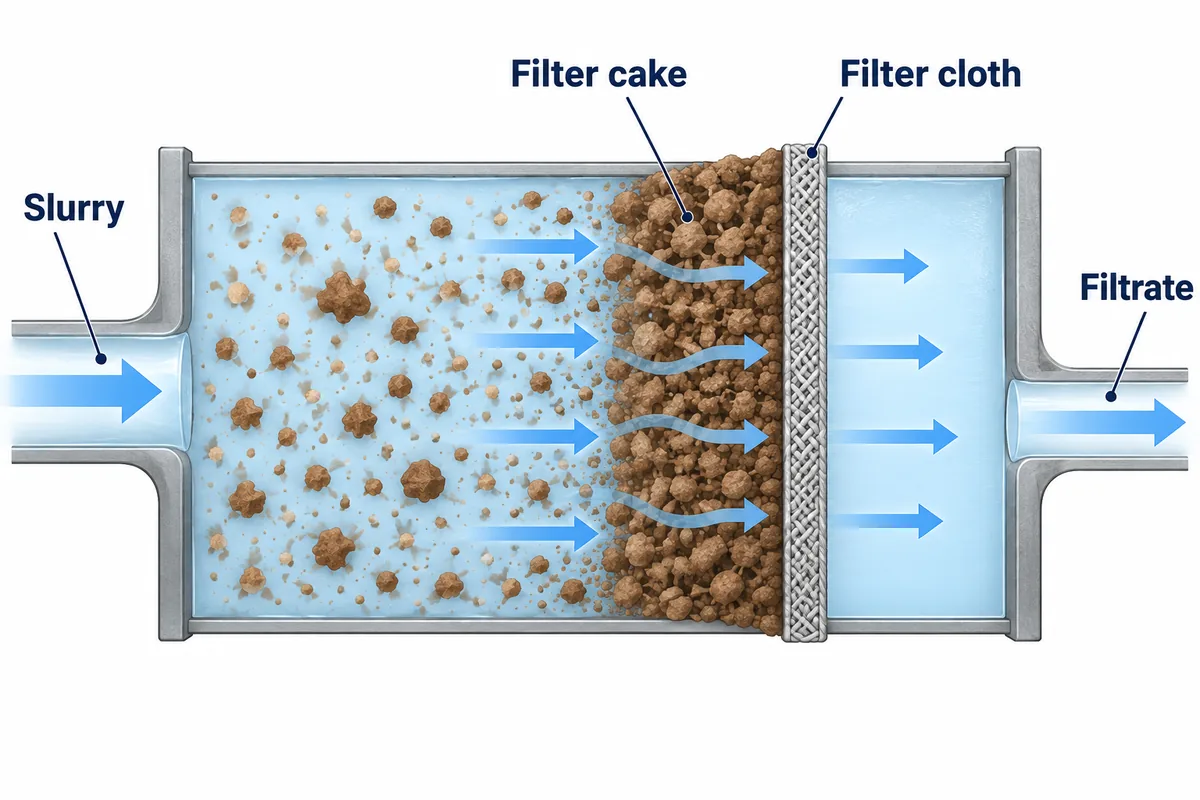
Filter press cake forms when a feed pump pushes slurry into cloth-lined chambers and liquid drains through the cloth. The captured particles accumulate into a layer that grows as filtration continues.
In a conventional recessed chamber filter press, the sequence looks like this:
- The plates close. The closing system clamps the plate stack together to contain the slurry pressure.
- Slurry enters the chambers. The feed pump supplies the pressure that drives liquid through the filtering surfaces.
- Solids build up. Particles collect against the cloth, and the growing cake helps retain additional particles.
- Drainage slows. Liquid encounters more resistance as the cake becomes thicker and the chambers fill.
- The cycle ends. After the approved dewatering and depressurization sequence, the plates separate and the cake discharges.
That distinction between closing pressure and feed pressure matters. The hydraulic closing system holds the plates together; the slurry pump provides the filtration pressure. McLanahan’s explanation of filter press operation describes these separate functions.
A membrane filter press can add another step. Its flexible membranes expand against the formed cake to squeeze out additional liquid. That is a separate action from clamping the plate stack.
Why the Cake Also Works as a Filter
The cake becomes an additional filtering layer because liquid must travel through the accumulated particles before reaching the cloth. That layer can capture fine solids that might pass through the cloth during initial filling.
There is a trade-off: the same layer also restricts liquid flow.
Think of water moving through a bed of gravel. Now imagine adding fine particles that fill the spaces between the stones. Water has fewer open routes through the bed.
That helps explain cake resistance: the opposition the accumulated solids create to liquid flow. As resistance rises, the filtration rate can fall, even while pressure stays steady.
What Is the Difference Between Slurry, Filtrate, and Cake?
Slurry is the incoming mixture, filtrate is the separated liquid, and cake is the retained solid-rich material. Keeping those three terms straight makes solid-liquid separation much easier to understand.
In an aggregate wash plant, for example, sand-washing slurry may contain water, sand fines, silt, and clay. The press retains much of the suspended material as cake while filtrate leaves through drainage ports.
In wastewater treatment, sludge dewatering concentrates the solids into a smaller, more manageable stream. In chemical manufacturing, the retained solids may be the product the plant wants to recover.
Cake is not automatically waste. Its value depends on what it contains and whether someone can use it.
Likewise, clear-looking filtrate is not proof of clean water. Dissolved salts and other dissolved contaminants can pass through ordinary filter cloth. Reuse or discharge still depends on the required water-quality checks.
How Dry Is Filter Press Cake?
Filter press cake has no universal moisture content. Its final dryness depends on the slurry, the equipment, the operating cycle, and any conditioning or additional dewatering steps.
That is why a claim such as “every press produces 80% solids” needs supporting test data for the actual material.
Coarse mineral particles often drain more readily than fine clay or biological sludge. Particle shape, water affinity, and cake compressibility also change the result. McLanahan identifies these material properties, feed pressure, filtration time, and additional dewatering as key influences on cake moisture.
The useful target is the solids content that satisfies your handling, product, or disposal requirements at an acceptable operating cost.
How to Calculate Cake Solids and Moisture
Cake solids percentage is the dry residue mass divided by the original wet sample mass, multiplied by 100. For a water-based sample measured on the same wet-mass basis, moisture percentage is 100 minus solids percentage.
Use these formulas:
- Cake solids (%) = dry sample mass ÷ wet sample mass × 100
- Cake moisture (%) = 100 − cake solids (%)
For an illustrative example, a 250-gram wet cake sample leaves 100 grams of dry residue after testing:
- Solids: 100 ÷ 250 × 100 = 40%.
- Moisture: 100 − 40 = 60%.
So a cake can hold its shape while still containing more water than dry solids by mass.
For reliable results, collect representative samples, subtract the container weight, and use the laboratory drying method appropriate to the material. McLanahan’s linked guidance describes drying and reweighing to a stable mass.
If solvents or other volatile compounds are present, mass lost during drying may include more than water. Ask the laboratory which method and reporting basis fit the sample.
Practical tip: Compare results using the same sampling locations and test method. A dry outer edge and a wet center can give very different answers.
What Controls Cake Quality and Moisture?
Cake quality comes from the interaction of the feed, filter cloth, chamber design, pressure, and cycle time. Changing one setting can affect both dryness and production rate.
Start with the material itself. Then evaluate what the press can realistically change.
Particle Size and Material Composition
Fine particles often create smaller drainage passages and hold more surface water than coarse particles. Clay-rich feeds and some organic sludges can therefore be harder to dewater than more permeable mineral slurries.
The particle size distribution matters as much as a single average size. Small particles can fill the gaps between larger ones, reducing cake permeability.
That is why two feeds with the same solids concentration can behave differently in the same machine. A representative filtration test is more useful than borrowing a dryness target from another plant.
Filter Cloth and Cake Thickness
The filter cloth controls initial particle retention and drainage, while the chamber design sets the available cake thickness. Both influence how quickly a cake forms and how easily it releases.
Cloth selection involves weave, permeability, chemical compatibility, and surface properties. A cloth that retains fine particles well may also restrict flow. A poorly matched cloth can allow excessive solids into the filtrate.
As particles or deposits obstruct the cloth, cloth blinding reduces its permeability. Cleaning may restore performance, but the cleaning method must suit the cloth and the deposits.
A thicker cake holds more material per chamber. It also gives liquid a longer path to travel. Select chamber depth through testing and equipment design; running a fixed-chamber press partly filled is not a general shortcut to better performance.
Feed Pressure and Filtration Time
Feed pressure drives drainage, and filtration time determines how long the cake has to release liquid. Their useful settings depend on how the particular cake responds.
More pressure does not guarantee a worthwhile improvement. In a compressible cake, greater pressure can tighten the structure and reduce the pathways available for drainage.
Longer cycles also reach diminishing returns. Once filtrate flow becomes very low, extra minutes may remove little water while delaying the next batch.
I recommend comparing dry solids processed per hour alongside cake solids percentage. The driest individual batch may not deliver the best daily output.
Conditioning, Membrane Squeeze, and Air Blow
Conditioning can change how particles collect, while membrane squeezing and suitable air-blow systems can remove additional liquid after cake formation. Each option needs testing on the actual feed.
Flocculants help particles form larger groups. Filter aids such as perlite or diatomaceous earth can create a more permeable cake structure in suitable applications. They also add material and cost, which may affect product purity or disposal requirements.
A membrane squeeze compresses the formed cake. An air-blow step pushes gas through it to displace some remaining liquid. The equipment must be designed for the selected step, and the material must respond well enough to justify it.
McLanahan’s cycle-time guidance explains these optional stages. Include their time and operating costs when comparing complete cycles.
Why Does Cake Dryness Affect Hauling Costs?
Higher cake solids reduce the wet mass you move for a fixed quantity of dry solids. That can lower transport and disposal costs when charges depend on weight.
Here is a worked example, using assumed values rather than plant test results.
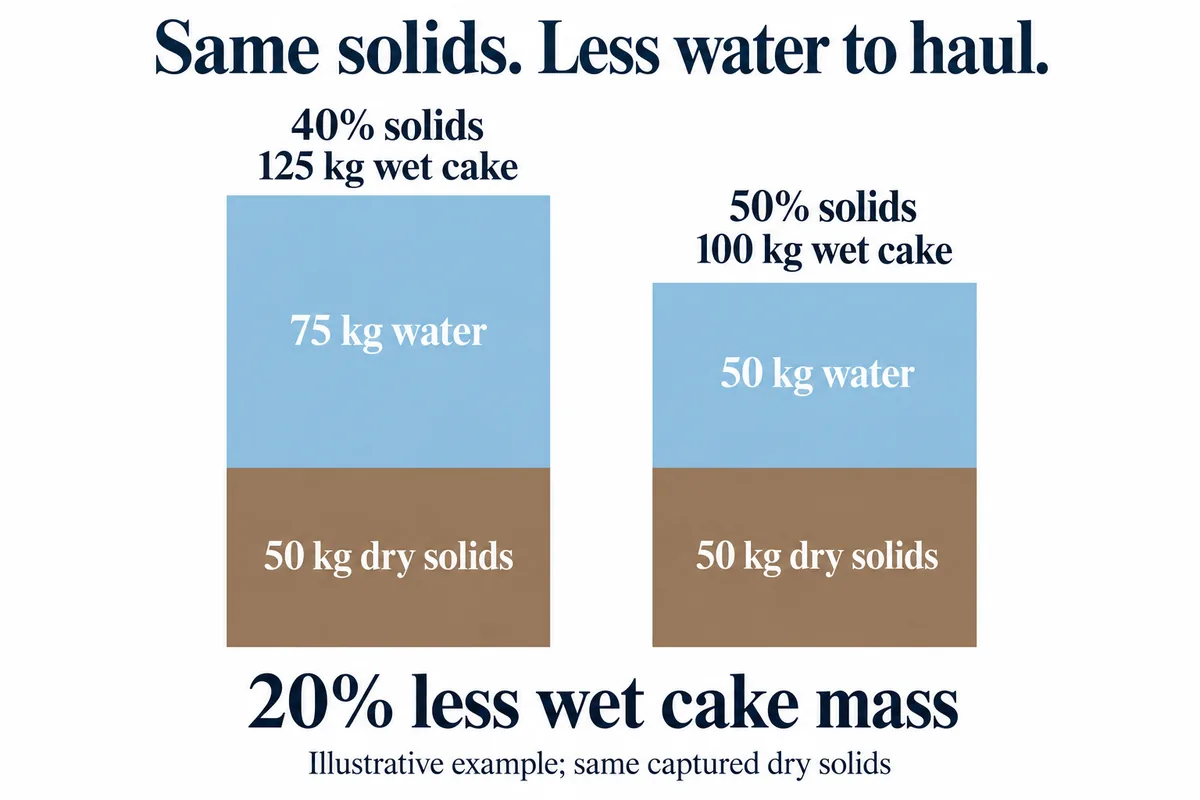
Suppose you process 1,000 kilograms of slurry at 5% dry solids. That feed contains 50 kilograms of dry solids and 950 kilograms of water.
Assume all 50 kilograms of solids reach the cake, no conditioning solids are added, and there are no wash-water additions.
| Measurement | Cake at 40% solids | Cake at 50% solids |
|---|---|---|
| Dry solids in cake | 50 kg | 50 kg |
| Total wet cake mass | 125 kg | 100 kg |
| Water remaining in cake | 75 kg | 50 kg |
| Water separated from feed | 875 kg | 900 kg |
The calculation is straightforward: wet cake mass equals dry solids mass divided by the cake solids fraction.
At 40% solids, that is 50 ÷ 0.40 = 125 kilograms. At 50% solids, it is 50 ÷ 0.50 = 100 kilograms.
You now have 20% less wet cake mass to haul: a 25-kilogram reduction from the original 125 kilograms. The dry solids quantity has stayed the same.
That does not automatically mean a 20% reduction in your total bill. Minimum charges, container capacity, transport schedules, chemical use, and extra press time can change the economics.
Use actual hauling terms and full-cycle costs before choosing a new dryness target.
What Does a Good Filter Press Cake Look Like?
A good cake meets its measured solids target, forms consistently across the chambers, and discharges acceptably for that material. Appearance is useful for spotting changes, but it cannot confirm a cause by itself.
Compare new batches with a documented baseline from successful operation.
| Observation | What to investigate |
|---|---|
| Wet or soft center | Filling, cycle endpoint, local drainage, and changes in feed material |
| Cake sticking to cloth | Cloth condition, surface compatibility, moisture, and conditioning |
| Uneven or incomplete cakes | Feed distribution, blocked passages, cloth permeability, and chamber filling |
| Unexpected cloudy filtrate | Cloth damage, sealing, feed changes, and whether sampling occurred during startup |
| A new color or crack pattern | Upstream changes and representative sample results before changing settings |
A crack pattern alone cannot prove that polymer dosage is too high or too low. Likewise, a dark patch alone cannot identify a pressure fault.
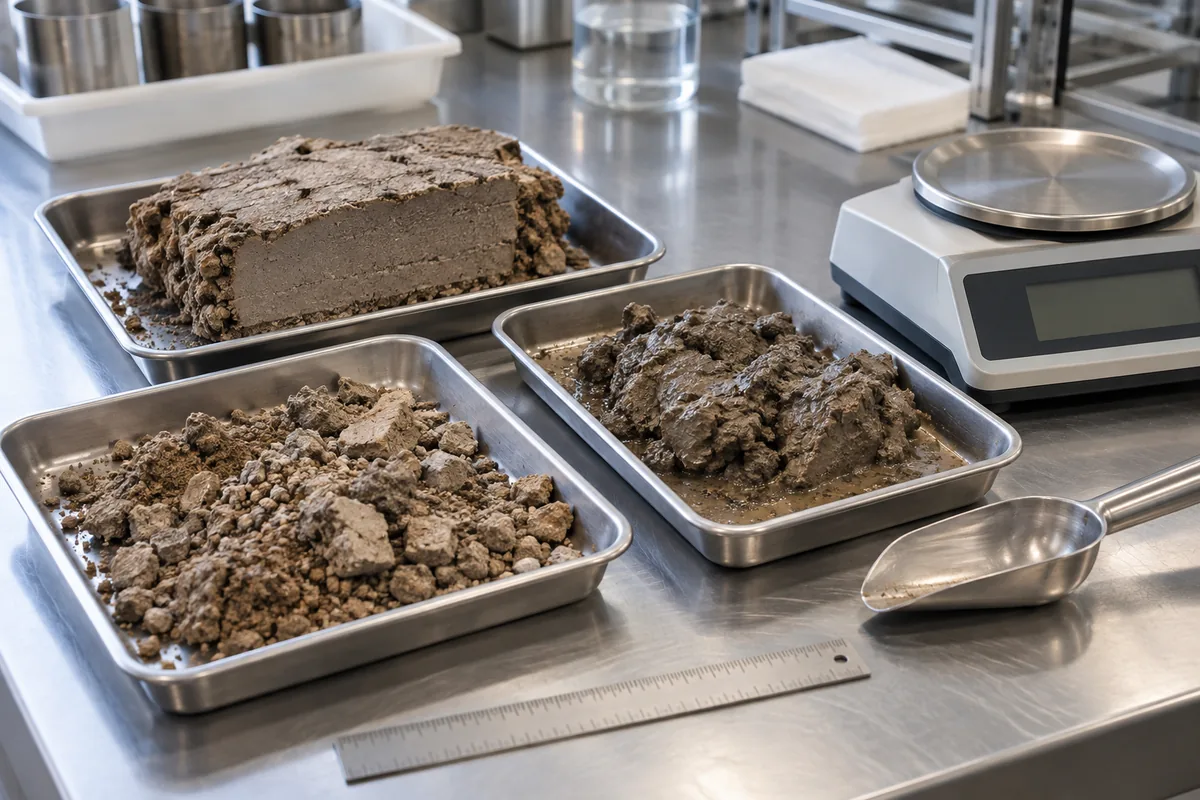
Record observations beside measured cake solids, feed solids, filtrate quality, cycle time, and chemical dose. The combination gives you a much stronger basis for troubleshooting.
Only inspect or sample where the site’s procedure allows it. Before reaching into the press or clearing stuck cake, follow the equipment’s isolation, depressurization, and lockout requirements.
Can Filter Press Cake Be Reused or Disposed Of?
Filter press cake can be recovered, processed further, reused under an approved route, or sent for permitted disposal. The right destination depends on its composition, the process that produced it, and applicable requirements.
Common possibilities include:
- Mineral processing: further processing of valuable concentrates or management of dewatered tailings.
- Chemical production: recovery, washing, or drying of a solid product.
- Industrial wastewater treatment: disposal or recovery based on the cake’s constituents and waste classification.
- Food and agricultural processing: potential recovery or beneficial use where testing and the receiving application permit it.
Removing water does not make contaminants disappear. Metals, process chemicals, or other retained contaminants may still determine how the cake must be handled.
For a United States example, EPA’s hazardous-waste guidance explains that classification can depend on waste listings or characteristics such as ignitability, corrosivity, reactivity, and toxicity. Cake dryness alone cannot establish that classification.
Does a Dry-Looking Cake Meet Landfill Requirements?
A dry-looking cake does not automatically qualify for landfill acceptance. The receiving facility may require specific testing, documentation, and compliance with its permit conditions.
In relevant U.S. applications, EPA Method 9095B, the Paint Filter Liquids Test, detects free liquids in a representative waste sample. It answers a different question from measuring total moisture content.
A cake can contain substantial moisture while having no free liquid under the test conditions. Passing that test alone does not establish that the waste is nonhazardous or acceptable at every facility.
Confirm the receiving facility’s requirements before setting the press’s operating target. Outside the United States, use the applicable local rules and test methods.
How Can You Improve Filter Press Cake Quality?
Improve cake quality by establishing a measured baseline, testing one change at a time, and comparing complete-cycle performance. Start with a clear target for dryness, release, throughput, and destination.
Use this sequence:
- Define success. Set the required cake solids, filtrate quality, handling behavior, and production rate.
- Measure the feed. Check solids concentration, particle characteristics, and changes in upstream chemistry.
- Inspect the equipment. Follow approved procedures to check cloths, drainage paths, feed passages, and plate condition.
- Run controlled trials. Evaluate approved changes to conditioning, pressure profile, or cycle duration one at a time.
- Compare the full result. Record cake solids, dry solids throughput, chemical consumption, release behavior, and disposal cost.
If an improvement only works on unusually easy feed, it is not yet a dependable operating setting. Repeat the trial across representative feed conditions before adopting it.
For a new installation, ask the equipment supplier for filtration tests using your material. Request the test conditions and performance assumptions alongside the promised cake dryness.
A laboratory filter press can help compare filter media and observe cake formation before selecting production equipment. Match the test conditions to the intended process and review how the results will scale up.
Your next useful step is simple: measure a representative cake sample, compare it with the process target, and confirm where that cake can go. Those checks give practical meaning to What Is Filter Press Cake.