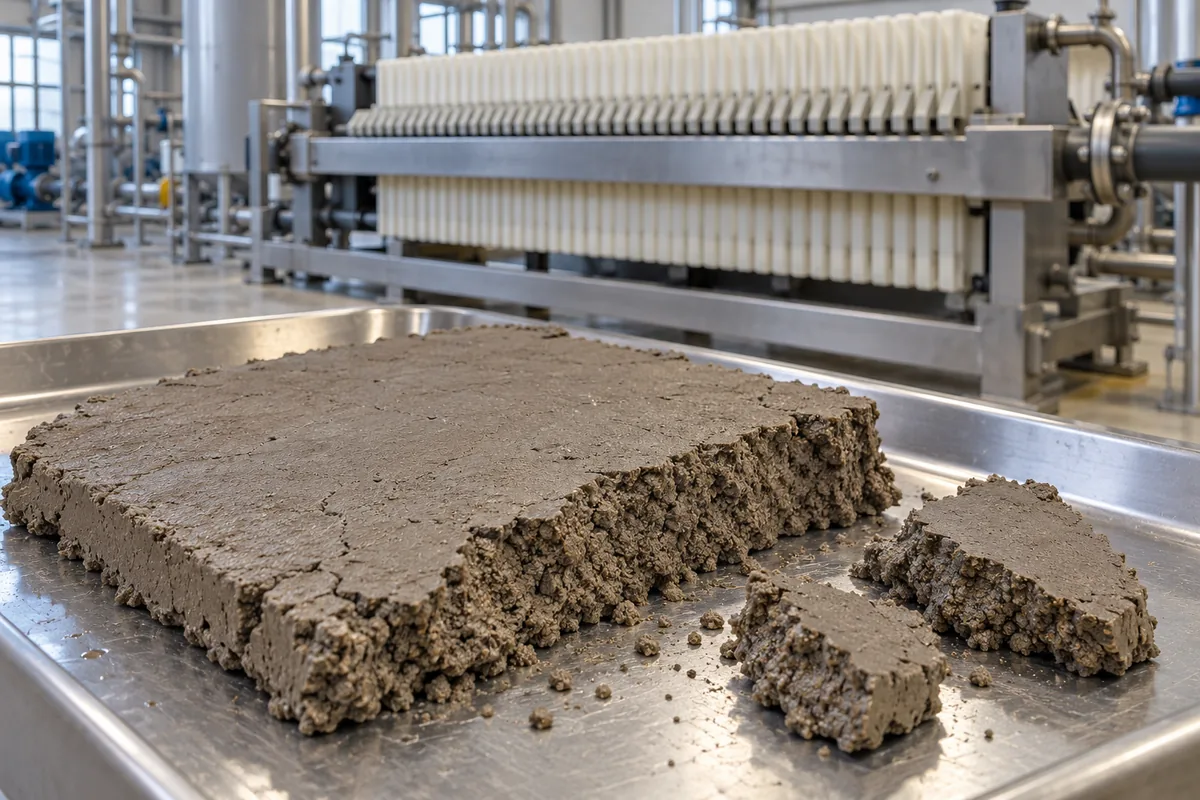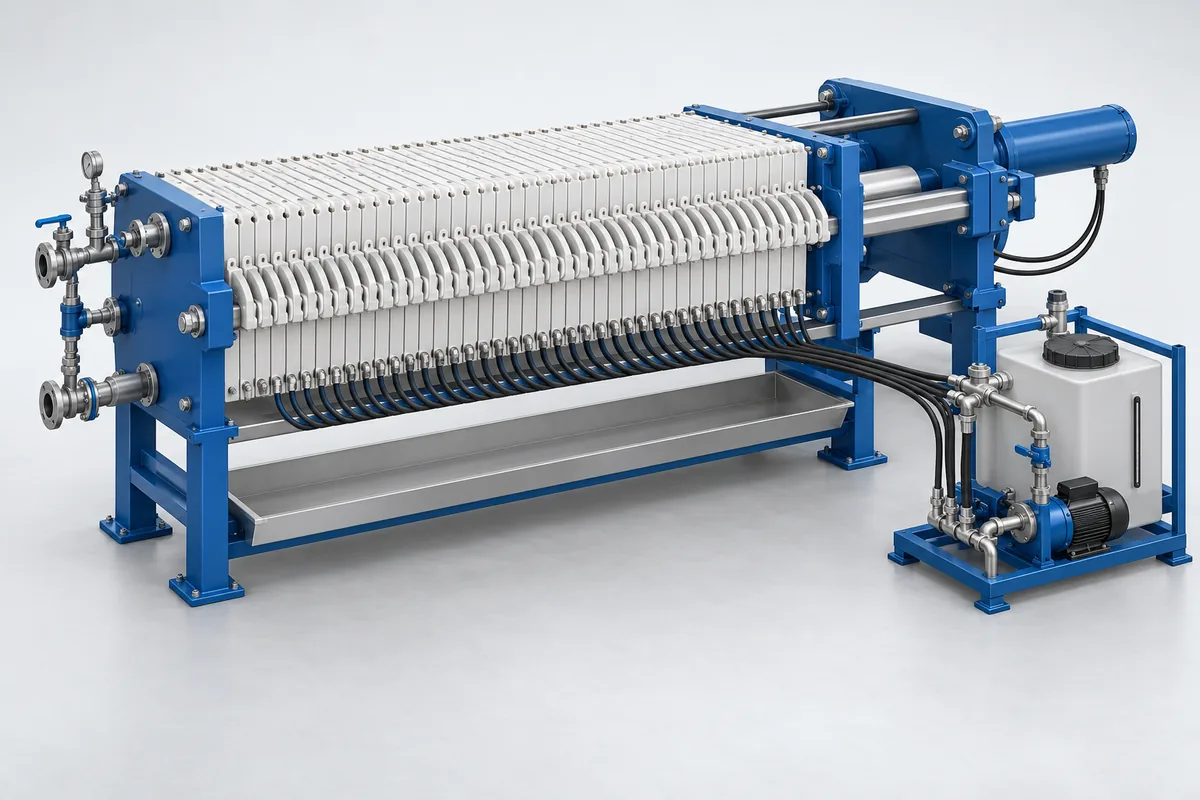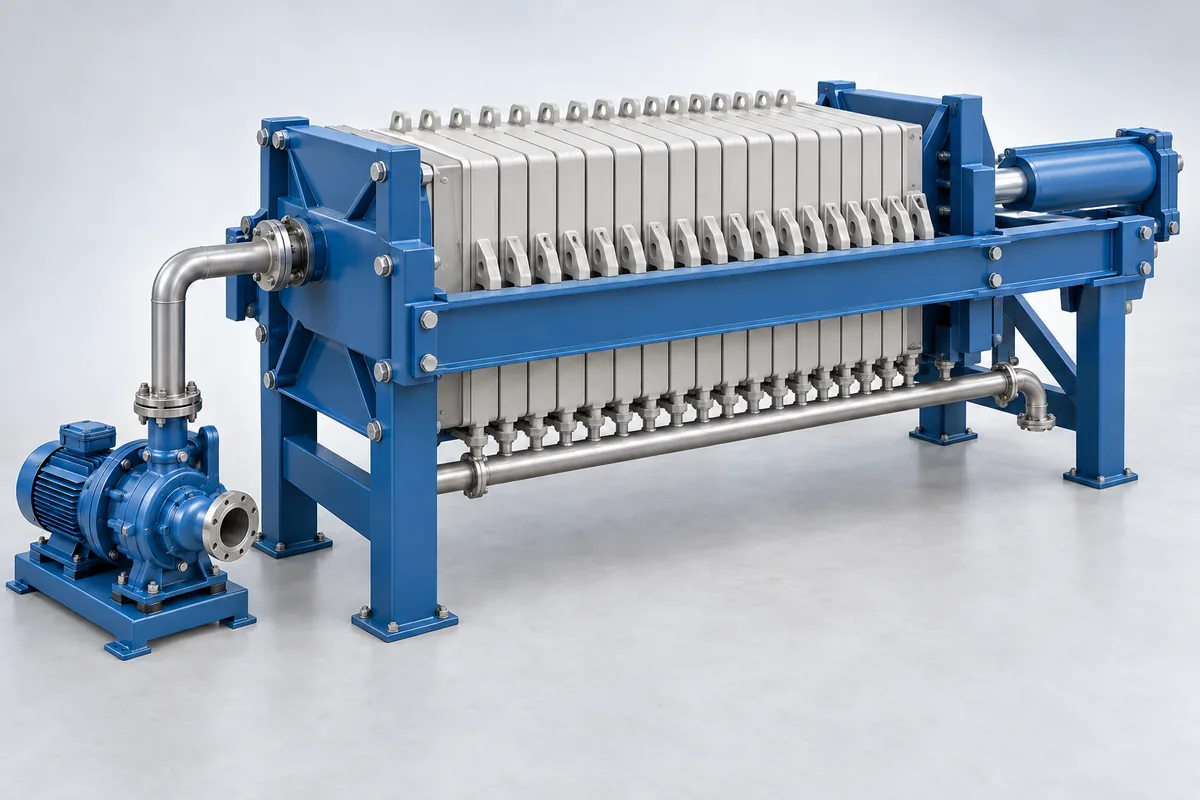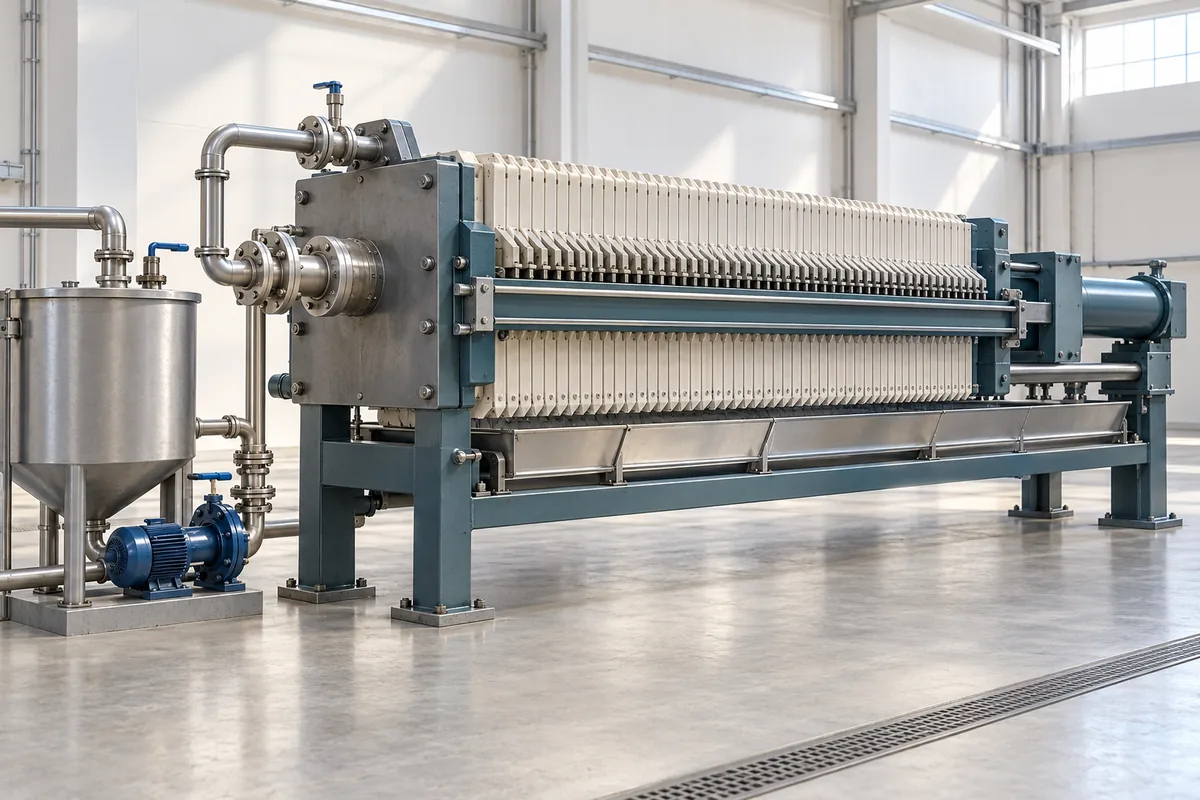
Selecting filter press capacity starts with the dry solids in each batch: convert that load into wet cake volume, then check the required filtration area with slurry tests. Choose a press that handles the load within your available operating hours and meets your cake dryness and filtrate quality targets.
| Sizing input | Example value | What it tells you |
|---|---|---|
| Daily dry solids load | 8,000 kg/day | Solids the system must handle |
| Scheduled operating time | 16 hours/day | Time allocated to the press |
| Operating availability | 85% | Leaves 13.6 hours/day for complete cycles |
| Full cycle time | 90 minutes | Allows 9 complete cycles in the planning window |
| Cake solids, by wet mass | 50% | Converts dry solids into wet cake mass |
| Wet cake bulk density | 1,600 kg/m³ | Converts wet cake mass into cake volume |
| Illustrative load allowance | 15% | Raises the design load to 9,200 kg/day |
| Calculated cake space per batch | Approximately 1.28 m³ | Starting point for selecting a chamber configuration |
The figures above are assumptions for the worked example, not plant measurements or recommended values for every application. They assume a recessed-chamber press captures essentially all incoming suspended solids and uses the full stated cake space.
A press can have enough chamber volume on paper and still miss your daily production target if it takes too long to finish each batch.
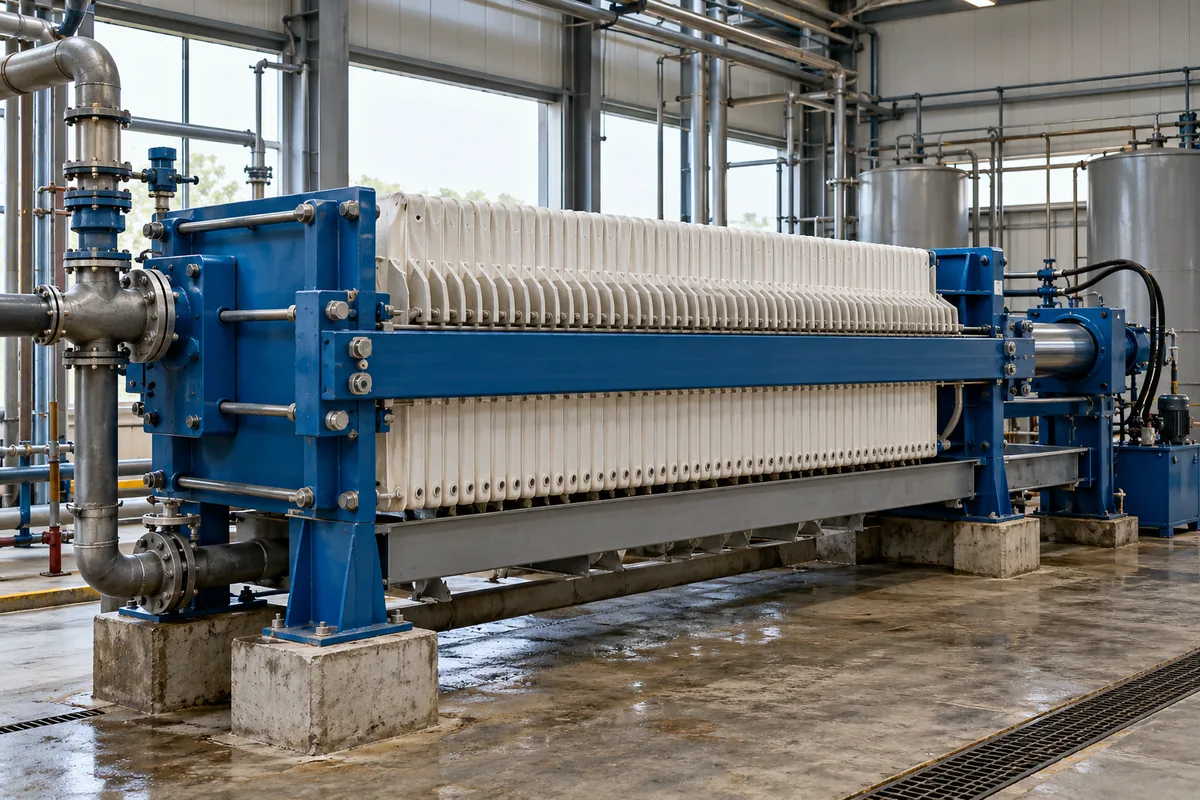
How to select filter press capacity
1. Define capacity in terms of dry solids and time
Specify capacity in kilograms of dry solids per hour or per day, with a target for cake solids and filtrate quality. List chamber volume separately: it tells you how much space the cake has in each batch.
A filter press performs solid-liquid separation. The feed pump pushes slurry into the chambers, solids accumulate on the filter cloth, and liquid leaves as filtrate.
Our guide to how a filter press works explains that sequence from filling through cake discharge.
The U.S. EPA’s recessed-plate filter press fact sheet describes dewatering wastewater residuals as removing water to produce a non-liquid cake. Your equipment specification therefore needs to say both how much material the press must handle and what condition the cake must reach.
When you read a quotation, keep these measurements separate:
- Chamber volume, in liters or cubic meters, limits the cake space available per batch.
- Filtration area, in square meters, provides the surface through which liquid can drain.
- Dry solids throughput, in kg/hour or kg/day, measures the solids processed over time.
For example, a press that discharges 800 kg of dry solids every two hours averages 400 kg per cycle-hour. The same batch mass discharged every hour gives 800 kg per cycle-hour, before allowing for downtime outside the cycle.
A “1,000-liter press” gives you only the volume. To estimate its output, you also need cake solids content, cake density, and cycle time.
2. Measure the slurry before choosing a machine
Before sizing the press, take representative feed samples and record solids concentration, slurry density, particle characteristics, and operating conditions. These measurements tell you how much material needs processing and how readily it releases liquid.
Gather the following:
- Daily slurry volume and the periods when that volume arrives.
- Feed solids concentration by mass, including normal and credible peak conditions.
- Slurry density, temperature, pH, and relevant chemical composition.
- Particle size distribution, abrasiveness, and any sticky or oily material.
- Required cake moisture, filtrate suspended solids, and solids recovery.
- Conditioning chemicals, filter aids, and product changes.
Sample the range of conditions the press will face. One convenient sample may miss a difficult production grade or a seasonal change in how well the sludge dewaters.
Calculate the daily dry solids load
Multiply daily slurry volume by slurry density and the feed solids mass fraction to find the incoming dry solids load. Write the units beside each value; percentage and density conversions are easy places to make a mistake.
Daily dry solids, kg/day = slurry volume, m³/day × slurry density, kg/m³ × feed solids fraction
If your records already give slurry mass, multiply it directly by the feed solids fraction. For a plant producing 100,000 kg of slurry per day at 8% suspended solids by mass:
100,000 × 0.08 = 8,000 kg of dry solids per day.
Enter 8% as 0.08. When converting volume to mass, use the actual slurry density. Substituting water density can put the calculation well off target.
If flow and concentration change together, calculate the load for each operating period and add the results. Multiplying their separate averages can give the wrong daily total.
Include retained filter aids or solids created by chemical conditioning in the mass balance. If the feed analysis includes dissolved solids, distinguish them from suspended solids that the filter can capture.
Test the cake properties you need for sizing
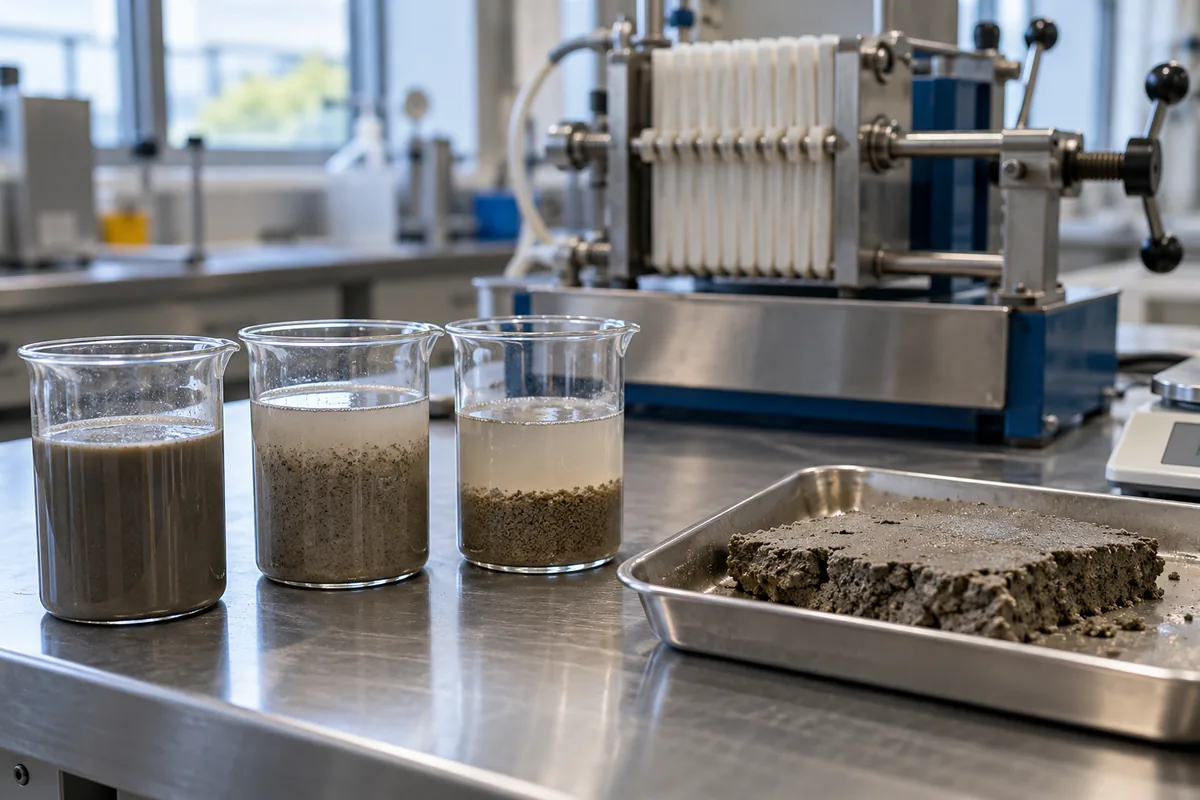
Measure the cake solids you can achieve, wet cake bulk density, filtration time, and cake release under representative conditions. You’ll need those results for the filter press sizing calculation.
Micronics’ pressure filtration laboratory guidance covers testing for feed solids, cake solids, cake density, cycle time, cloth selection, and filtrate quality.
With difficult sludge, test conditioning and cloth options together. Fine particles, cake compressibility, and cloth blinding can affect performance enough to make a generic sizing chart unreliable.
I’d ask for the test conditions alongside the results. A claim of “50% cake solids” needs the pressure, cake thickness, temperature, and time taken to reach it.
The EPA’s design guidance for recessed-plate filter presses recommends vendor pilot testing as the best way to obtain the design data needed for wastewater solids. A suitable laboratory filter press can help you begin by comparing media and cake formation. Before scaling up the results, check that its pressure range and process functions represent the intended production duty.
3. Count the batches you can finish each day
Divide the available operating time by the full batch duration to work out cycles per day. Count every operation that must finish before the next batch can start.
A complete filtration cycle can include plate closing, filling, filtration, membrane squeezing, cake washing, air blowing, pressure release, plate opening, cake discharge, and routine cleaning.
McLanahan’s cycle-time guidance explains how equipment design and slurry characteristics affect these stages. Allow time for the whole sequence, including the work before and after filtration.
Suppose filtration takes 60 minutes and the other batch operations take another 30 minutes. That makes a 90-minute cycle. A schedule based on 60 minutes would promise more batches than the press can finish.
For the worked example:
- Scheduled operating time: 16 hours/day.
- Assumed availability: 85%.
- Available cycle time: 16 × 0.85 = 13.6 hours/day.
- Full cycle duration: 1.5 hours.
- Complete planned batches: 13.6 ÷ 1.5 = 9.06, rounded down to 9.
Here, availability accounts for time lost outside the stated cycle, such as extended cleaning or maintenance. Don’t deduct cleaning time again if you’ve already included it in each cycle.
Nine batches is still a planning estimate. Check whether your shifts, interruptions, and operator coverage leave enough time to finish them. If the plant runs continuously, model whether batches can carry across shifts.
4. Calculate the chamber volume
Divide the daily design dry solids load by the number of complete cycles. Divide that batch load by the cake solids fraction and wet cake density to get the cake volume required per batch.
For preliminary sizing of a fully filled recessed-chamber press:
Required cake volume, m³/cycle = design dry solids, kg/day ÷ cycles/day ÷ cake solids fraction ÷ wet cake density, kg/m³
Find the volume for the current production load
The current 8,000 kg/day load requires approximately 1.11 m³ of cake space per batch when the press completes nine cycles and produces the assumed cake.
- Dry solids per batch: 8,000 ÷ 9 = 888.9 kg.
- Wet cake mass per batch: 888.9 ÷ 0.50 = 1,777.8 kg.
- Cake volume per batch: 1,777.8 ÷ 1,600 = 1.11 m³.
At 50% cake solids by wet mass, the other 50% is moisture. Use that same wet-basis definition throughout the calculation.
Use the measured wet cake bulk density here. Substituting the density of the slurry, liquid, or solid mineral would change the result.
Add a documented allowance for the design load
A 15% allowance brings the example design load to 9,200 kg/day and the required cake volume to approximately 1.28 m³ per batch. This percentage is an assumption for the example, not a rule for every plant.
8,000 × 1.15 ÷ 9 ÷ 0.50 ÷ 1,600 = 1.278 m³ per batch.
Base your allowance on realistic load variation, committed production growth, and the consequences of a backlog. If the starting load already includes peak future production, any extra margin needs its own justification.
Have the supplier confirm the usable chamber volume of the proposed configuration. It must meet the calculated requirement after accounting for underfilling, uneven cake formation, or differences in the tested cake properties.
For membrane filter press sizing, ask how the measured dry solids per batch relate to the quoted chamber volume. Squeezing reduces the space the cake occupies, so you can’t size the nominal chamber from the final cake volume alone.
5. Check filtration area and cake thickness together
The press needs enough filtration area to finish the cycle at the chosen cake thickness. Once you’ve calculated the cake space, use testing to check how quickly it can be filled and dewatered.
For a simplified chamber with drainage through both cake faces:
Chamber volume ≈ total filtration area × cake thickness ÷ 2.
Divide by two only when the quoted filtration area counts both cake-forming faces. Check the manufacturer’s area convention and plate geometry before using this relationship.
With a 30 mm cake thickness, or 0.03 m:
0.03 ÷ 2 = 0.015 m³/m² = 15 liters of chamber volume per m².
For the example’s 1.28 m³ cake space:
Approximate filtration area = 2 × 1.28 ÷ 0.03 = 85.3 m².
This checks the geometry. You still need filtration tests to establish whether 85.3 m² can deliver a 90-minute cycle on your slurry.
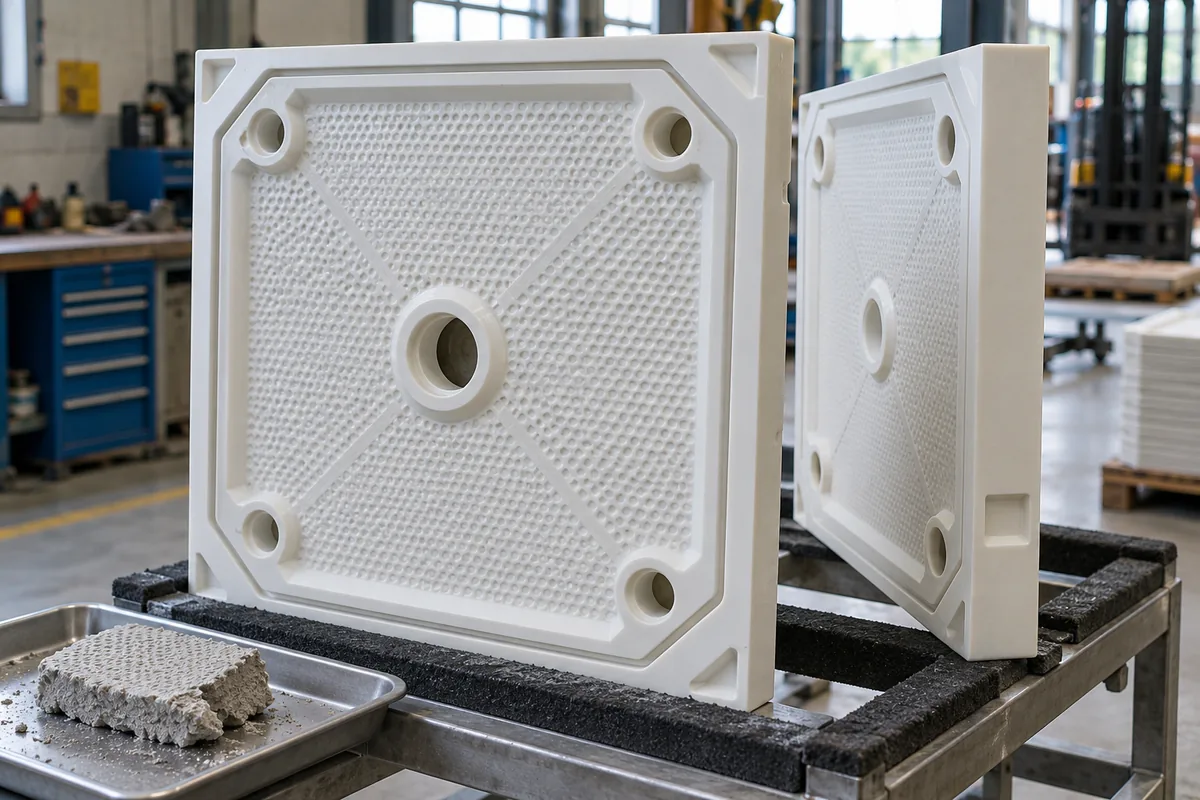
A deeper chamber holds more cake per unit of area, although the thicker cake can take longer to dewater. Adding plates at the same chamber depth increases both volume and area, so it changes the design in a different way.
Get the effective area, chamber count, and chamber volume from the plate drawings. Simply multiplying nominal plate width by height leaves out sealing edges, feed holes, support bosses, and end-plate arrangements.
6. Check what happens when cycles take longer
Recalculate daily output using a realistic slower cycle. You need to know whether the press can keep up when slurry conditions worsen or cake discharge takes longer.
At the assumed cake properties, a fully used 1.28 m³ chamber volume holds:
1.28 × 1,600 × 0.50 = 1,024 kg of dry solids per cycle.
With the same dry solids mass in every batch, output changes as follows:
| Full cycle time | Complete cycles/day | Dry solids output/day | Meets the 9,200 kg design load? |
|---|---|---|---|
| 60 minutes | 13 | 13,312 kg | Yes |
| 90 minutes | 9 | 9,216 kg | Yes, narrowly |
| 120 minutes | 6 | 6,144 kg | No |
These scenarios are calculations, not measured performance. On a working press, cycle time, cake solids, density, and chamber filling can all change together.
At a two-hour cycle, you’d need about 1.92 m³ per batch to handle the example’s 9,200 kg/day design load in six cycles, assuming the cake properties stay the same. The cycle time would then need checking for that larger configuration.
Before buying more chamber volume, compare the alternatives: longer operating hours, better feed thickening, faster cake discharge, or presses running in parallel.
7. Choose components for your slurry
Use the slurry test results and required output to choose the plates, filter cloth, feed pump, and automation. Those choices affect whether the press can deliver the capacity you’ve calculated.
Choose recessed chambers or membrane plates from test results
A recessed-chamber filter press uses feed pressure to form and dewater cake, while a membrane filter press adds a squeeze stage through flexible plate surfaces. Compare their complete cycles, cake quality, and operating costs using the same feed.
McLanahan’s filter press options guide explains membrane squeezing, cake drying, cake washing, and other process options.
A membrane squeeze may lower final moisture or help the cake reach the required dryness sooner. Allow for the squeeze stage itself when comparing total throughput; the benefit depends on the application.
Our membrane vs. chamber filter press comparison covers the squeeze stage and its added maintenance and cost. The membrane filter press model specifications list combinations of area and chamber volume you can compare with your tested duty. Check the published dimensions against that duty before shortlisting a model.
CGR means caulked, gasketed, and recessed, as Micronics explains. It describes the plate construction and seal. It doesn’t stand for “cake growth ring,” and the designation alone doesn’t establish additional capacity.
Specify pump performance throughout the feed cycle
The feed pump must supply the filling flow and work through the changing pressure and flow conditions as cake resistance builds. Its maximum-flow rating alone won’t tell you whether it can do that.
Ask the supplier for the expected operating profile, including the effects of slurry viscosity, abrasive wear, piping losses, and compatibility with conditioning chemicals.
Keep slurry feed pressure, hydraulic clamping pressure, and membrane squeeze pressure separate in the specification. Each does a different job and has its own equipment limits.
Use representative pressure tests to check whether higher pressure improves output, especially with compressible cake. Don’t assume that turning up the pressure will increase capacity.
Include cloth performance, discharge, and cleaning
Choose cloth for solids retention, drainage, chemical compatibility, and cake release. Include cleaning and discharge time in the capacity calculation, since a cake that sticks to the cloth can delay every batch even when filtration is fast.
For sludge dewatering, check filtrate clarity as well as cake moisture. Cloth that lets too many solids through may drain quickly and still fail the recovery target.
Automated plate shifting or cloth washing can raise daily output if those jobs are holding up the cycle. Ask which stage the automation shortens and whether the quoted cycle includes all the time it needs.
8. Check the equipment around the press
Check that feed storage, filtrate handling, utilities, and cake removal can keep pace with the batch schedule. Any of them can limit output from an otherwise correctly sized press.
If slurry keeps arriving while the press stops feeding for discharge, the buffer tank needs to accommodate the difference. Size it from the incoming flow and the press’s changing feed demand over the cycle. Average flow rates alone miss those interruptions.
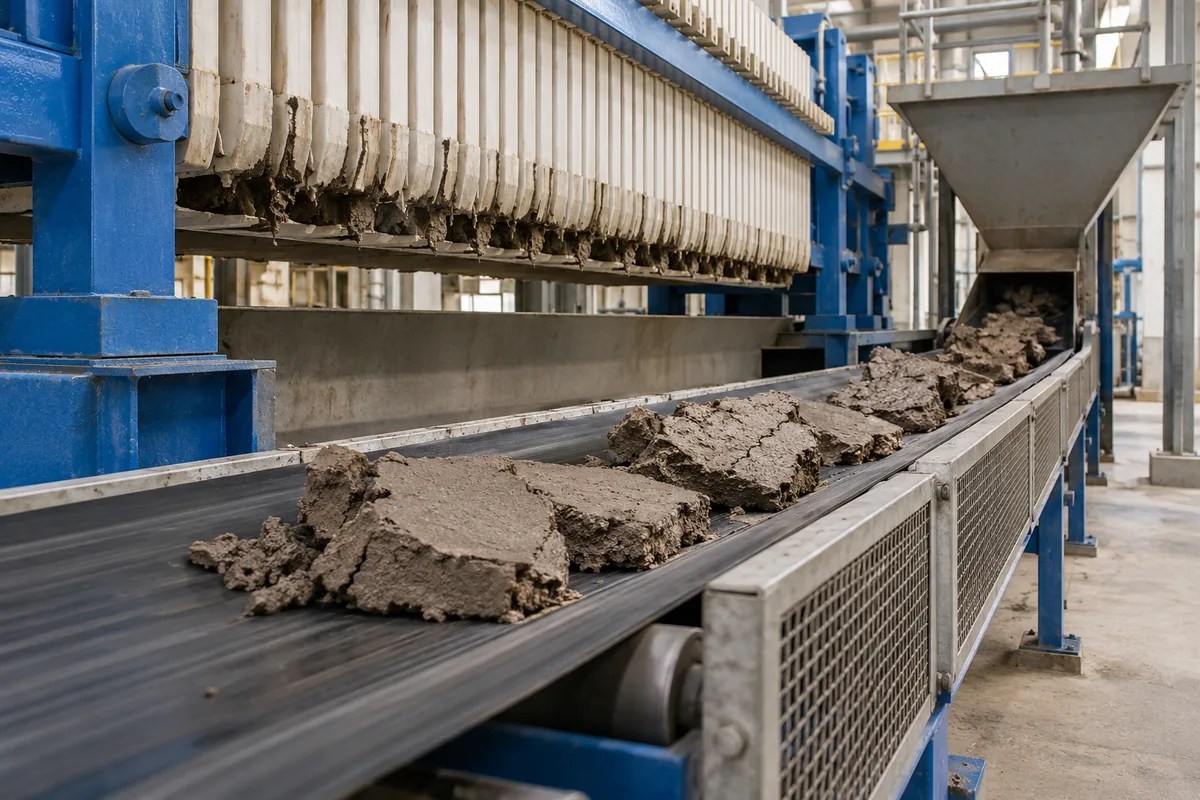
The conveyor or receiving hopper must accept a full batch of cake at discharge. A modest hourly average can hide a much larger batch-handling requirement.
Check compressed air demand, membrane squeeze services, wash-water supply, maintenance access, and lifting space too. If production must continue during an outage, assess storage or a standby press separately from the normal sizing margin.
Compare operating costs per tonne of dry solids at the required performance. Count labor, cloth replacement, pumping, compressed air, conditioning chemicals, and wet cake disposal where it applies.
For example, 8,000 kg of dry solids produces 20,000 kg of wet cake at 40% cake solids. At 50% cake solids, the wet mass drops to 16,000 kg. That calculated 4,000 kg reduction may lower hauling costs. Weigh those savings against the extra dewatering time and energy.
9. Ask for a performance-based quotation
Give each supplier the same feed data, operating schedule, and acceptance criteria. Ask how the proposed press will deliver the required daily output so you can compare quotations on the same basis.
Your request for quotation should include:
- Normal and design dry solids loads, with feed volume and concentration ranges.
- Representative slurry test results and the expected difficult operating conditions.
- Required cake solids, filtrate quality, and solids recovery.
- Scheduled hours, availability assumptions, and complete cycles per day.
- Proposed chamber volume, effective filtration area, and cake thickness.
- The full cycle breakdown, including washing, squeeze, discharge, and cleaning.
- Pump duty, utility demand, automation scope, and operator requirements.
- A commissioning acceptance test with agreed sampling and measurement methods.
I’d pay close attention to the acceptance test. Agree on a representative run that measures throughput and product quality together, with the feed conditions recorded.
For this example, the target is 9,200 kg/day of dry solids at the agreed cake and filtrate specifications within the stated schedule. Before choosing a nominal 1.28 m³ machine, you need test data and a supplier design that support that duty.
Prepare your sizing brief
Build your sizing brief from the measured dry solids load, available operating hours, and representative tests of cake properties and cycle time. Use those inputs to calculate chamber volume and check filtration area, then compare the output each proposed press can deliver.
Before asking for a final price, put the load, feed range, quality targets, available hours, and test results on a one-page duty sheet. Keep it beside each quotation to check the assumptions behind the capacity claim.
You can send your process requirements to our team to discuss a configuration. Include throughput units and the available test data so we can assess the proposal against your performance targets.