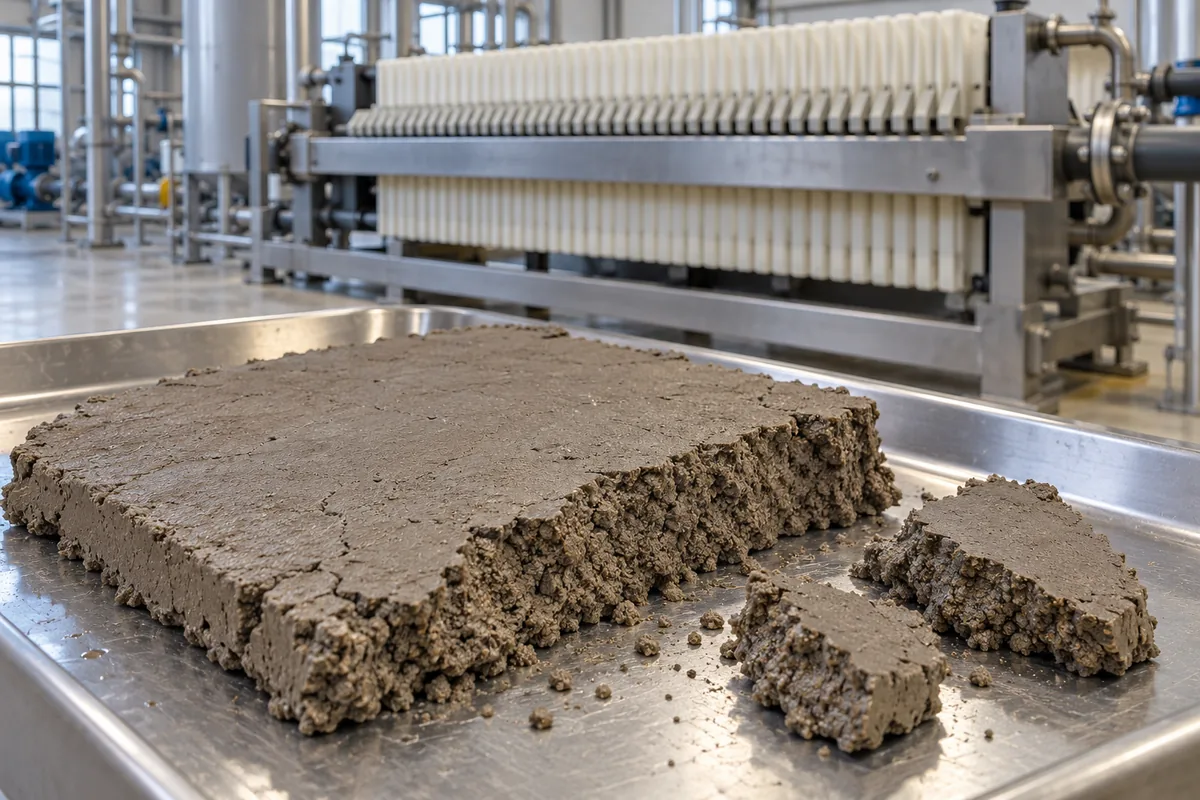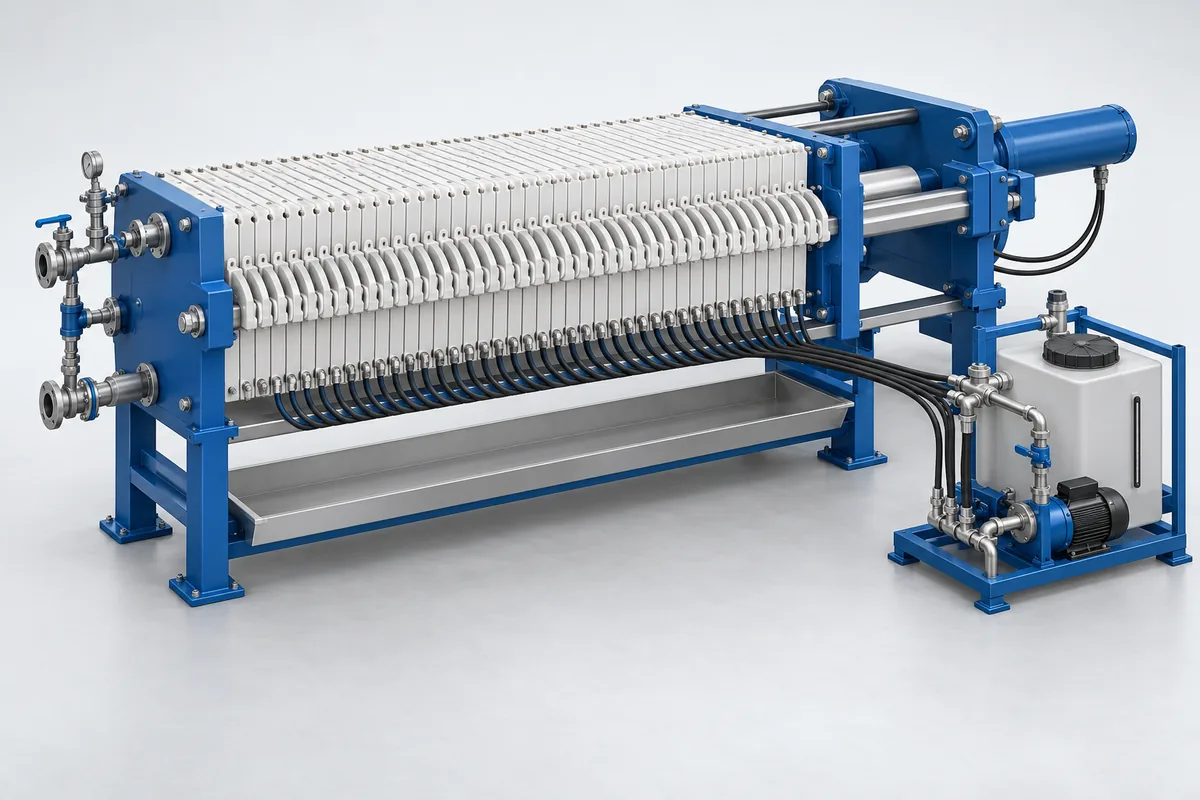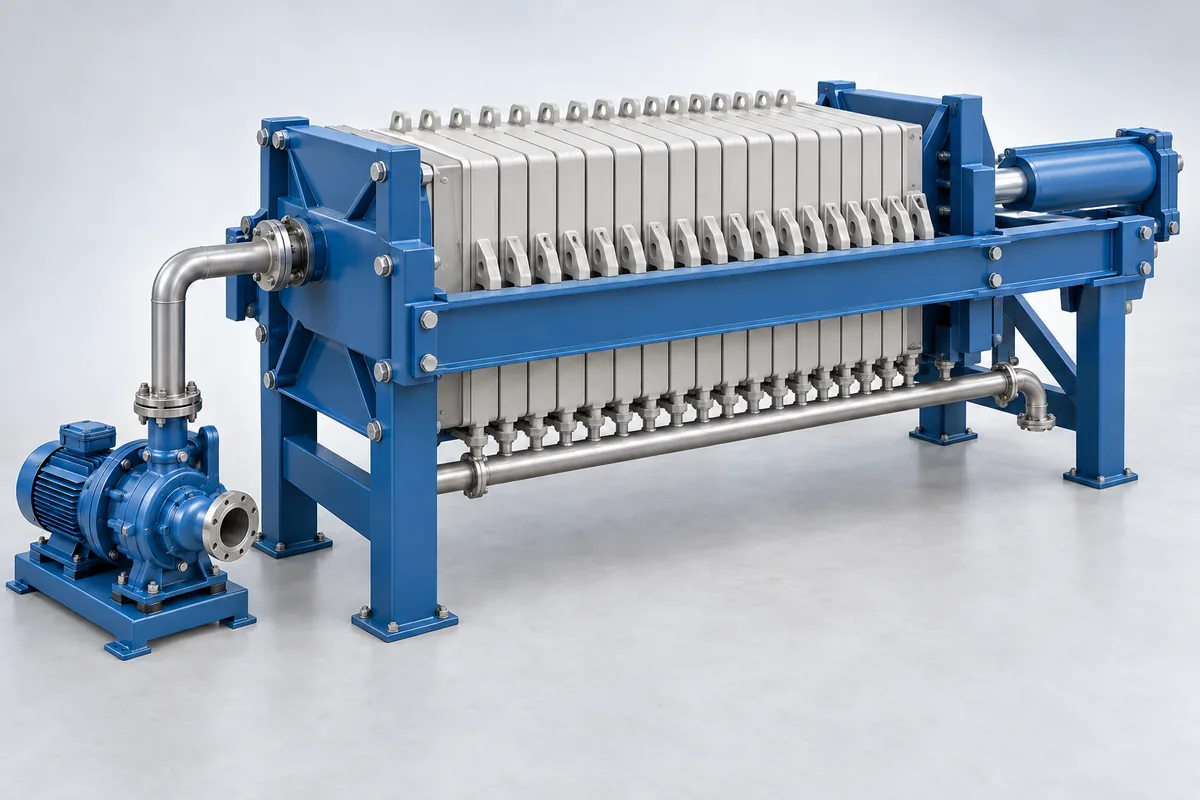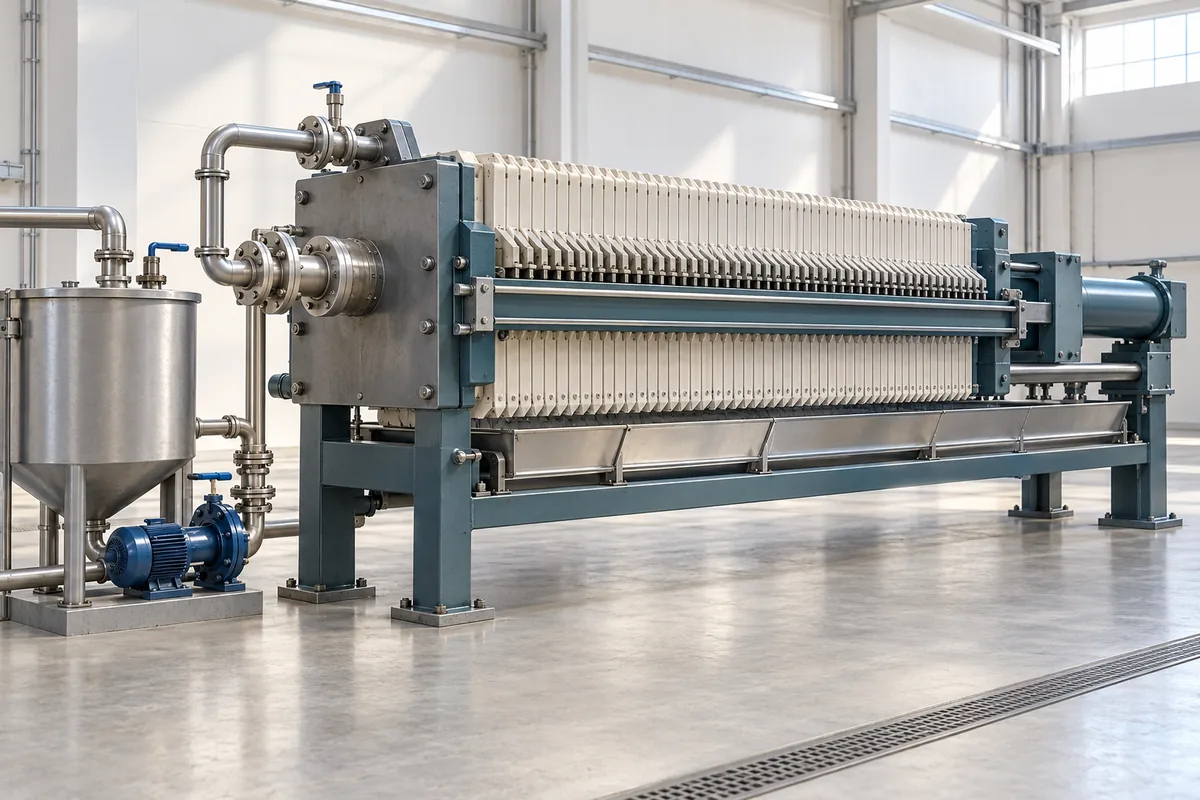
A filter press pumps slurry into cloth-lined chambers, where pressure pushes liquid through the cloth while solids collect as a filter cake.
| Stage | What happens | Result |
|---|---|---|
| Close and clamp | The closure system holds the plate stack together. | Sealed chambers are ready for feeding. |
| Feed and filter | A pump delivers slurry; liquid passes through the cloth. | Filtrate leaves through drainage channels. |
| Build the cake | Retained solids form an increasingly thick layer. | A dewatered cake develops inside each chamber. |
| Optional treatment | Configured systems wash the cake, squeeze it, or blow air through it. | Purity or moisture content can improve. |
| Depressurize and discharge | Process pressure is safely released before the plates separate. | Cakes are collected, and the press is prepared for another batch. |
The liquid leaving the machine is called filtrate. The incoming mixture of liquid and suspended solids is called slurry. The retained solids, together with their remaining moisture, make up the filter cake.
Those three terms explain most of what you will see during a cycle.
The useful part is understanding what changes as the cake grows. That helps you evaluate a press, interpret operating data, and investigate a batch that suddenly takes longer than usual.
What Does a Filter Press Actually Do?
A filter press separates suspended solids from a liquid and concentrates those solids into a cake that can be easier to handle, recover, or dispose of. Recessed-plate filter presses are used to dewater chemically conditioned sludge on a batch basis using mechanically-applied pressure to achieve high sludge cake solids content (US EPA, Design Information Report).
Depending on the process, the valuable output might be the cake, the filtrate, or both. A mineral processor may want to recover solids. In wastewater sludge dewatering, a plant may want to reduce the wet mass sent for disposal.
Most plate filter presses operate in batches: close, fill, filter, empty, and repeat. Automated controls can repeat that sequence with less manual involvement, but the individual press still needs time to discharge its cakes.
This same pressure-filtration process and its use in industrial wastewater, chemical processing, and other applications.
Clear filtrate does not automatically mean clean, reusable water. Dissolved salts and other dissolved contaminants can remain in the liquid. Testing and any required downstream treatment determine whether that filtrate meets its intended use or discharge limits.
Which Parts Make the Process Work?
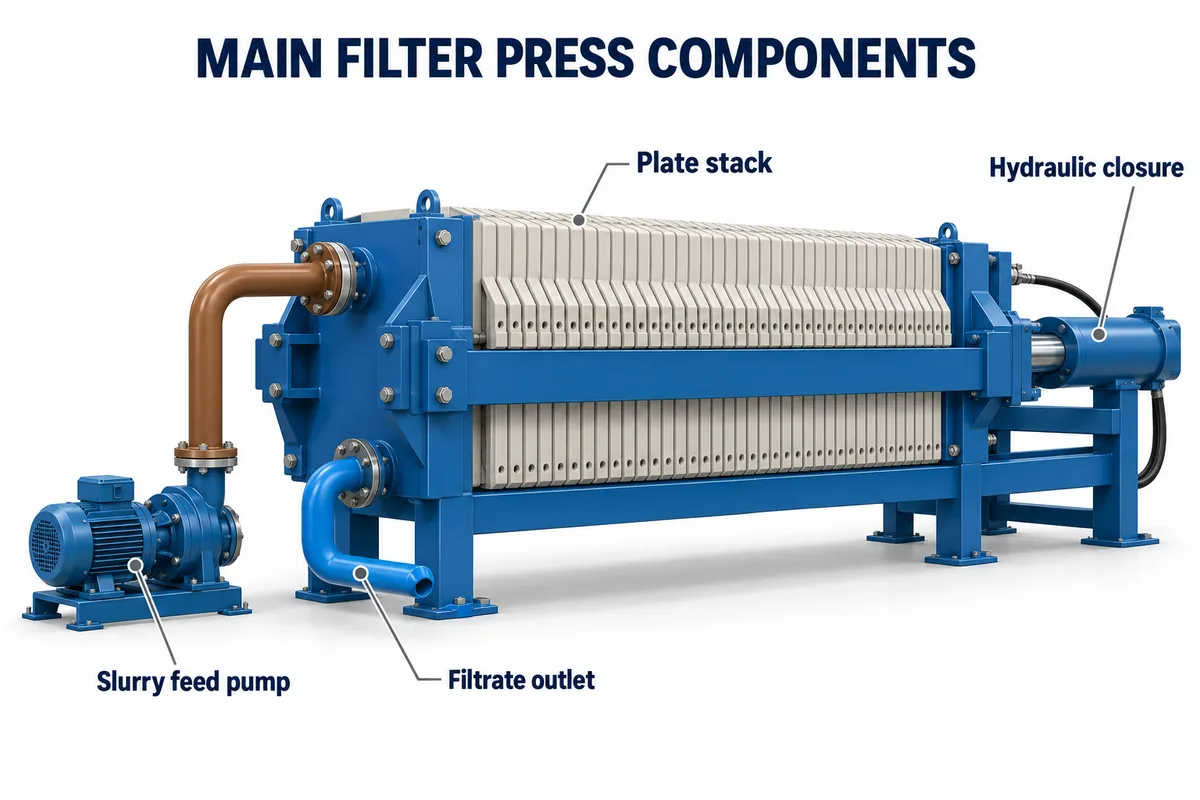
The frame, closure system, plates, cloths, feed pump, and liquid-handling pipework work together to contain the slurry and separate its liquid from its solids.
Each component has a specific job. Confusing those jobs can lead to poor equipment choices or misleading pressure readings.
The Frame and Closure System Hold the Plates Together
The frame supports the plate stack, while the closure system supplies the force needed to keep the plates clamped during filtration.
Many presses use a hydraulic cylinder for this task. That cylinder resists the force trying to push the plates apart as slurry enters under pressure.
Clamping pressure and slurry feed pressure are different measurements. You cannot use the hydraulic gauge reading as the slurry pressure without the equipment manufacturer’s engineering information.
The Plates Form the Chambers
The filter plates support the cloths, provide drainage paths, and define the spaces where cakes form.
In a recessed chamber filter press, recesses in adjacent plate faces create each chamber when the stack closes. A plate-and-frame design uses separate frames to provide that space.
Chamber depth affects cake thickness. Total chamber volume helps determine how much cake the press can hold per batch.
The Cloths Retain Solids and Let Liquid Pass
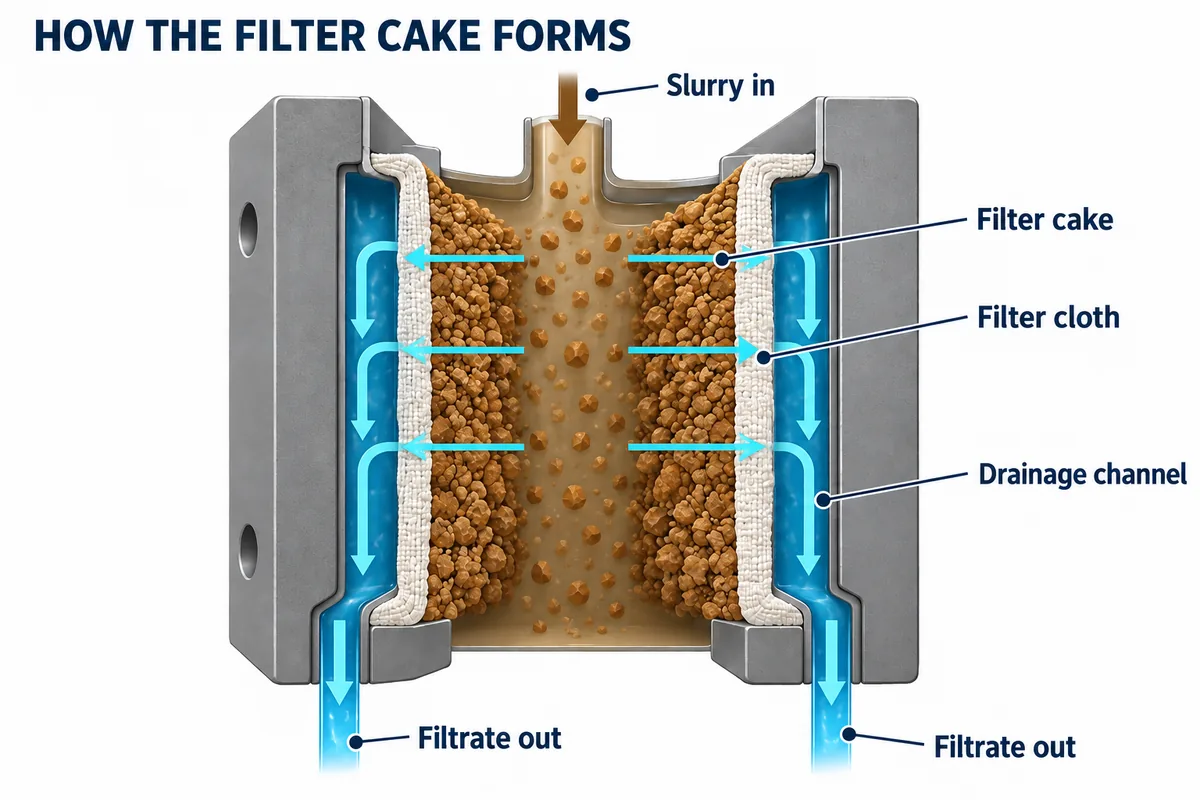
Filter cloths provide the initial separation surface, allowing liquid through while retaining particles that establish the cake.
Cloth selection depends on the slurry, temperature, chemical compatibility, desired filtrate quality, and how easily the cake must release. A tighter cloth is not automatically the best choice: it may restrict flow or become blocked more quickly.
The Pump and Pipework Move the Material
The feed pump moves slurry into the chambers and supplies the pressure difference that drives filtration. Ports, channels, valves, and manifolds route feed and filtrate through the machine.
Depending on the design, filtrate may leave through individual outlets into a collection trough or through enclosed drainage passages and a manifold.
The flow path matters. Restricted drainage can reduce performance even when the feed pump appears to be working normally.
How Does the Operating Cycle Unfold?
A typical cycle closes the press, feeds slurry, builds and dewaters the cake, completes any optional treatments, then releases pressure before discharging the solids.
The following steps explain the sequence. Actual valve positions, pressure limits, and interlocks come from the machine’s operating manual and approved site procedure.
1. Close and Clamp the Plate Stack
The closure system brings the plates together and establishes the specified clamping force before feeding begins. During operation, the collection of filter plates are moved to the closed position to form the sealed filter chambers, with the plates squeezed together until they contact the adjacent plate to form the sealed chamber for containing the pressurized slurry (US Patent US20090211990A1).
Cloths must sit correctly, sealing surfaces must be clear, and the required guards and interlocks must be in place. Residual cake trapped between sealing faces can cause leakage during the next cycle.
2. Pump Slurry into the Chambers
The feed pump delivers slurry through the feed passages, distributing it across the chambers as liquid starts passing through the cloth.
Filling and filtration overlap. The press does not need to finish filling with slurry before any liquid can leave.
Early filtrate can contain more fine particles before a stable cake layer develops. Where the process requires it, that initial liquid is collected separately or returned for treatment according to the plant’s procedure.
3. Build and Dewater the Filter Cake
Solids accumulate against the cloth, forming a porous cake through which additional liquid must travel. The filtration rate depends on the area of the filter cloth, the viscosity of the liquid, the pressure drop across the filter and filter cake resistance (ScienceDirect, Filter Cake).
The cake becomes part of the filtering medium. It can capture fine particles that the cloth alone would not retain as effectively.
As that layer thickens, resistance to liquid flow increases. Depending on the pump and control strategy, feed pressure may rise, flow may fall, or both may happen.
That is why a strong initial flow can gradually turn into a slow stream without anything being broken.
4. Finish Filtration at a Defined Endpoint
The filtration stage ends when the process reaches its validated completion criteria, such as low filtrate flow at the specified pressure for a defined period.
Pressure alone is an incomplete signal. A blocked cloth or restricted feed path can create high pressure before the chambers contain satisfactory cakes.
Useful endpoint checks combine pressure and flow trends with cycle history and cake results. Waiting for absolutely zero flow is not a universal operating rule.
5. Apply Optional Washing, Squeezing, or Air Blow
Additional stages can remove soluble material from the cake or reduce residual liquid when the press is designed for those functions.
These stages do different jobs:
- Cake washing passes a compatible wash liquid through the cake to displace mother liquor or remove soluble impurities.
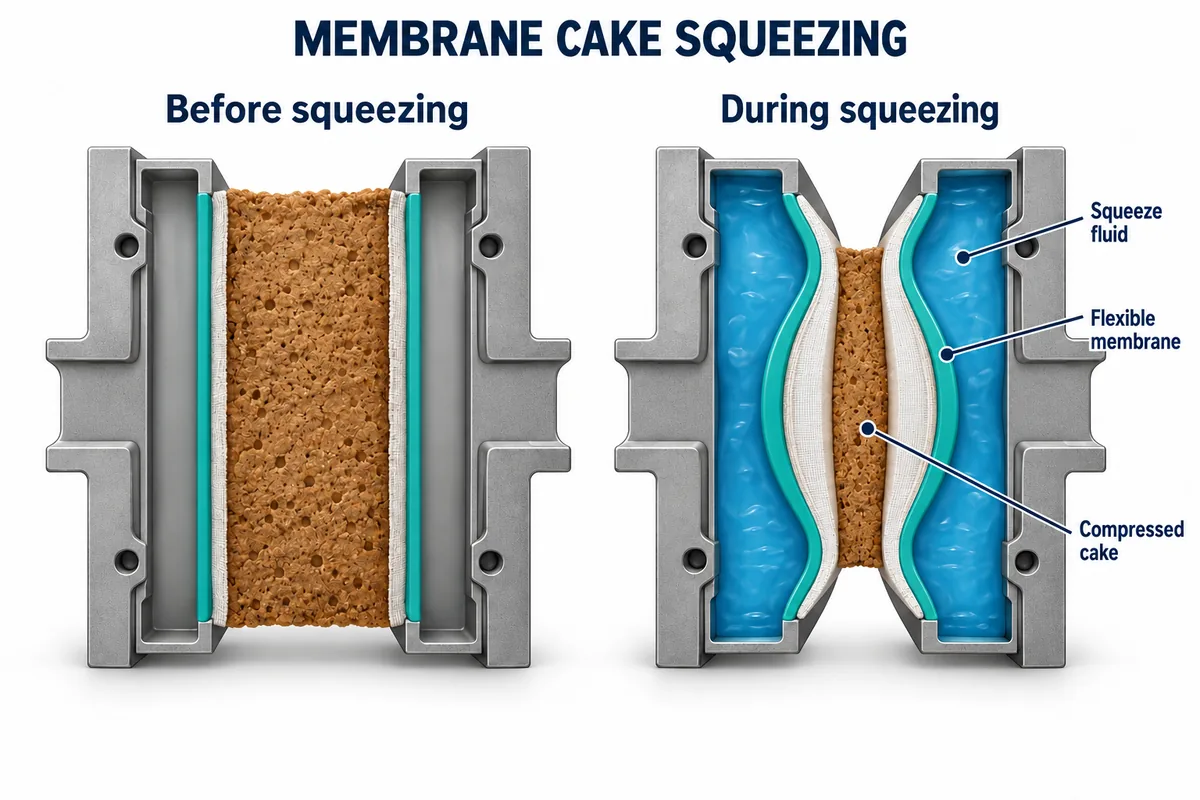
- Membrane squeezing uses a separate pressurized medium behind flexible plate membranes to compress the cake.
- Air blow passes compressed gas through a suitable cake and flow path to displace additional liquid.
In a membrane press, squeeze water or air normally stays behind the intact membrane. It applies force through that membrane rather than mixing directly with the slurry.
Diemme Filtration’s membrane guide explains this separate squeezing mechanism. The precise order of optional stages depends on the application and equipment configuration.
6. Release Pressure, Open, and Discharge
The process circuits must be safely depressurized before the closure system releases the plate stack and the cakes are discharged.
Membrane squeeze pressure and trapped air also need to be released through the designed sequence. A stopped pump does not prove that every chamber is pressure-free.
The plates then separate manually or through an automatic shifting system. Cakes drop into the designated collection area, sometimes with assistance from equipment designed for cake release.
Operators check cloth condition and sealing surfaces before the next batch. Clearing obstructions or performing maintenance requires the site’s isolation and lockout procedure.
Filter Press Working Principle: Why Does Flow Slow Down?
Liquid flow slows because the growing cake adds resistance to the path between the slurry side and the filtrate outlet.
A simplified filtration relationship makes this easier to understand:
Flow rate is proportional to pressure difference × filtration area ÷ (liquid viscosity × total filtration resistance).
Total resistance includes the cloth and the cake. This relationship explains four practical observations:
- More filtration area can support greater flow under otherwise comparable conditions.
- A more viscous liquid usually passes through more slowly.
- A thicker or less permeable cake increases resistance.
- Higher pressure does not guarantee a proportional increase in flow.
That last point deserves attention. Some cakes compress as pressure increases, making their internal liquid pathways smaller. Extra pressure may deliver diminishing returns.
Picture two slurries with the same solids concentration. One contains coarse mineral particles; the other contains fine, compressible solids. Their filtration behavior can be very different.
A slurry sample tells you more than a pressure specification alone. Testing establishes how that particular material behaves as the cake forms and consolidates.
What Is the Difference Between Chamber and Membrane Presses?
A chamber press relies primarily on feed pressure to dewater the cake, while a membrane filter press adds a separate mechanical squeeze through flexible plate surfaces.
Neither design wins every application. The right choice depends on the material, moisture target, cycle time, and cost of achieving those results.
| Design | How the cake space works | Main selection question |
|---|---|---|
| Plate and frame | Separate frames create cake spaces between filter plates. | Does this arrangement suit the media, cake, and handling requirements? |
| Recessed chamber | Recessed plate faces create chambers of fixed geometry. | Can feed-pressure filtration meet the required dryness and throughput? |
| Membrane | Flexible membranes reduce the cake space during squeezing. | Does the extra liquid recovery or time saving justify the added equipment? |
“Automatic” describes how operations are controlled and performed. It can apply to different plate designs. The filter press types guide explains how plate arrangements differ from automation, materials, and other configuration choices.
M.W. Watermark’s membrane explanation identifies potential gains in moisture reduction and cycle time, while noting the additional equipment involved. Treat those gains as application-dependent, and confirm them with trials.
How Much Liquid Can a Filter Press Remove?
The amount removed depends on the feed solids concentration and the final cake solids concentration. There is no single dryness percentage that applies to every slurry.
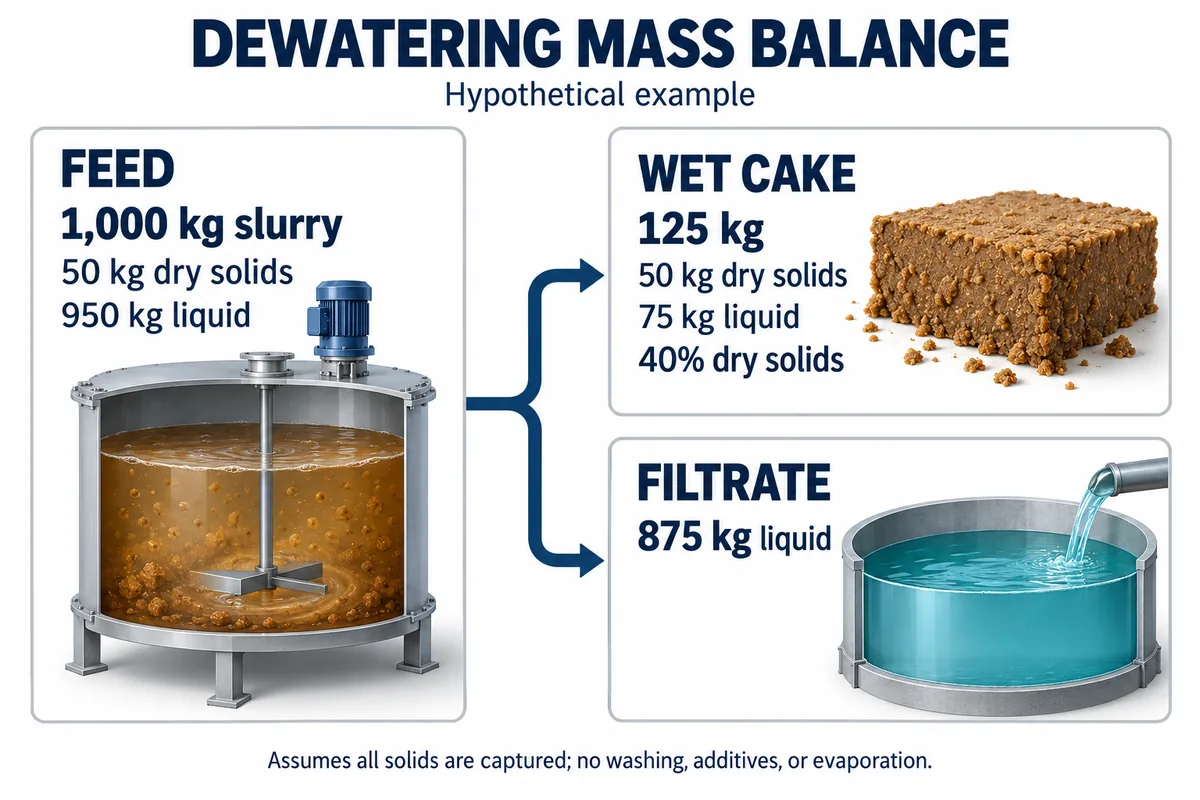
Consider this hypothetical mass-balance example, using percentages by mass. Assume all suspended solids are captured, no conditioning chemicals add mass, and no washing or evaporation occurs.
You start with 1,000 kg of slurry at 5% dry solids:
- Dry solids: 1,000 × 0.05 = 50 kg.
- Liquid in the feed: 1,000 − 50 = 950 kg.
If testing shows the press can produce a cake at 40% dry solids, the cake calculation is:
Wet cake mass = dry solids mass ÷ cake solids fraction.
That gives 50 ÷ 0.40 = 125 kg of wet cake.
The cake still contains 75 kg of liquid. The other 875 kg leaves as filtrate under the stated assumptions.
| Material | Feed | Final cake | Filtrate |
|---|---|---|---|
| Dry solids | 50 kg | 50 kg | 0 kg assumed |
| Liquid | 950 kg | 75 kg | 875 kg |
| Total mass | 1,000 kg | 125 kg | 875 kg |
The material retained for cake handling now weighs 87.5% less than the original slurry. That is a reduction in wet mass, not a guaranteed reduction in disposal cost or volume.
Also notice the wording: a cake at 40% dry solids still contains 60% liquid by mass. A firm-looking cake can hold substantial moisture.
What Determines Cake Dryness and Cycle Time?
Slurry properties, cloth selection, cake thickness, operating conditions, and optional treatments jointly determine the result.
Start with these variables when comparing test data:
- Particle size and structure: Fine or compressible particles can produce cakes with high resistance.
- Feed concentration: Dilute slurry requires processing more liquid to load the same dry solids mass.
- Viscosity and temperature: Changes affect liquid flow, while equipment and material temperature limits still apply.
- Cloth condition: Blinding, damage, or incompatible cloth selection can reduce performance.
- Conditioning: Suitable coagulants, flocculants, or filter aids may help particular slurries, but require testing.
- Cake thickness: Thicker cakes hold more solids per chamber but create longer drainage paths.
- Discharge and cleaning time: These stages count toward total cycle time, even when filtration itself is fast.
Micronics’ technical FAQ discusses cloth condition, slurry characteristics, and cake thickness as practical influences on performance.
My recommendation: compare dry solids processed per operating hour alongside cake moisture and filtrate quality. The driest possible cake may require extra time that reduces overall plant capacity.
What Should You Check When Performance Changes?
Compare the current pressure, flow, cake, and filtrate results with a known good batch, then investigate the differences under the approved operating procedure.
A single symptom can have several causes. Use the following table to narrow the investigation rather than diagnose the machine from one observation.
| Symptom | Possible causes to investigate | Useful comparison |
|---|---|---|
| Cloudy filtrate | Damaged cloth, poor sealing, startup fines, changed feed | Startup versus established filtration; individual outlets where designed |
| Longer filtration time | Cloth blinding, finer solids, higher viscosity, restricted drainage | Feed properties, flow trend, maintenance history |
| Wetter cake | Changed slurry, incomplete filling, unsuitable endpoint, squeeze-stage fault | Cake solids, chamber consistency, validated cycle settings |
| Leakage around plates | Trapped solids, cloth folds, damaged seals, closure or pressure problem | Sealing surfaces and manufacturer-approved checks |
| Uneven cakes | Feed distribution problems, blocked passages, incorrect plate arrangement | Cake pattern across the plate stack |
Avoid turning up pressure as a default response. Confirm the cause and the permitted operating conditions before adjusting the cycle.
How Do You Choose a Press for Your Process?
Choose a press using representative slurry tests and the required daily dry solids load, then check whether the complete cycle meets your production schedule.
Before requesting a proposal, gather:
- Feed volume and dry solids concentration, including normal variation.
- Slurry chemistry, temperature, and particle characteristics.
- Required cake solids concentration and filtrate quality.
- Operating hours, staffing, and available space.
- Cake handling, liquid recovery, washing, and automation requirements.
Ask the supplier to report test conditions, conditioning chemicals, cycle stages, cake solids, and expected throughput together. A moisture result without its associated cycle time gives you only part of the picture.
For a new application, a useful next step is a bench or pilot trial using samples that represent the actual process. A suitable laboratory filter press can help compare media and observe cake formation under recorded test conditions. Include difficult feed conditions as well as the easiest sample to filter.
Once you connect the pump, cloth, cake, and drainage path, the machine becomes much easier to understand. Pressure moves liquid through a porous barrier; retained solids form the cake; controlled discharge prepares the press for another batch. That is the practical answer to How does a filter press work.