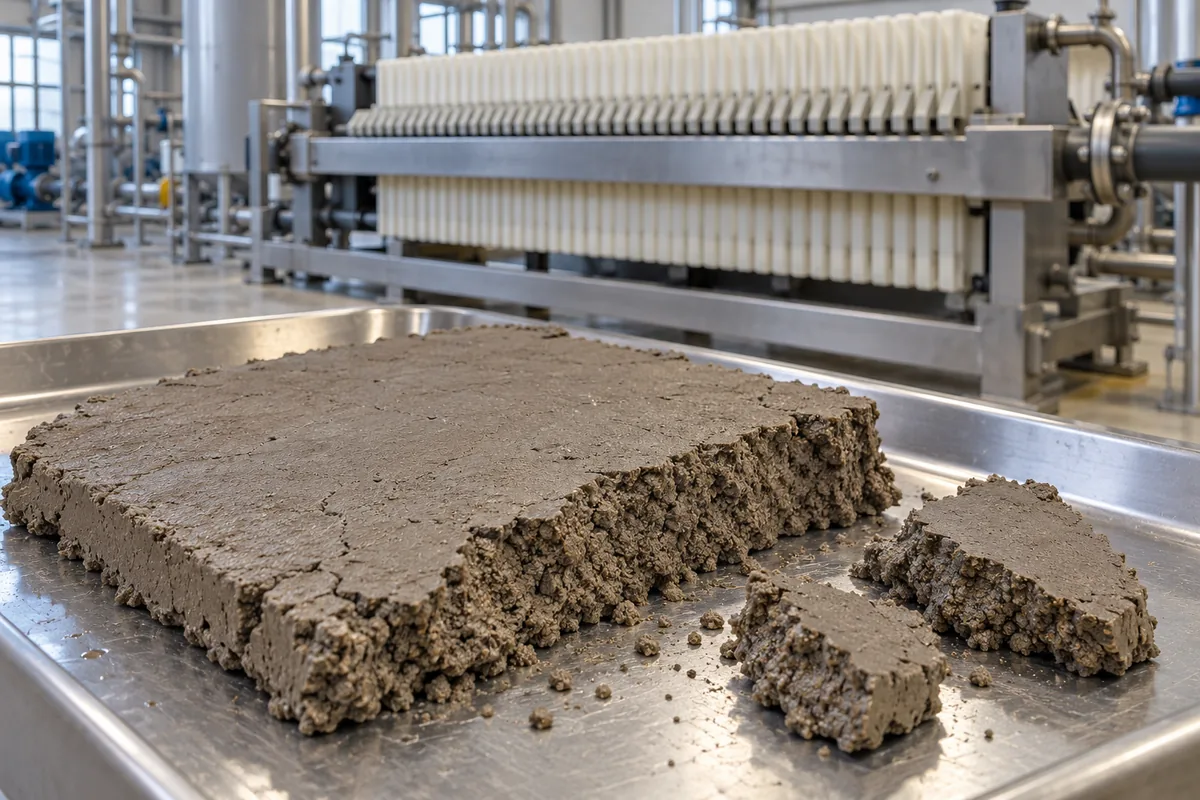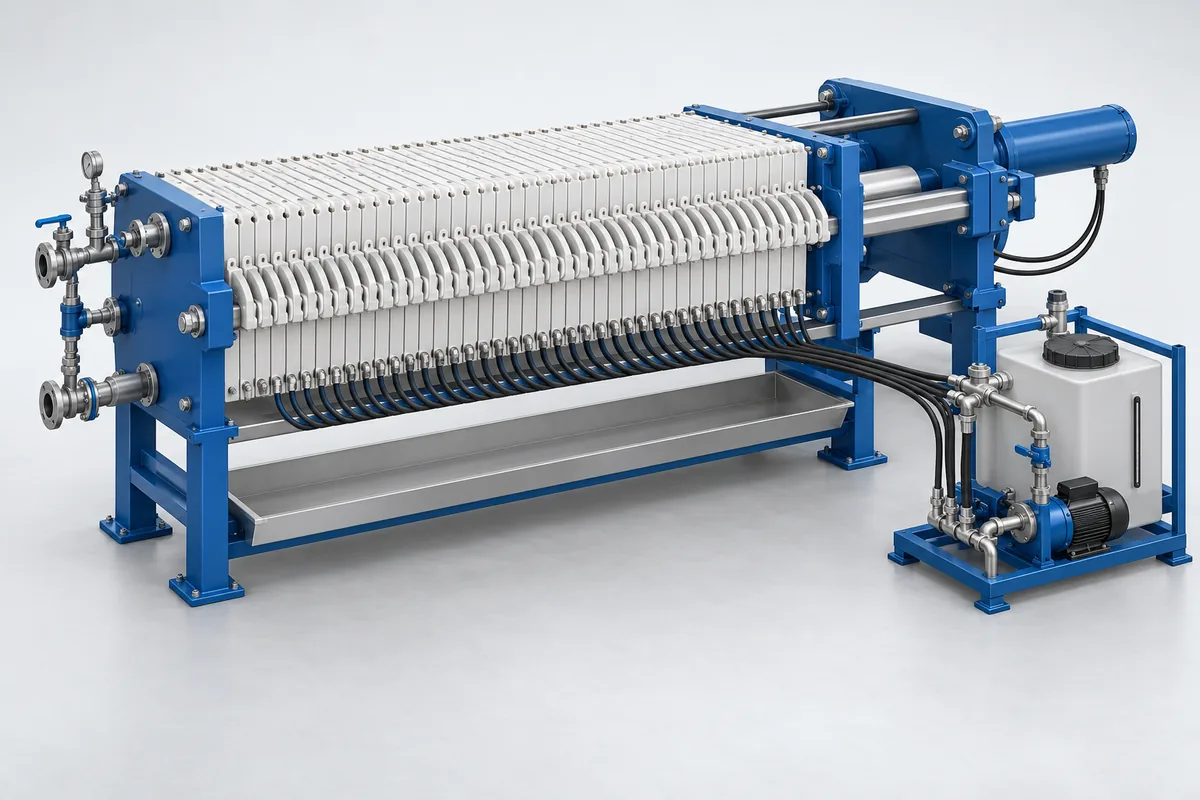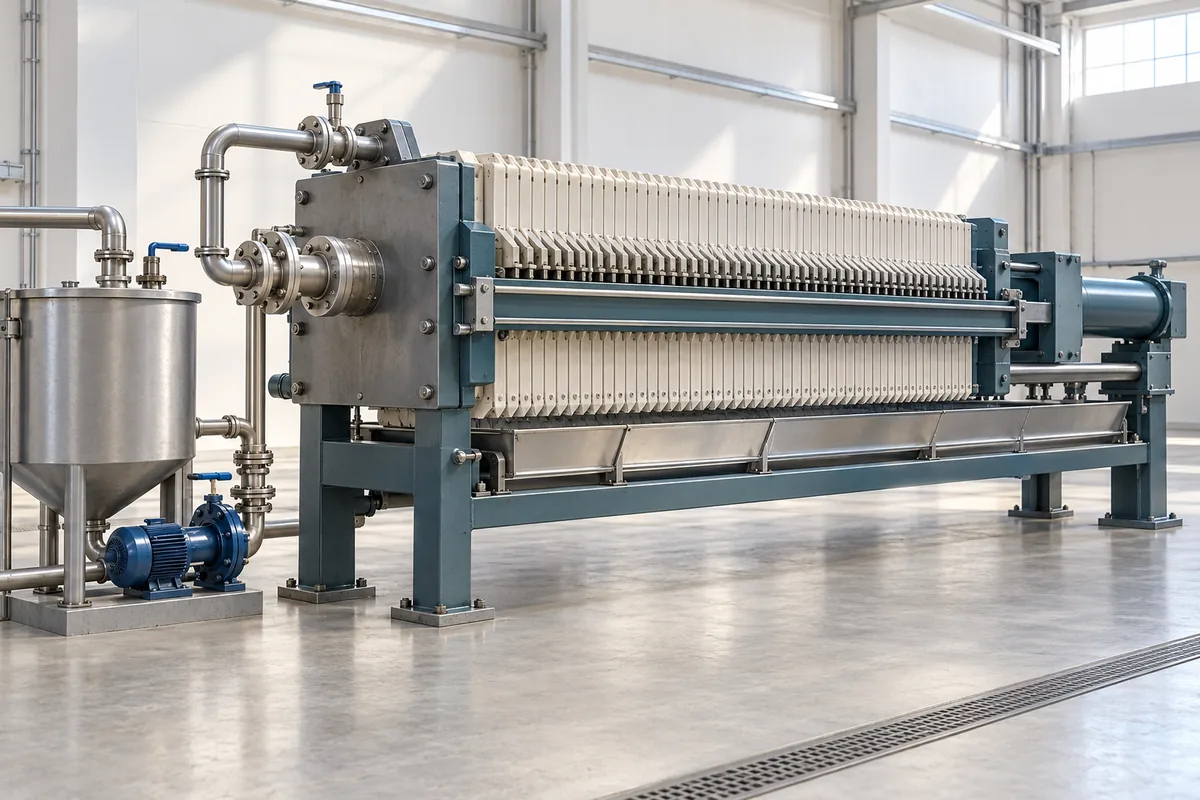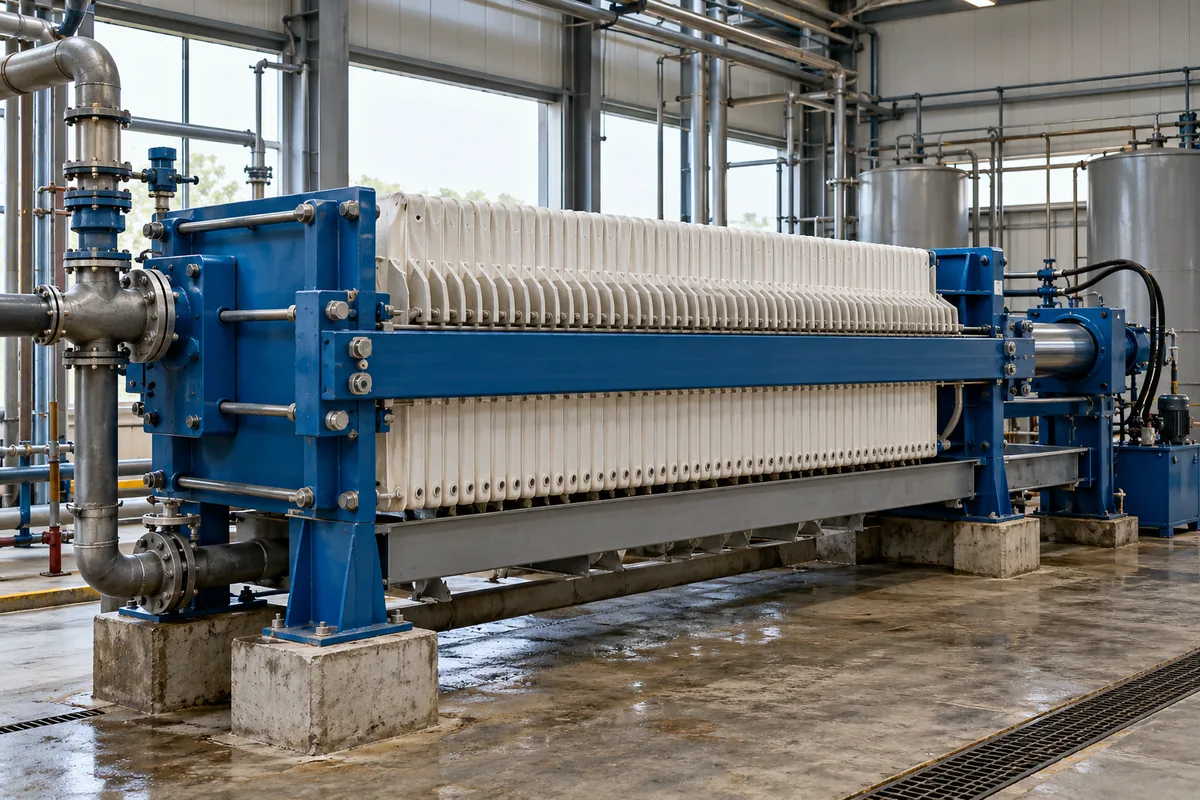
A filter press is a machine that uses pressure to separate suspended solids from a liquid, producing a dewatered solid called filter cake and a liquid stream called filtrate. That’s the practical answer to “What Is a Filter Press”: it turns a pumpable slurry into two streams you can handle separately.
| Feature | What it means |
|---|---|
| Main purpose | Separate suspended solids from liquid and reduce the liquid retained in the solids. |
| Feed material | A slurry: solid particles suspended in a liquid. |
| Separation method | A pressure difference drives liquid through filter cloth and the developing cake. |
| Outputs | Filter cake and filtrate; either stream may be the valuable product. |
| Operating pattern | Conventional plate filter presses run in batches. |
| Main designs | Plate and frame, recessed chamber, and membrane filter presses. |
| Typical applications | Wastewater treatment, mining, mineral processing, chemicals, and selected food processes. |
| Performance check | Test the actual slurry to establish cake solids, filtrate quality, and cycle time. |
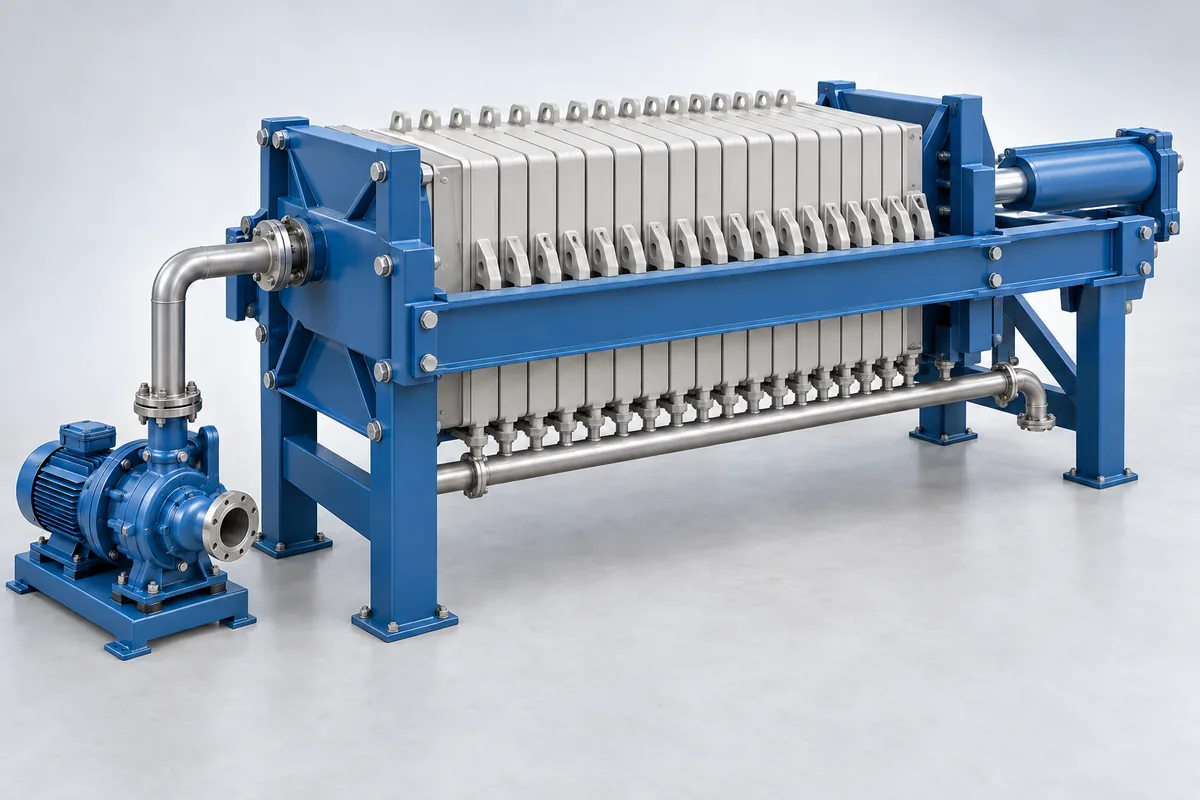
Imagine paying to transport a tank of sludge that contains mostly water. Removing some of that water can leave you with less material to haul and a cake that’s easier to collect.
That’s why filter presses matter. But choosing one takes more than picking a plate size or asking for the highest pressure.
Let’s look at the process, the trade-offs, and the numbers that help you make a useful comparison.
How Does a Filter Press Separate Solids and Liquids?
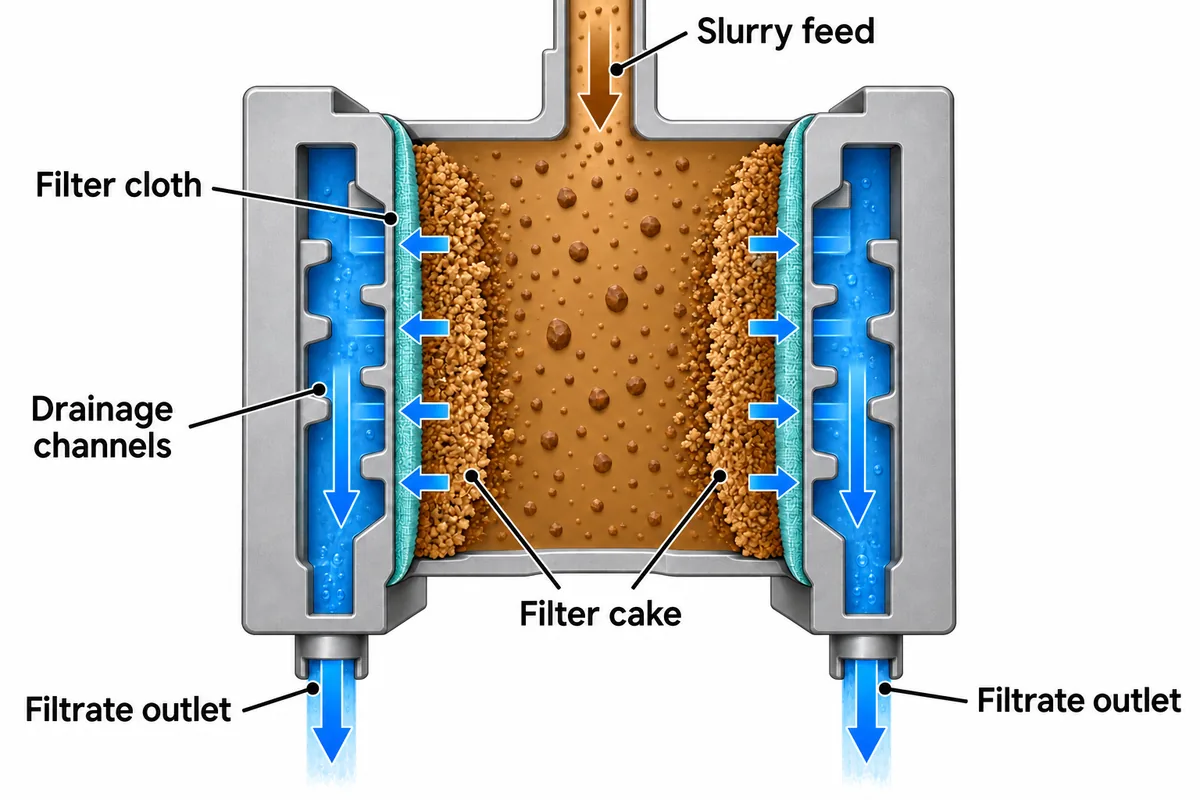
A filter press separates a slurry by forcing liquid through a permeable filter cloth while retaining solid particles inside enclosed chambers. As the retained solids accumulate, they form a cake that also helps capture particles.
Think of the cloth as a supporting barrier. The growing cake becomes part of the filtration system, too.
Liquid travels through the cloth, enters drainage channels in the plates, and leaves through discharge ports. The collected filtrate goes to the next process step, which might be reuse, product recovery, or further treatment.
Micronics’ explanation of filter press operation describes this same sequence: slurry enters, solids build up, and filtrate exits the plates.
There’s one mechanical distinction to understand: the hydraulic closing system holds the plates together; the feed pump creates the pressure that drives filtration. In a conventional recessed chamber press, the rigid plates remain stationary during dewatering.
A membrane press adds a separate squeezing action after initial filtration. We’ll cover that below.
What Are the Main Parts of a Filter Press?
The main components are the frame, filter plates, filter cloths, closing system, feed pump, and liquid-handling pipework. Each affects how reliably the machine fills, filters, and discharges.
- Frame: Supports the plate stack and carries the loads created during operation.
- Filter plates: Form the chambers and provide drainage paths for the filtrate.
- Filter cloths: Retain particles while allowing liquid to pass. Their material and weave must suit the slurry.
- Closing system: Usually hydraulic, it clamps the plate stack to maintain the required seal.
- Feed pump: Delivers slurry at the flow and pressure required by the filtration cycle.
- Manifold and valves: Route slurry, filtrate, and any process-specific wash or air flows.
- Controls and guards: Coordinate the cycle and protect access to moving or pressurized equipment.
Larger installations may also include an automatic plate shifter, cloth washing equipment, drip trays, and a conveyor beneath the press.
Those accessories can save handling time. They also add maintenance requirements, so include them when comparing the complete system.
How Does a Filter Press Work, Step by Step?
A conventional plate filter press runs through a repeating batch cycle: close, fill, filter, complete any optional treatment, release pressure, and discharge the cake. Total production depends on the time required for the entire cycle.
To see the moving components and operating stages, explore the filter press working animations.
1. Close and Clamp the Plates
The closing system brings the plates together and applies the specified clamping force before slurry enters. The cloths, sealing surfaces, and plate alignment must be in suitable condition for the cycle to begin.
Wrinkled cloth or material trapped on a sealing surface can cause leakage. Follow the manufacturer’s inspection and interlock requirements.
2. Pump Slurry Into the Chambers
The feed pump moves slurry through the feed passages and into the chambers. Liquid starts passing through the cloth as the chambers fill, so filling and filtration overlap.
The pump must suit the slurry’s abrasiveness, viscosity, and changing resistance during the cycle. A pump that delivers enough flow at low pressure may still be unsuitable later in the cycle.
3. Build the Filter Cake
Solid particles collect against the cloth, and the cake thickens as more slurry enters. The growing cake increases resistance to liquid flow, so the filtration rate generally falls as the cycle progresses.
Fine, compressible material can be particularly difficult to dewater. Increasing pressure alone may provide diminishing gains.
4. Complete Any Optional Squeeze, Wash, or Air Step
Some presses use membrane squeezing, cake washing, or air blowing to meet specific moisture or product requirements. These are optional, engineered features; their sequence depends on the process.
Cake washing moves a suitable wash liquid through the cake to remove soluble material. A cake air-blow step can remove additional liquid from suitable cakes. A core blow clears residual slurry from feed passages before discharge.
These steps perform different jobs. Ask which one a supplier means when discussing “drying” or “washing.”
5. End Filtration and Release Pressure
The control system ends filtration when the validated endpoint is reached, using criteria such as flow, pressure, or elapsed time. Reaching a pressure limit by itself does not prove that every chamber contains a well-formed cake.
Before opening, the machine must complete its specified shutdown, draining, and pressure-release sequence. Feed, membrane, and air systems may contain separate sources of stored pressure.
6. Discharge the Cake and Prepare for the Next Batch
Once the press is safe to open, the plates separate and the cakes discharge into the collection system. Manual or automatic plate shifting exposes the chambers for cake release and inspection.
Residual cake and dirty sealing surfaces can disrupt the next batch. Cleaning, inspection, opening, and closing time all belong in the production calculation.
Which Type of Filter Press Should You Consider?
The three main plate arrangements are plate and frame, recessed chamber, and membrane. Select among them using filtration tests, cake handling requirements, and the value of any additional liquid removal.
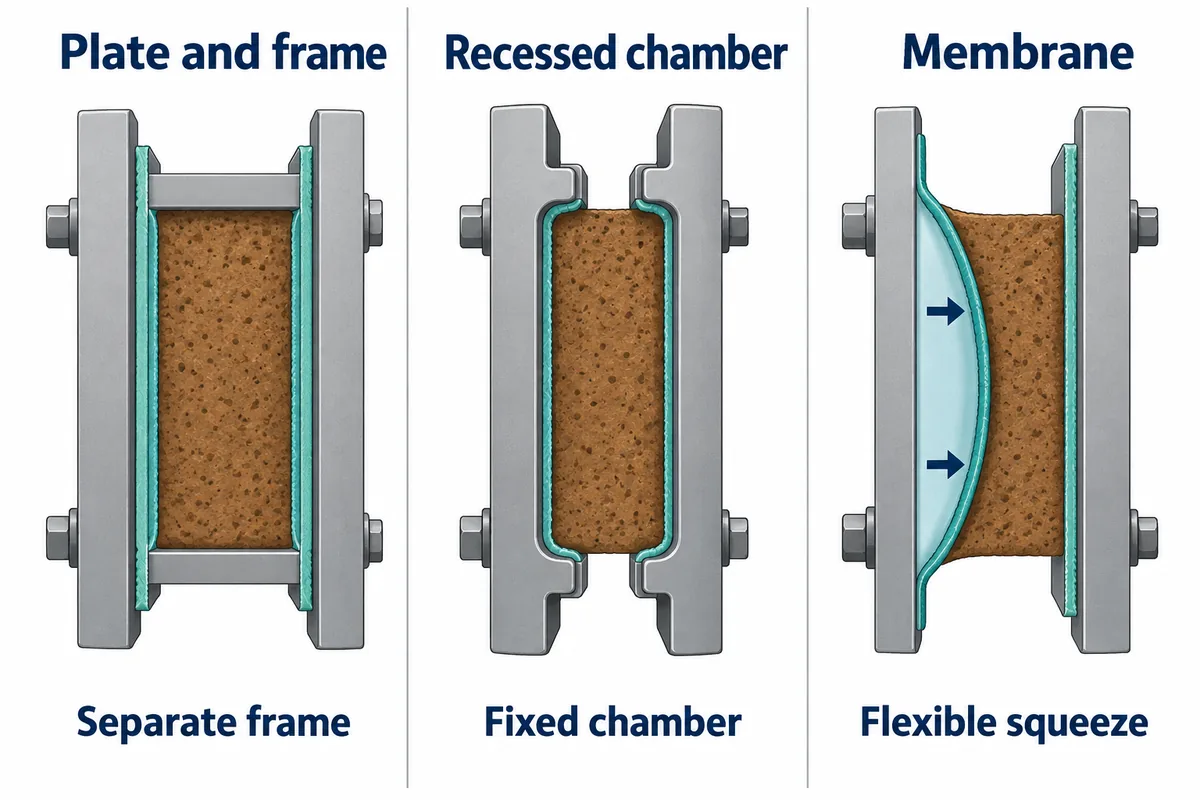
Plate and Frame Filter Press
A plate and frame filter press uses separate frames between plates to create the spaces where cake accumulates. Filter media retain the solids, while drainage surfaces guide the liquid out.
This configuration remains useful in applications with particular media or cake-washing requirements. However, cake release and manual handling deserve attention when evaluating its operating cost.
Recessed Chamber Filter Press
A recessed chamber filter press forms chambers from depressions in adjacent plates, without separate frames. The feed pump supplies the filtration pressure, and cake forms in the spaces between the cloth-covered faces.
This is a common arrangement for industrial sludge dewatering and mineral processing. Its suitability still depends on the material’s filtration behavior and how easily the cake releases.
Membrane Filter Press
A membrane filter press uses flexible plate surfaces that expand to squeeze an already formed cake. Depending on the design, water or compressed air provides the squeeze pressure.
This additional stage can increase cake solids or shorten the time needed to reach a target moisture level. The improvement depends on the cake’s compressibility and the complete cycle conditions.
McLanahan’s filter press guide explains the difference between pump-driven filtration in recessed plates and the additional squeezing action of membrane plates.
Automation is a separate choice. An automatic filter press may use recessed or membrane plates. Automated valves, plate shifting, and cloth washing change how the machine operates; they do not create a separate filtration principle.
What Is a Filter Press Used For?
Filter presses are used to dewater waste solids, recover useful liquids, or collect a solid product. The required outcome determines how the press should be designed and operated.
- Industrial wastewater treatment: Dewater sludge from processes such as metal finishing, chemical treatment, and manufacturing.
- Mining and mineral processing: Separate water from mineral concentrates or tailings and support process-water recovery.
- Chemical production: Recover precipitated solids, pigments, or other products, sometimes with a cake-washing stage.
- Food processing: Separate solids and liquids where the selected equipment meets the process’s hygiene and material requirements.
- Municipal treatment: Dewater suitable treatment sludges, with conditioning and equipment selection based on testing.
For example, a chemical producer may care most about removing soluble impurities from a valuable cake. A wastewater operator may care more about reducing wet disposal mass.
Those are different targets. A useful specification states which stream matters, what quality it must meet, and how much must be processed.
How Dry Does the Filter Cake Get?
There is no single cake dryness that every filter press can achieve. Particle size, material composition, cake thickness, feed pressure, filtration time, and any additional squeezing or air treatment all affect the result.
Discuss dryness as a measured percentage of dry solids by mass. For an aqueous cake, 40% dry solids means the remaining 60% of its wet mass is moisture.
McLanahan’s discussion of cake solids and moisture identifies particle characteristics, composition, pressure, time, and additional dewatering steps as major influences.
That explains why a mineral slurry and an organic sludge can behave very differently in similar machines.
A Simple Dewatering Calculation
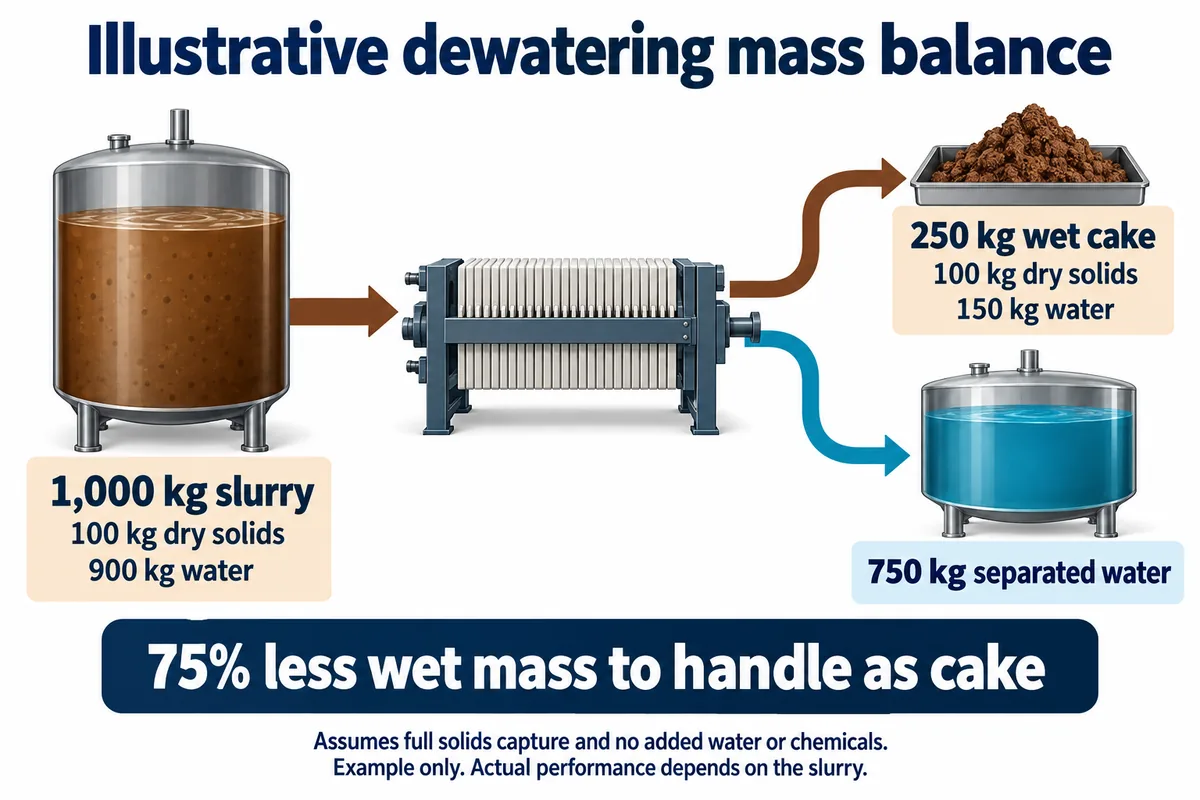
An illustrative mass balance shows how increasing cake solids reduces the wet mass you need to handle. The following numbers are assumptions for explanation, not a claimed plant result or a guaranteed press performance.
Suppose a batch contains 1,000 kg of slurry at 10% dry solids by mass. It contains 100 kg of dry solids and 900 kg of water.
Assume the press captures all those solids and produces a cake at 40% dry solids, with no added wash water or conditioning chemicals.
- Dry solids retained: 1,000 × 0.10 = 100 kg.
- Wet cake mass: 100 ÷ 0.40 = 250 kg.
- Water remaining in the cake: 250 − 100 = 150 kg.
- Water separated: 900 − 150 = 750 kg.
The wet material requiring cake handling falls from 1,000 kg to 250 kg: a 75% reduction in wet mass.
That does not mean disposal costs automatically fall by 75%. Hauling rates, minimum collection charges, cake classification, solids losses, and filtrate treatment all affect the financial result. Volume reduction also requires density information.
Use this calculation to check a proposal’s logic. Use a representative filtration test to establish its inputs.
What Are the Benefits and Limitations?
A well-matched filter press can reduce wet waste mass, recover liquid, and produce a more manageable solid cake. Its trade-offs include batch operation, cloth maintenance, cake handling, and application-specific performance.
The potential benefits are practical:
- Less liquid transported with waste solids.
- Recovery of process liquid when its quality meets reuse requirements.
- Easier collection and handling of suitable dewatered cakes.
- Product recovery or cake washing within the filtration process.
- Reduced manual handling where effective automation is justified.
However, a press still needs time to discharge and prepare for the next batch. Cloths can blind, pumps can wear, and sticky cakes can delay release.
Clear filtrate is not proof of safe water. Dissolved contaminants can pass through a filter press, and reuse or discharge must be based on the relevant analytical and permit requirements.
Likewise, dewatering does not automatically make a hazardous sludge nonhazardous. Evaluate the cake and filtrate as separate process streams.
How Do You Choose the Right Filter Press?
Choose a filter press by testing representative slurry and comparing complete systems against a defined duty. The most useful proposal connects throughput, cake solids, filtrate quality, and operating cost to the same test conditions.
I’d start with these five checks:
- Define the feed. Record slurry volume, solids concentration, particle size distribution, temperature, pH, and any abrasive or corrosive characteristics. Include realistic variation between batches.
- Set measurable output targets. Specify dry solids processed per hour, required cake solids, acceptable filtrate quality, and any cake-washing requirement.
- Run representative tests. Ask for documented cloth selection, conditioning dose if used, feed conditions, cake thickness, cycle time, and cake-release observations. A suitable laboratory filter press can help evaluate media, cake formation, and filtrate before production-scale selection.
- Match the system to the site. Check pump duty, holding-tank capacity, chemical compatibility, utilities, access, and how cake will leave the building.
- Compare lifetime operating costs. Include labor, cloth replacement, pump maintenance, energy, compressed air, chemicals, cleaning water, and disposal or recovery costs.
Practical tip: Ask each supplier for dry solids throughput using the full cycle. A quoted filtration time that excludes discharge and cleaning can overstate useful capacity.
For example, assume a press handles 100 kg of dry solids per completed cycle. At one complete cycle every two hours, its nominal average is 50 kg of dry solids per hour before additional downtime. Plate area alone cannot tell you that.
For the next step, use the guide to choosing a filter press size to organize dry solids loading, chamber volume, and operating schedule before requesting a quotation.
McLanahan’s sizing considerations cover related choices, including plate design, pumps, filtrate discharge, cloth cleaning, and optional cake treatment.
When comparing a plate press with a belt press or centrifuge, test the same feed against the same targets. Continuous operation, labor, cake solids, and conditioning needs can change which system offers the better result.
What Causes Common Filter Press Problems?
Common problems involve poor cake formation, dirty filtrate, slow cycles, leakage, or difficult cake release. Treat each symptom as a reason to investigate; several different faults can produce similar results.
| Symptom | Possible causes to check | Useful evidence |
|---|---|---|
| Persistently cloudy filtrate | Damaged cloth, poor cloth seating, unsuitable media, or changed feed characteristics. | Filtrate samples, inspection findings, and which outlets show the problem. |
| Longer filtration time | Cloth blinding, finer feed, lower feed solids, restricted passages, or reduced pump delivery. | Trends in feed solids, flow, pressure, and cleaning history. |
| Wet or uneven cakes | Incomplete chamber filling, uneven feed distribution, unsuitable conditioning, or an early endpoint. | Cake samples from several chambers and the complete cycle record. |
| Leakage between plates | Dirty sealing faces, folded cloth, misalignment, damage, or a clamping-system fault. | Inspection after the machine has been made safe. |
| Cake sticks to cloth | Sticky material, unsuitable cloth, residual deposits, or an unsuitable cycle. | Cake-release observations alongside cloth and feed-condition records. |
Some fine particles may pass through during initial cake formation. Persistent or newly worsening cloudiness deserves investigation rather than an assumption that it is normal.
Stop and follow the manufacturer’s procedure for abnormal leakage or equipment faults. Apply the site’s isolation and lockout procedure before servicing; never reach between moving plates or attempt repairs on a pressurized system.
Frequently Asked Questions
A filter press does not always need polymer, can serve a continuous plant with adequate buffering, and needs maintenance based on the feed and equipment. The details below help you turn those general answers into operating decisions.
Does a Filter Press Always Need Polymer?
No. Some slurries filter effectively without polymer, while others benefit from appropriate conditioning or filter aids. Select any treatment through testing rather than assuming one chemical program works for every feed.
Conditioning can change cake formation, filtrate quality, and operating cost. It may also affect whether the cake or recovered liquid is suitable for its intended use.
Can a Filter Press Work in a Continuous Plant?
Yes. A batch filter press can serve a continuous upstream process when holding capacity and equipment scheduling accommodate the interruptions between batches.
Depending on the duty, the design may use a surge tank or multiple presses. Automatic operation reduces manual tasks, but an individual conventional plate press still needs to open and discharge.
How Often Should Filter Cloths Be Cleaned or Replaced?
The interval depends on the feed, cloth material, cleaning method, and observed performance. Follow the equipment supplier’s guidance and track changes in cycle time, filtrate quality, and cake release.
Inspect for damage as well as deposits. An unsuitable cleaning chemical or excessive cleaning force can shorten cloth life.
Start With a Slurry Test and Clear Targets
The right filter press is the one that meets your required throughput, cake quality, and filtrate quality under realistic operating conditions. A representative test gives you evidence to compare designs and calculate the cost of running them.
Begin with three questions: How much dry material must you process? What moisture level can the cake contain? Where will the filtrate go?
Bring those answers, along with a representative sample, to the equipment supplier. You can discuss your filtration requirements to start defining the scope of a suitable system. You’ll turn a general equipment discussion into a measurable specification—and put your understanding to work the next time someone asks, What Is a Filter Press?