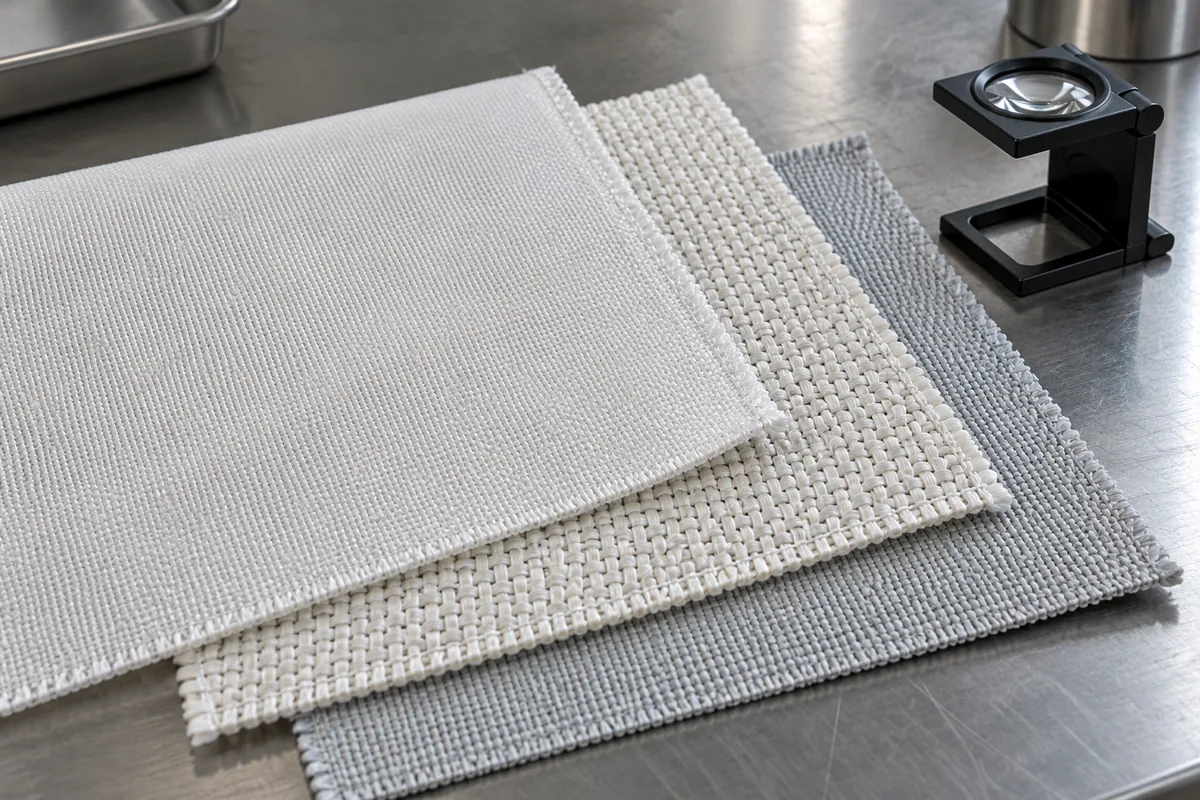
Choose your filter press cloth material by matching it to the slurry chemistry, temperature, particle behavior, and cleaning method. Polypropylene (PP) is a common starting point for chemical duties, polyester (PET) can suit compatible processes that need greater heat tolerance, and polyamide (PA, or nylon) is worth testing when abrasive solids wear out the cloth.
| Material | Why consider it? | Chemical compatibility checks | What to confirm |
|---|---|---|---|
| Polypropylene (PP) | Broad chemical resistance; a common, economical option | Often suitable for many acids and alkalis; strong oxidizers and hot, concentrated chemicals require specific review | Actual chemical mixture, wet operating temperature, cleaning exposure, and fabric construction |
| Polyester (PET) | Strength and dimensional stability; potentially suitable for higher-temperature duties than PP | Often useful with many acids; hot or concentrated alkalis can attack the polymer | Wet-service conditions, alkaline cleaning, exposure time, and supplier approval |
| Polyamide (PA / nylon) | High abrasion resistance, strength, and flexibility | Often considered for compatible alkaline duties; mineral acids and oxidizers can degrade it | Exact PA grade, process and cleaning chemistry, dimensional behavior, and wear in trials |
Use these tendencies to narrow your shortlist. But you still need to confirm the offered fabric for your chemicals and temperatures.
Even two PP cloths can behave differently in the same press. Their yarns, weave, finishing, and fit affect performance, as does the cake that builds on the cloth during a cycle.
Start with the slurry and cleaning conditions
Give the supplier the chemical composition, concentration, temperature, solids characteristics, operating pressures, and cleaning conditions before asking for a cloth recommendation. These details determine which fabrics are worth testing.
I recommend keeping them on one process sheet:
- List chemical names and concentrations, normal pH and its variation, solvents, oxidizers, and conditioning additives.
- Record normal and peak slurry temperatures, how long peaks last, and the temperature used during cleaning.
- Describe solids concentration, particle-size distribution, shape, abrasiveness, and whether the slurry is flocculated.
- State feed pressure, the pressure ramp, cycle frequency, and any membrane squeeze or air-blow stages separately.
- Name each cleaning chemical and give its concentration, contact time, and frequency. Include the mechanical washing method.
- Define acceptable filtrate solids, cake moisture, production rate, and discharge behavior.
Two liquids with similar pH can contain different chemicals at very different concentrations. A pH reading helps, but it can’t replace the composition.
Suppose a plant filters a mild slurry, then washes its cloths with hot caustic solution. In that hypothetical case, the cleaning step could decide which material survives.
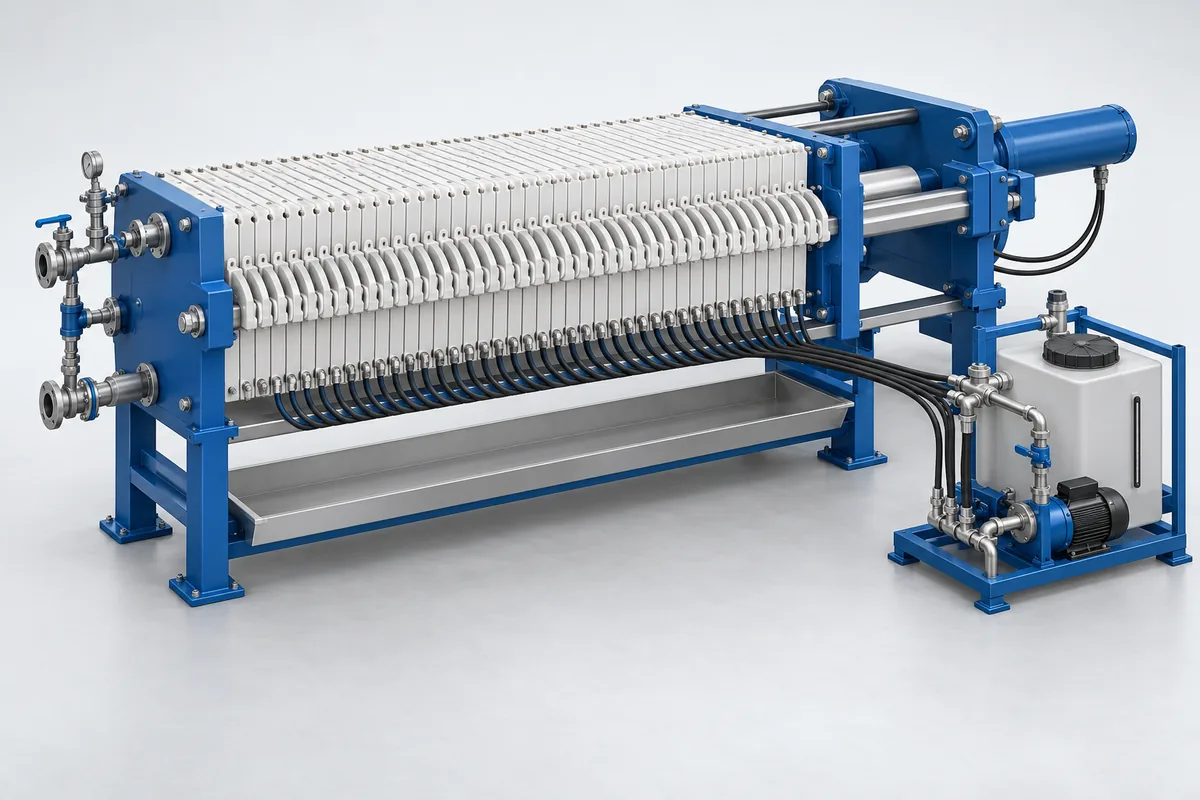
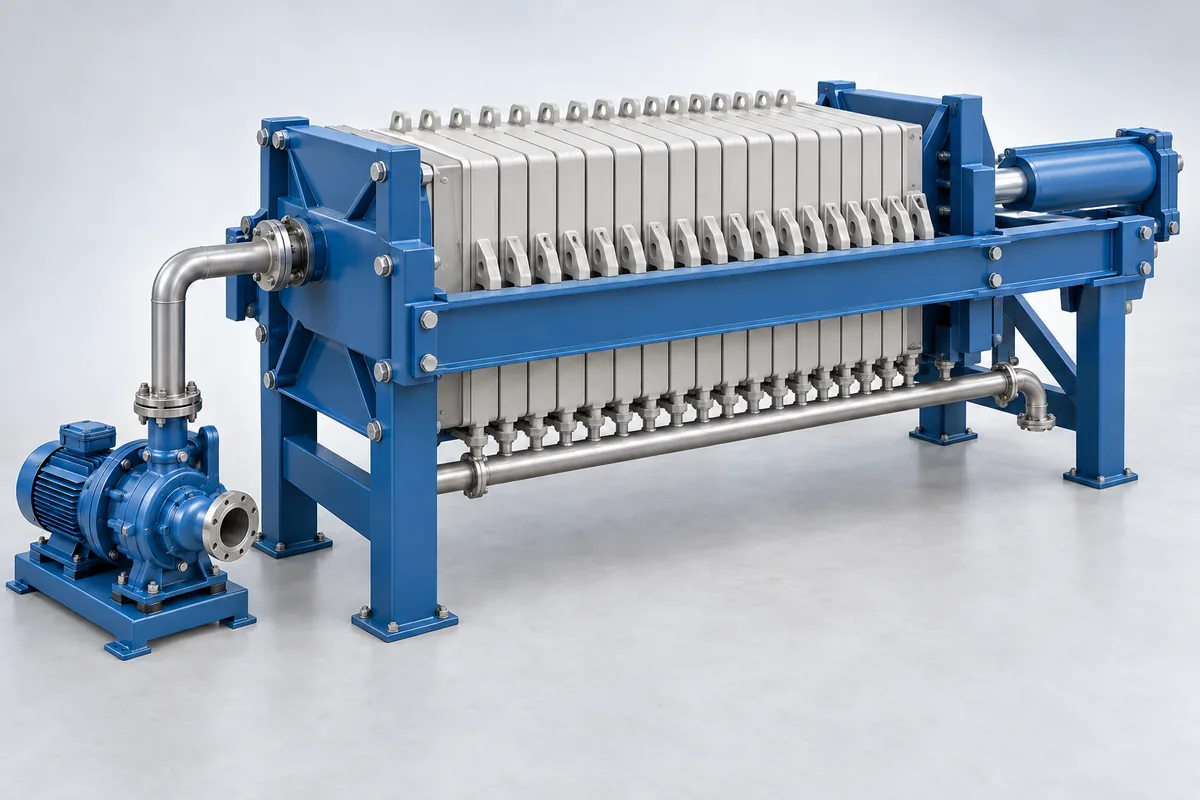
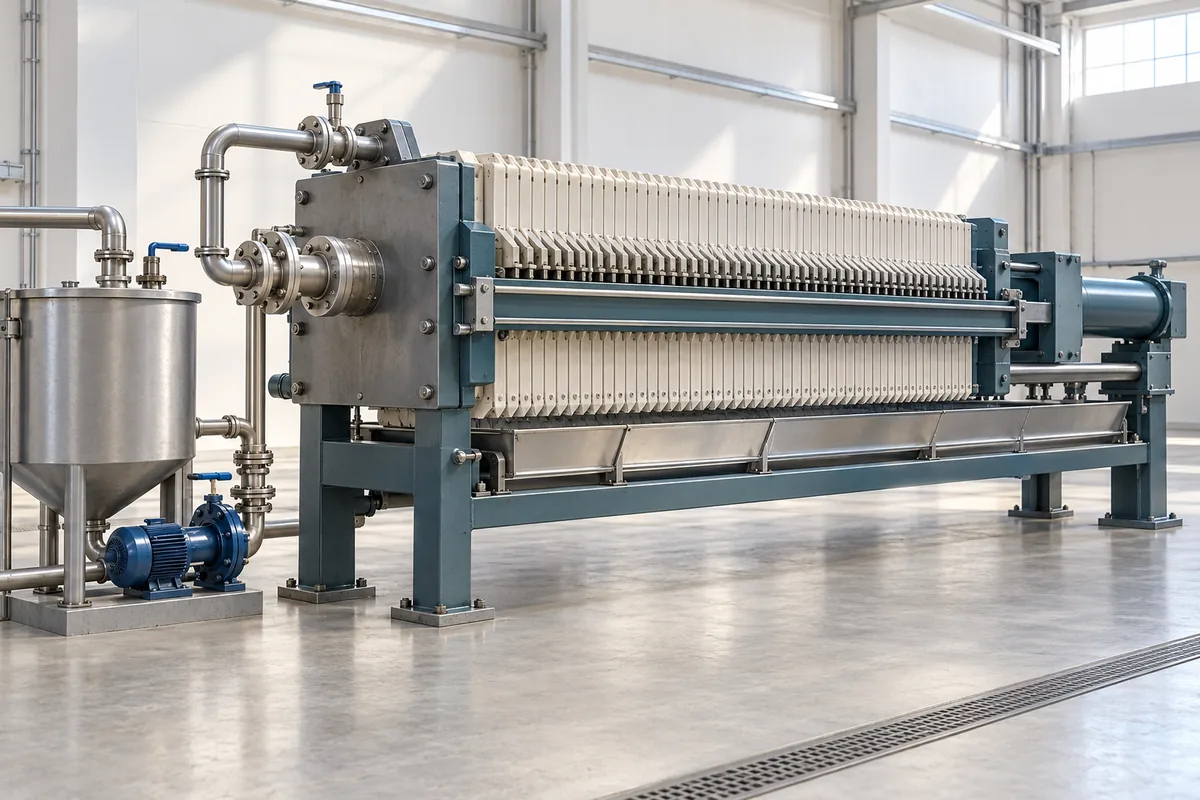
For a new installation, review the available filter press configurations at the same time. Plate geometry, membrane squeezing, and discharge arrangements also affect what the cloth must withstand.
Compare PP, polyester, and nylon against the actual duty
Check chemical compatibility and mechanical demands for the exact fabric grade you’re considering. Labels such as “mining” and “wastewater” cover too many different slurries to settle the choice.
Polypropylene: start with chemical compatibility
Polypropylene filter press cloth suits many chemical duties because PP resists a broad range of acids and alkalis. Its cost makes it a useful reference when comparing fabrics that meet the process requirements.
Met-Chem identifies exceptions involving aggressive acids and hot, concentrated alkalis. Review temperature, concentration, exposure time, and mechanical loading together before approving the material.
PP is hydrophobic: it resists wetting by water. You’ll still need separate evidence for drinking-water suitability, hygienic certification, or the filtrate quality your process requires.
Polyester: check heat and alkaline exposure together
Polyester is worth considering when strength, dimensional stability, and greater heat tolerance matter, provided the process and cleaning chemistry are compatible. Check hot or concentrated alkaline exposure carefully because it can attack PET.
A catalog’s maximum temperature may describe a particular textile or a brief exposure. It may not apply to your continuous wet filtration duty.
Ask the manufacturer to confirm the fabric, liquid mixture, continuous temperature, peak duration, and cleaning cycle in writing. Include the sewing thread, feed-neck material, and edge treatments in that review.
Nylon: evaluate wear resistance without overlooking acids
Nylon can help where abrasive solids and repeated mechanical wear are the main problems. Its strength and flexibility are useful, although mineral acids and oxidizers can limit where you can use it.
Ask which polyamide grade and fabric construction the supplier proposes. That matters when you’re replacing a cloth that has stretched, worn around the feed opening, or changed fit after cleaning.
Keep compatible PP and PET fabrics in the comparison. Depending on the chemistry, cake release, and service life, one may work better than nylon even with an abrasive slurry.
Filter press cloth types: separate yarn from weave
When comparing filter press cloth types, specify the polymer, yarn structure, weave, and finished configuration separately. Otherwise, two suppliers can quote different products under the same broad description.
Choose the yarn around retention and cleanability
Monofilament yarns usually give the cloth a smoother surface that is easier to clean. Multifilament and spun yarns can capture fine particles within the yarn structure, with results that depend on the finished fabric.
- A monofilament is a single continuous strand. Try this construction when cake sticks or cleaning takes too long.
- Multifilament yarn contains several filaments. Fine particles can lodge between them, helping capture but making cleaning harder.
- Spun or staple yarn consists of short fibers twisted together. Both the yarn and the spaces between yarns affect retention and flow.
- Combined constructions use different yarns in the warp and weft to balance retention, cake release, and strength.
Warp runs along the fabric roll; weft runs across it.
Choose the weave around stability and cake release
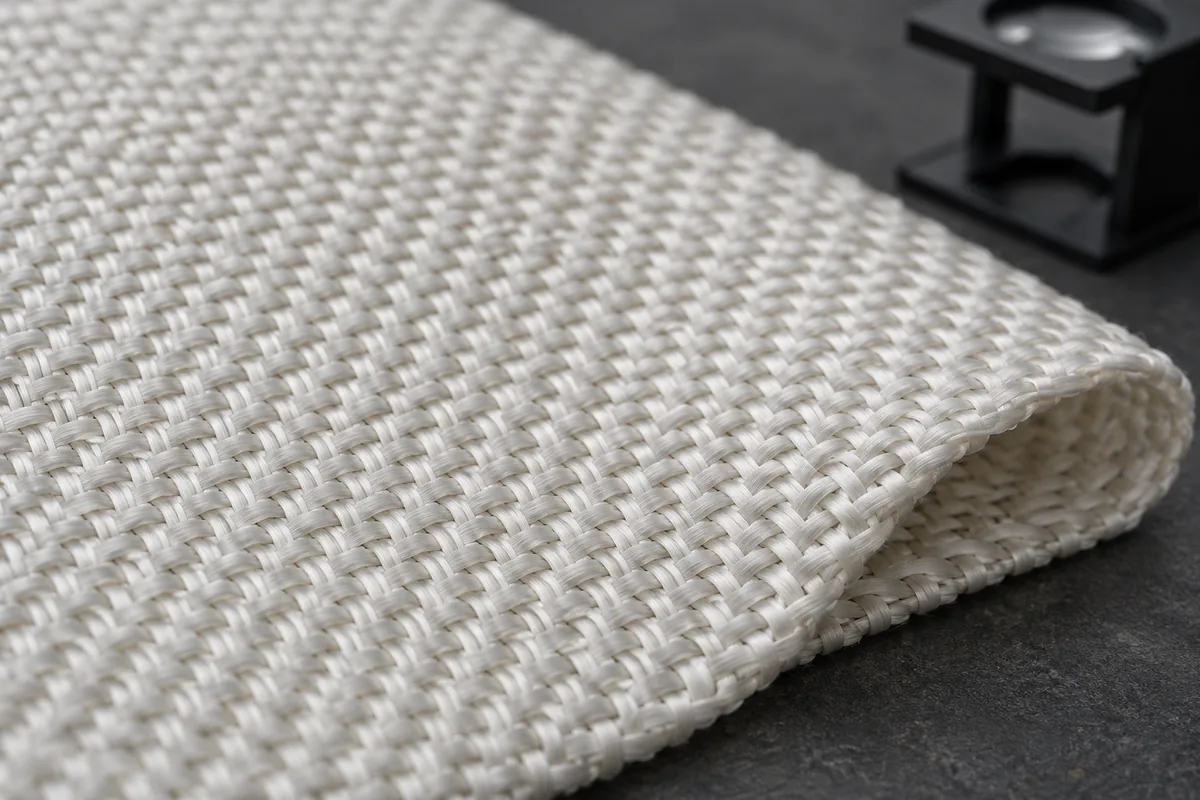
Plain, twill, and satin weaves change how yarns cross, which affects stability, surface texture, and cake release. You’ll need more than the weave name to specify pore size or filtration efficiency.
Plain weave uses alternating interlacing to form a stable structure. Tightly constructed versions can give good initial retention, though blinding needs attention.
Twill has a diagonal pattern and can provide useful strength and flexibility where handling and wear matter. Satin’s longer yarn floats create a smoother face that can help cake release; check abrasion and retention requirements before choosing it.
Yarn dimensions, thread count, and finishing can change the result substantially.
Ask for photographs of the actual sample with a scale and fabric code. A generic weave illustration helps explain the structure, but it won’t identify the cloth on a quotation.
Filter press cloth micron size: understand what the number measures
A filter press cloth micron size needs a definition: does the number describe an opening, a measured pore characteristic, or particle retention in a particular test? Mesh count, pore size, air permeability, and filtration performance answer different questions.
Mesh count does not equal opening size
Mesh count commonly describes a count per linear inch; opening size is the distance between adjacent yarns. Confirm the supplier’s counting convention and the values in both fabric directions.
For an ideal square mesh made from round monofilaments, you can estimate the opening geometrically:
Opening in millimeters ≈ 25.4 ÷ mesh count − yarn diameter in millimeters.
For example, a 100-count mesh has a pitch of 0.254 mm. A yarn diameter of 0.100 mm gives a calculated opening of about 0.154 mm, or 154 microns. Increase the yarn diameter to 0.150 mm and the opening falls to about 104 microns, despite the unchanged count.
That calculation describes geometry, not retention. It isn’t a universal conversion for compressed yarns, multifilament fabrics, unequal warp and weft counts, or complex weaves.
Air permeability describes flow under a test condition
Air permeability measures airflow through a known area of fabric at a stated pressure difference. It lets you compare resistance under matching test conditions, but it doesn’t directly predict slurry throughput or particle capture.
Get the units, test method, pressure difference, and fabric condition with each result. We suggest you to test at a 0.5-inch pressure drop, for example. To compare that with another supplier’s value, you’ll need matching conditions and clearly defined units.
Check the finish, too. Calendering compresses and smooths the fabric and can change its openings, permeability, and cake release.
Particle retention changes as the cake develops
During the filter press operating cycle, solids collect on the cloth and become part of the filtering layer. Retention can improve as the cake develops, so the clean cloth’s opening size doesn’t establish the final filtrate quality.
Sample the early filtrate as well as the liquid produced later in the cycle. If your process allows initial filtrate recirculation, define that procedure before comparing cloths.
For a “nominal” or “absolute” rating, ask for the test method, challenge particles, capture efficiency, and operating conditions. A micron number without that information is an incomplete specification.
Build a filter press cloth specification you can verify
A useful filter press cloth specification identifies the fabric, its performance measurements, chemical limits, and finished dimensions. A request for “PP cloth, 800 mm” leaves the supplier to resolve most of those details.
Include the following in your quotation request:
- Polymer and grade, yarn construction in both directions, and weave pattern.
- Fabric code, mass per unit area, thickness, and finish.
- Air permeability with units and test conditions, plus the method behind any pore or retention data.
- Tensile and elongation data where the duty requires them, including the test direction.
- Confirmed process and cleaning compatibility for the complete cloth assembly.
- A finished cloth drawing, dimensional tolerances, attachment details, and quantities by position.
- Contact-material documentation for regulated applications.
- Trial conditions and acceptance criteria.
For food contact, the documentation must cover the supplied article and intended use. The FDA’s food types and conditions of use distinguish between different foods and thermal conditions. A polymer name alone doesn’t establish compliance for your process.
Keep the accepted sample code and specification revision with the order. You’ll need them when reordering fabrics that look alike but have different properties.
Test sample cloths under comparable operating conditions
Test candidates with representative slurry and agreed limits for pressure, filtrate quality, cycle time, and cake release. A clean-water test won’t tell you how the cloth handles your solids.
A suitable laboratory filter press can help compare media and observe cake formation. Check that its configuration can reproduce the conditions relevant to your production duty.
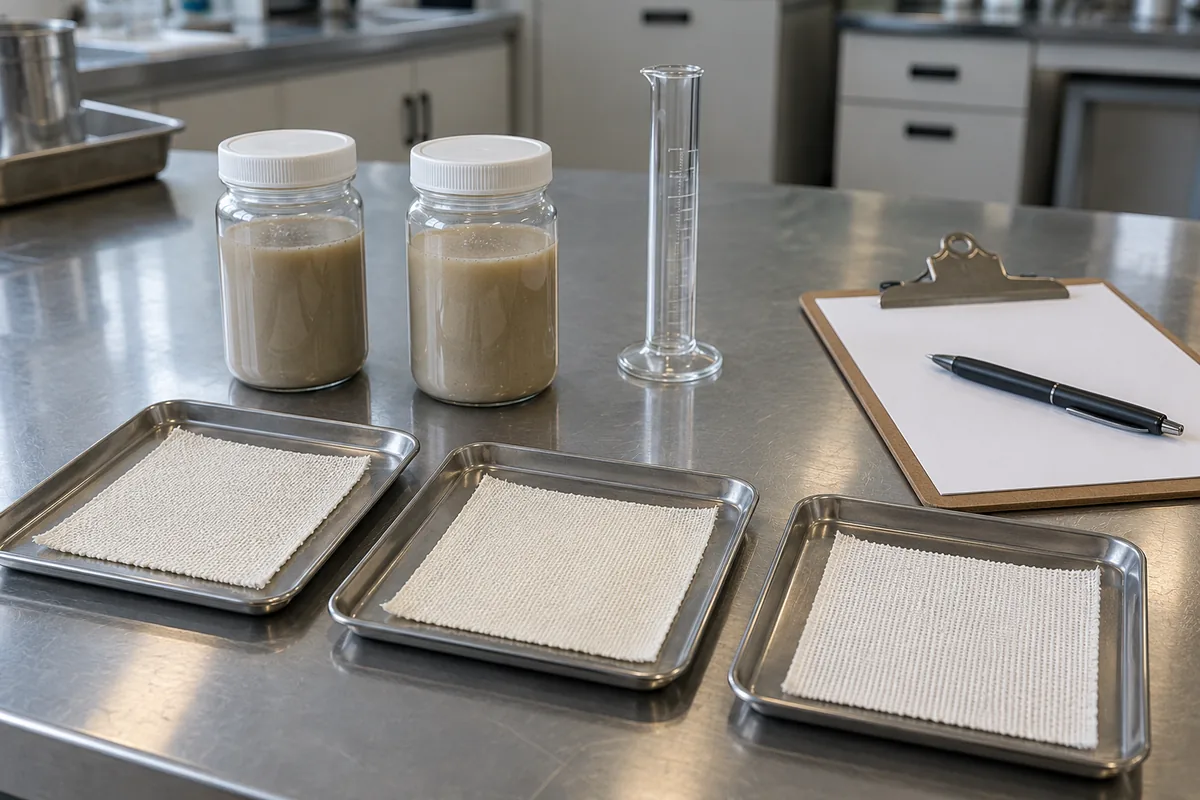
I’d agree on the pass/fail criteria before running the first sample. A fast cycle is little help if too much product escapes in the filtrate or the cake takes extra time to remove.
Record enough detail to repeat the trial:
- Use a representative, well-mixed slurry batch. Record solids concentration, temperature, conditioning, and any settling during sampling.
- Log feed and filtrate-side pressures, the sensor locations, and filtrate volume over time. During filtration, the differential pressure acts across the cloth and developing cake; the measured value can include other losses depending on sensor positions.
- Collect early and later filtrate samples. Measure suspended solids where relevant. The USGS explains turbidity as an optical measurement of scattered light, so record it separately from solids concentration rather than treating the readings as interchangeable.
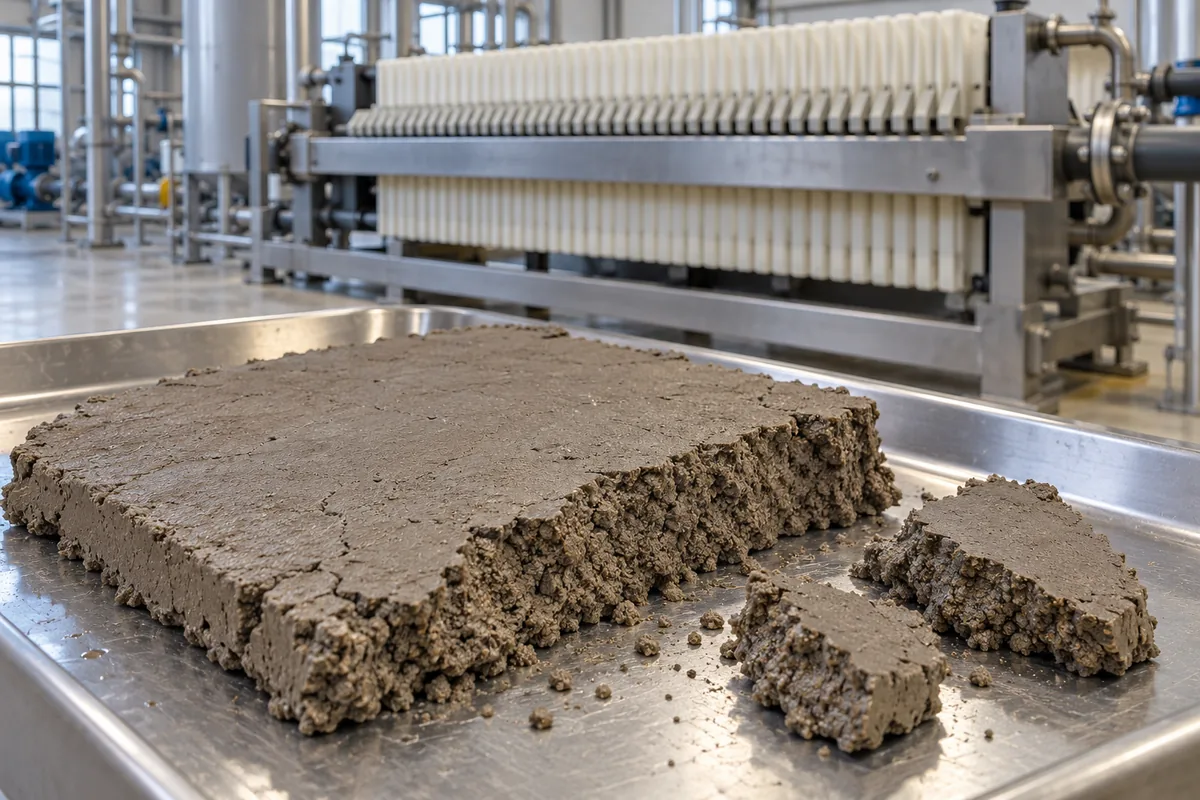
- Measure cake moisture on a consistent basis and inspect thickness, cracking, and wet pockets.
- Time cake release. Record manual assistance, residual cake coverage, and visible cloth damage.
- Repeat cycles, then check performance after the proposed cleaning procedure. Measure how much permeability or filtration rate recovers.
Keep filtration area, cake thickness, pressure program, slurry conditions, and endpoint comparable. Extra pressure can compress a compressible cake and change its resistance, so a higher gauge reading doesn’t prove that a cloth performs better.
Plot filtrate volume against time and read it alongside the early and late solids results. Photograph the same cloth area after each discharge to compare how much cake remains.
Compare filter press cloth price by useful service
Filter press cloth price varies with construction, dimensions, finish, feed-neck and edge details, quantity, documentation, and delivery terms. Get quotations for the same specification before comparing operating costs.
Check the quoted unit first. A price per panel, per connected pair, and per complete press set can look similar on paper while covering very different quantities.
Use your production records to calculate:
Cloth-related cost per tonne of dry solids = cloth purchase, replacement labor, cleaning, and attributable downtime costs ÷ dry solids processed during that service period.
Consider this hypothetical purchase-cost comparison. A $1,200 set that processes 600 tonnes of dry solids costs $2.00 per tonne. A $1,500 set that processes 1,000 tonnes costs $1.50 per tonne, a 25% reduction on the same basis.
These are illustrative figures, not market prices. They exclude cleaning, labor, downtime, and disposal; add your plant’s costs before deciding whether the more expensive set is better value.
Use short sample trials to narrow the options. You’ll need a controlled production evaluation to establish service life and lifetime savings.
Send the plate drawing before ordering replacements
The cloth must fit the plate’s feed openings, drainage features, edges, and attachment system. A nominal plate size gives the supplier too little information to confirm that fit.
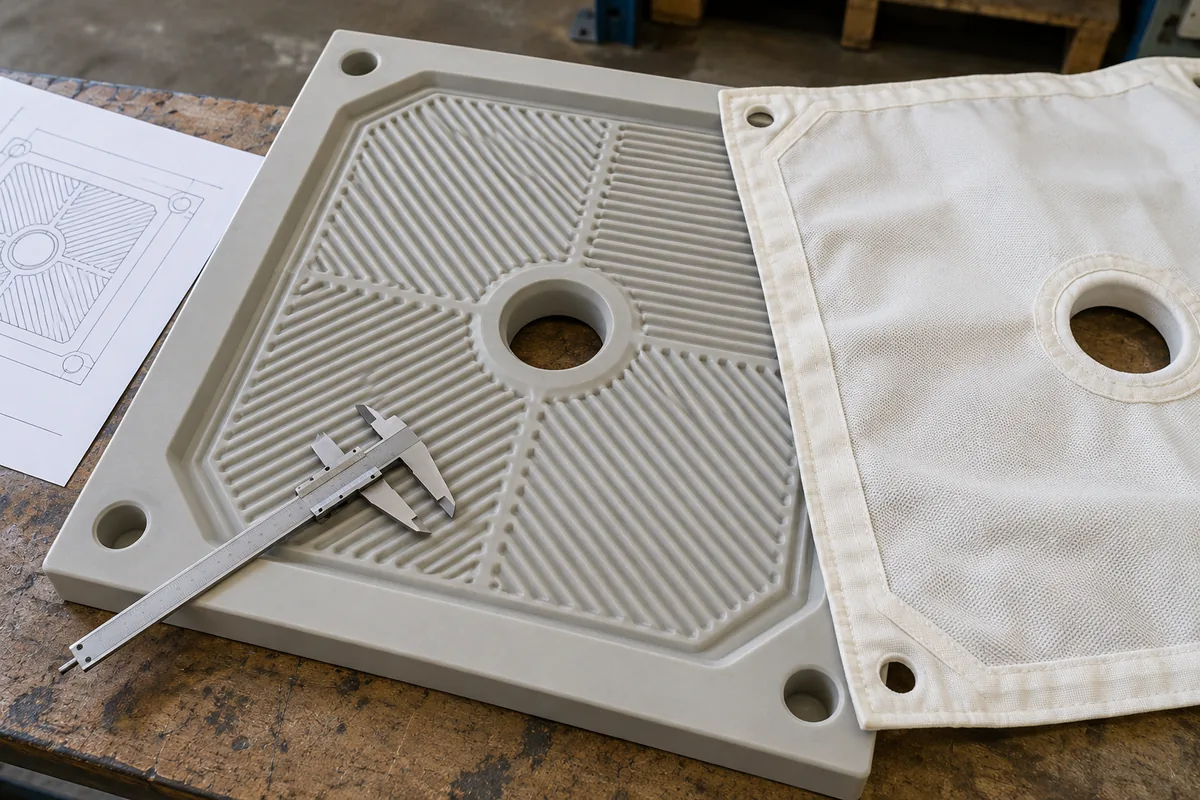
Send a dimensioned drawing with units and orientation. Include:
- Press manufacturer, model, plate reference, and drawing revision.
- Plate width and height, chamber geometry, and plate configuration.
- Feed-hole diameter and position, plus the required neck or barrel dimensions.
- Filtrate, wash, and air-port positions and clearances where applicable.
- Cloth perimeter profile, fixing points, overhang, and edge treatment.
- Caulking-cord and groove details for applicable gasketed designs.
- Head, intermediate, and tail cloth arrangements and quantities.
- Membrane-plate details and any backing cloth requirements.
On a gasketed CGR filter press, the retained cloth edge, plate groove, and gasket arrangement have to match. A gasketed cloth won’t automatically fit a non-gasketed plate.
An old cloth is useful supporting evidence, but compare it with the plate drawing. It may have worn, shrunk, or stretched since installation.
Send your slurry information and filter plate drawing to discuss cloth matching. Describe the current problem and the result you want to improve. The proposal should confirm the available construction, supply scope, and delivery timing.
FAQs
PP, PET, and nylon are common filter press cloth materials. The right choice depends on the slurry, cleaning chemicals, and fabric construction; mesh count alone can’t establish retention or drinking-water safety.
Which material suits my slurry?
Start with a chemically compatible polymer, then test yarn and weave options with representative slurry. PP is a common starting candidate, PET may suit compatible duties with higher heat demands, and nylon can help where abrasion dominates.
Supply the full chemical composition, concentrations, temperatures, solids characteristics, and cleaning method. A pH value or industry name won’t tell the supplier enough.
Is mesh size the same as particle retention?
No. Mesh count describes fabric geometry; retention describes how effectively the medium captures specified particles under defined conditions.
Yarn diameter, weave, finish, particle shape, and cake formation all affect the result. Ask for test data and compare early filtrate with filtrate collected after a cake develops.
Can the same cloth be used after a chemical change?
Possibly, once the supplier has checked the revised chemistry against the complete cloth assembly. Reassess concentrations, temperature, exposure time, cleaning agents, sewing thread, and edge treatments before reuse.
A chemically compatible change can still affect particle behavior, flocculation, or cake release. Run a controlled filtration trial where needed after the compatibility review. A cloth that looks intact may no longer suit the process.
What is filter cloth made of?
Filter cloth is commonly made from polypropylene, polyester, or polyamide such as nylon. Cotton and specialty fibers are used for some applications.
Manufacturers turn these materials into different yarns and woven structures; some filtration duties use nonwoven media. The polymer affects chemical and mechanical performance, while construction and finishing help determine flow, retention, and cleanability.
What material is a pressing cloth made of?
For ironing, a pressing cloth is commonly cotton, such as unbleached muslin, or silk organza when you need to see delicate work beneath it. Threads’ guide to press cloths explains these and other options for garment pressing.
If you mean the cloth inside an industrial filter press, the usual choices are PP, PET, and nylon. An ironing cloth cannot substitute for specified industrial filter media.
What type of fabric is best for filtering water?
For industrial suspended-solids removal, polypropylene is often a practical starting point. Polyester or nylon may suit particular chemical, temperature, or wear conditions, so the water stream determines the choice.
Ordinary fabric may catch coarse sediment, but it doesn’t reliably remove pathogens or dissolved contaminants. The EPA’s emergency drinking-water guidance treats cloth filtering as a preliminary step before disinfection and explains that boiling or disinfection won’t remove heavy metals, salts, or most other chemicals.
Choose treatment for the hazards present. If fuel or toxic chemical contamination is suspected, use a different water source, as the CDC’s water-safety guidance advises.
For a filter press, specify the water chemistry, suspended solids, and required filtrate quality before selecting your filter press cloth material.