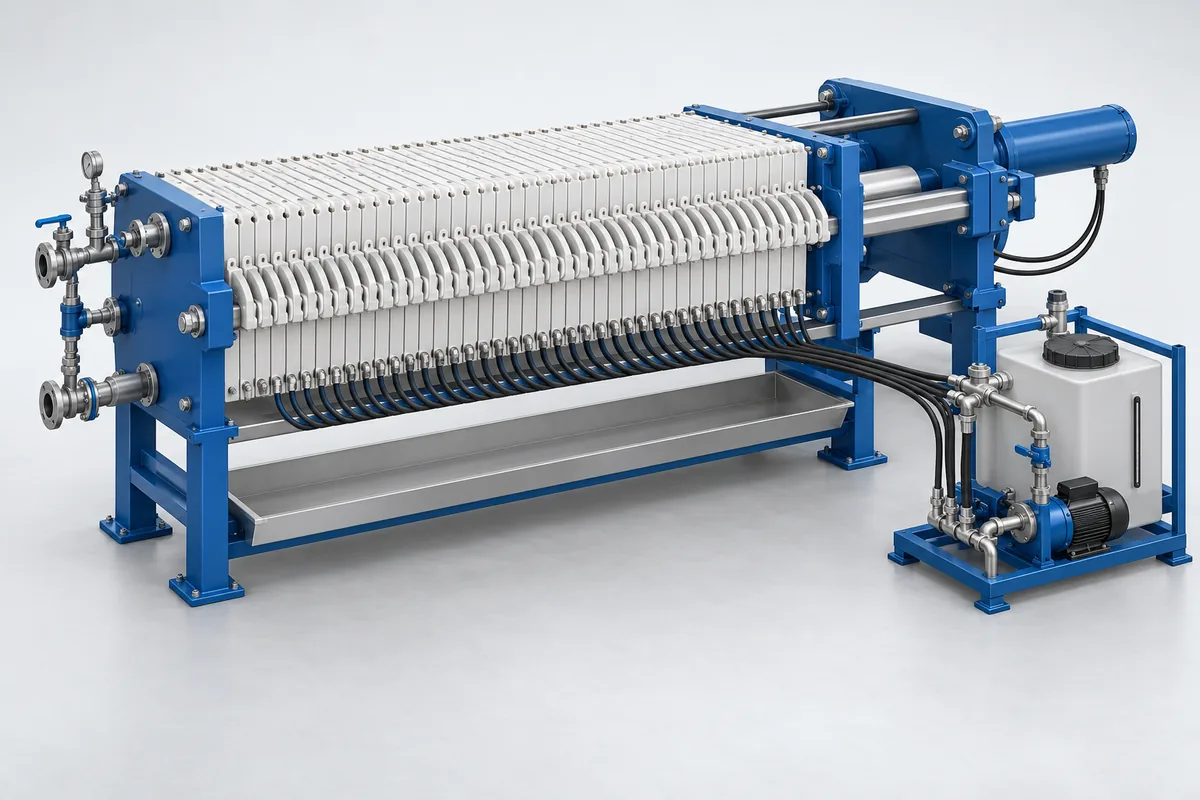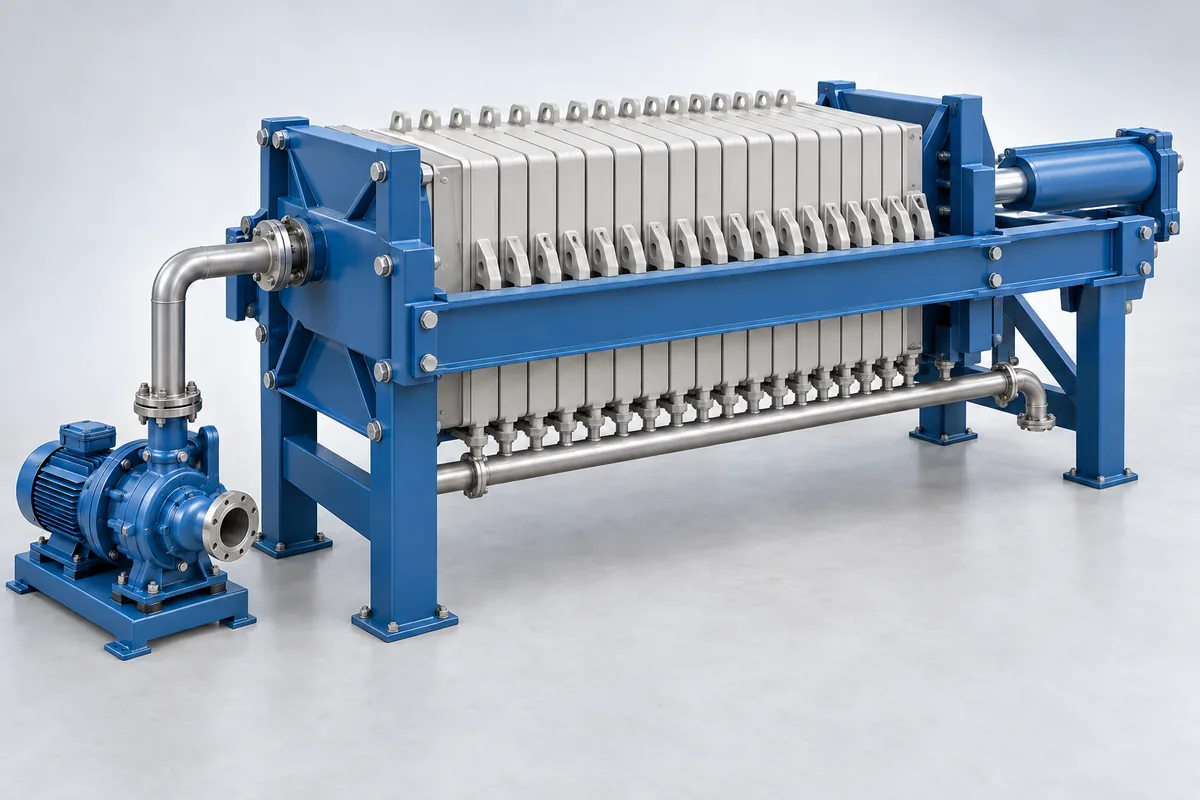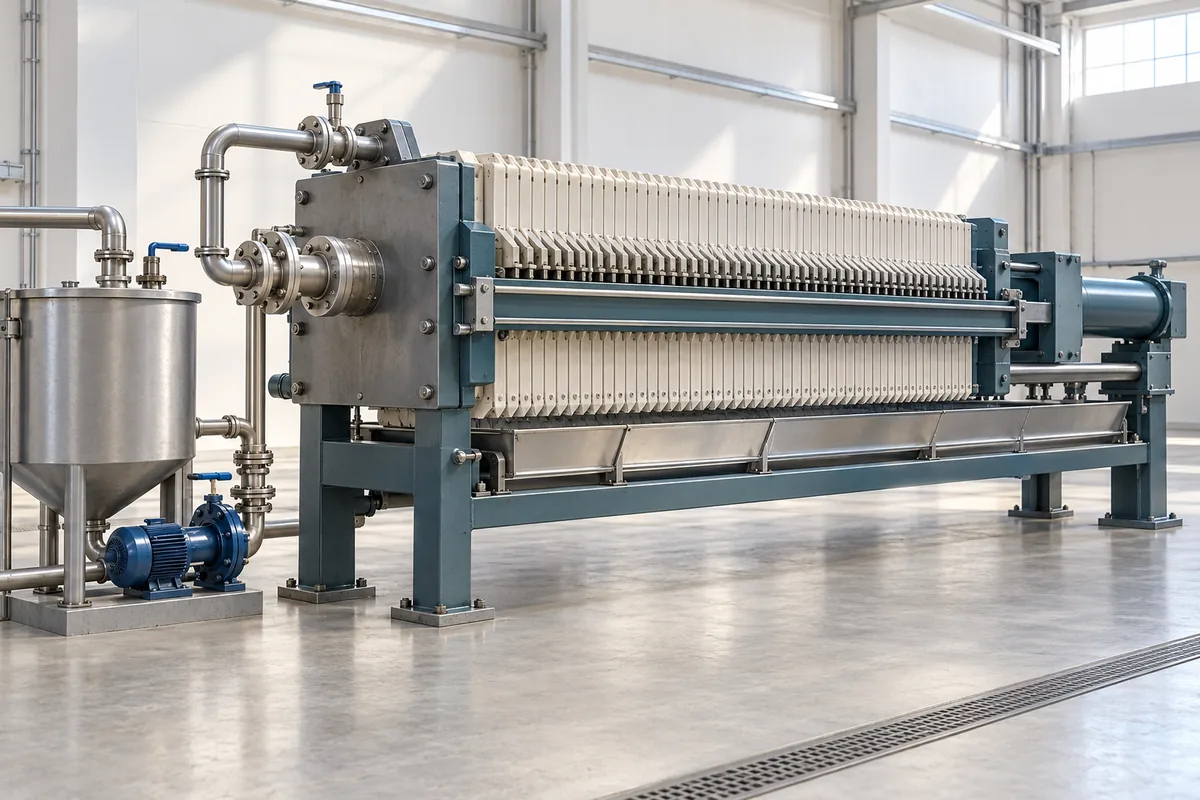
The answer to membrane filter press working principleis pressure filtration followed by membrane squeezing. A feed pump pushes slurry into cloth-lined chambers, where solids form a cake; flexible membranes then inflate to squeeze out more liquid.
| Stage | What happens | Purpose |
|---|---|---|
| 1. Close the press | The closing system clamps the filter plates together. | Contain the slurry during filtration and squeezing. |
| 2. Feed and filter | Slurry enters the chambers; liquid passes through the cloths. | Collect filtrate and build a filter cake. |
| 3. End feeding | The controls stop feeding at a validated endpoint. | Prepare a suitable cake for squeezing. |
| 4. Squeeze the cake | Water or air pressurizes the space behind each membrane. | Compress the cake and remove more liquid. |
| 5. Optional treatment | Cake washing or air blowing occurs in the specified sequence. | Remove soluble residues or displace additional liquid. |
| 6. Release and discharge | Pressure is released, membranes relax, and plates separate. | Remove the cake and prepare for another batch. |
Washing and air blowing can occur at different points in the cycle. Follow the manufacturer’s approved sequence for the equipment and process.
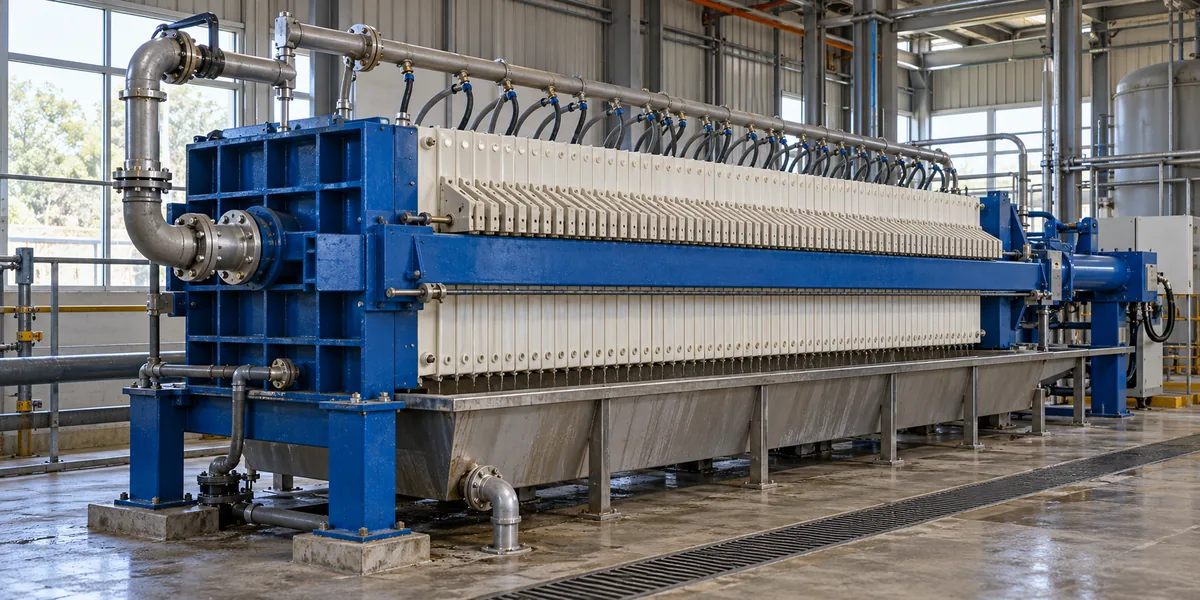
What makes a membrane filter press different?
A membrane filter press has flexible diaphragms in its plate pack that compress the cake after initial filtration. A conventional recessed chamber press uses rigid chambers and relies on slurry feed pressure for its main dewatering action.
Inside each chamber, filter cloth covers the filtering faces of the plates. Slurry, a mixture of liquid and suspended solids, enters through feed passages.
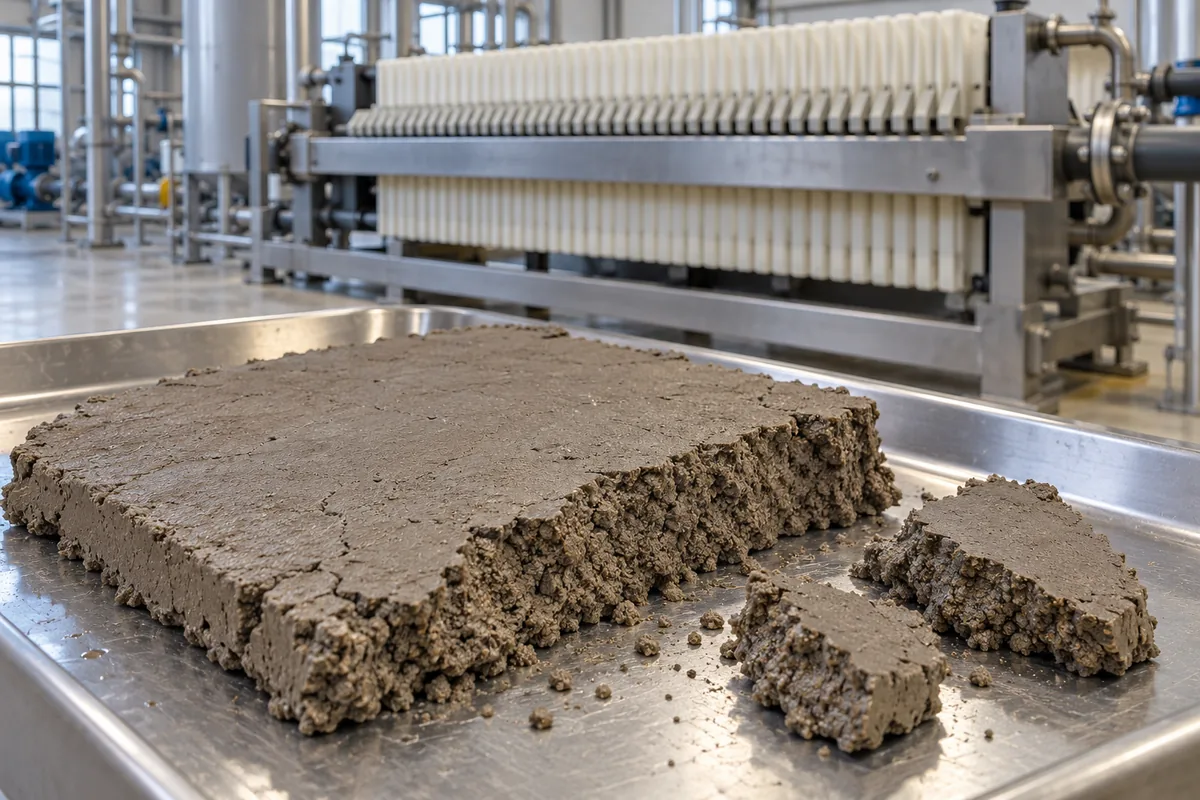
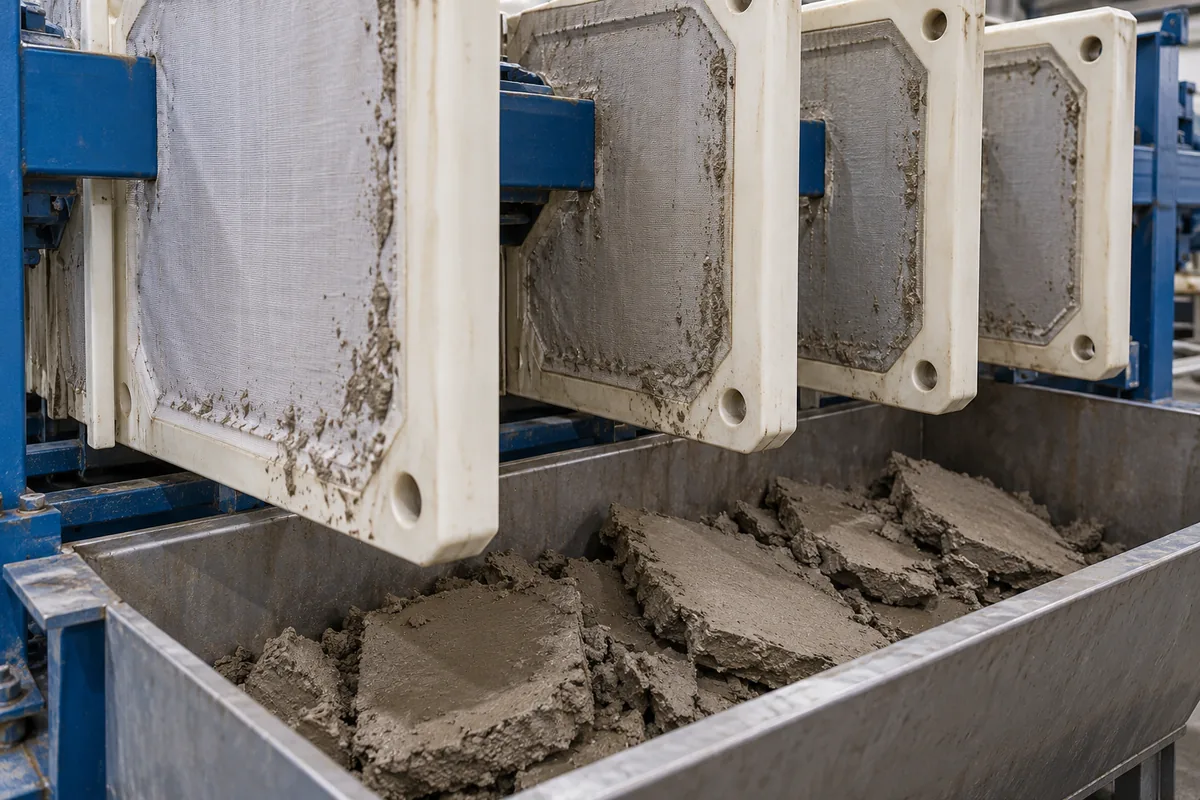
Liquid passes through the cloth and drainage channels while retained solids build up into a filter cake. The U.S. EPA’s recessed-plate filter press fact sheet describes the same basic purpose for wastewater residuals: remove water and produce a non-liquid cake.
The membrane sits behind the cloth. When its separate pressure cavity receives water or compressed air, the membrane moves toward the cake and reduces the available chamber volume.
The cloth retains the solids, and the membrane applies the squeeze. Liquid does not normally pass through the flexible membrane itself.
A mixed plate pack alternates membrane plates with rigid recessed plates. That gives each chamber a flexible squeezing surface on one side. Other designs use a full membrane plate pack. Micronics explains both configurations and their equipment differences.
Keep the three pressure systems separate
Closing pressure, slurry feed pressure, and membrane squeeze pressure do different jobs. Check which pressure a specification refers to before using it to compare equipment or set operating limits.
- The closing system develops the force that holds the plate pack together.
- The feed pump creates the pressure difference that drives liquid through the cake and cloth.
- The squeeze system pressurizes the cavity behind the membrane to compress the cake.
A hydraulic cylinder gauge reading does not directly tell you the filtration pressure. Cylinder area, plate geometry, and the press design determine how hydraulic pressure translates into closing force.
How the filtration cycle works, step by step
The press forms and squeezes the cake before depressurizing for discharge. Filling and filtration overlap: liquid begins leaving the press while slurry is still entering.
1. Close and secure the plate pack
The closing mechanism pushes the plates together and holds them with the required clamping force. Correct plate alignment, clean sealing surfaces, and properly fitted cloths help contain the slurry.
An automated system checks its required operating conditions before feeding starts. A fold in a cloth or debris on a sealing edge can cause leakage even when the closing system appears to be working normally.
2. Pump slurry into the chambers
The feed pump distributes slurry through the plate pack, where the cloths retain solids and allow liquid to drain away. The collected liquid is called filtrate.
As solids accumulate, they create an additional filtering layer. The cake itself increasingly affects both particle retention and resistance to flow.
Early filtrate may contain more fine particles before that layer develops. Depending on the process, it may need recirculation or separate collection until it meets the required quality.
Clear-looking filtrate is not automatically suitable for discharge or reuse. Dissolved contaminants can remain, so the destination depends on testing and the applicable process requirements.
3. Build enough cake before switching to squeeze
Feeding continues until the press reaches a tested stopping point that leaves enough cake for membrane compression. The controls may use pressure, flow, elapsed time, delivered slurry volume, or a combination of those measurements.
As the cake thickens, liquid meets more resistance. Feed flow often falls, and the final part of pressure filtration can become slow.
The controls then stop or isolate feeding as specified and prepare the squeeze circuit.
Minimum filling requirements depend on the plate design, so a chamber-fill percentage from another installation may not apply. Some specialized plates tolerate underfilled chambers; others can be damaged by squeezing without adequate cake support.
4. Inflate the membranes and compress the cake
Water or compressed air enters the sealed cavities behind the membranes, making them expand toward the cake. The resulting compression forces additional liquid through the cloths and into the filtrate drainage system.
The squeeze medium normally stays behind the membrane, separate from the slurry and cake.
LENSER’s membrane filtration explanation describes how this flexible surface replaces part of the slow dewatering phase with mechanical squeezing.
The squeeze ends after the specified pressure and hold time, or when another tested stopping condition is reached. Beyond that point, extra squeezing time may remove very little liquid.
5. Wash or air-blow the cake when required
Cake washing removes soluble material from the cake, while air blowing can displace additional liquid from its pores. These are optional operations with different purposes.
For example, a chemical product may need washing to reduce dissolved residues left in the liquid surrounding its particles. The equipment must have the appropriate ports, piping, and flow arrangement.
Some processes use a preliminary squeeze, wash while maintaining membrane pressure, and then squeeze again. The order depends on the equipment and the washing duty. M.W. Watermark’s process overview describes washing as an option that requires suitable manifold configuration.
Air used behind a membrane is also different from air blown through a cake. Clearing slurry from a feed passage is another separate operation. Check which functions the equipment proposal includes.
6. Depressurize, open, and discharge
The press releases process and squeeze pressure before the plates separate and the cake is discharged. Water returns to its collection system, or air vents through the designed arrangement, allowing the membranes to relax.
The closing mechanism then releases the plate pack. Cakes fall into a hopper or conveyor, sometimes with assistance from an approved discharge device.
Check the cloths and sealing surfaces and clean them as needed before the next batch. Never loosen a plate pack to relieve trapped pressure; follow the equipment’s depressurization procedure.
Why can membrane squeezing shorten the cycle?
Membrane squeezing can shorten a cycle by replacing part of the slow final feeding period with direct cake compression. The benefit depends on how the slurry drains and how its solids respond to pressure.
When the feed pump is running but filtrate has slowed to a trickle, continued feeding may remove little more liquid. A squeeze can be more useful at that stage if the cake responds to compression.
A membrane stage gives the process another way to remove liquid from the cake already inside the chambers. Diemme Filtration’s technical guide explains this transition from feeding to squeezing.
To compare complete cycles, add together:
- Closing and filling time.
- Filtration and membrane squeeze time.
- Any washing or air-blowing time.
- Depressurization, discharge, and cloth cleaning time.
Compare dry solids processed per operating hour at the required cake moisture. Include all the stages above; a faster feed stage alone does not establish higher production. This measure also lets you compare machines with different chamber volumes or cycle sequences.
How much drier can the filter cake get?
The achievable cake moisture depends on the slurry, cloth, chamber geometry, pressure, and cycle settings. A membrane press can improve dryness, but no single final moisture percentage applies to every material.
Check the measurement basis in the test report. On a wet-mass basis, a cake containing 40% dry solids contains 60% moisture.
A change from 30% to 40% dry solids is an increase of 10 percentage points. For the same captured solids, it means less wet cake to handle.
A worked example: less water to haul
Increasing cake solids from 30% to 40% would reduce total wet cake mass by 25% for the same captured dry solids. This is an illustrative mass balance, not a measured result or a promised membrane press performance gain.
Assume a batch contains 1,000 kg of captured dry solids, and the remaining cake mass is water:
| Measure | 30% dry solids | 40% dry solids |
|---|---|---|
| Captured dry solids | 1,000 kg | 1,000 kg |
| Total wet cake mass | 3,333 kg | 2,500 kg |
| Water remaining in cake | 2,333 kg | 1,500 kg |
Use wet cake mass = dry solids mass ÷ dry-solids fraction to calculate either case.
In this example, about 833 kg less water leaves with the cake. If disposal is charged by wet mass, that can reduce the bill. The actual financial result also depends on transport arrangements, utility use, maintenance, and whether the higher solids concentration is achievable.
Should the membranes use water or air?
Both water and compressed air can inflate membrane plates, provided the press is designed for the chosen medium. Selection depends on pressure requirements, available utilities, equipment ratings, and the consequences of a membrane failure.
Water squeeze systems typically use a pump, reservoir, manifold, and return arrangement. Compressed-air systems need appropriate regulation, protection, and controlled venting.
Micronics notes that water is typically the safer alternative for membrane inflation. One reason is that compressed gas stores substantial expansion energy. Water pressure still requires properly rated equipment and controlled pressure release.
Use the manufacturer’s approved medium and operating limits. Switching from water to air, or the reverse, needs engineering review even when both options appear in a product brochure.
Membrane vs. recessed chamber press: which fits your process?
A membrane press is worth evaluating when lower cake moisture, better liquid recovery, or a shorter dewatering stage has measurable value. A recessed chamber press may meet the process target with fewer components and lower initial cost.
| Factor | Membrane filter press | Recessed chamber press |
|---|---|---|
| Main dewatering action | Feed-pressure filtration plus membrane squeezing | Feed-pressure filtration |
| Chamber behavior | Flexible surfaces reduce chamber volume during squeeze | Rigid surfaces define chamber volume |
| Additional equipment | Squeeze supply, piping, valves, and controls | No membrane squeeze circuit |
| Maintenance considerations | Cloths, plates, membranes, and squeeze circuit | Cloths, plates, and standard press systems |
| Performance assessment | Test whether squeezing improves the required result | Test whether feed filtration already meets the target |
Applications include industrial sludge dewatering, mineral concentrates, tailings, and chemical products. The useful outcome may be a lighter waste cake, more recovered liquid, or less moisture entering a downstream dryer.
Compare results on representative slurry before deciding which machine will cost less to run. Our membrane vs. chamber filter press comparison covers the equipment, maintenance, and cost differences to include in that decision.
What controls cake dryness and filtration performance?
Slurry characteristics, filter cloth selection, and the operating cycle jointly control solid-liquid separation. Increasing squeeze pressure addresses only one part of that system.
When reviewing a test, check these conditions:
- Fine particles can create a dense cake that resists liquid flow. Strongly compressible cakes may become less permeable as pressure rises.
- Dilute feed brings more liquid into the press for each kilogram of solids. A change in feed concentration can also change when feeding should stop.
- Cloth material and weave affect particle retention, drainage, and cake release. They must also suit the slurry chemistry.
- Cake thickness changes drainage distance and chamber capacity. Test its effect on production.
- Slurry temperature and chemistry affect liquid properties and the suitability of the cloths, plates, and membranes.
- Where conditioning is appropriate, coagulation or flocculation can change cake formation. Establish the chemical dose through trials.
I’d ask the supplier to record these conditions alongside the moisture result. Without them, you cannot tell whether a reported dryness is relevant to your feed.
What should you check when cakes stay wet?
Start with feed consistency, cloth condition, chamber filling, and squeeze performance when cakes stay wet. Several faults can produce similar-looking cakes, so appearance alone will not identify the cause.
Use observations to narrow the investigation:
- With wet or uneven cakes, investigate slurry variation, blocked feed passages, and uneven chamber filling.
- If cycles are long and flow is low, check for cloth blinding, restricted drainage, or a change in cake permeability.
- For cloudy filtrate, check the cloth for damage, its fit and seals, and whether the cake has developed normally.
- If squeeze pressure drops unexpectedly, investigate the squeeze circuit and possible membrane damage under the manufacturer’s procedure.
Record pressure, flow, and timing together. If performance changed after a new slurry source or cloth replacement, that information helps identify the cause.
Before physical inspection, stop, isolate, and depressurize the equipment under the site procedure. OSHA’s hazardous-energy guidance explains why electrical, hydraulic, and pneumatic energy must be controlled during servicing. Raising pressure to compensate for an unknown fault can damage components without improving dewatering.
What should you ask before buying or upgrading?
Ask for test evidence that the proposed press can meet your moisture and throughput targets with your slurry. A laboratory filter press can support initial trials, provided its configuration reproduces the relevant conditions. Confirm membrane squeezing separately; pilot testing may still be needed to check scale-up and operating behavior.
Ask the supplier:
- What dry-solids load must the press handle each day?
- What cake moisture and filtrate quality must it achieve?
- How were the proposed feed and squeeze endpoints established?
- Does the quoted cycle include washing, discharge, and cleaning?
- What utilities, consumables, and replacement membranes are required?
- How does performance change across the expected range of slurry conditions?
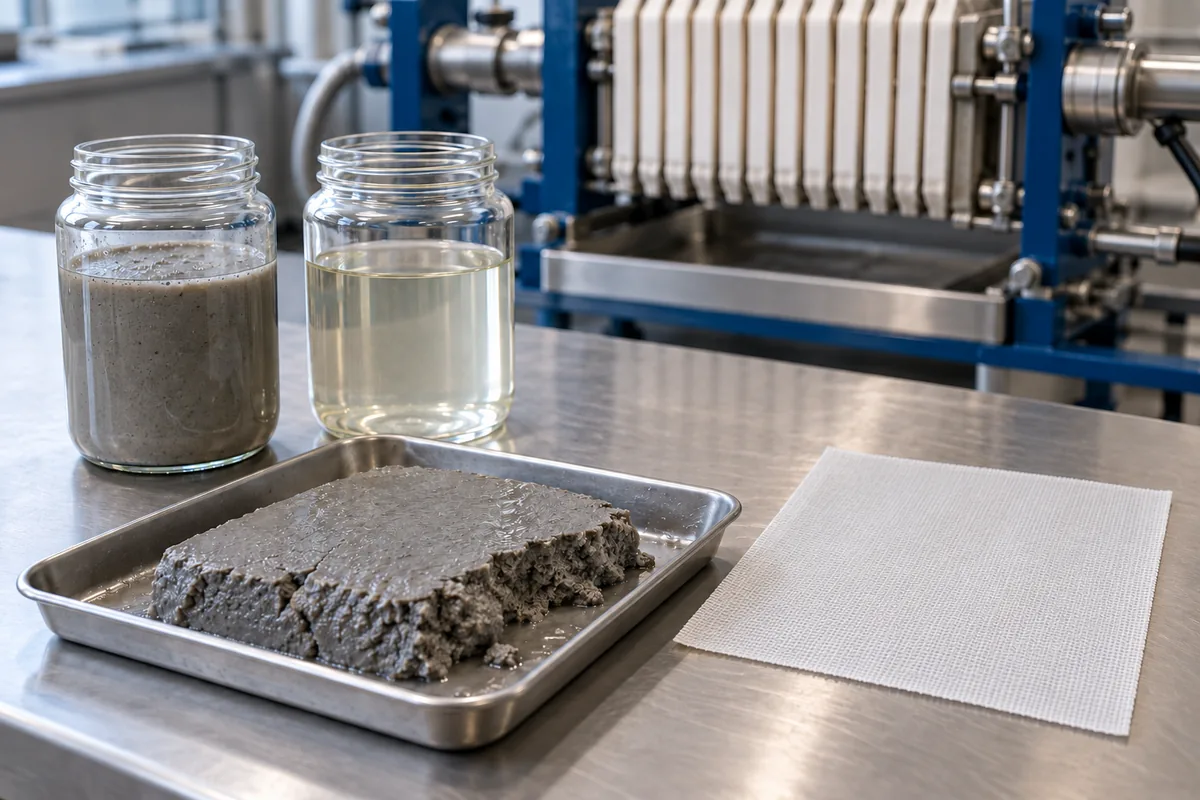
A retrofit also needs an engineering assessment of the frame, closing force, plate dimensions, pressure ratings, piping, and controls. Matching plate dimensions alone does not establish compatibility.
Use those test results to choose the filter press size, checking chamber volume and filtration area against the operating schedule. Before ordering, agree on acceptance criteria such as captured dry solids per hour at a stated cake moisture, over a defined feed range and including all normal cycle operations.
Set a test target before choosing a press
Set targets for cake moisture, recovered liquid, production rate, and total operating cost before comparing presses. Then run the complete sequence with representative slurry and record the result against each target.
The test should show how much liquid the squeeze removes and whether that saving pays for the extra equipment and operating time. It gives your plant a measured answer to the question: how does a membrane filter press work?