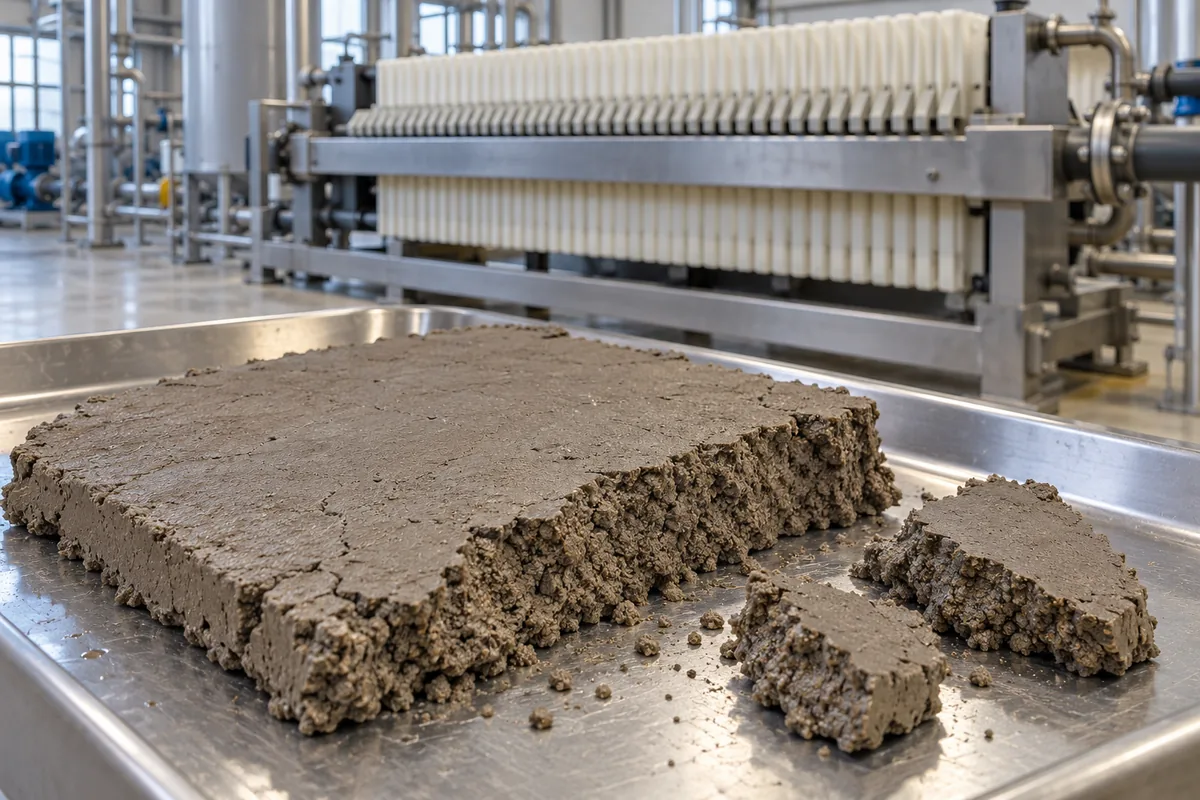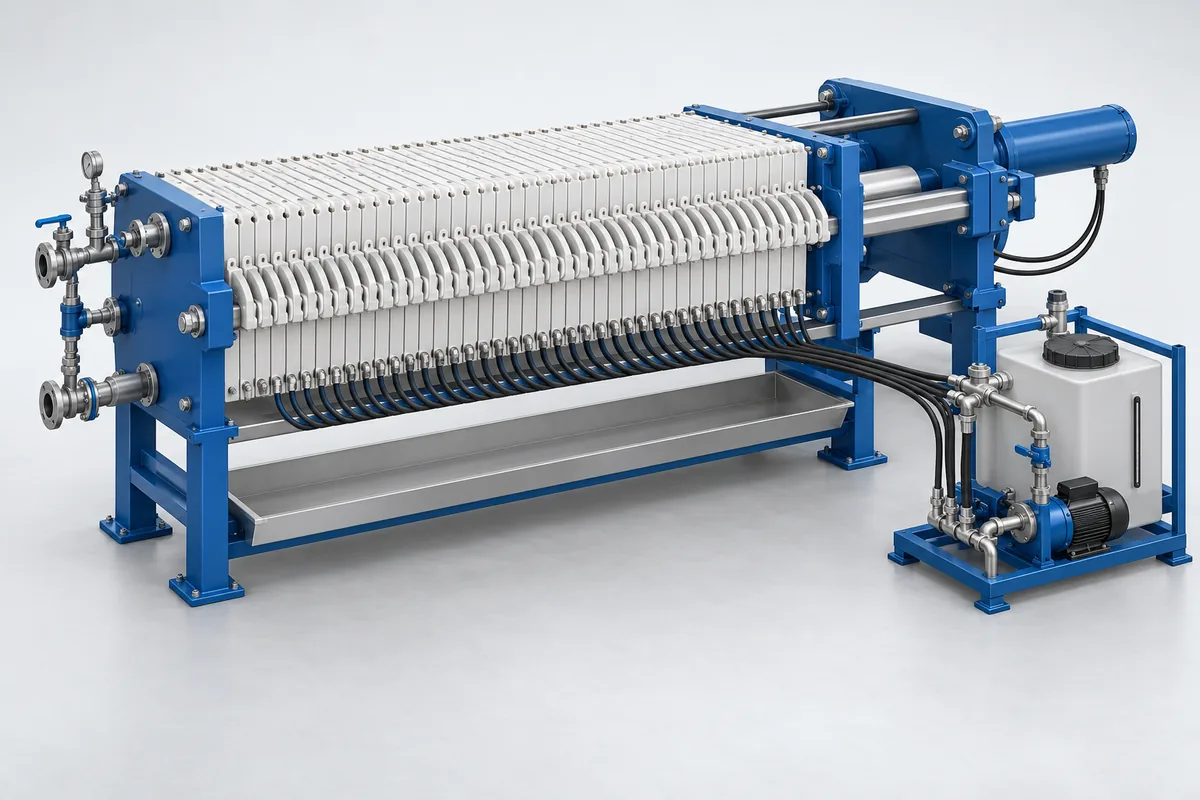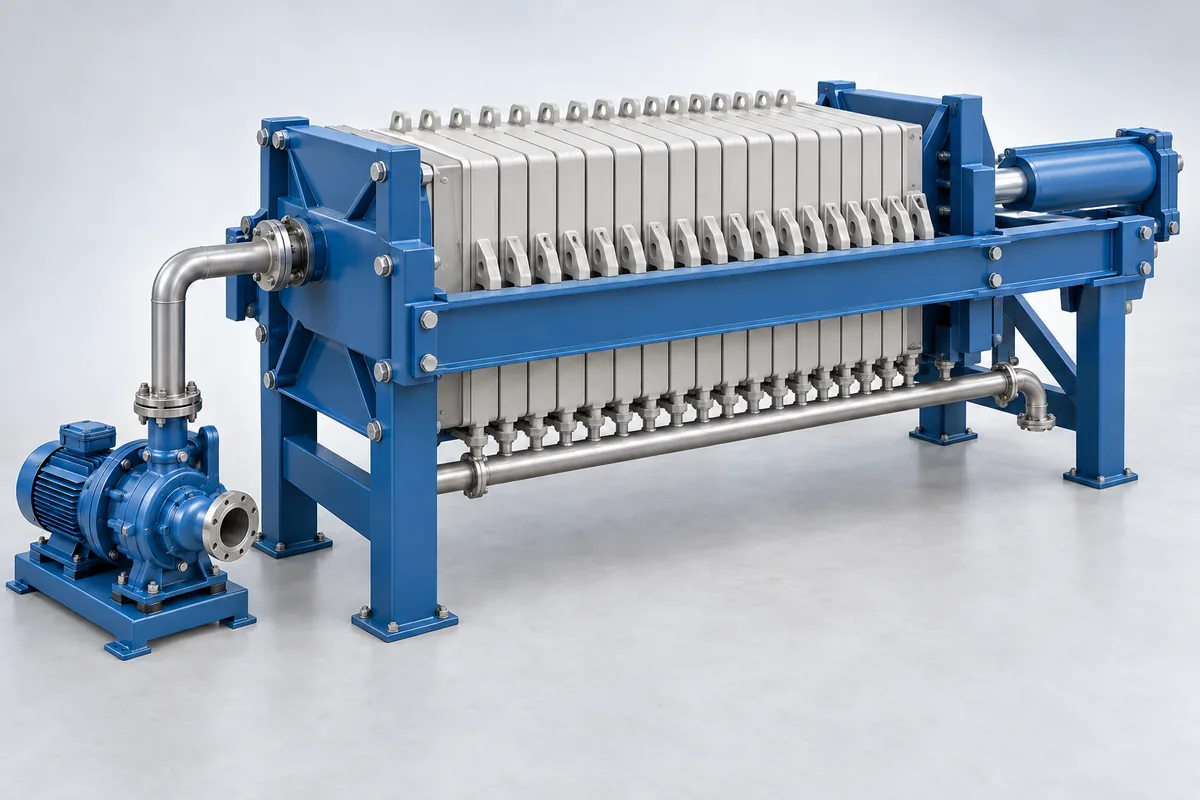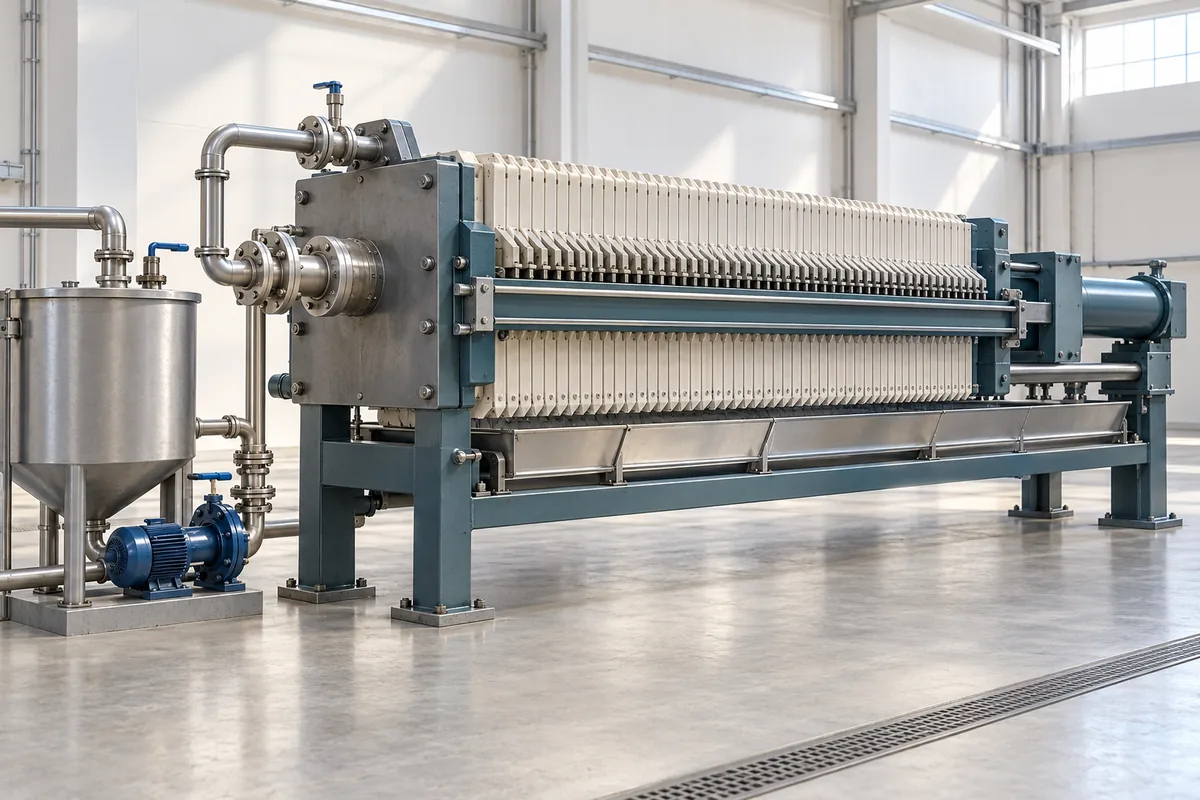
A frame filter press separates suspended solids from liquid to clarify process fluids, recover useful solids, or dewater sludge. If you’re asking “what is a frame filter press used for,” those are its main jobs: the liquid leaves as filtrate, while retained solids form a filter cake.
| Process | Example feed | Main purpose | What to verify |
|---|---|---|---|
| Liquid clarification | Process liquid containing fine particles | Remove suspended solids | Filtrate clarity and media retention |
| Product recovery | Crystals or pigments suspended in liquid | Collect useful solids as cake | Product yield, purity, and cake release |
| Food processing | Suitable syrup, oil, or beverage process streams | Separate unwanted solids | Hygienic design and product compatibility |
| Wastewater treatment | Conditioned industrial sludge | Reduce water carried with waste solids | Cake solids and disposal requirements |
| Mineral processing | Mineral slurry or process water | Recover solids and separate water | Throughput and the appropriate press design |
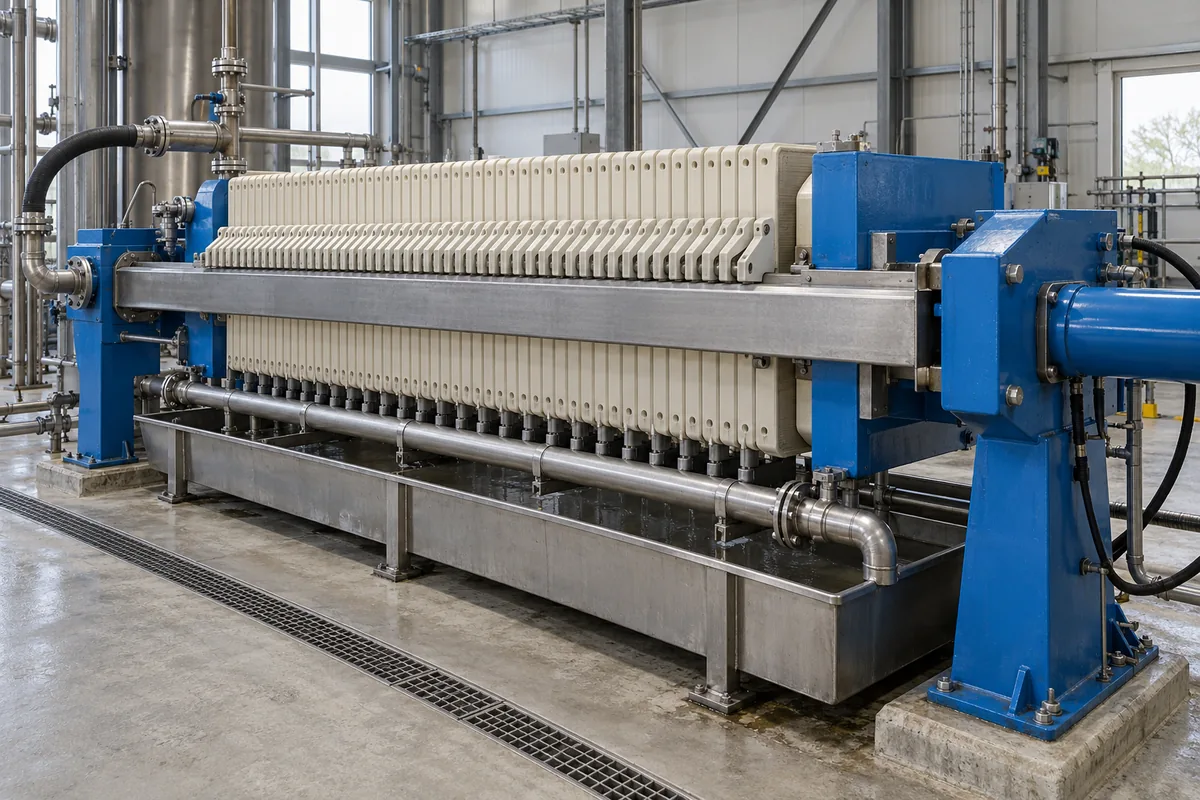
Suppliers sometimes use “plate and frame” loosely for several filter press designs. A traditional press has separate flat plates and hollow frames; recessed-chamber and membrane presses use different plate arrangements. Check which design you’re comparing, because it affects filtration, cake removal, and the performance you can expect.
Start With the Material You Want to Recover
A frame filter press can recover the liquid, the solids, or both. What you want to keep determines the filter medium, operating cycle, and results you need to measure.
For a clearer process liquid, start with filtrate quality. A firm cake is little help if fine particles still reach the next production stage.
Solid-product manufacturers have a different concern: capturing the product without making it difficult to release from the cloth. They also need to limit unwanted liquid left in the cake. Waste-sludge operators, meanwhile, care about moisture and handling because removing water can reduce the wet mass sent for transport or disposal. The remaining solids still need appropriate characterization and management.
Consider a chemical producer collecting crystals from a batch. The producer might keep the cake and return the separated liquid, called mother liquor, to the process. A liquid-product manufacturer may keep the filtrate and discard the captured residue. You need to know which stream matters before setting a filtration target.
Where the Traditional Frame Design Fits Best
A traditional plate-and-frame press is useful for liquid polishing, flexible filter-media selection, and accessible cloth replacement. It also collects solids, though demanding dewatering duties deserve a comparison with other press designs.
M.W. Watermark’s comparison of plate-and-frame and recessed-chamber presses describes using filter paper supported by cloth in the traditional design. It also describes polishing applications with feed solids often below 1% by weight, an application range rather than a universal operating limit.
Polishing removes relatively small amounts of remaining particles from a liquid. Available filtration area and liquid flow can therefore matter more than the space available to hold cake.
Heavy sludge loads put more emphasis on cake capacity and discharge. Recessed-chamber presses are common in those applications, while membrane presses add a separate cake-squeezing stage. Check the plate arrangement on the quotation; the equipment name alone may leave that unclear.
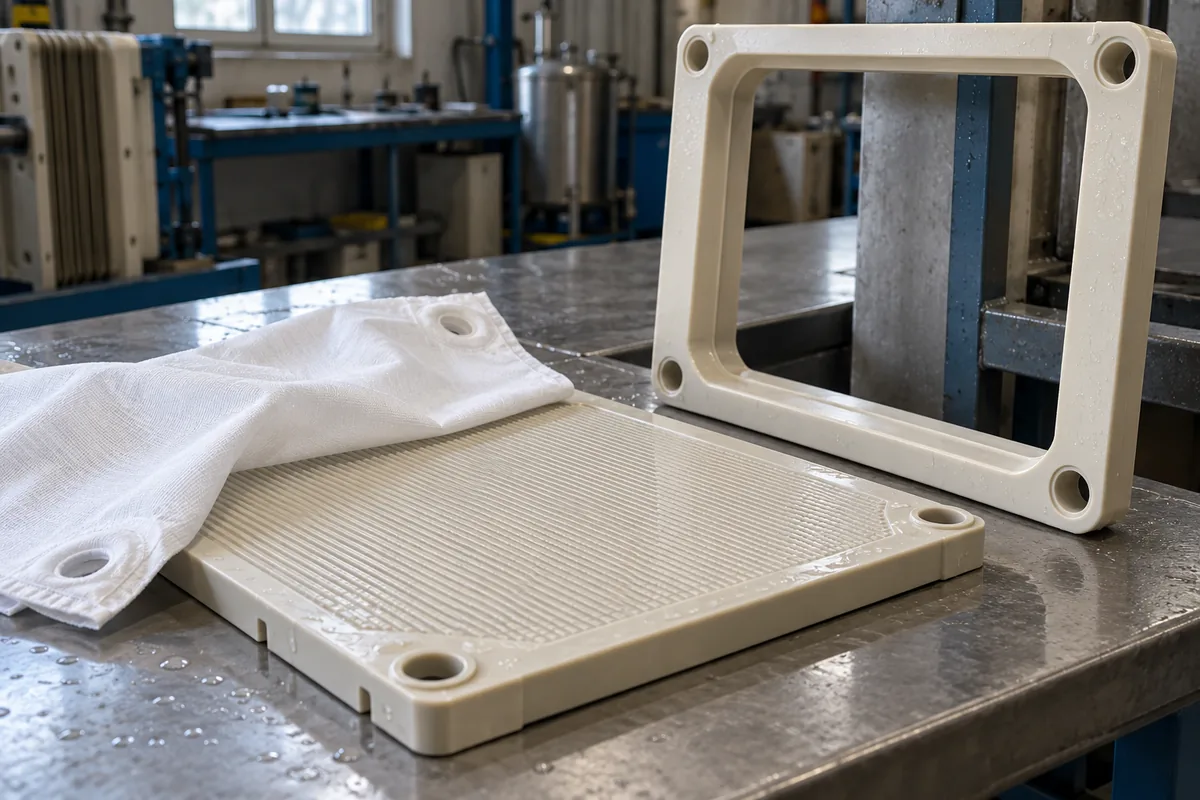
Plate and Frame Filter Press Applications
Plate and frame filter press applications include chemical processing, food and beverage clarification, wastewater treatment, and mineral processing. The configuration depends on the slurry, the stream you want to recover, and the required production rate.
Micronics’ filter press overview covers these industries across the wider filter press market. Within each industry, the individual filtration duty determines whether a particular design is suitable.
Chemical Processing: Recover Solids or Clarify Liquids
Chemical plants use suitable filter presses to collect suspended products or remove unwanted particles from process liquids. Typical duties include recovering precipitated solids and pigments or clarifying a solution before another processing step.
Take a batch of crystals suspended in mother liquor. Filtration collects the crystals as cake and allows the liquid to drain away. Where the process and equipment support cake washing, a wash liquid can displace some of the retained mother liquor before discharge.
Choose that liquid carefully. If it dissolves the crystals, you’ll lose product. Cloth selection matters too: a medium may retain the particles well but leave you struggling to remove the cake.
Specify the chemical composition, concentration, temperature, and cleaning agents when selecting materials. The words “stainless steel” or “polypropylene” don’t establish compatibility with a particular process.
Food and Beverage Processing: Remove Unwanted Particles
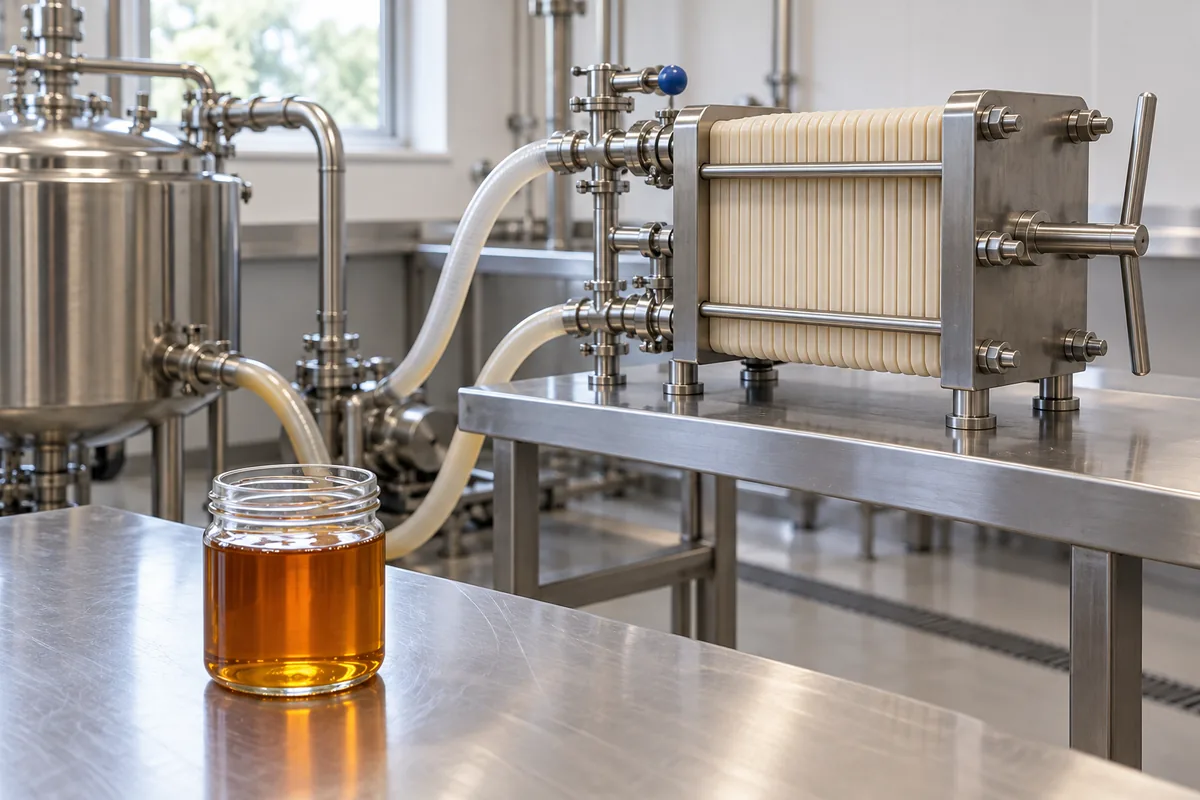
Food processors use appropriately designed filtration systems to clarify liquids or separate solids during production. Syrup processing, edible-oil filtration, and certain beverage streams are examples.
Micronics’ food and beverage application guide covers sugar processing, wine lees, brewing, juice filtration, starch, and edible oils across several filtration technologies.
For a syrup containing suspended processing residue, the press and medium need to capture that residue while allowing the syrup through. Temperature and viscosity affect how readily it flows.
When reviewing a stainless steel plate-and-frame press, check food contact materials, cleaning access, and suitability for the intended filtration duty. Removing visible particles alone does not establish microbial safety or shelf stability.
Wastewater Treatment: Reduce the Water in Sludge
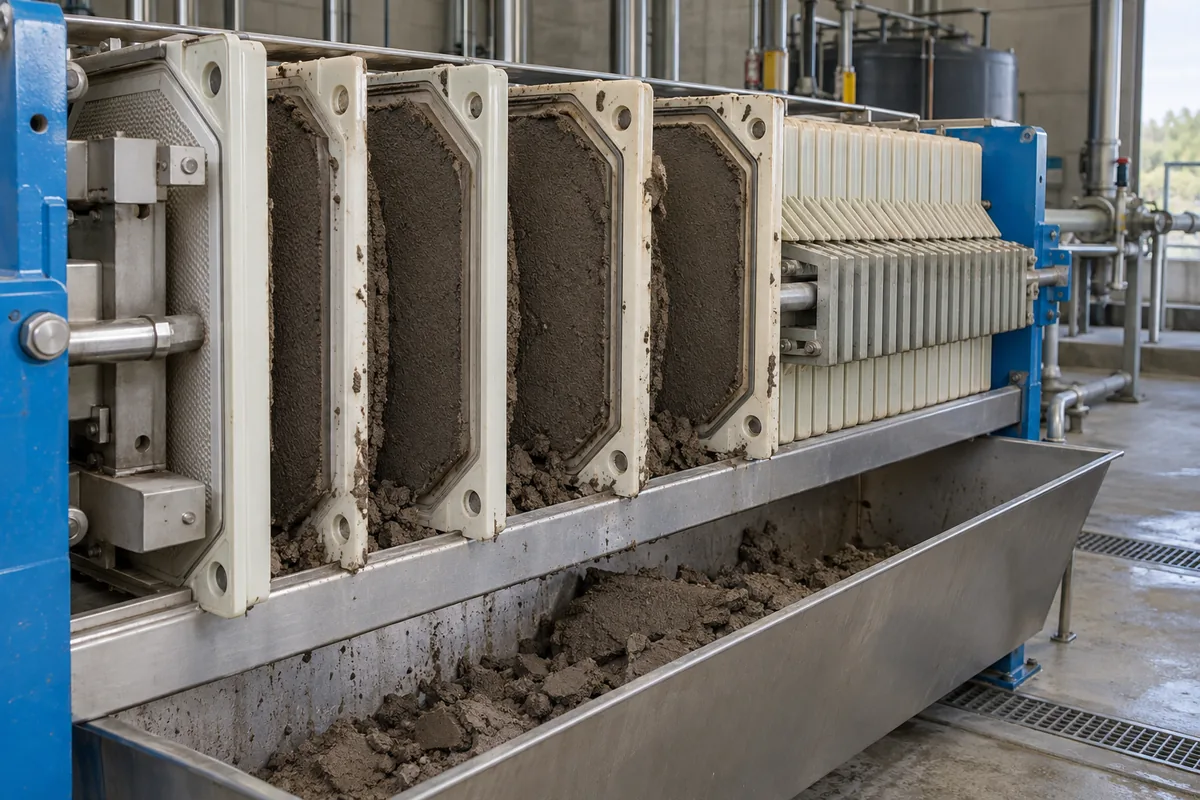
Filter presses dewater sludge to make the separated solids easier to handle and potentially less costly to transport. Depending on its quality, the filtrate can return to treatment or another approved destination.
In industrial sludge dewatering, an upstream chemical treatment may first convert dissolved metals into insoluble particles. The press then captures those particles. Filtration depends on that earlier treatment; it doesn’t perform the precipitation itself.
The U.S. EPA’s recessed-plate filter press fact sheet describes removing water from wastewater residuals to produce cake. Its guidance applies to recessed-plate equipment, which differs from the traditional flat-plate-and-frame arrangement.
A drier cake can still be hazardous. Its composition and the applicable disposal requirements determine how it must be managed.
Mineral Processing: Separate Water From Mineral Solids
Mineral operations use filter presses to dewater suitable concentrates, tailings, and other slurries. The separated water may be reusable after quality checks, while the cake is easier to handle.
A concentrate producer may focus on moisture before transport. A plant filtering process water may care more about the fine material reaching downstream equipment. Large mineral duties often call for recessed-chamber or membrane presses, with abrasiveness, throughput, and cake discharge influencing the choice.
A Penn State study of coal-refuse and silica-sand slurries found that filtration time and drying time had the largest effects on product moisture and unit capacity among the conditions tested. Results from one slurry won’t establish the operating cycle for another, so ask for tests using your own feed.
Plate and Frame Filter Press Working Principle
The plate and frame filter press working principle is pressure-driven filtration. A feed pump pushes slurry into enclosed frames, liquid passes through the filter medium, and retained solids build into cake. The closing mechanism keeps the plate pack clamped throughout filtration.
Feed pressure and hydraulic closing pressure are separate quantities. You can’t use the hydraulic gauge reading as the pressure to apply to the slurry.
A typical batch runs as follows:
- Inspect and close the press. Check the media, plate arrangement, sealing surfaces, and passages, then close the pack according to the equipment procedure.
- Feed the slurry. The pump delivers the solid-liquid mixture through feed passages into the frames. Traditional designs commonly use corner feed passages; confirm the layout on the equipment drawing.
- Build the filter cake. Liquid crosses the medium and drains through the plates while solids collect on the media surfaces. The developing cake can retain smaller particles, but it also adds resistance to flow.
- Finish filtration and any optional treatment. Use validated criteria such as pressure, filtrate flow, and elapsed time to determine the endpoint. Cake washing or a gas blow requires a system designed for that operation.
- Depressurize, open, and discharge. Complete the required isolation and pressure-release checks before opening the pack and removing the cake. Inspect and clean the media for the next batch.
A filter press operates in batches. Automation can shorten handling time, and multiple presses can support ongoing plant production. Each individual press still needs a discharge stage.
Low filtrate flow can indicate full frames, blinded cloth, or a blocked passage. Read it alongside the rest of the cycle data before deciding the batch is complete.
Plate and Frame Filter Press Diagram: Follow Both Streams
A plate and frame filter press diagram shows slurry entering the frame cavity, filtrate leaving through the cloth and plate drainage, and cake remaining inside the frame. This text schematic represents one simplified chamber; the press repeats that arrangement across the plate pack.
                   Slurry feed
                        |
                        v
Plate | Cloth | Hollow frame | Cloth | Plate
      <--- liquid      liquid --->
      drainage          drainage
                        |
                Solids stay as cake

Plate drainage --> Filtrate collection
Cake removed after safe opening
The plates support the filter medium and provide drainage paths. The hollow frame holds the cake, while the cloth or other supported medium separates particles from the flowing liquid.
The liquid arrows point toward both sides of the chamber. Slurry does not pass through one frame and then through every other frame in series.
On a supplier’s drawing, locate the feed passage, filtrate outlets, closing mechanism, and cake discharge area. Check optional washing connections separately. Use the manufacturer’s drawing to confirm the actual flow paths and connections.
How Much Can Dewatering Reduce Waste Mass?
Dewatering reduces the wet mass handled as cake by removing water. The size of that reduction depends on the starting solids concentration and the cake solids you can achieve.
Suppose you have 1,000 kg of slurry containing 5% dry solids by mass. Assume all 50 kg of solids are captured, no conditioning solids are added, and the remaining mass is water.
If a test achieves 30% cake solids by mass:
Wet cake mass = dry solids mass ÷ cake solids fraction
50 kg ÷ 0.30 = approximately 167 kg of wet cake.
| Measure | Result |
|---|---|
| Starting slurry mass | 1,000 kg |
| Dry solids retained | 50 kg |
| Assumed final cake solids | 30% by mass |
| Calculated wet cake mass | About 167 kg |
| Calculated separated water | About 833 kg |
| Reduction in mass handled as cake | About 83% |
These are assumed values for a worked example, not field results or a promised dryness figure. At 30% cake solids, the cake still contains 70% water by mass.
The roughly 83% reduction in handled mass won’t translate directly into the same reduction in total cost. You still need to account for labor, conditioning chemicals, power, maintenance, filtrate treatment, and disposal charges.
Choose a Press Using Your Slurry Data
Choose the press by testing a representative slurry against targets for filtrate quality, cake condition, and full-cycle throughput. Plate size or a headline flow rating won’t tell you whether the machine can meet your production needs.
I recommend writing down the following before asking for a quotation:
- Feed solids concentration, particle size, viscosity, temperature, and chemical composition.
- Acceptable suspended solids, turbidity, or another relevant measure of filtrate quality.
- Required cake solids, product purity, washing requirements, and ease of discharge.
- Volume or dry solids to process per shift, including downtime.
- Available labor and space, cleaning requirements, and materials compatibility.
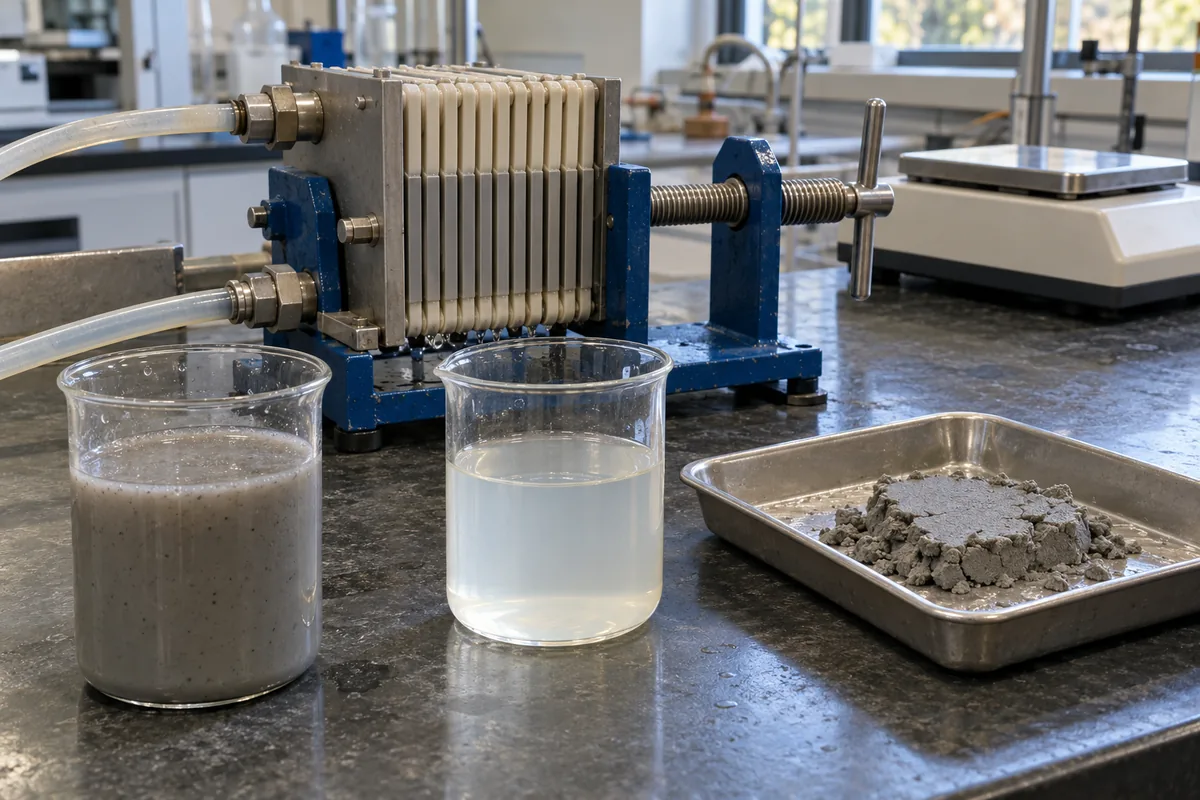
Micronics’ pressure filtration laboratory services evaluate feed solids, cake moisture, cake release, filtrate quality, and cycle time. Request those measurements from your trial so you can compare proposals against the same requirements.
A suitably configured laboratory filter press can help compare media and collect cake and filtrate samples before you select production equipment. Record the test conditions along with the results.
Measure the Entire Cycle
Useful throughput includes filling, filtration, optional washing, discharge, and cleaning. Counting only the time when liquid flows overstates what the press can deliver during a shift.
A hypothetical press processing 100 kg of dry solids per complete two-hour cycle averages 50 kg per hour before additional plant downtime. Use this as a planning calculation, not a machine specification.
Ask what cycle sits behind a supplier’s capacity claim, then allow for feed variation and maintenance. The filter press sizing guide connects dry-solids loading, cake volume, filtration area, and the number of batches your schedule can accommodate.
Match the Design to the Duty
Traditional plate-and-frame presses suit media flexibility and accessible cloth changes. Recessed-chamber presses are common for cake-producing duties, while membrane presses add a squeeze stage. Test the options against the same feed and product requirements.
The distinction between membrane and chamber filter presses is the additional pressurized system that moves flexible membranes against the cake. That squeeze is separate from the hydraulic clamp and is not a standard feature of every frame press.
If uninterrupted feed is essential, compare a buffered or multiple-press arrangement with suitable continuous equipment, such as a belt press or decanter centrifuge. Keep the feed and product targets consistent when comparing technologies.
Know the Limits Before You Specify the Machine
A frame filter press removes suitable suspended solids. Dissolved-salt removal, sterilization, and discharge compliance require their own treatment steps and verification.
Several operating limits deserve attention:
- Mineral particles and soft, compressible sludge can produce very different cake dryness.
- Increasing pressure can make a compressible cake less permeable. Follow test results and the equipment’s rated limits.
- Clear-looking liquid still needs checks for the substances relevant to reuse, product quality, or discharge.
- Replace damaged cloth and investigate persistent loss of flow or clarity. Cloth life depends on the application, so a fixed replacement interval may be misleading.
- Cake can remain inside a traditional frame and require labor and approved removal methods.
Track feed pressure, filtrate flow, cycle duration, cake solids, and filtrate quality. Changes in those measurements can help you find a problem before it interrupts production.
Follow the manufacturer’s isolation and depressurization procedure before opening or servicing the press. Stopping the pump does not prove that trapped pressure has been released. For servicing and maintenance, OSHA’s hazardous-energy guidance explains why hydraulic, pneumatic, and other stored energy must be controlled through appropriate lockout/tagout procedures.
Make the Decision With a Representative Slurry Test
A representative slurry test establishes whether a press can deliver the clarity, solids recovery, and cake handling your process needs. Get recorded results for the complete cycle, then compare equipment configurations and operating costs.
Tell the supplier which stream you want to recover and what acceptable performance looks like. Use the trial to select the plate arrangement, medium, and operating sequence. Your feed data and measured results provide the practical answer to what is a frame filter press used for.