The decision comes down to this: chamber presses usually cost less upfront, while membrane presses add a squeeze stage that can produce drier cake and shorter cycles. Choose a membrane press when tested savings justify the extra equipment; choose a chamber press when it already meets your process targets.
| Buying factor | Chamber filter press | Membrane filter press |
|---|---|---|
| Main dewatering method | Feed-pump pressure with rigid recessed plates | Feed-pump pressure plus a flexible diaphragm squeeze |
| Separate membrane squeeze stage | No | Yes |
| Cake dryness | Depends on slurry and filtration conditions | Can improve when the cake responds to squeezing |
| Complete cycle time | May include a lengthy final filtration stage | Can shorten that stage; total savings require testing |
| Initial investment | Usually lower for comparable scope | Usually higher because of plates and squeeze equipment |
| Maintenance | Cloths, plates, seals, pumps, hydraulics and controls | The same core items, plus membranes and the squeeze circuit |
| Automation | Available | Available |
| Strongest buying case | Meets the required duty with a simpler system | Proven gains in disposal cost, recovery or capacity |
These comparisons assume a similar application and equipment scope. Actual moisture, capacity and cost depend on your slurry, press sizing and operating conditions.
Main Difference Between Membrane and Chamber Filter Press
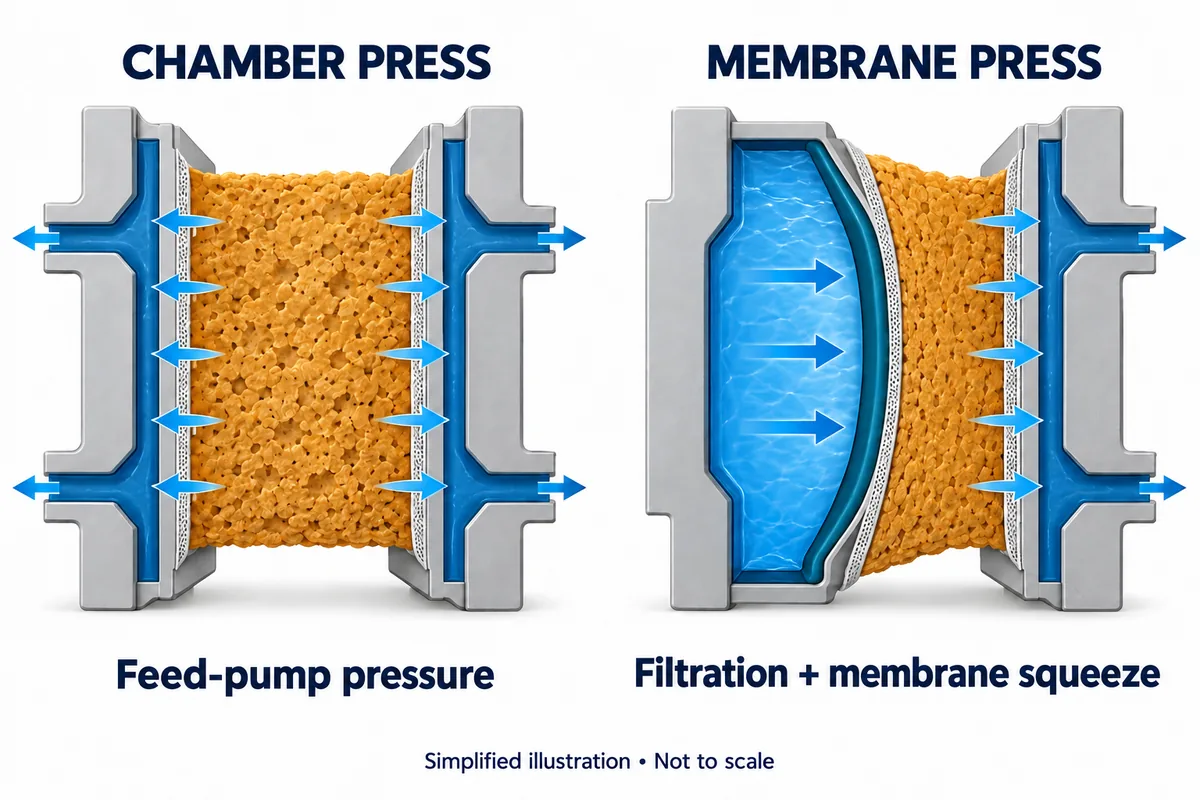
The main difference is how the plates act on the cake: chamber plates remain rigid, while membrane plates have flexible diaphragms that press into the chamber during squeezing. Both designs first use pressure filtration to separate suspended solids from liquid.
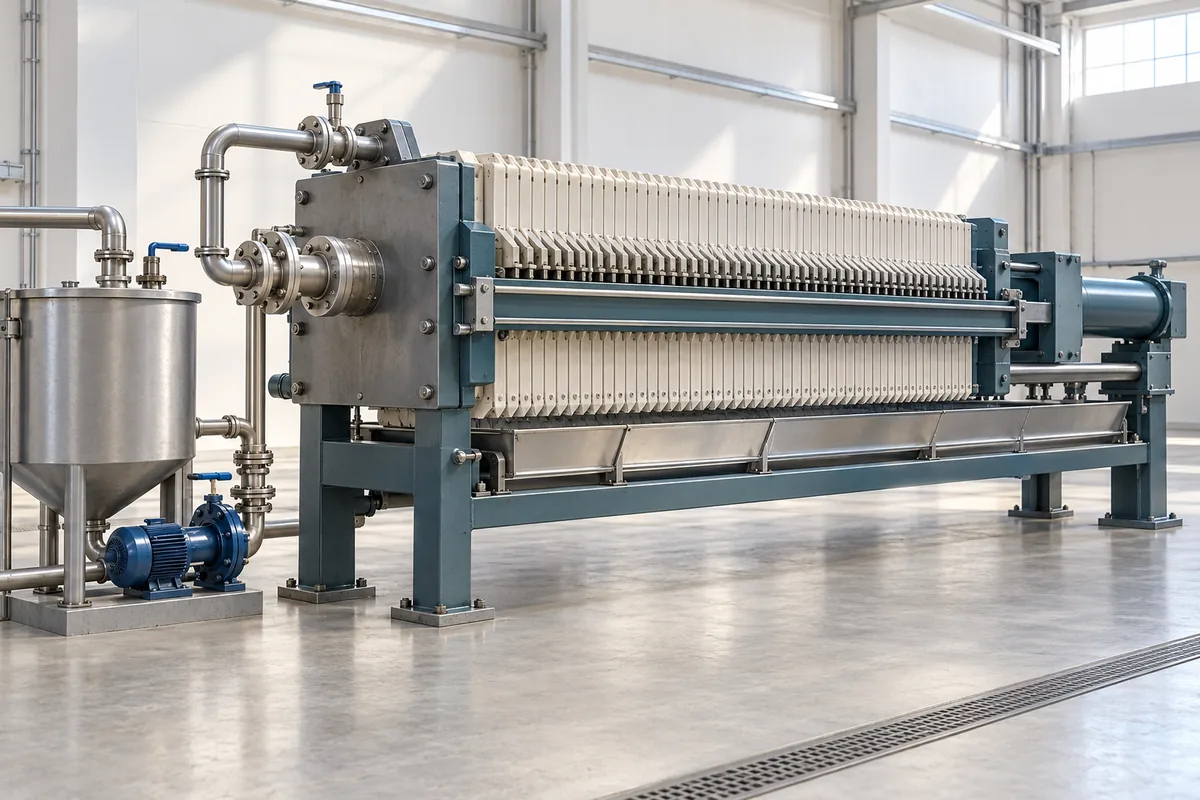
Think of the equipment in two parts. The hydraulic closing system holds the plate pack together. The feed pump supplies the pressure that drives liquid through the filter cloth and developing cake.
Those pressures do different jobs. A hydraulic gauge reading is not the pressure applied to the slurry.
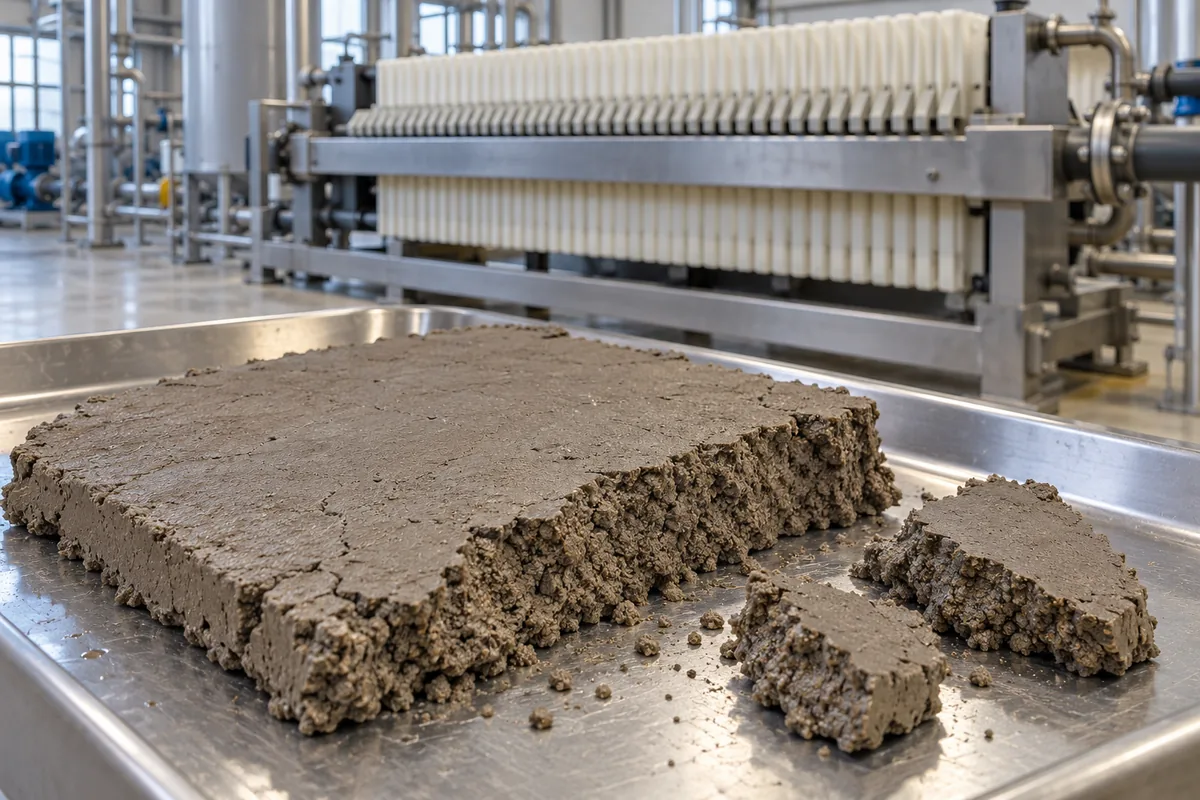
As Micronics explains in its filter press overview, solids accumulate on the cloth while filtrate leaves through the plate drainage system. The retained solids form the filter cake.
The U.S. EPA’s recessed-plate filter press fact sheet describes the same purpose for wastewater residuals: remove water and produce a non-liquid cake.
How a Chamber Filter Press Works
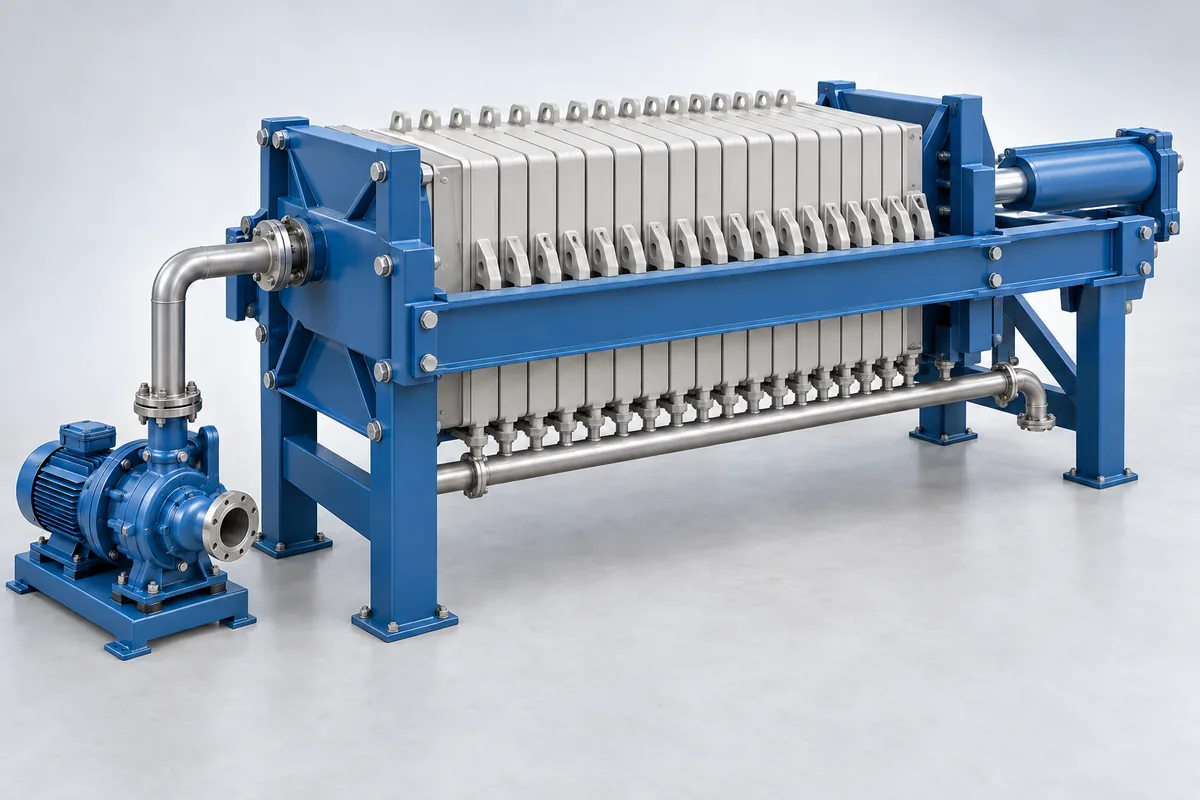
A recessed chamber filter press fills the spaces between recessed plates with slurry, retains solids on filter cloths, and removes liquid under feed-pump pressure. Its standard dewatering cycle has no membrane squeeze.
The basic sequence looks like this:
- Close and clamp the plate pack.
- Pump slurry into the chambers using the specified feed profile.
- Continue filtration until the validated endpoint is reached.
- Depressurize, open the press and discharge the cake.
Depending on the configuration, cake washing, core clearing or an air blow may also be included. So “no membrane” does not mean “no additional process options.”
The attraction is straightforward: fewer components dedicated to squeezing, with a system that may already deliver all the dryness you need.
How a Membrane Filter Press Works
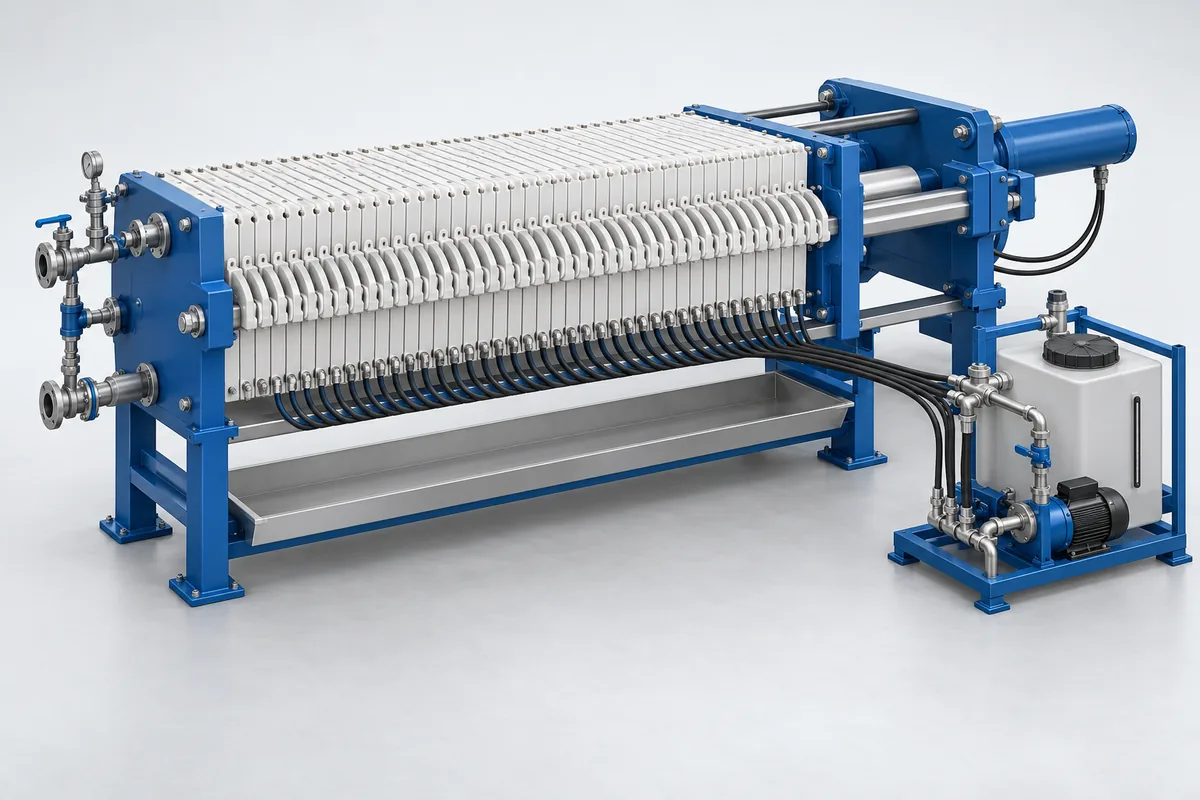
A membrane filter press adds a controlled squeeze after initial cake formation by introducing pressurized water or air behind flexible diaphragms. The diaphragms displace into the cake space and force additional liquid toward the drainage channels.
The inflation medium stays behind the membrane during normal operation. It is separate from the slurry and filtrate.
Many systems alternate membrane plates with rigid recessed plates in a mixed pack. Others use different arrangements. A mixed pack does not mean that a few arbitrary chambers receive squeezing; the plate arrangement is engineered to create the intended squeeze action across the pack.
M.W. Watermark’s plate guide describes this arrangement and the additional manifold and pressurization equipment it requires.
Which Press Produces Drier Filter Cake?
A membrane press can produce drier cake when the material releases more liquid under squeezing, but neither design has a universal final moisture percentage. The useful comparison is a test on your slurry under clearly documented conditions.
A mineral slurry, a metal hydroxide sludge and an organic sludge can behave very differently. Even two batches from one plant may differ after a change in raw materials or chemical conditioning.
The main variables include:
- Particle size, shape and distribution.
- Feed solids concentration and slurry temperature.
- Cake compressibility and permeability.
- Filter cloth selection and cleanliness.
- Conditioning chemicals, cake thickness and pressure profile.
M.W. Watermark specifically identifies cake compressibility as a consideration when recommending membrane squeeze plates. Squeezing is useful when the cake can consolidate and still provide a path for liquid to escape.
That last part matters. Compressing a difficult cake can also restrict its flow paths, so increasing pressure indefinitely is not a reliable route to better results.
Check the measurement basis, too. For a cake described as dry solids plus water, 40% dry solids means 60% moisture on a wet-mass basis. Raising dry solids to 50% changes moisture to 50%: a reduction of 10 percentage points.
Ask suppliers to state that basis explicitly. Otherwise, two attractive moisture claims may describe different measurements.
Does a Membrane Press Always Finish Faster?
A membrane press can shorten the slow final part of filtration, but it does not automatically shorten every complete cycle. Its advantage depends on how much time squeezing saves after allowing for squeeze-system filling, holding and draining.
As cake accumulates, liquid encounters more resistance. The final portion of a chamber filtration cycle can therefore take disproportionately long.
A membrane system can stop feeding at an earlier, validated point and use squeezing to reach the required cake condition. Met-Chem describes substantial cycle reductions in suitable applications, while also noting that results depend on the application. Treat those figures as a reason to test, not a production guarantee.
Measure the whole cycle: filling, filtration, squeezing if fitted, washing if required, depressurization, discharge, and preparation for the next batch.
For example, cutting a complete cycle from 120 to 90 minutes gives a theoretical 33% increase in cycles per hour. That assumes equal dry-solids loading per batch and equal availability. A 25% shorter cycle does not mean a 25% throughput gain.
And if cake discharge is your bottleneck, improving filtration alone may deliver less than you expect.
Membrane vs Chamber Filter Press Cost: Compare the Full Bill
Chamber presses usually have the lower initial price, while membrane presses can have the lower lifetime cost when extra liquid removal creates enough savings. Compare installed equipment, annual operating expenses and useful output together.
A bare machine price leaves out too much. Plate area, chamber volume, materials, automation, installation and required guarantees can all change the quotation substantially.
What Makes a Membrane System More Expensive?
The additional cost usually comes from membrane plates, a squeeze-medium supply system, associated piping and valves, and the controls needed to run them. Replacement diaphragms or membrane plates also belong in the operating budget.
Get both vendors to price the same scope, including:
- Feed equipment and slurry preparation.
- Plate shifting, cloth washing and cake handling.
- Electrical work, foundations and utility connections.
- Commissioning, operator training and initial spares.
- Comparable duty, materials and performance commitments.
I would compare cost per dry tonne processed before deciding which quotation is cheaper. A smaller purchase price can lose its appeal if the press needs extra shifts or produces substantially more wet cake.
How Drier Cake Can Reduce Disposal Costs
Drier cake reduces the wet mass you ship when the quantity of captured dry solids stays constant. That can lower disposal costs where charges depend on wet weight.
Here is a transparent example. These are illustrative assumptions, not a measured plant case study or supplier quotation. Assume an aqueous cake, the same solids capture for both presses, and:
- Captured dry solids: 1,000 kg per operating day.
- Chamber cake: 40% dry solids.
- Membrane cake: 50% dry solids.
- Combined variable hauling and disposal charge: $100 per wet metric tonne.
- Operation: 250 days per year.
The calculation is simple:
Wet cake mass = dry solids mass ÷ dry-solids fraction.
| Calculated result | Chamber case | Membrane case |
|---|---|---|
| Wet cake per day | 1,000 ÷ 0.40 = 2,500 kg | 1,000 ÷ 0.50 = 2,000 kg |
| Water in that cake | 1,500 kg | 1,000 kg |
| Variable disposal cost per day | $250 | $200 |
| Variable disposal cost per year | $62,500 | $50,000 |
The result is 500 kg less wet cake per day, a 20% reduction in shipped mass, and $12,500 in gross annual savings.
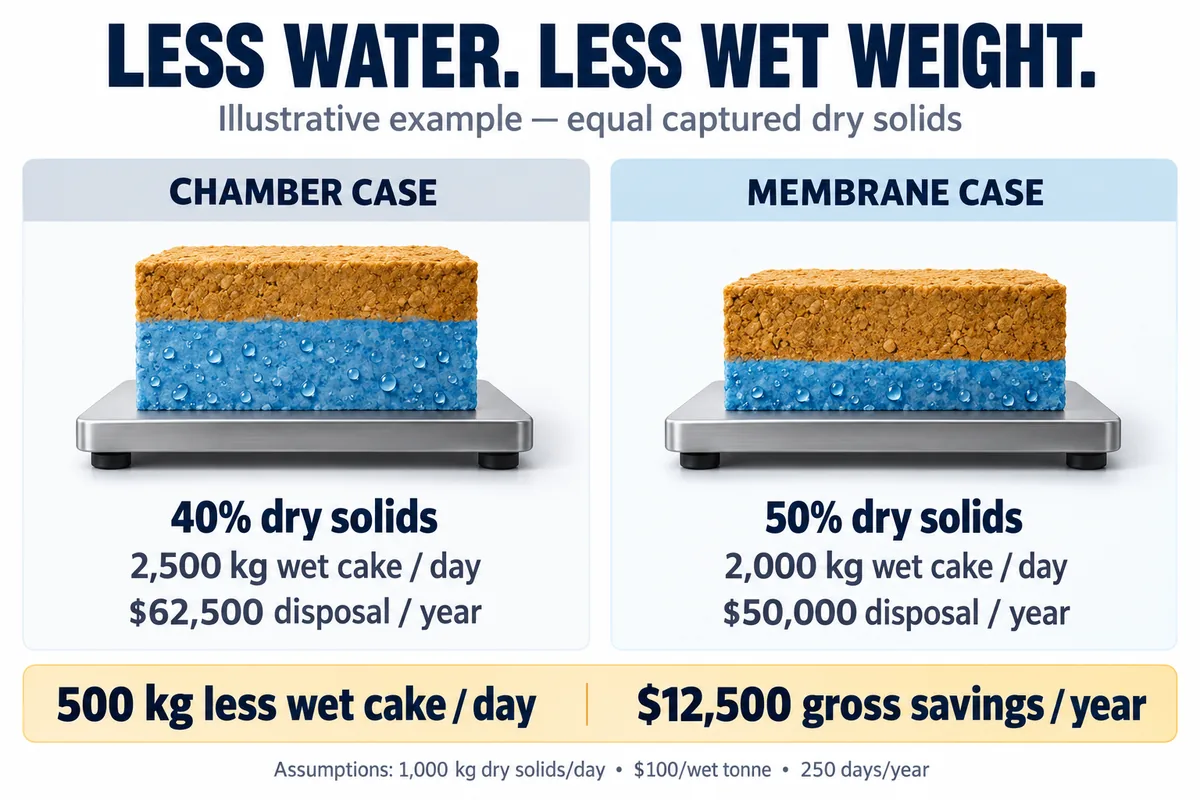
Now subtract the extra membrane-system costs. If additional maintenance and utilities total $3,500 annually, net savings become $9,000. An additional installed investment of $45,000 would then have a five-year simple payback.
This calculation excludes financing, taxes and the time value of money. Actual truck charges may also include minimum loads or fixed collection fees, so fewer wet tonnes will not always translate directly into fewer invoices.
When the Cost Advantage Disappears
A membrane investment becomes harder to justify when squeezing delivers little extra dryness, operating hours are low, or disposal charges barely change with cake mass. The additional equipment still needs maintenance even when its benefits are small.
The opposite can also happen. Recovering valuable liquid or freeing a genuine production bottleneck may justify the investment even when disposal savings are modest.
Count those benefits only where they create usable value. Extra theoretical capacity has no financial return if the rest of the plant cannot use it.
What Changes in Maintenance and Operation?
Both presses need cloth, plate and mechanical maintenance; a membrane press adds diaphragms and a separate squeeze circuit to inspect. The practical difference is the additional failure modes, replacement costs and troubleshooting work.
For both systems, watch cloth blinding, torn cloths, dirty sealing faces, blocked drainage paths and uneven cake formation. A poorly maintained chamber press is a weak baseline for evaluating a new membrane machine.
For the membrane system, add checks for diaphragm condition, squeeze-medium leaks, valves, instrumentation and the supply equipment.
Plate construction affects repair costs. Met-Chem distinguishes welded membrane designs from plates with replaceable diaphragms. Ask whether a damaged membrane requires replacing the diaphragm alone or a larger plate assembly, and confirm the actual spare-part lead time.
Water and air squeezing also need different engineering considerations. Compressed air stores more releasable energy than water at comparable pressure and volume. Use the manufacturer’s approved medium, pressure limits, relief devices and operating sequence.
Before opening or servicing either press, follow its documented isolation and depressurization procedure. Never treat a generic pressure value from a comparison article as an equipment setting.
For maintenance, OSHA’s hazardous-energy guidance explains why electrical, hydraulic and pneumatic energy must be controlled before work begins.
For purchasing, I would ask for a maintenance task list and priced spares schedule. That makes the ongoing workload much easier to compare.
Which Press Fits Your Application?
A chamber press fits when it meets the required dryness and throughput economically; a membrane press fits when tested improvements solve a costly process constraint. Your industry name alone cannot determine the better choice.
Choose a Chamber Press When the Existing Result Is Enough
A chamber press is often the better purchase when conventional pressure filtration meets the cake specification, available operating time is sufficient, and the value of further liquid removal is low.
For example, a plant handling an easily filtered mineral slurry may have enough capacity and acceptable cake moisture already. Paying for more squeezing would need a separate economic justification.
Chamber presses can also use automatic plate shifting and cloth washing. Automation is an equipment specification, not a feature reserved for membrane technology.
Choose a Membrane Press When Extra Dewatering Has Measurable Value
A membrane press deserves closer evaluation when wet-weight disposal is expensive, recovered liquid has value, or the filtration stage limits production. It can also help reduce the water load entering a downstream dryer.
That does not mean it will eliminate thermal drying. Your final moisture specification may still require a dryer, and some moisture remains difficult to remove mechanically.
For chemical, food or pharmaceutical applications, also verify contact materials, cleanability and product-quality requirements. A membrane plate by itself does not establish hygienic suitability or improve product purity automatically.
How to Compare Supplier Proposals Before Buying
Use representative slurry tests and a shared specification to compare suppliers. The strongest proposal connects measured performance to your required daily duty and operating costs.
A laboratory filter press can help compare media, cake formation and filtrate quality. Specify membrane squeezing separately if that function is needed for the trial; a laboratory unit does not automatically include it.
Follow these five steps:
- Define the acceptance targets. State dry-solids throughput, cake moisture, filtrate requirements, available operating hours and any downstream restrictions. Specify how each result will be measured.
- Provide representative samples. Include normal feed and foreseeable difficult batches. Record solids concentration, temperature, chemistry and conditioning. One convenient sample may miss the material that causes production trouble.
- Compare realistic configurations. Test suitable cloths, cake thicknesses and pressure profiles for each design. Record differences so that improvements are not attributed to membranes when another change caused them.
- Measure the complete result. Request dry solids per batch, full cycle time, representative cake moisture, filtrate quality, utility use and cake-release behavior. Repeat runs to establish consistency.
- Translate results into a purchase specification. Ask the supplier to explain scale-up assumptions, guaranteed performance conditions, exclusions and how acceptance testing will work.
Practical tip: Ask for the complete cycle record, not just the driest cake sample. Sample cake across locations using an agreed method; a dry surface can conceal a wetter interior.
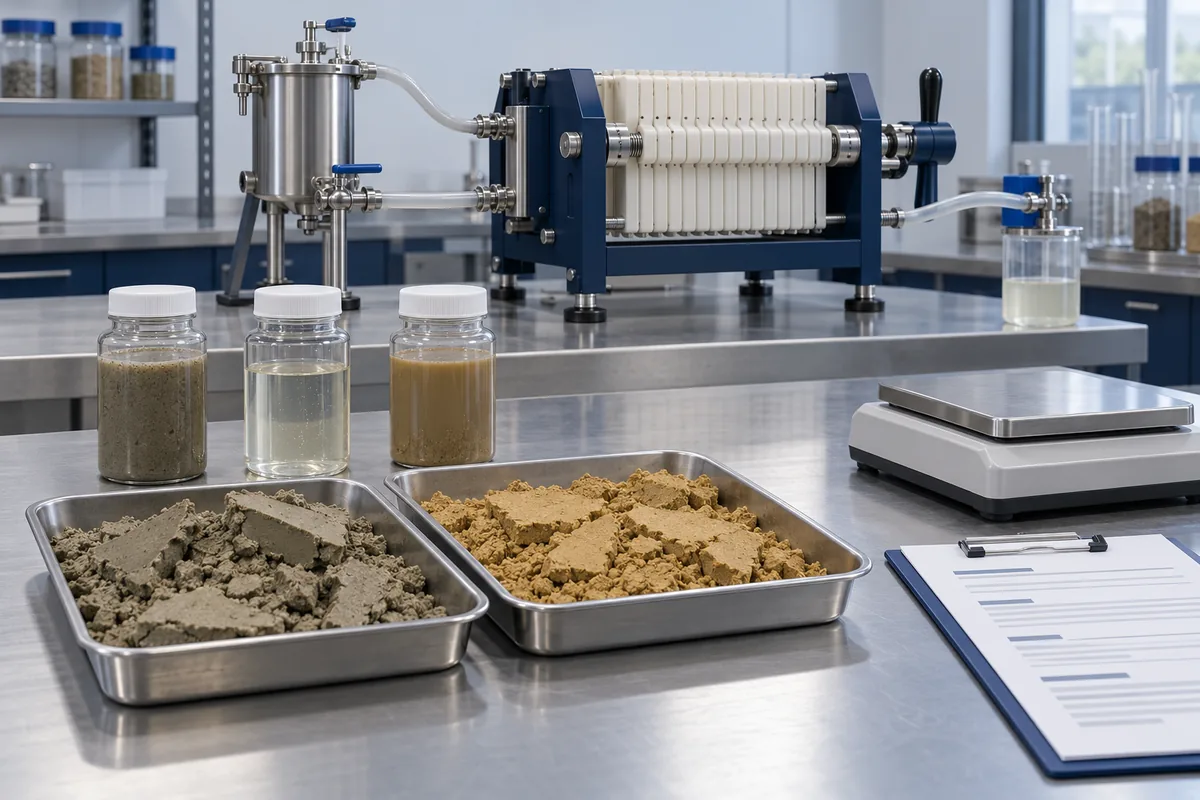
Use the test results to choose the right filter press size, checking chamber volume and filtration area against the complete operating schedule.
Then run the cost calculation again using the measured results. This is where a promising concept becomes a defensible equipment choice.
Frequently Asked Questions
Membranes do not guarantee cleaner filtrate, upgrades need engineering review, and higher pressure does not always improve dryness. Check each point against your process and the proposed equipment.
Does a Membrane Press Produce Cleaner Filtrate?
Not necessarily. Filtrate quality depends on particle retention, cloth selection, cake formation, sealing and operating conditions. Membrane squeezing mainly changes cake dewatering.
Neither design automatically removes dissolved contaminants or makes water suitable for discharge or reuse. Measure the properties required by your process or discharge specification.
Can a Chamber Press Be Converted to a Membrane Press?
Sometimes, but only after the manufacturer or a qualified engineer confirms that the frame, closing system, plates, piping and controls support the proposed conversion.
The work can require a new plate pack and squeeze system, plus changes to controls and utilities. Compare a fully scoped retrofit quotation with a new machine, including downtime and warranty implications.
Does Higher Pressure Always Mean Drier Cake?
No. The result depends on how the cake responds and whether liquid can still flow through it. Higher pressure can produce diminishing returns and must remain within the approved equipment limits.
Use a tested pressure profile and endpoint. Maximum pressure alone is a poor purchasing criterion.
Make the Choice With Your Slurry and Your Numbers
Choose the press that meets your process targets at the best justified total cost. A chamber press may deliver everything you need with simpler equipment; a membrane press may earn its premium through additional liquid recovery, reduced cake mass or useful capacity.
Start with a representative test. Check the complete cycle. Price the maintenance. Then calculate what the improvement is actually worth.
That gives you a practical, evidence-based answer to membrane vs chamber filter press.