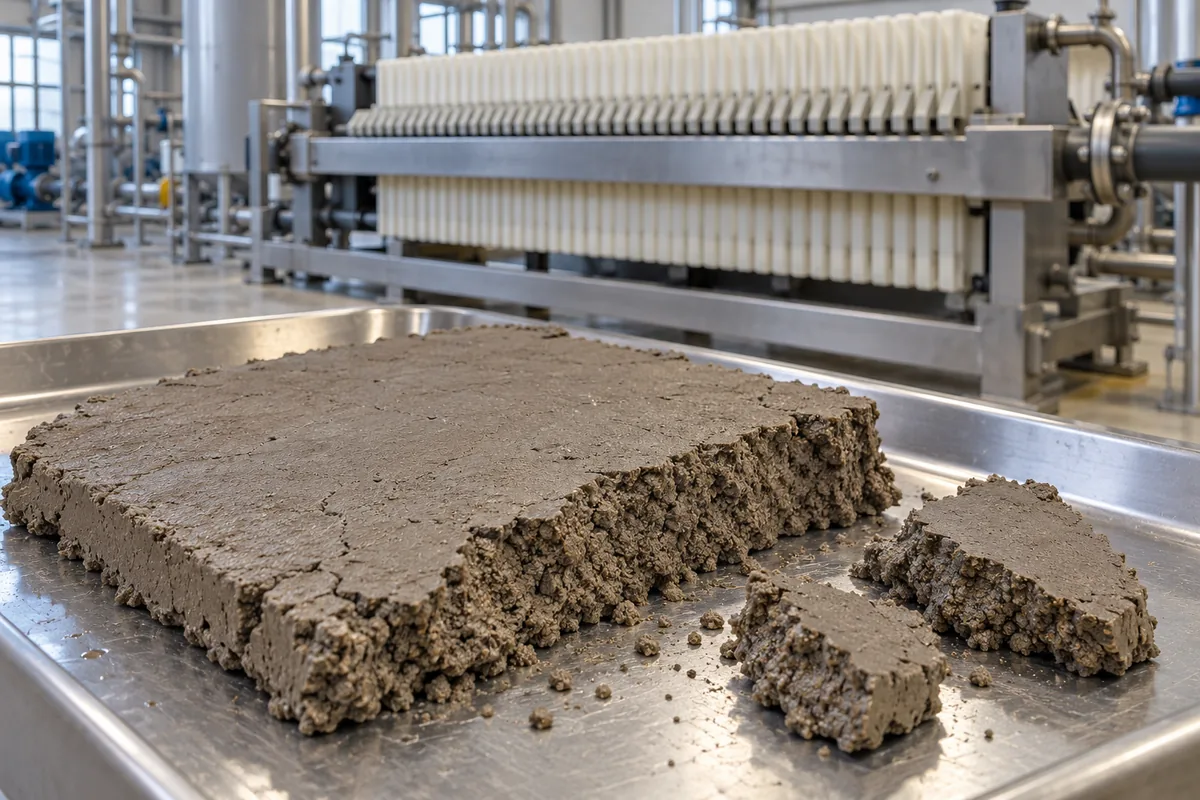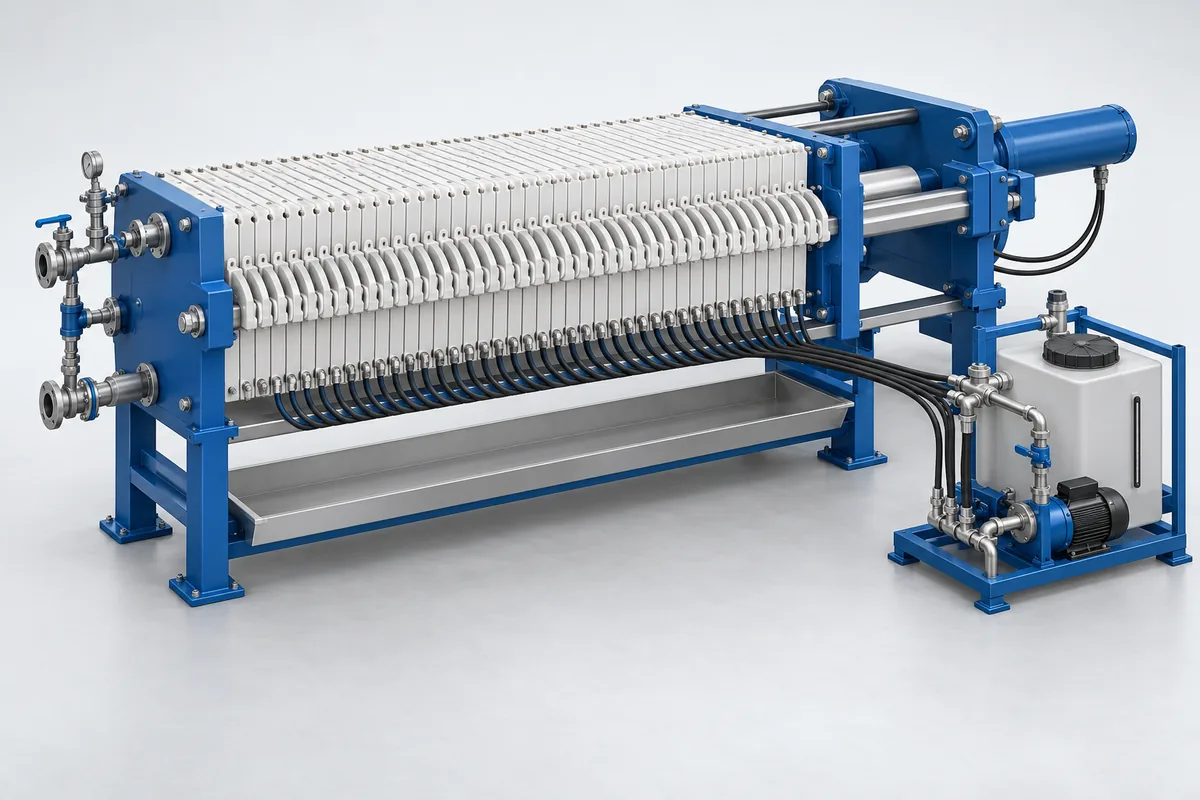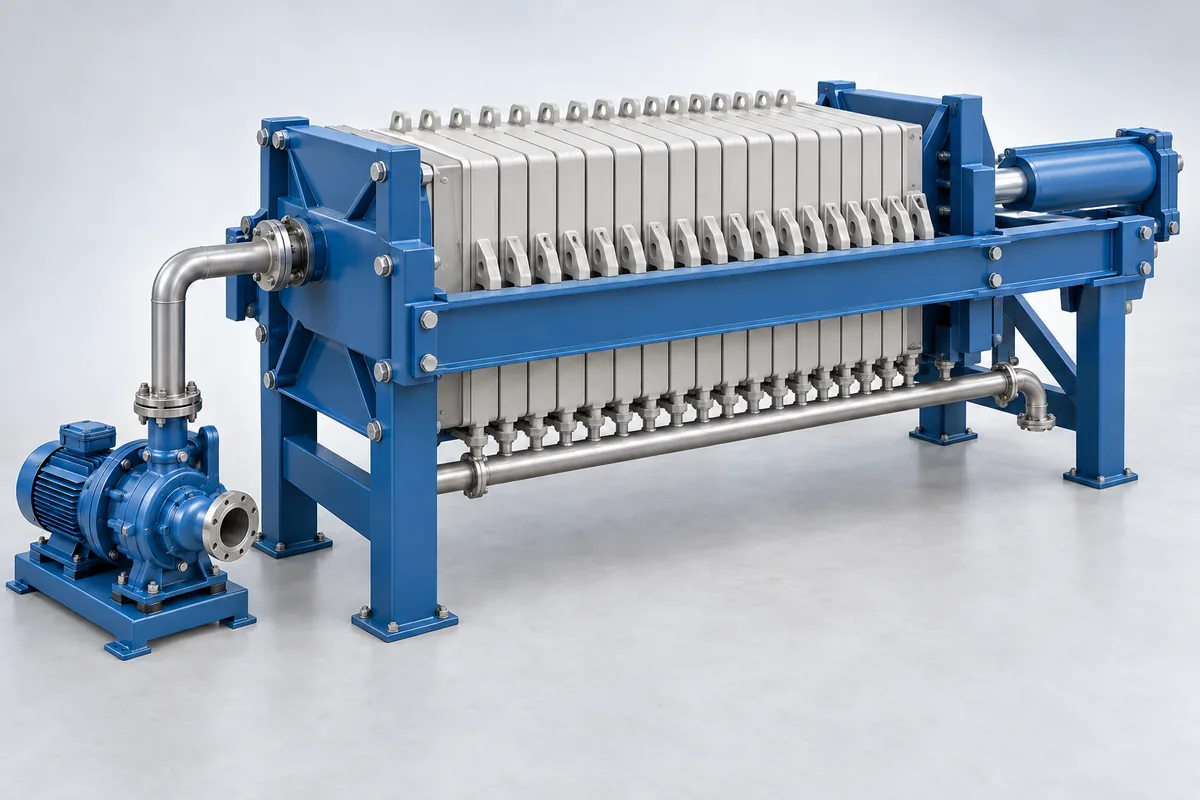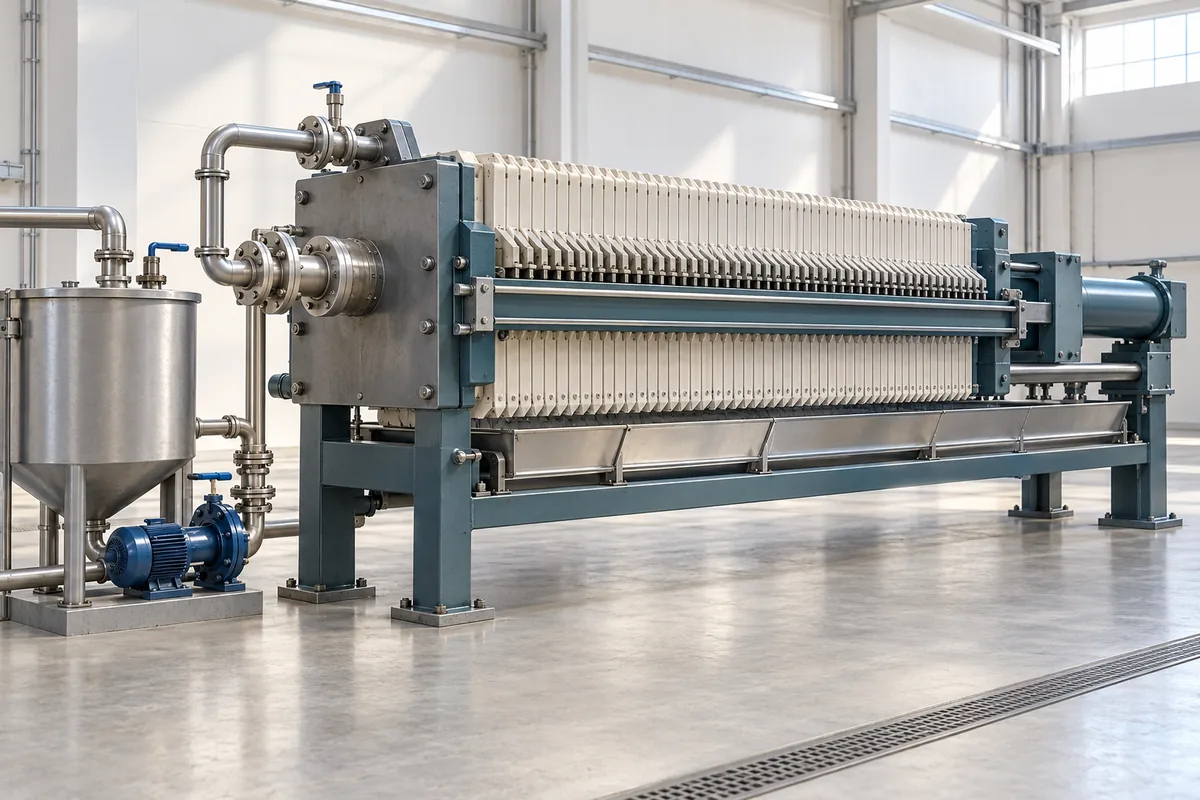
If you’re investigating why filter press cake is too wet, the usual causes are restricted drainage, insufficient effective feed pressure, a short filtration cycle, or poorly conditioned slurry. Changes in feed solids and particle properties can also leave wetter cake, even when the press appears to run normally.
| What you observe | Possible cause | Check first |
|---|---|---|
| Soft cake across most chambers | Changed feed, inadequate conditioning, or incomplete dewatering | Feed solids, cycle history, and measured cake solids |
| High pressure unusually early, with little filtrate | Blinded cloth, restricted drainage, or a feed blockage | Gauge location and flow paths |
| Wet cake in only a few chambers | Local cloth, feed-port, or plate-drainage fault | Cloths and ports at the affected positions |
| Persistently cloudy filtrate | Cloth damage, poor sealing, unsuitable media, or conditioning trouble | Where the solids escape and when cloudiness begins |
| Liquid slurry around the center feed hole | Residual feed-core slurry | Core-blow sequence, if fitted |
| Dryness worsens after a process change | Different solids concentration, particle size, viscosity, or chemistry | Current feed against the last successful baseline |
Use these patterns to choose a test. They aren’t proof of a single fault.
This guide covers recessed-chamber and membrane filter presses. Their settings and optional stages vary, so use your equipment manual for pressure limits, valve sequences, and maintenance procedures.
Measure Cake Moisture Before Changing the Press
Measure the cake’s solids percentage and compare it with your own successful operating baseline. Appearance alone can’t tell you whether dewatering has deteriorated or whether a different material simply handles differently.
A cake can feel firm and still contain substantial water. Another can feel sticky because of its composition, even when its moisture meets the process requirement.
Our guide to filter press cake formation and dryness explains why appearance and measured solids content can tell different stories.
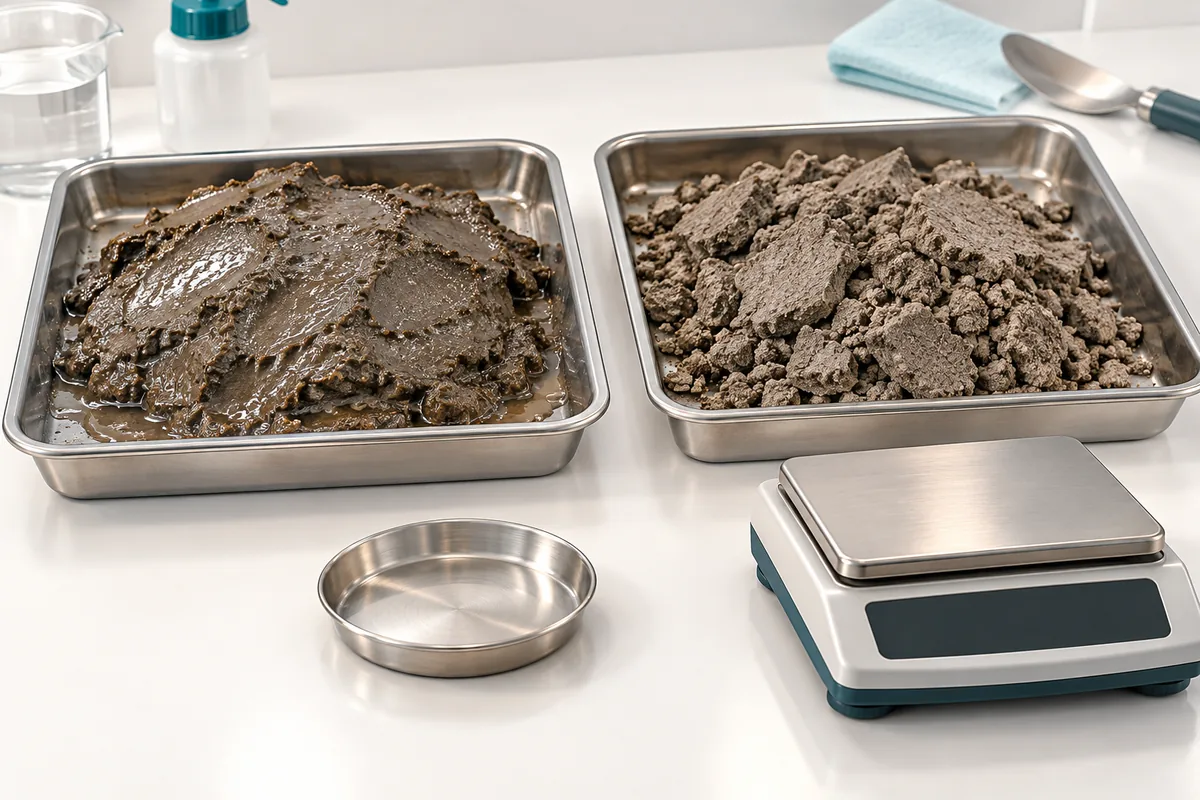
For a water-based cake, using wet-basis percentages:
- Cake solids (%) = dry sample mass ÷ wet sample mass × 100.
- Cake moisture (%) = 100 − cake solids (%).
For example, a 100 g wet sample that leaves 35 g of dry solids contains 35% solids and 65% moisture. Subtract the sample container’s mass from both measurements.
McLanahan’s explanation of cake solids and moisture describes this mass-based measurement and the influence of material characteristics. Use a validated laboratory method suitable for your material; volatile compounds can complicate a simple loss-on-drying result.
For sewage sludge, EPA’s analytical methods and sampling guidance lists Standard Methods 2540 G for total, fixed, and volatile solids. Ask your laboratory to confirm the appropriate method and reporting basis for your samples; an industrial filter cake may need a different approach.
Take samples consistently across the plate pack. Keep visibly wet locations separate for diagnosis, and use a representative sampling plan for the overall result. Sampling only the driest edge can hide a wet center.
There is no useful universal moisture target for every sludge or mineral slurry. Establish yours from handling requirements, downstream specifications, and testing of the actual feed.
8 Causes of Wet Filter Press Cake—and What to Check
Wet cake develops when the press cannot establish or maintain effective liquid removal, or when the feed is harder to dewater than the operating recipe allows. Check the cause that best matches your pressure, flow, and cake observations before changing several settings together.
Before clearing ports, removing cloths, or servicing valves, isolate the equipment, release stored pressure, and follow the site’s lockout procedure. For covered U.S. maintenance work, OSHA’s hazardous-energy standard requires hazardous stored energy to be made safe and isolation verified before work begins. Routine opening for cake discharge follows the manufacturer’s depressurization sequence; pressure adjustments must stay within approved operating limits.
1. Feed Pressure Is Inadequate—or the Reading Is Misleading
Insufficient feed pressure can reduce dewatering, but a high gauge reading does not prove water is leaving the cake. Pressure and flow must be interpreted together.
Three pressures may appear on a membrane press:
- Hydraulic closing pressure holds the plate pack closed against the internal load.
- Slurry feed pressure drives liquid through the cake and cloth during filtration.
- Membrane squeeze pressure expands flexible membranes after the required cake formation stage.
They perform different jobs. Turning up the hydraulic closing pressure is not a substitute for restoring slurry feed pressure. McLanahan’s filter press cycle guide explains the separate clamping, filling, filtration, and optional squeeze stages.
To trace those stages through the equipment, see our step-by-step explanation of how a filter press works.
If feed pressure stays below the established target, check pump performance, suction conditions, bypasses, valve positions, and instrument accuracy. On an air-operated pump, also check the air supply under load.
If pressure rises unusually fast while filtrate flow collapses, investigate restrictions. A gauge upstream of a blocked feed line can report high pressure even while the chambers receive too little slurry.
Compare the whole pressure-and-flow curve with a good cycle. The final number alone leaves too much out.
2. Filter Cloths or Drainage Paths Are Restricted
Filter cloth blinding and blocked drainage channels prevent liquid from escaping, leaving wet cake even at an apparently normal pressure. Fines, scale, oil, and other deposits can reduce permeability before obvious damage appears.
Inspect the cloth surface, seams, feed holes, plate grooves, filtrate ports, and discharge manifold. Where the design allows safe observation, compare drainage from different plate positions.
A repeat problem at the same chamber is a useful clue. Look for a folded cloth, trapped debris, a blocked outlet, or a damaged plate before replacing the entire cloth set.

Follow the supplier’s cleaning procedure and chemical compatibility guidance. Aggressive washing or an unsuitable cleaner can damage the cloth or plate materials.
If cleaning restores flow only briefly, investigate what is causing the fouling. Simply replacing cloths can leave an upstream conditioning problem untouched.
Also distinguish blinding from tearing. Blinding restricts drainage; tears can let solids escape. Micronics’ troubleshooting guidance identifies cloth fit, plugged drain holes, sludge conditioning, and feed-pump pressure as possible causes of poor filtration.
3. Slurry Conditioning No Longer Matches the Feed
Poor slurry conditioning can create particles or flocs that drain badly, break apart, or blind the cloth. Polymer selection and dosage deserve testing when the process depends on chemical conditioning.
The useful question is whether today’s chemistry works with today’s slurry.
Check the polymer product, prepared solution concentration, make-up procedure, dosing-pump calibration, addition point, and mixing conditions. Check pH where it affects your treatment chemistry.
Too little polymer may leave fine particles poorly captured. Too much can produce an unhelpful cake structure or contribute to fouling. More chemical is not automatically more dewatering.
Run jar tests to screen conditioning options, then confirm promising results with filtration tests. A large floc that settles nicely in a beaker may still perform poorly under pressure.
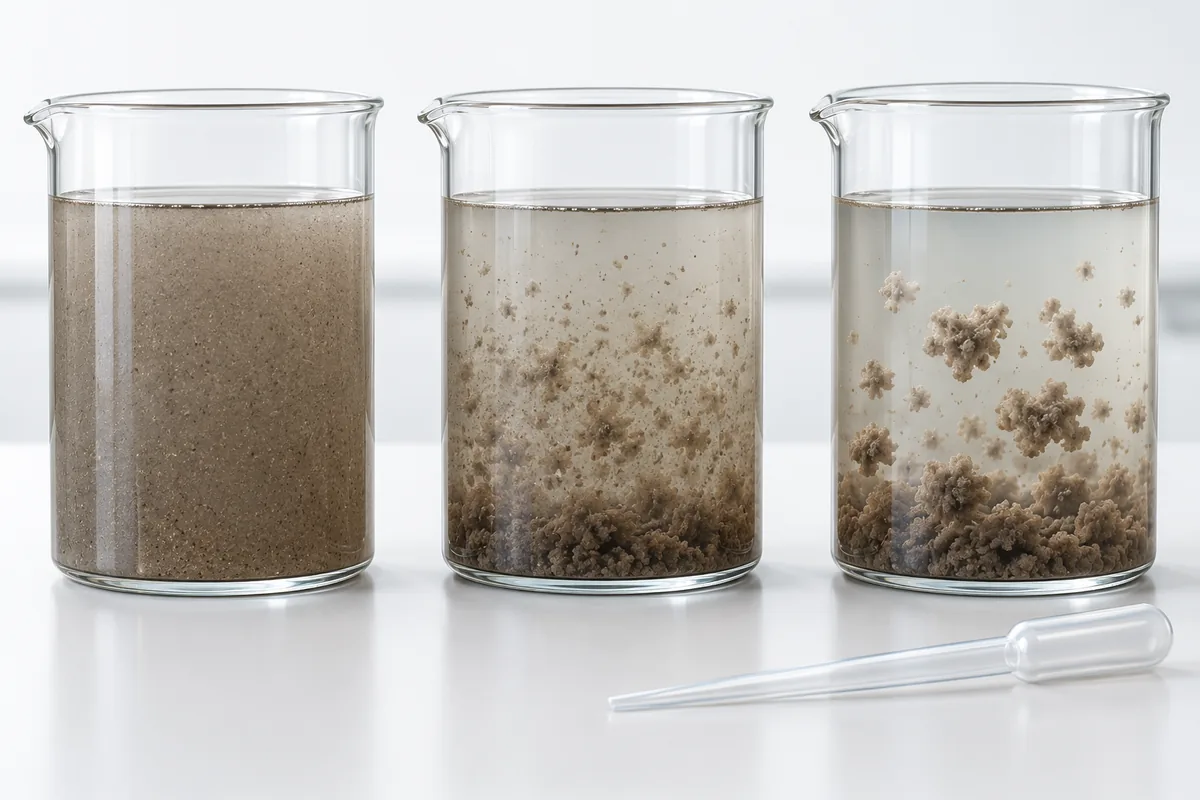
Compare drainage rate, filtrate clarity, cake solids, and chemical use per unit of dry feed solids. The largest-looking floc is only one observation.
Some mineral and process slurries filter successfully without polymer. Investigate conditioning where it belongs in the process; don’t assume every wet cake has the same chemical cause.
4. Feed Solids, Particle Size, or Viscosity Has Changed
Dilute feed takes longer to deliver the same mass of solids, while finer or more water-retentive particles can resist dewatering. An unchanged timer can therefore produce a different cake after an upstream process change.
Suppose feed solids fall from 4% to 2% by mass. Delivering 100 kg of dry solids now requires 5,000 kg of slurry instead of 2,500 kg, assuming the same solids capture. That doubles the slurry mass the system must process.
It does not mean cycle time will exactly double. Pump behavior and filtration resistance also matter.
Review thickener performance, dilution water, tank mixing, solids settling, product changes, and cleaning discharges. Record temperature if it varies enough to affect liquid viscosity.
Particle size distribution matters too. Fine particles have more surface area per unit mass and can form less permeable cakes. Clay-rich or organic material may retain water that ordinary pressure filtration cannot readily remove.
A material limit needs a process solution. If the target remains out of reach after restoring normal operation, test alternative conditioning, filter aids, or downstream drying with a qualified supplier.
5. The Filtration Cycle Ends Before Useful Dewatering Is Complete
A short cycle leaves removable liquid behind when the press stops while productive filtration is still occurring. However, extending every cycle indefinitely sacrifices throughput for diminishing moisture reduction.
Review how the machine decides filtration is complete. Depending on the system, the endpoint may involve time, feed flow, pump behavior, or a combination of conditions.
A timer that worked with one feed may stop too early with another. A flow instrument or control setting can also trigger an incorrect transition.
For comparable batches, test a modest, approved increase in filtration time. Record the extra filtrate, final cake solids, and total cycle duration.
If the additional time produces a meaningful improvement, adjust the recipe through your operating procedure. If little liquid leaves and cake solids barely change, return to cloth permeability, feed properties, and drainage restrictions.
McLanahan’s cake-moisture guidance shows why this happens: water removal is rapid early in the cycle and slows as the cake develops. The best endpoint balances dryness with dry-solids throughput.
6. Chamber Filling or Cake Thickness Is Unsuitable
Uneven chamber filling and excessive cake thickness for the application can leave poorly dewatered regions. The remedy depends on chamber geometry and feed distribution, rather than a blanket instruction to shorten filling.
In a recessed-chamber press, plate recesses establish the available chamber depth. Filling those chambers is part of normal cake formation. Calling every wet, thick cake “overfilled” can send troubleshooting in the wrong direction.
Compare cake thickness and formation across the pack. Inspect feed passages, cloth fit, plate condition, and the approved plate arrangement if some chambers form thin or incomplete cakes.
A wet center can suggest incomplete cake formation or slower drainage through the cake’s interior, but the pattern is not unique to either problem. Confirm it with pressure, flow, and sampling data.
Thicker chambers generally require longer filling and filtration, as described in McLanahan’s cycle-time guidance. If chamber depth is a persistent limitation, ask the manufacturer about a suitable configuration and validate it with representative feed tests.
7. The Membrane Squeeze Stage Is Ineffective
A membrane press can discharge wetter cake when its squeeze stage is skipped, interrupted, or unable to reach the approved operating condition. First establish that the press actually has membrane plates and that its required filling conditions were satisfied.
Check the squeeze sequence, pressure record, supply system, valve operation, alarms, and evidence of membrane leakage. Follow the manufacturer’s inspection procedure; do not improvise pressurization tests.
A squeeze-pressure reading alone doesn’t establish that every membrane is working as intended. Compare the expected squeeze behavior with actual filtrate release and final cake solids.
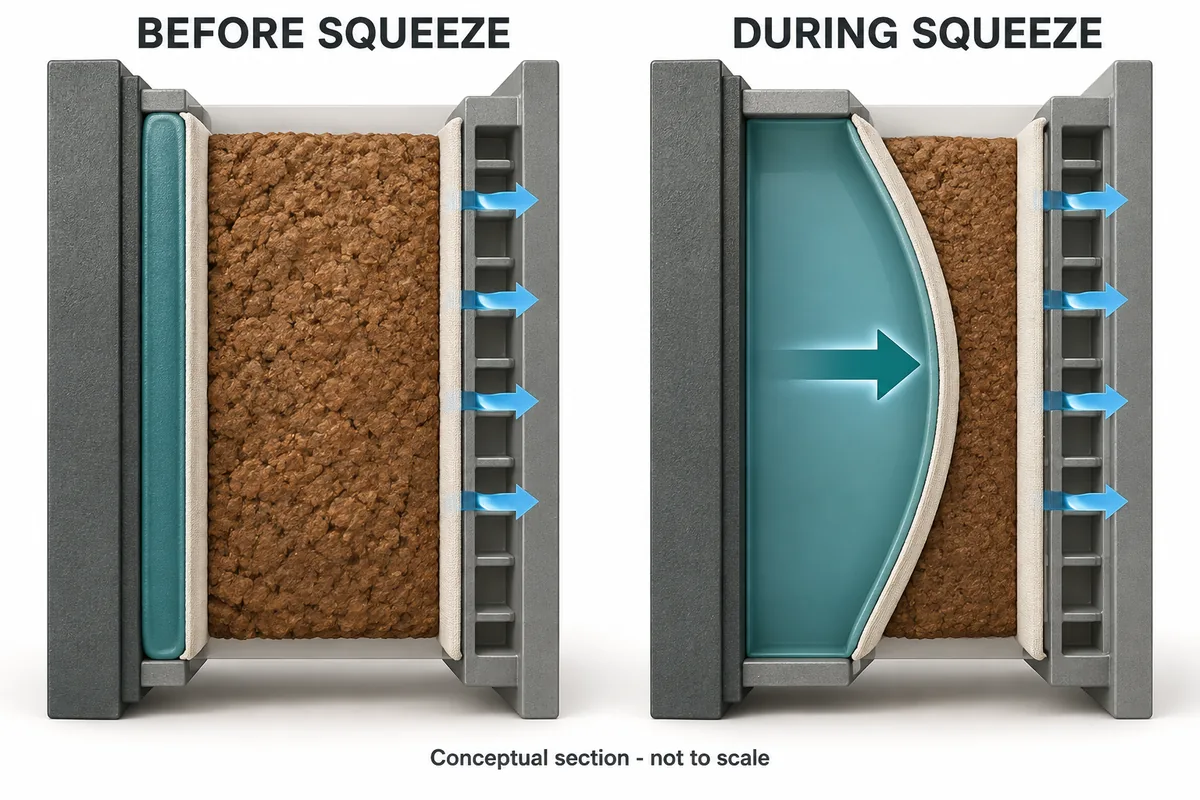
Longer squeezing is useful only while it produces worthwhile additional dewatering. A membrane stage cannot fully compensate for blocked drainage or unsuitable feed preparation.
For a conventional recessed-chamber press, a membrane squeeze is an equipment option to evaluate through testing, not an operating step that can simply be switched on.
Our membrane-versus-chamber filter press comparison explains the additional equipment, maintenance, and cost factors to assess alongside cake dryness.
8. Residual Core Slurry or an Ineffective Air Blow Rewets the Cake
Slurry left in the feed core can spill onto otherwise well-formed cake during discharge. If wet material is concentrated around the central feed hole, inspect the core-clearing system where one is installed.
Core blow and cake air blow have different purposes. Core blow clears residual slurry from feed passages. Cake air blow pushes air through the formed cake to displace additional liquid.
Check the designed valve sequence, available air supply, and discharge route. For cake air blow, poor cake formation or preferential air channels may let air escape without removing much additional water.
Use these stages only on equipment designed for them. Both their pressure limits and their sequence depend on the particular press.
Also check for unwanted wash-water entry after dewatering. Filter cake washing removes or displaces soluble material; it should not be treated as a drying step. Water introduced during washing still needs to be removed afterward.
Use a Six-Step Troubleshooting Test Plan
Record a baseline, isolate the most likely fault, and change one controlled variable at a time. This gives you evidence you can use across shifts and helps prevent an apparent improvement from masking a new problem.
- Define the failure. Record cake solids, handling behavior, and whether the issue affects every chamber or specific locations.
- Capture a complete cycle. Log feed solids, pressure, filtrate flow or volume, filtrate clarity, stage durations, and relevant alarms.
- Compare with a successful batch. Look for changes in feed, chemistry, maintenance, cloths, and operating settings.
- Test the strongest explanation. Check a suspect drainage path, verify dosing, or trial an approved timing adjustment. Avoid changing pressure, polymer, and time together.
- Measure the tradeoff. Compare cake solids with cycle time, solids capture, chemical use, and dry solids processed per hour.
- Repeat and document. Confirm the result on comparable batches, then update the operating recipe or maintenance procedure.
I recommend a simple cycle log over a long list of unrecorded adjustments. A modest improvement you can reproduce is far more useful than one unusually dry batch.
See What Better Cake Solids Means for Disposal Weight
Raising cake solids reduces the wet mass hauled away when the captured dry-solids mass stays constant. This worked example shows the arithmetic; it is not a reported plant trial or a promised performance gain.
Assume a plant captures 1,000 kg of dry solids per day:
| Measure | At 25% cake solids | At 30% cake solids |
|---|---|---|
| Cake moisture, wet basis | 75% | 70% |
| Total wet-cake mass | 4,000 kg/day | 3,333 kg/day |
| Water in discharged cake | 3,000 kg/day | 2,333 kg/day |
The calculation is straightforward: wet-cake mass = dry-solids mass ÷ cake-solids fraction.
Moving from 25% to 30% solids reduces wet-cake mass by approximately 667 kg per day, or 16.7%. That is a five-percentage-point increase in solids content—not a five-percent reduction in haulage weight.
The financial benefit depends on actual disposal charges, transport arrangements, chemical costs, energy, and throughput. Include added conditioning solids in the mass balance if treatment changes. A drier cake that takes much longer to produce may not give the lowest total cost.
Frequently Asked Questions About Wet Filter Cake
Use measured cake solids and the complete cycle record to judge dryness, pressure, and timing. The following answers address common decisions that those measurements help resolve.
Will Increasing Pressure Always Make the Cake Drier?
No. Higher feed pressure can help some slurries, but it cannot clear a blocked drain or guarantee better dewatering from a highly compressible cake. Compression can reduce permeability, so test the response within the press’s approved limits and compare both moisture and cycle time.
Does Clear Filtrate Mean the Cake Is Dry Enough?
No. Clear filtrate indicates good visible solids retention, but it does not establish the cake’s moisture content. A press can retain particles effectively while removing water too slowly. Measure cake solids separately.
When Should You Consider New Equipment?
Consider a different configuration when testing shows that your current press cannot meet the required dryness and throughput after maintenance and process settings are corrected. Ask suppliers to test representative slurry and state the achieved cake solids, cycle time, chemical consumption, and operating conditions.
An equipment proposal becomes much easier to assess when it includes results from your material.
Use our filter press sizing guide to connect those results with dry-solids loading, chamber volume, and the available operating schedule.
Start With the Evidence From Your Next Cycle
The most useful next step is to collect cake samples and compare pressure, flow, and feed conditions with a successful run. Those observations show whether to investigate drainage, conditioning, cycle control, or the material itself.
Keep the changes controlled. Verify the result. Then make the successful fix part of the routine.
That gives you a repeatable way to identify and resolve why filter press cake is too wet.