The calculation for sizing a filter press starts with your daily dry solids load: convert it to wet cake volume, then divide by the number of complete cycles you can run each day. Choose a press with enough chamber volume and filtration area to reach the required cake dryness within that cycle time.
| Sizing input or result | Example value | What it tells you |
|---|---|---|
| Daily slurry volume | 20 m³/day | Feed volume to process |
| Slurry density and feed solids | 1,050 kg/m³; 8% by mass | 1,680 kg of dry solids per day |
| Cake solids and wet cake density | 35% by mass; 1,200 kg/m³ | 4.00 m³ of wet cake per day |
| Complete cycles per day | 3 | 1.33 m³ of cake per cycle |
| Illustrative capacity allowance | 20% | 1.60 m³ required chamber capacity |
| Chamber depth | 32 mm | Approximately 100 m² of two-sided filtration area |
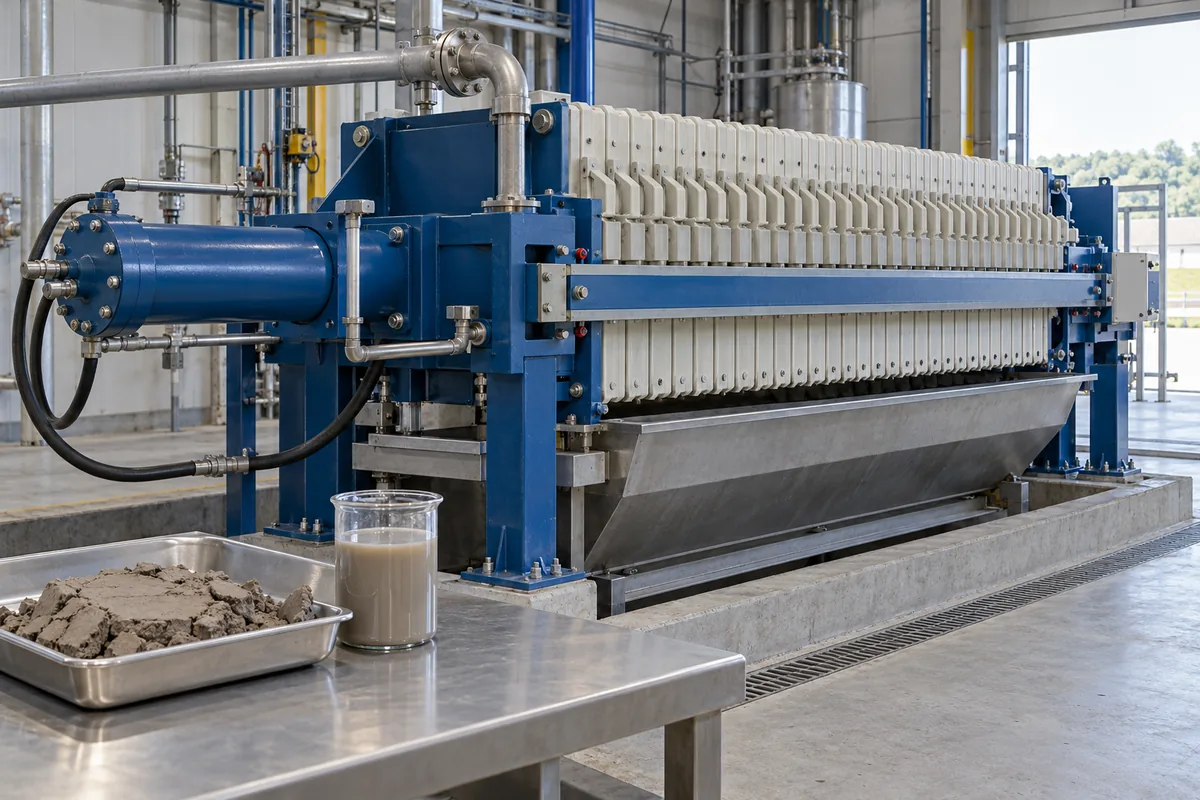
A press may have enough room for the cake and still miss your daily production target. Filling, washing, discharge, and preparation for the next batch all take time.
These calculations apply to a batch recessed-chamber filter press. Membrane presses also need a check of chamber loading before squeezing, since the compressed cake occupies less space. The numerical examples are hypothetical; use representative filtration tests to establish your design inputs.
For wastewater applications, the U.S. EPA’s recessed-plate filter press fact sheet explains how the equipment removes water from liquid residuals to produce cake and covers design criteria, performance, and maintenance.
1. Collect the Process Data That Controls Press Capacity
Start with slurry volume, feed solids concentration, slurry density, achievable cake solids, wet cake density, and available operating time. Record both the normal operating range and the difficult conditions the press must handle.
- Feed quantity: cubic meters or US gallons of slurry per day.
- Feed solids: dry solids as a percentage of total slurry mass.
- Slurry density: kilograms per cubic meter or pounds per US gallon.
- Cake target: required solids percentage or moisture percentage, with the measurement basis stated.
- Wet cake density: mass per unit volume of the formed cake.
- Operating window: hours available for complete press cycles.
- Process conditions: temperature, pH, particle size, abrasiveness, and chemical conditioning.
- Quality requirements: filtrate clarity, solids capture, cake washing, and acceptable cake handling properties.
Sample the slurry your plant normally processes, including difficult batches. A sample from an unusually easy run can make the expected cycle time look shorter than it is.
McLanahan identifies slurry solids, particle size distribution, chamber thickness, cake solids, and permeability as major factors affecting dewatering. Its guidance also recommends testing material before sizing equipment because filtration behavior varies between applications.
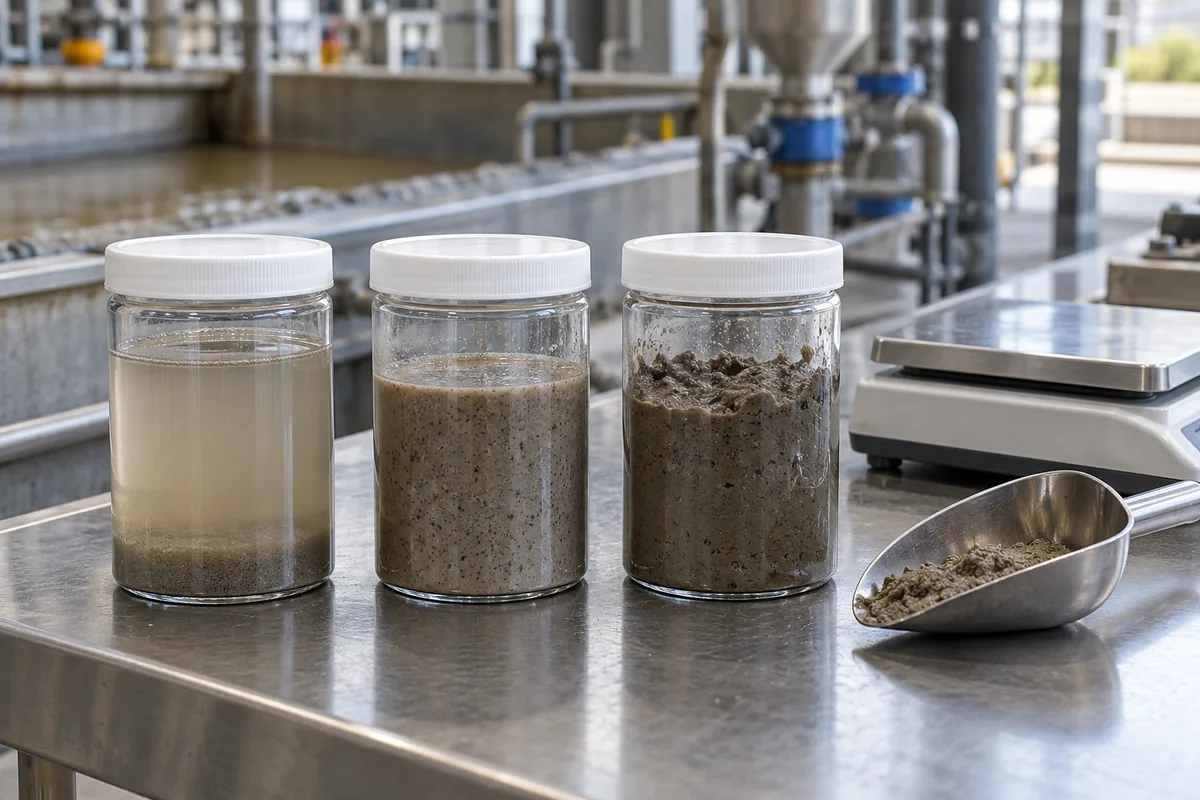
Keep Feed Solids, Cake Solids, and Moisture Separate
Feed solids describe the incoming slurry; cake solids describe the material discharged from the press. On a wet-mass basis, cake solids percentage plus cake moisture percentage equals 100%.
For example, a cake containing 35% dry solids contains 65% moisture by mass. Enter 0.35 as the cake solids fraction in the equations below.
Do not substitute the 8% feed solids concentration for that value. Doing so would calculate the volume of a much wetter material and distort the required chamber capacity.
Also check whether a laboratory report gives moisture on a wet or dry basis. The simple subtraction from 100% applies to wet-basis moisture.
2. Calculate the Daily Dry Solids Load
Multiply daily slurry volume by slurry density and the feed solids mass fraction to calculate the dry solids entering the press each day. Keep all three inputs in compatible units.
Daily dry solids, M = Q × ρs × xs
Where:
- Q = slurry volume, m³/day.
- ρs = slurry density, kg/m³.
- xs = feed solids mass fraction.
- M = dry solids load, kg/day.
For the example:
20 × 1,050 × 0.08 = 1,680 kg/day of dry solids.
If you work in US units, multiply US gallons per day by slurry density in lb/US gal and the solids fraction. The result is pounds of dry solids per day. Keep the cake density in compatible units when you calculate volume.
Use the slurry’s measured density. Mineral slurries can differ substantially from water, and using water density carries that error straight into the calculated solids load.
Lime, filter aid, and chemical precipitates can add to the solids retained in the chambers. A sample of fully conditioned feed may already include them. For measurements taken upstream of conditioning, add the retained conditioning solids separately so you count them once.
The example assumes all incoming suspended dry solids are retained. If capture losses or recirculation are significant, use a complete process mass balance and check the filtrate requirements as well.
3. Convert Dry Solids Into Wet Cake Volume
Divide the retained dry solids by the cake solids fraction to obtain wet cake mass, then divide by wet cake density to obtain cake volume. Use cake properties measured at the same dewatering condition.
Wet cake mass = M ÷ xc
Daily cake volume = M ÷ (xc × ρc)
Here, xc is the cake solids mass fraction and ρc is the wet cake density in kg/m³.
Using 35% cake solids and a wet cake density of 1,200 kg/m³:
- Wet cake mass = 1,680 ÷ 0.35 = 4,800 kg/day.
- Wet cake volume = 4,800 ÷ 1,200 = 4.00 m³/day.
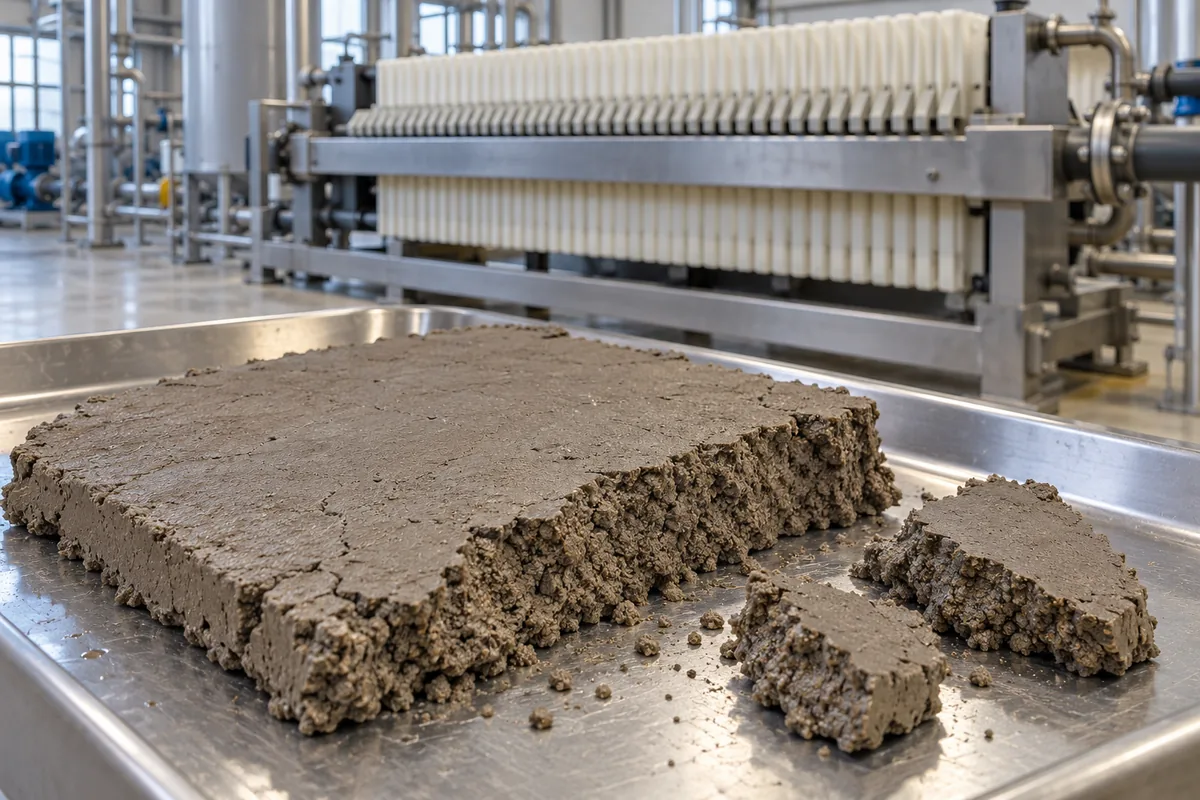
Use the density of the formed cake. Mineral-particle density excludes the retained liquid and pore space, while the loose bulk density of broken cake in a disposal bin can differ from the cake’s density inside the press. Neither value should be substituted without checking the measurement basis.
For a membrane filter press, final cake volume alone can understate the chamber volume needed before squeezing. Ask the supplier to check the initial fill volume against the retained dry solids per cycle and final cake properties, using test results.
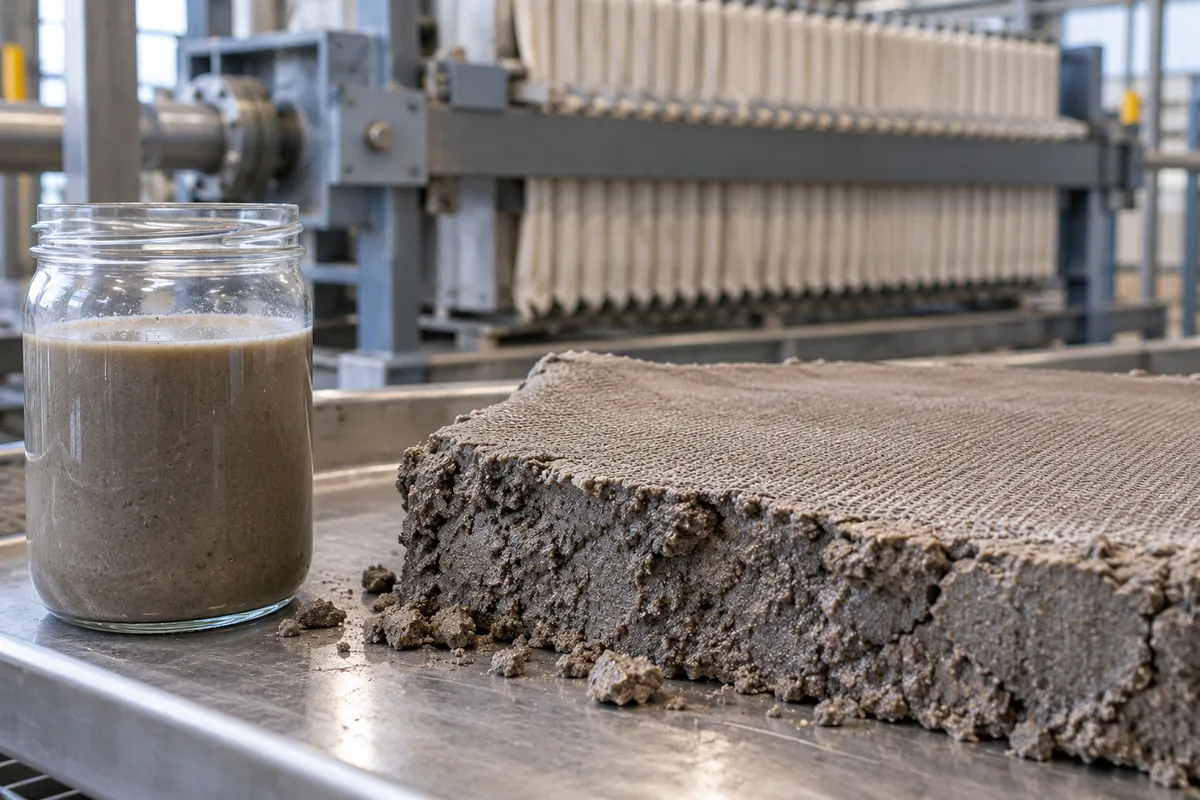
4. Count Complete Cycles Within Your Operating Window
Divide the available operating hours by the full cycle duration to estimate cycles per day. For a shift that must finish with an empty press, round down to the number of complete cycles that fit.
Complete cycles = round down (available hours ÷ full cycle hours)
Count every step needed before the next batch can start: plate closing, filling and filtration, any washing or squeezing, air blowing, depressurization, discharge, and routine cloth cleaning. Include only the steps your process uses.
For example, a recessed-chamber cycle might take:
| Cycle step | Assumed time |
|---|---|
| Plate closing and preparation | 10 minutes |
| Filling and filtration | 90 minutes |
| Depressurization and cake discharge | 25 minutes |
| Routine cloth cleaning | 10 minutes |
| Total | 135 minutes, or 2.25 hours |
Assume an eight-hour shift has 30 minutes reserved for daily work outside these cycles. That leaves 7.5 hours.
7.5 ÷ 2.25 = 3.33, so plan for three complete cycles. Those cycles occupy 6.75 hours and leave 45 minutes within the available window.
Keep routine cycle cleaning in the cycle time and separate maintenance outside it. Subtracting the same allowance in both places would count that downtime twice.
A continuously operated press may finish a batch in the next shift. Calculate its throughput over the actual operating schedule, including downtime. Rounding down by shift applies when the press must finish empty each day.
Check How Slower Cycles Change the Required Size
Fewer cycles increase the cake volume each batch must hold. If the example falls from three cycles to two, its base chamber requirement rises from 1.33 m³ to 2.00 m³ per cycle.
With the same 20% allowance, the requirement rises from 1.60 m³ to 2.40 m³. That is a 50% increase caused entirely by the operating schedule.
I would check the complete cycle before comparing plate sizes. Slow cake discharge can erase the time saved by a short filtration stage.
5. Build Your Filter Press Design Calculation
Calculate the chamber-volume requirement from the dry solids load, cake properties, complete cycles, and a documented capacity allowance. Give the supplier those inputs along with the result so they can verify the proposed press.
Required chamber volume = M × (1 + a) ÷ (xc × ρc × N)
Where a is the fractional capacity allowance and N is complete cycles per day.
For the example:
1,680 × 1.20 ÷ (0.35 × 1,200 × 3) = 1.60 m³ per cycle.
That equals 1,600 liters, or approximately 56.5 ft³, of required chamber capacity.
The 20% allowance is an assumption for this example. Set yours from measured feed variability, confidence in the test results, planned growth, and the cost of missed production. If you have already used the peak design load, record what the extra allowance is meant to cover.
The proposed press still has to fill, dewater, and discharge within the assumed time. Check its full cycle at the design load, including the extra capacity allowance.
How to Size a Filter Press Calculator: Inputs and Formula
Check the density, cake solids, cycle count, and capacity allowance behind any calculator result. You can run the same calculation in a spreadsheet with seven inputs.
| Cell | Input | Example entry |
|---|---|---|
| B2 | Daily slurry volume, m³/day | 20 |
| B3 | Slurry density, kg/m³ | 1050 |
| B4 | Feed solids by mass | 8% |
| B5 | Cake solids by mass | 35% |
| B6 | Wet cake density, kg/m³ | 1200 |
| B7 | Complete cycles per day | 3 |
| B8 | Capacity allowance | 20% |
Enter this formula in the output cell:
=B2*B3*B4*(1+B8)/(B5*B6*B7)
The result is 1.60 m³. Enter the percentage cells as percentages, not whole numbers such as 8 or 35. Densities, cake solids, and cycle count must be positive; a zero-cycle schedule cannot meet the daily load.
M.W. Watermark also provides a filter press sizing calculator for preliminary equipment selection. Whichever tool you use, replace assumed cake properties and cycle times with test data before making a purchase decision.
6. Use a Filter Press Sizing Chart to Compare Loads
Use a sizing chart only with its stated assumptions. These chamber requirements assume 35% cake solids, 1,200 kg/m³ wet cake density, three complete cycles per day, and a 20% capacity allowance.
| Dry solids load | Required chamber volume | Approximate volume |
|---|---|---|
| 250 kg/day | 0.238 m³ | 8.4 ft³ |
| 500 kg/day | 0.476 m³ | 16.8 ft³ |
| 1,000 kg/day | 0.952 m³ | 33.6 ft³ |
| 1,680 kg/day | 1.600 m³ | 56.5 ft³ |
| 2,500 kg/day | 2.381 m³ | 84.1 ft³ |
| 5,000 kg/day | 4.762 m³ | 168.2 ft³ |
These are calculated requirements, not ratings for particular commercial machines. Select an available configuration that meets or exceeds the unrounded requirement and passes the cycle-time check.
For comparison, Micronics publishes a manufacturer sizing chart based on 32 mm cake chambers. Changing chamber depth or chamber count changes capacity even when the nominal plate size stays the same.
Run the formula again with less favorable inputs, too. If cake solids fall from 35% to 25%, holding density and cycles constant for illustration, the example’s required capacity increases from 1.60 m³ to 2.24 m³. Actual cake density and cycle time may also change, so test those together.
Need a filter press sized for your slurry?
Send your material, throughput with units, feed solids if known, and project country. We can review the available information and discuss a suitable configuration.
Request a Model Recommendation → https://filter-press.org/contact-us/
7. Verify Filtration Area and Select the Plate Configuration
Check both chamber volume and effective filtration area against the tested cycle. Chamber geometry gives you a preliminary cross-check; the supplier’s data and filtration results establish what the proposed plate pack can do.
For an ideal recessed chamber with two active filtering faces, when the quoted area counts both faces:
Total filtration area ≈ 2 × chamber volume ÷ chamber depth
Using the example’s 1.60 m³ requirement and 32 mm chamber depth:
A ≈ 2 × 1.60 ÷ 0.032 = 100 m².
The factor of two accounts for the filtering face on each side of the chamber. Check how the supplier counts area before using this relationship. Ports, support bosses, edge geometry, and membrane movement can affect the actual catalog values.
When you compare recessed chamber filter press specifications, read the filtration area, chamber volume, and cake thickness together. Confirm the quoted configuration against the machine drawing.
Geometry alone cannot predict filtration speed. Ask for the tested dry solids loading per square meter per cycle at your intended cake thickness and operating conditions. Divide the design dry solids per cycle by that loading, keep the area convention consistent, and check the full cycle time used in the test.
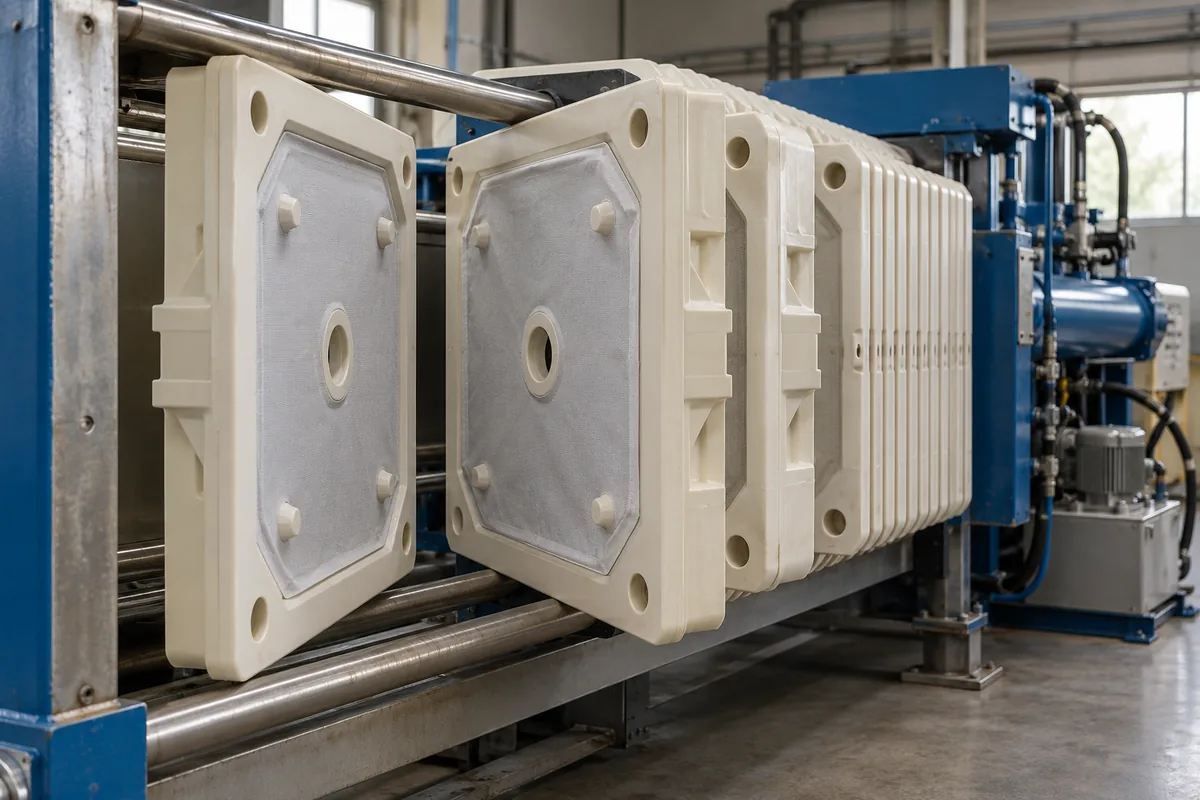
Convert Chamber Capacity Into a Chamber Count
Divide the required total volume by the supplier’s usable volume per chamber and round up. Then verify the resulting plate pack’s area, length, and operating performance.
Suppose a candidate chamber holds 28 liters:
- Required chambers = 1,600 ÷ 28 = 57.14.
- Round up to at least 58 chambers.
- If the available configuration has 60 chambers, total capacity is 1,680 liters.
The 28-liter figure is illustrative and does not identify a particular plate size. Ask for the actual chamber-volume and effective-area data for the quoted configuration.
Check whether the quotation counts chambers or plates. End plates and mixed membrane arrangements can change how the supplier describes the pack, so use the drawing and bill of materials.
Check Daily Capacity From the Selected Machine
Multiply usable chamber volume by wet cake density, cake solids fraction, and achievable cycles to cross-check the selected machine’s daily dry solids capacity. This assumes the chambers fill effectively at the stated cake condition.
For the illustrative 60-chamber selection:
1.68 × 1,200 × 0.35 × 3 = 2,116.8 kg/day.
That exceeds the example’s 2,016 kg/day design load, which includes its 20% allowance. It remains conditional on achieving the assumed cake properties and three complete cycles.
At two cycles, capacity falls to 1,411.2 kg/day. The same press would then miss even the original 1,680 kg/day load.
8. Confirm the Pump, Plate Type, and Installation Space
Confirm the feed system, plate design, cloth, and discharge arrangement before selecting the machine. A suitable chamber volume is only one of the requirements. The filter press types guide explains how plate arrangements differ from options such as automation and construction materials.
The feed pump must deliver the filling flow and filtration pressure needed throughout the cycle. The EPA’s design report on recessed plate filter presses describes a high initial flow at low back pressure, followed by falling flow as solids accumulate and pressure rises. Dividing daily slurry volume by shift hours gives an average process flow, so you still need to check the pump’s full operating range.
Check whether the process benefits from membrane squeezing, cake washing, or air drying. McLanahan’s guide to filter press options describes how these features change the equipment arrangement and operating sequence.
Check the plate terminology in the quotation. CGR means caulked, gasketed, and recessed, as defined by Micronics. The term describes a plate and sealing arrangement; it does not establish a larger cake capacity by itself.
Before approving the layout, check:
- Space for the fully opened plate pack and maintenance access.
- Clearance for cake bins, conveyors, and discharge equipment.
- Access for replacing plates and filter cloths.
- Feed storage needed while the press is unavailable to accept slurry.
- Electrical, wash-water, compressed-air, and squeeze-system requirements.
- Chemical compatibility and pressure/temperature ratings of wetted components.
9. Verify the Design With Representative Filtration Tests
Test cake solids, filtrate quality, cake release, and cycle performance under the conditions used in your sizing calculation. Include the difficult feeds your plant can reasonably expect to process.
Ask the supplier to document:
- Sample identity, feed solids, slurry density, and conditioning recipe.
- Cloth type, chamber depth, temperature, and pressure profile.
- Retained dry solids and cake volume per cycle.
- Cake solids, wet cake density, and filtrate quality.
- Filtration time and the expected full-scale time for auxiliary steps.
- The basis for scale-up and any capacity allowance.
A laboratory filter press can help compare cloths and conditioning options. Pilot testing can give you better evidence about cake release, handling, and daily operation. Ask which activities were measured and which still rely on estimates for the production machine.
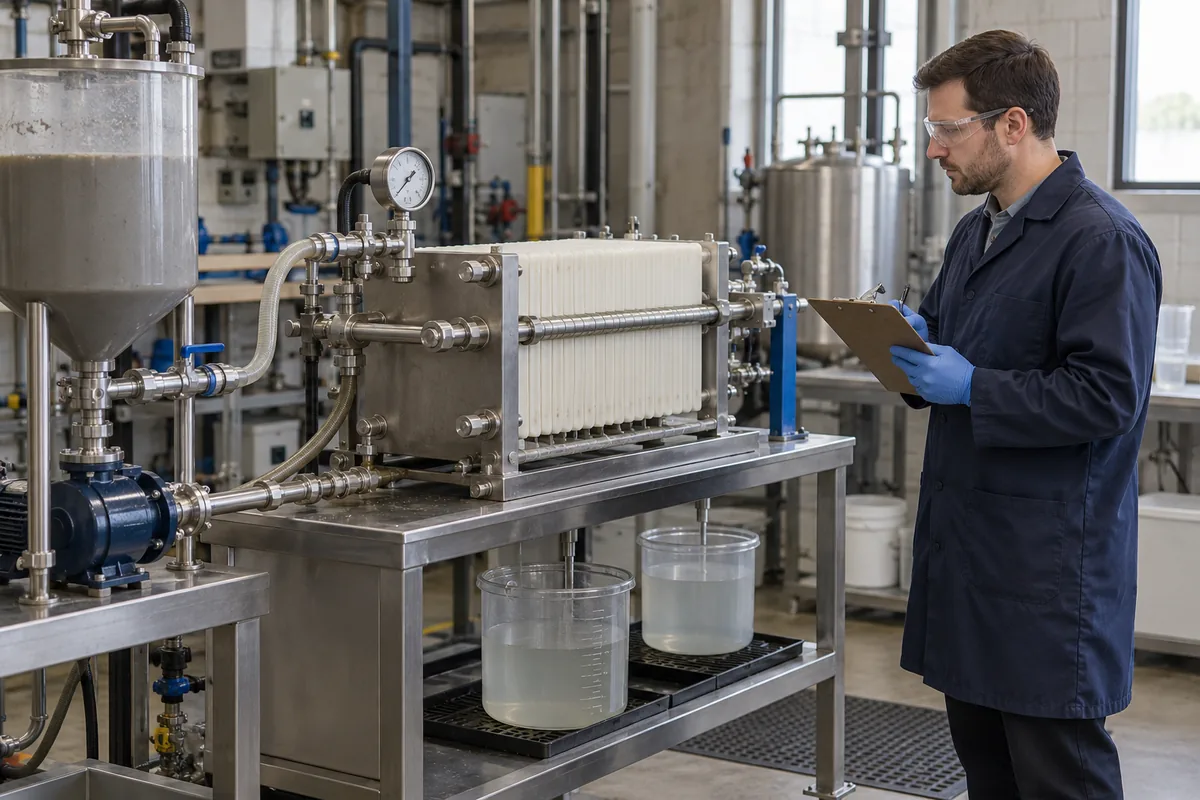
Give each supplier the same performance specification: dry solids per day, required cake solids, filtrate quality, operating hours, and feed range. You can then judge differences in price against the duty each machine is expected to meet.
Keep the load calculation, required chamber volume, effective filtration area, selected chamber count, and supported full cycle time on one sizing sheet. Record the assumptions beside the results so another engineer can check your answer to how to size a filter press.
Need a filter press sized for your slurry?
Send your material, throughput with units, feed solids if known, and project country. We can review the available information and discuss a suitable configuration.
Request a Model Recommendation → https://filter-press.org/contact-us/