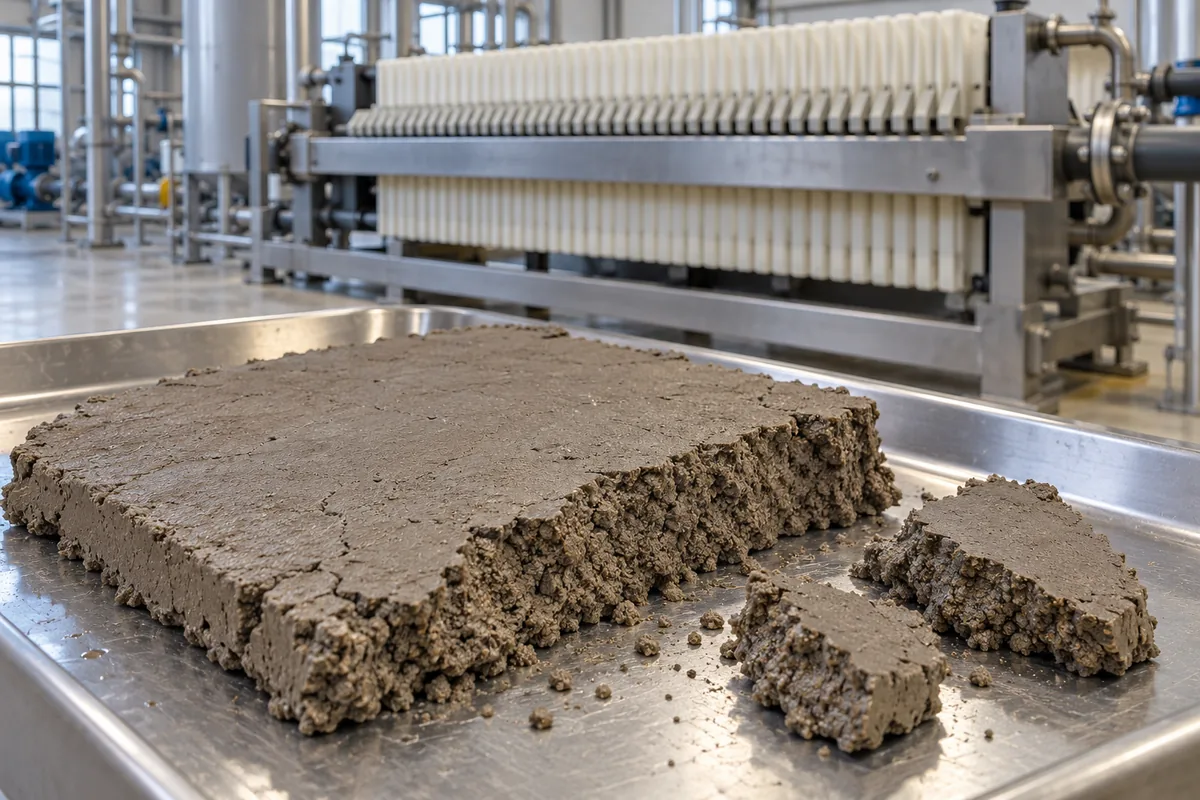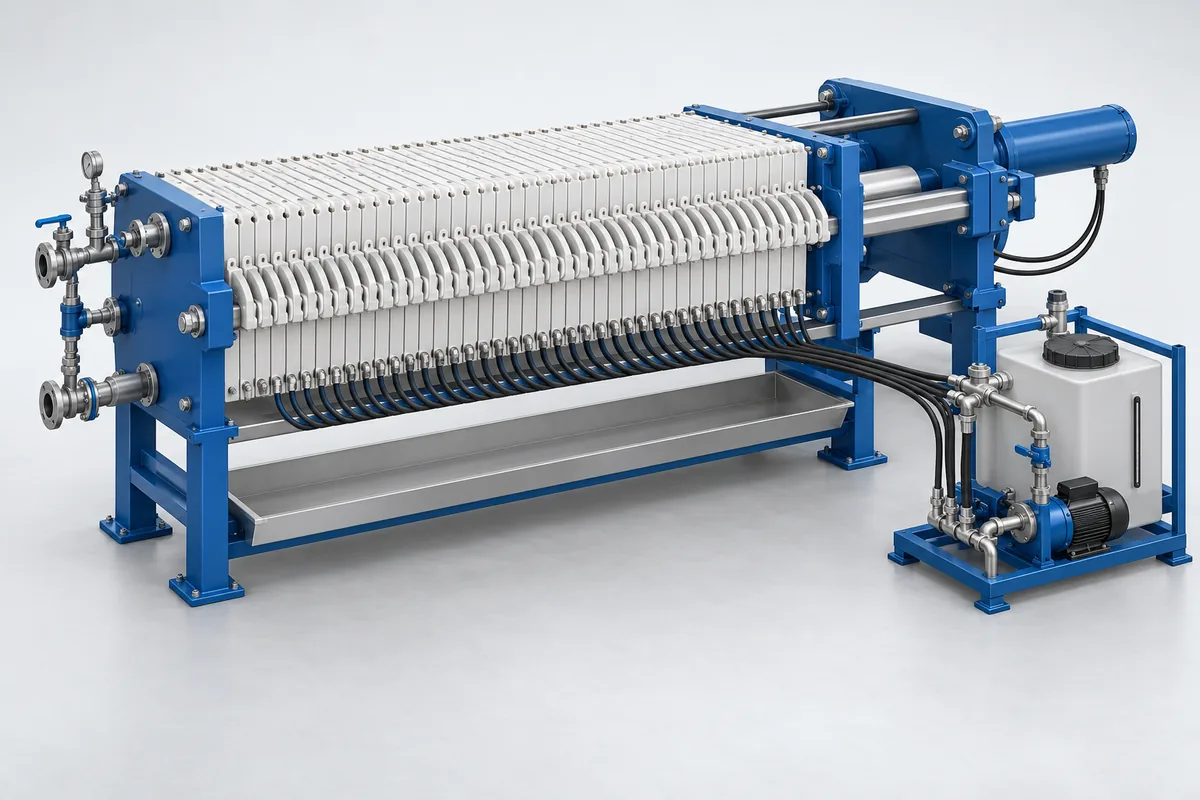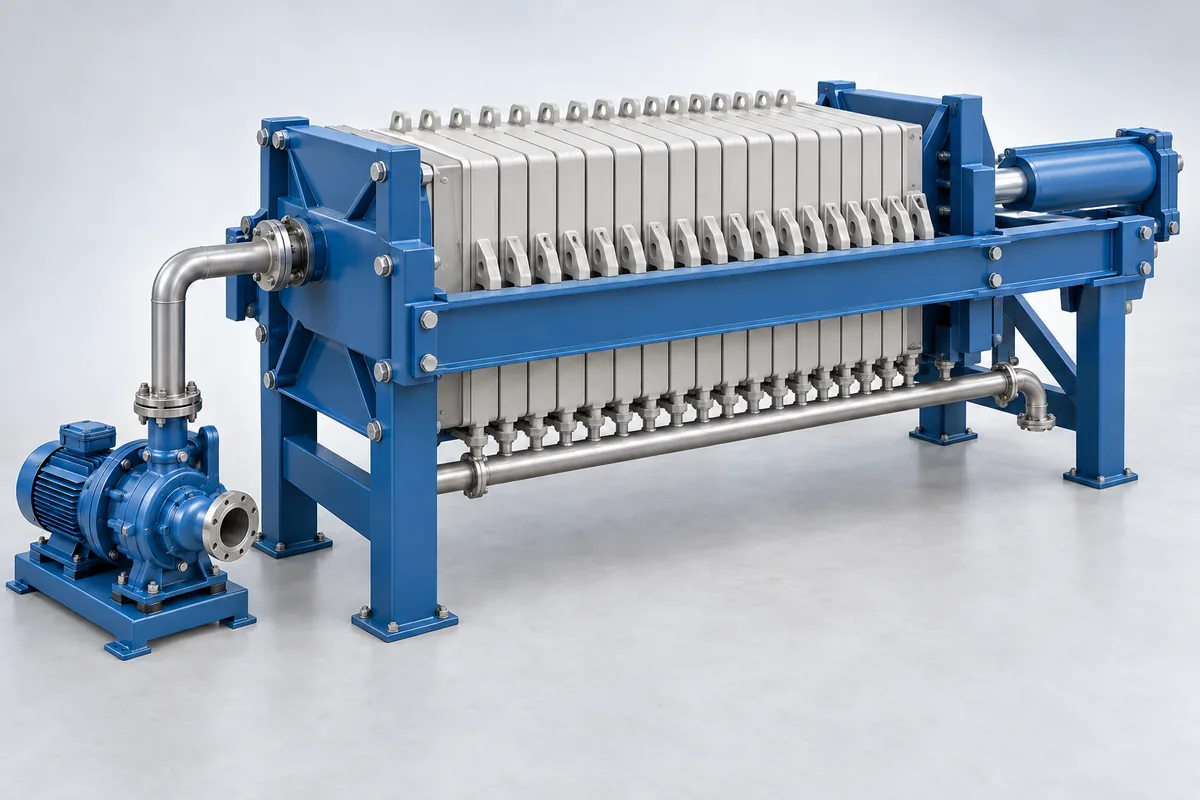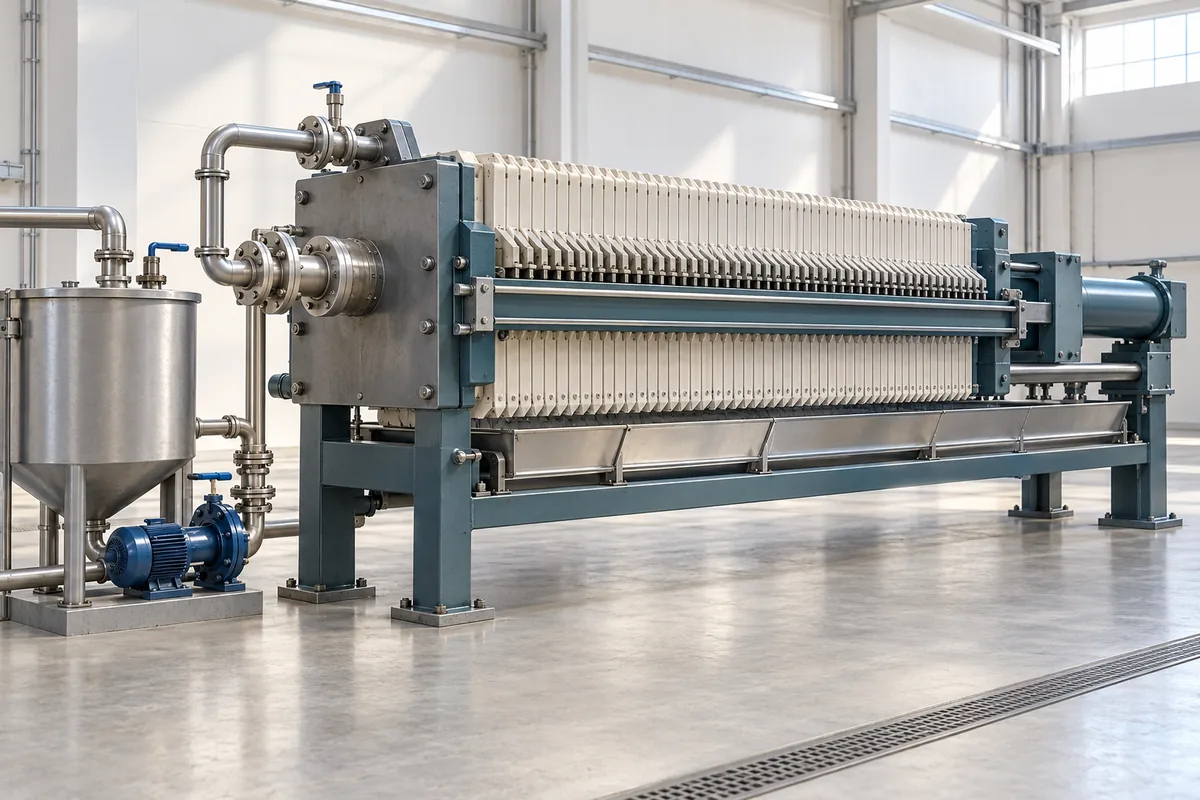
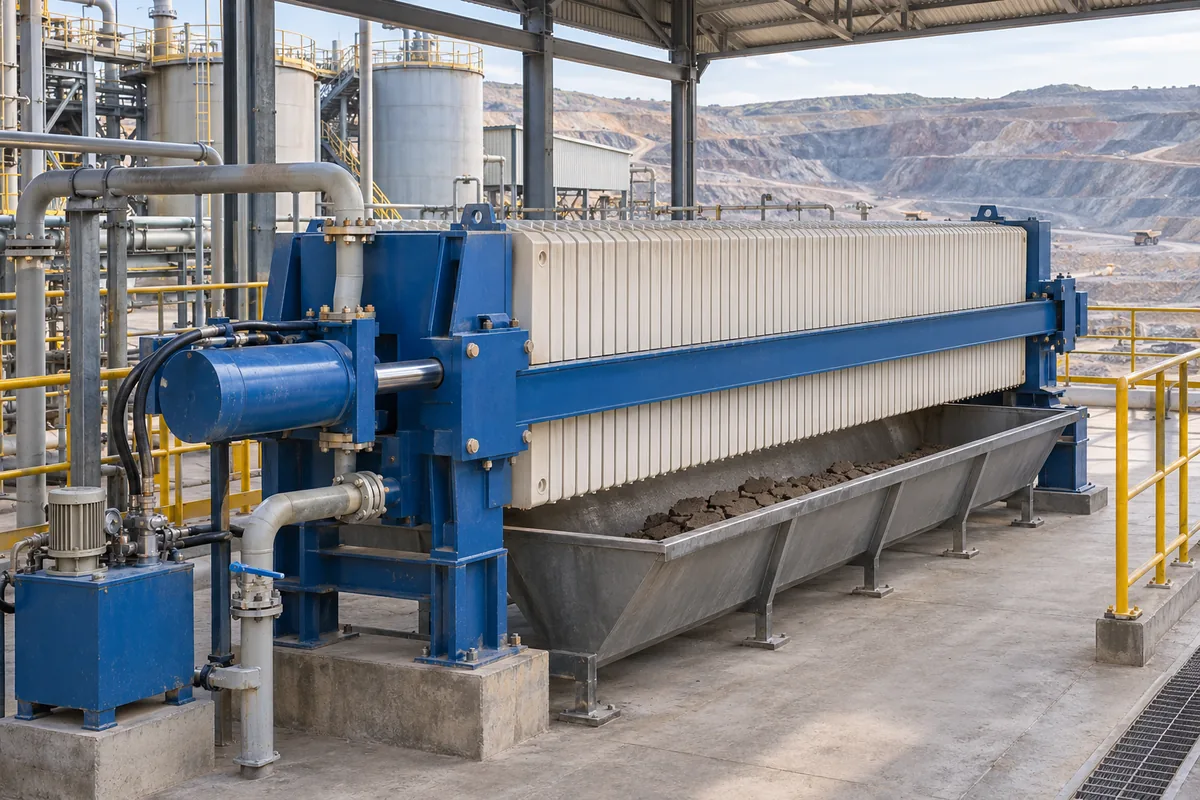
The mining filter press is a pressure-filtration machine that separates mineral slurry into a solid filter cake and a liquid called filtrate. Mines use it to dewater tailings and concentrates and recover process water.
| Item | What it means |
|---|---|
| Feed material | Slurry: mineral particles suspended in liquid |
| Separation method | Pressure drives liquid through filter cloth while solids form a cake |
| Main outputs | Dewatered filter cake and collected filtrate |
| Common applications | Tailings, mineral concentrates, and treatment sludges |
| Common plate designs | Recessed chamber and membrane |
| Operating pattern | Batch cycles; multiple presses can serve a continuously operating plant |
| Performance limits | Cake moisture, capacity, and water recovery depend on the slurry and operating conditions |
When you compare presses, check how much water they recover, whether the cake releases cleanly, and whether capacity holds up when the ore changes. Those results will tell you how well a machine fits your operation.
The Parts That Turn Slurry into Filter Cake
A mining filter press combines a plate pack, filter cloths, a feed pump, a closing system, and controls. Each part affects how reliably the machine captures solids and removes liquid.
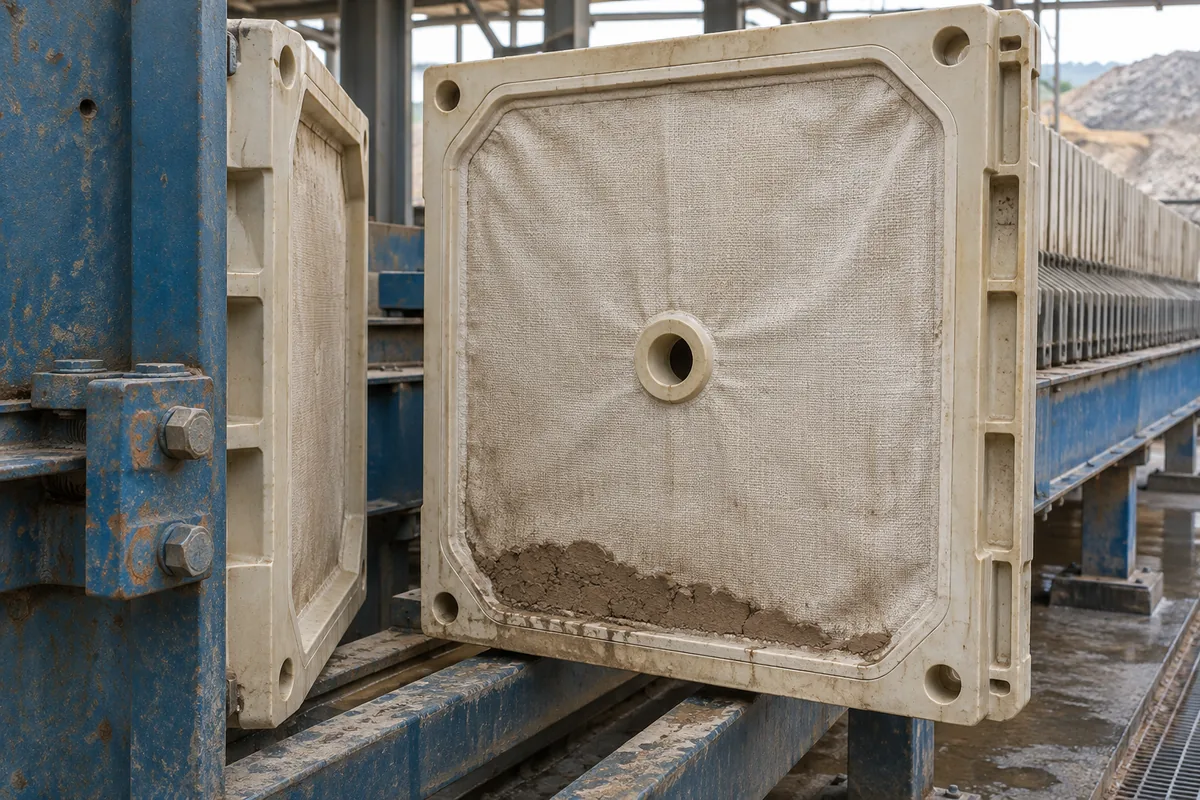
- Filter plates form enclosed chambers and provide drainage paths for the filtrate.
- Filter cloths retain particles while allowing liquid to pass. The accumulating cake also becomes part of the filtering layer.
- The feed pump moves slurry into the chambers and supplies the pressure needed for filtration.
- The closing system holds the plates tightly together. Many presses use a hydraulic ram for this job.
- Filtrate piping collects the separated liquid for reuse, treatment, or another process step.
- Controls and discharge equipment manage the cycle, separate the plates, and help move the cake out of the machine.
On a conventional recessed chamber press, the ram holds the plate pack shut while the feed pump drives dewatering. Clamping pressure and filtration pressure have different jobs. The plates stay in place during filtration; they do not keep moving together to crush water out of the slurry.
The U.S. EPA’s recessed-plate filter press fact sheet describes the same basic purpose for wastewater residuals: removing water to produce a non-liquid cake. Membrane presses add a separate squeezing action.
Why Removing Water Changes the Economics
Dewatering can reduce the wet mass you handle, recover water for the plant, and lower the load on downstream drying equipment. The value depends on what water, transport, and disposal actually cost at your site.
Consider a shipment containing 100 tonnes of dry solids. At 20% moisture by total wet mass, it weighs 125 tonnes. At 10% moisture, it weighs about 111.1 tonnes: roughly 13.9 fewer tonnes to move, with the same dry solids content.
Wet mass = dry solids mass ÷ (1 − moisture fraction)
These figures use assumed moisture values. Actual freight savings depend on the moisture achieved and how the carrier charges. The finished product must also meet its handling and transport requirements.
A silica operation used a thickener and filter press to manage clay tailings and reduce its need for large settling ponds. The supplier reports recovery of about 96% of process water for reuse in the wash plant.
The reported 96% applies to that plant arrangement. A different orebody or an individual press will need its own water balance.
What Is Mining Filter Press Used for?
Mining filter presses dewater tailings, prepare concentrates for handling and shipment, and capture solids from treatment or metal-recovery circuits. What you need from the press depends on where it sits in the plant.
Tailings Dewatering and Filtered Stacking
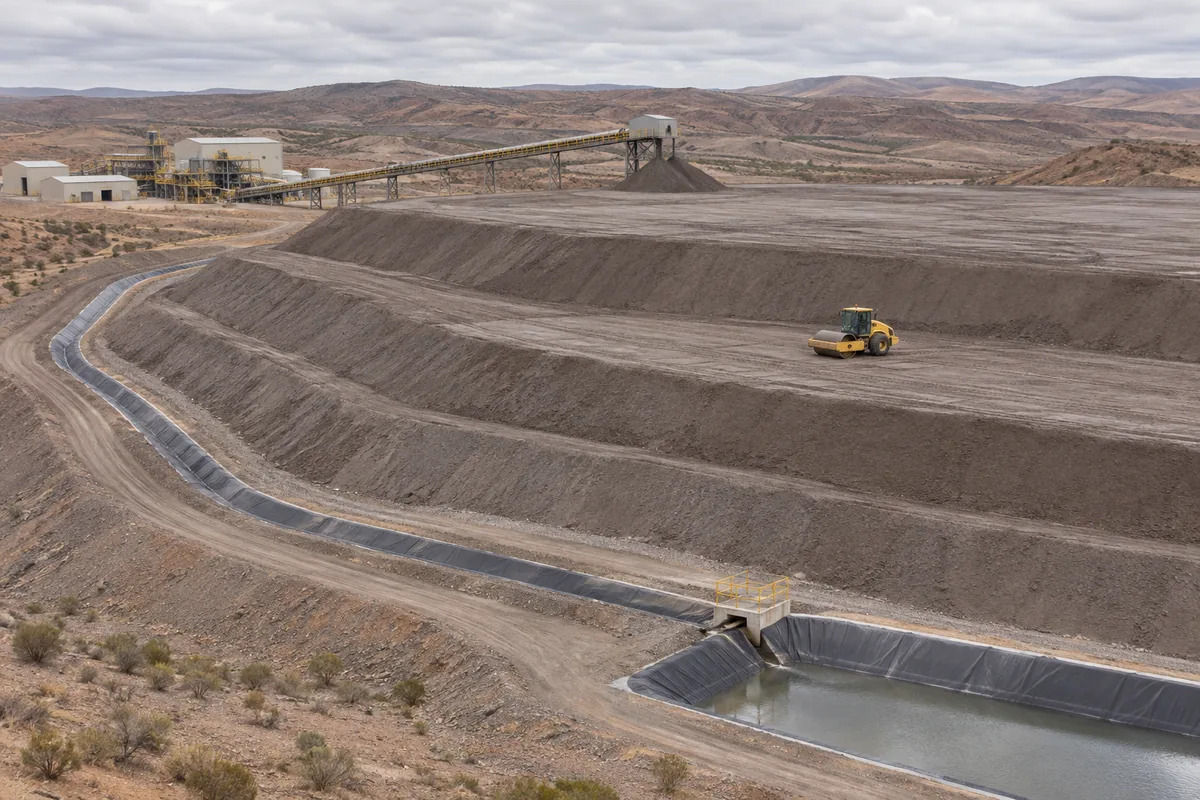
A filter press removes water from tailings so the solids can be handled as cake and, where suitable, placed in an engineered filtered-tailings facility. This can reduce the volume of water stored with the tailings and return more water to processing.
The cake still contains moisture, even when the storage method is called “dry stacking.” Test whether it can be transported, placed, and compacted as planned.
Filtered storage can reduce the risks of keeping large volumes of water with tailings. It still needs geotechnical design, drainage, erosion control, and monitoring, with allowance for rainfall, slope stability, dust, and contaminated drainage. The EPA’s explanation of mine drainage describes how water reacting with sulfur-bearing minerals can become acidic and leach metals. Removing water from tailings does not remove the need to assess that chemistry.
The safety across the facility lifecycle, including design, operation, monitoring, and closure. Buying a filter press does not, by itself, establish that a tailings facility meets those requirements.
Concentrate Dewatering
A filter press reduces the moisture in concentrates such as copper, zinc, or lead products before transport or further processing. Less retained water can mean less wet mass to ship and less water to remove in a subsequent dryer.
Aim for a product that meets the required specification at the necessary production rate. A longer cycle may produce a drier cake, but a small moisture improvement can be costly if the press becomes a bottleneck for the concentrator. Compare moisture and dry-solids throughput together.
Water Treatment and Precious-Metal Recovery
A filter press captures suspended or precipitated solids from certain treatment and recovery circuits. In the Merrill-Crowe process, filtration collects gold- and silver-bearing precipitate after zinc precipitation.
In wastewater treatment, chemicals may first convert dissolved contaminants into solids that a press can capture. Filtration alone does not reliably remove dissolved salts, dissolved metals, or residual process chemicals.
Filtrate can look clear while still containing dissolved contaminants. Check its quality against the requirements for the intended reuse or discharge.
What Is Mining Filter Press and How Does It Work?
A mining filter press works by filling closed, cloth-lined chambers with slurry, collecting the liquid that passes through, and discharging the retained solids after dewatering. A conventional plate press repeats this sequence in batches.
The exact cycle sequence depends on the machine and application.
1. Close and Secure the Plate Pack
The closing system brings the plates together and holds them at the specified clamping force. The recesses between adjacent plates form the chambers that will hold the cake.
Sealing surfaces need to be clean and correctly aligned. Trapped solids, damaged cloths, or plate defects can cause leaks and disrupt the cycle.
2. Pump Slurry into the Chambers
The feed pump fills the chambers and drives liquid through the filter cloths. Solids begin accumulating against the cloth, while filtrate travels through the plate drainage channels into collection piping.
Flow commonly declines as the growing cake creates more resistance. The pressure-and-flow pattern depends on the pump, slurry, and control settings.
3. Build the Cake and Complete Dewatering
Feeding continues until the cake reaches the selected cycle endpoint. Operators control that endpoint using pressure, flow, time, or a combination of measurements.
A membrane press can then inflate flexible diaphragms using the manufacturer-specified squeeze medium, often water or air. The diaphragms press against the cake to remove additional liquid.
Some installations also use cake washing or an air-blow stage. These functions must be part of the engineered equipment configuration; they are not interchangeable features on every press.
4. Depressurize and Discharge
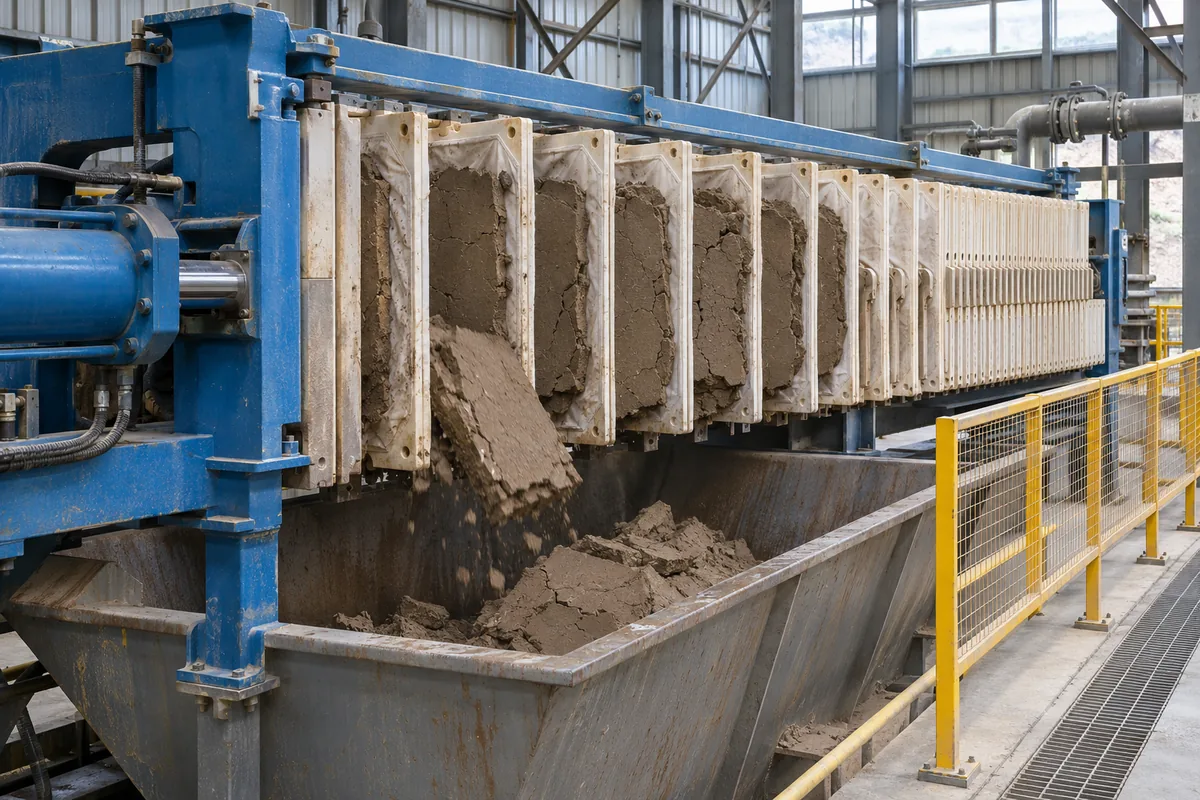
Once feed, squeeze, and any air systems have been safely depressurized according to the equipment procedure, the plate pack opens and releases the cake. The solids fall into a hopper, conveyor, or other handling system.
Automatic plate shifting and cake-release devices can reduce manual handling. Cloth inspection and cleaning help prepare the press for its next cycle.
Include opening, discharge, and cleaning when calculating the complete cycle. Counting only pumping time will overstate production.
Recessed Chamber or Membrane: Which Should You Choose?
A recessed chamber press relies on feed pressure for its main dewatering action, while a membrane press adds a diaphragm squeeze. Choose between them by testing which meets your moisture and throughput targets at an acceptable total cost.
| Factor | Recessed chamber | Membrane |
|---|---|---|
| Main mechanism | Filtration driven by feed pressure | Feed filtration followed by diaphragm squeezing |
| Equipment complexity | Fewer squeeze-system components | Additional membranes, controls, and squeeze equipment |
| Moisture outcome | May meet the target without a squeeze stage | Can remove additional water where the cake responds to squeezing |
| Cycle time | Depends on filling, filtration, and discharge | Includes squeezing; the complete cycle may be shorter or longer |
| Selection evidence | Test moisture, cake release, and dry-solids capacity | Test the improvement against extra cost and maintenance |
Fine particles and clay can make a cake difficult to drain. A membrane may help with some compressible materials; testing will show whether the extra squeeze is worth the cost. Our membrane vs chamber filter press comparison covers the differences in cycle time, equipment, and maintenance.
A belt filter press dewaters between moving belts, while a vacuum filter uses a pressure difference created by vacuum. Both work differently from a batch plate press. The filter press types guide explains how plate arrangements differ from features such as automation and operating pressure.
How Much Water Can a Filter Press Recover?
Water recovery depends on the feed’s water content and how much water remains in the discharged cake. Cake moisture alone cannot tell you the recovery percentage.
For a simplified mass balance, assume the following feed and cake conditions:
- Feed 100 tonnes of slurry containing 40% dry solids by mass. That gives you 40 tonnes of solids and 60 tonnes of water.
- Assume the cake finishes at 20% moisture by total wet mass, or 80% solids.
- Cake mass is 40 ÷ 0.80 = 50 tonnes.
- Water remaining in the cake is 50 − 40 = 10 tonnes.
- Water separated is 60 − 10 = 50 tonnes.
- Recovery of the feed water is 50 ÷ 60 × 100 = 83.3%.
The calculation assumes complete solids capture and excludes wash water, leaks, and other losses. Use measured feed and cake values to estimate recovery for a particular machine.
The cake is 80% solids, while feed-water recovery is 83.3%. Ask suppliers to define the moisture basis and which streams they include in any water-recovery figure.
How to Specify a Press That Fits Your Slurry
Specify the required dry-solids capacity and where the cake and filtrate will go, then test representative slurry. You need those results alongside the catalog dimensions to judge whether a press can meet your production target.
Test the Feed You Will Actually Process
Filtration tests should cover the expected range of ore types, particle sizes, solids concentrations, and process chemistry. Include difficult feeds, such as clay-rich blends, so an easy-to-filter sample does not hide a production problem.
Ask the test program to measure:
- Cake moisture on a stated wet or dry basis.
- Dry solids processed per complete cycle.
- Filtrate quality and solids capture.
- Cake release and handling behavior.
- Cloth performance and cleaning requirements.
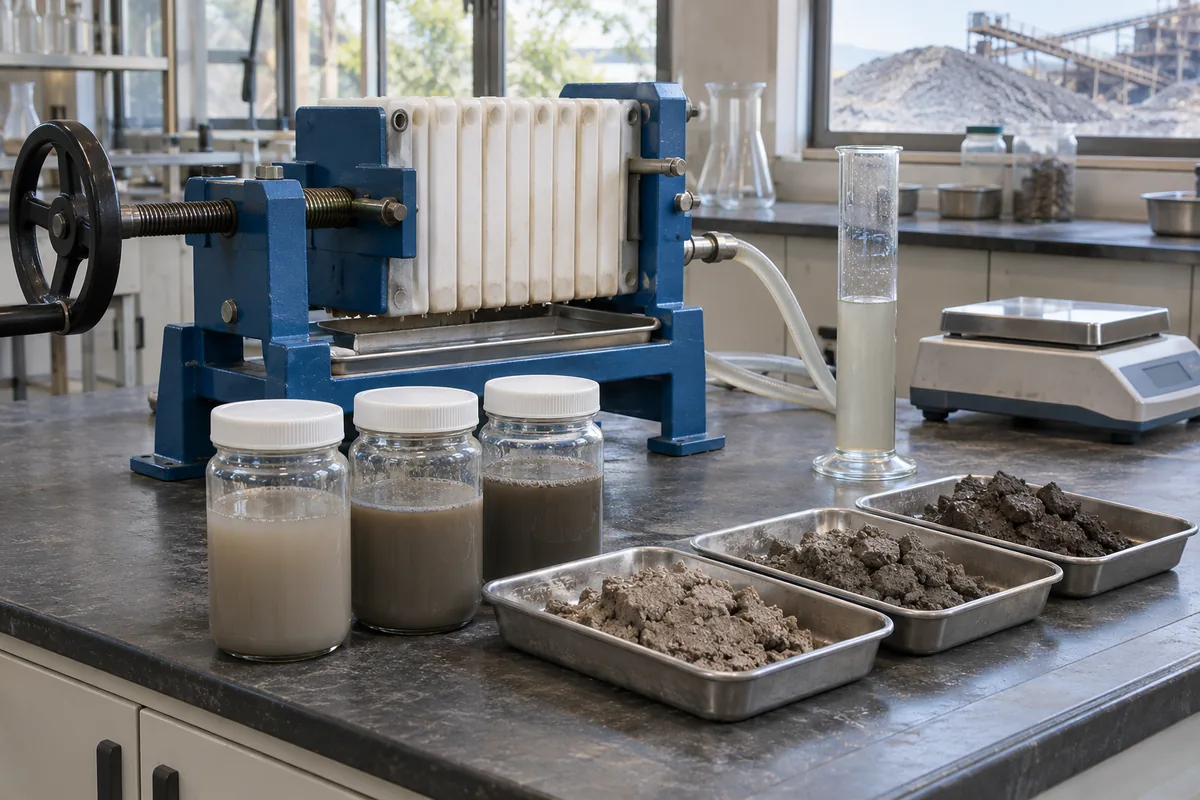
Record the pressure, chamber thickness, conditioning chemicals, and cycle sequence used so you can compare results on the same basis. A laboratory filter press can help compare media and observe cake formation before production equipment is selected.
Size for Complete Cycles and Real Availability
Calculate press capacity from dry solids per cycle, total cycle duration, and expected availability. Include plate movement, discharge, routine washing, and maintenance in the production assessment. Our filter press sizing guide connects these inputs to chamber volume and filtration area.
For illustration, a press producing 5 dry tonnes per 30-minute complete cycle has a nominal rate of 10 dry tonnes per hour. At an assumed 85% availability, its average output over scheduled hours is 8.5 dry tonnes per hour, provided it has sufficient feed.
The 85% availability is an assumption for this example. In a continuously operating plant, slurry storage, multiple presses, or standby capacity may be needed while a press discharges or undergoes maintenance.
Match the Cloth, Plates, and Pump
The cloth, plate materials, and feed pump need to match the slurry’s particle distribution, chemistry, temperature, and abrasiveness. A mismatch can cause poor capture, slow filtration, leakage, or premature wear.
Choose cloth by its weave, permeability, surface finish, cake release, and cleaning behavior as well as pore size.
Request confirmed pressure and temperature limits for the complete system. Higher pressure is useful only within those limits and when testing shows a worthwhile improvement.
Compare Cost per Dry Tonne
Total cost per dry tonne gives you a more useful comparison than purchase price alone. Include installation, pumps, energy, cloths, plates, labor, wash water, maintenance, cake handling, and expected downtime.
Credit the benefits you can substantiate, such as recovered process water, reduced transport mass, avoided pond maintenance, and lower downstream drying demand. Keep the assumptions visible so you can recalculate when water prices or the ore blend change.
Maintenance Problems Worth Catching Early
Investigate longer cycles, wetter cakes, cloudy filtrate, and leakage as soon as they appear. Record the feed conditions too, so you can tell whether the equipment has deteriorated or the slurry has changed.
- Longer filtration cycles: check cloth blinding, feed concentration, particle size, and pump performance.
- Cloudy filtrate: inspect cloth integrity and fit, and check whether startup filtrate needs separate routing.
- Wet or uneven cakes: review chamber filling, blocked passages, feed changes, and any membrane squeeze sequence.
- Poor cake release: investigate sticky material, cloth condition, and discharge settings.
- Plate-edge leakage: check sealing surfaces, cloth placement, plate condition, and the approved closing settings.
Follow the manufacturer’s isolation and depressurization procedures before inspection or maintenance. Plate packs, pressurized slurry, and moving discharge equipment present hazards even when a cycle appears to have stopped.
Start with a Representative Slurry Test
Test representative slurry against your required dry-solids throughput, cake moisture, filtrate quality, and handling performance. Those results give you a basis for selecting equipment and assessing the supplier’s proposal.
To discuss your filter press application, bring those requirements, your expected feed variation, and your operating schedule. Ask for the complete cycle assumptions and test evidence behind the proposed configuration. Use the results to assess the equipment as you move beyond the initial question: what is a mining filter press?