To select a suitable filter press for your plant, test the slurry, calculate the dry solids load, and set your cake and filtrate quality targets. Then use those results to choose the plate design, chamber volume, filtration area, and automation that will process the load within your operating hours.
| Selection input | Example value | Why it matters |
|---|---|---|
| Slurry feed volume | 100 m³/day | Establishes the daily feed load |
| Feed solids concentration | 2% by mass | Converts slurry mass into dry solids |
| Slurry density | 1,000 kg/m³ | Converts feed volume into mass |
| Target cake solids | 25% by mass | Determines wet cake mass |
| Wet cake bulk density | 1,200 kg/m³ | Converts wet cake mass into cake volume |
| Usable operating time | 8 hours/day | Sets the time available for complete batches |
| Complete batch cycle | 2 hours | Allows four completed cycles within that window |
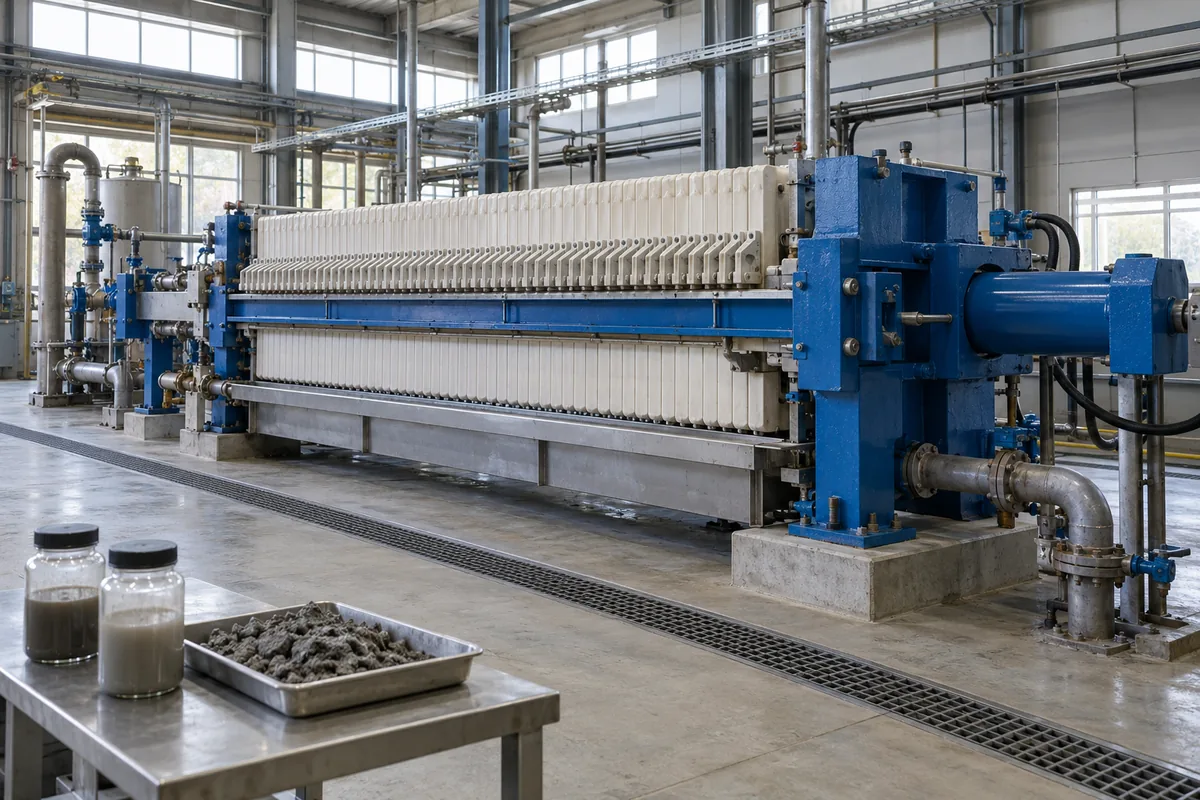
A filter press can look right on paper and still leave you with wet cake or batches that run into the next shift. You may also spend more time cleaning it than you expected. What matters is how the machine handles your slurry.
1. Define What the Press Must Deliver
Before you compare machines, write down the dry solids mass you need to process each day, the required cake solids content, the filtrate quality limits, and your operating hours. Give every supplier those same targets.
The targets depend on what happens after filtration. For sludge disposal, check wet cake weight and the receiving facility’s acceptance requirements. A saleable cake may need a particular purity or washing result. Recovered water must meet the requirements of the process that will use it.
Write down:
- The dry solids mass to process each day, including peak loads.
- The required cake solids percentage, stated on a mass basis.
- The filtrate suspended solids limit and any relevant chemical limits.
- The available shifts and maximum acceptable batch time.
- Any cake washing, product recovery, or downstream drying requirements.
Be precise about moisture: a cake containing 25% solids by mass contains 75% moisture on a wet basis. Both figures describe the same material.
The U.S. EPA’s recessed-plate filter press overview describes this equipment as a way to remove water from wastewater residuals and produce cake. Dewatering alone doesn’t establish that the water meets discharge or reuse requirements. Even clear-looking filtrate can contain dissolved contaminants.
2. Test a Representative Slurry Sample
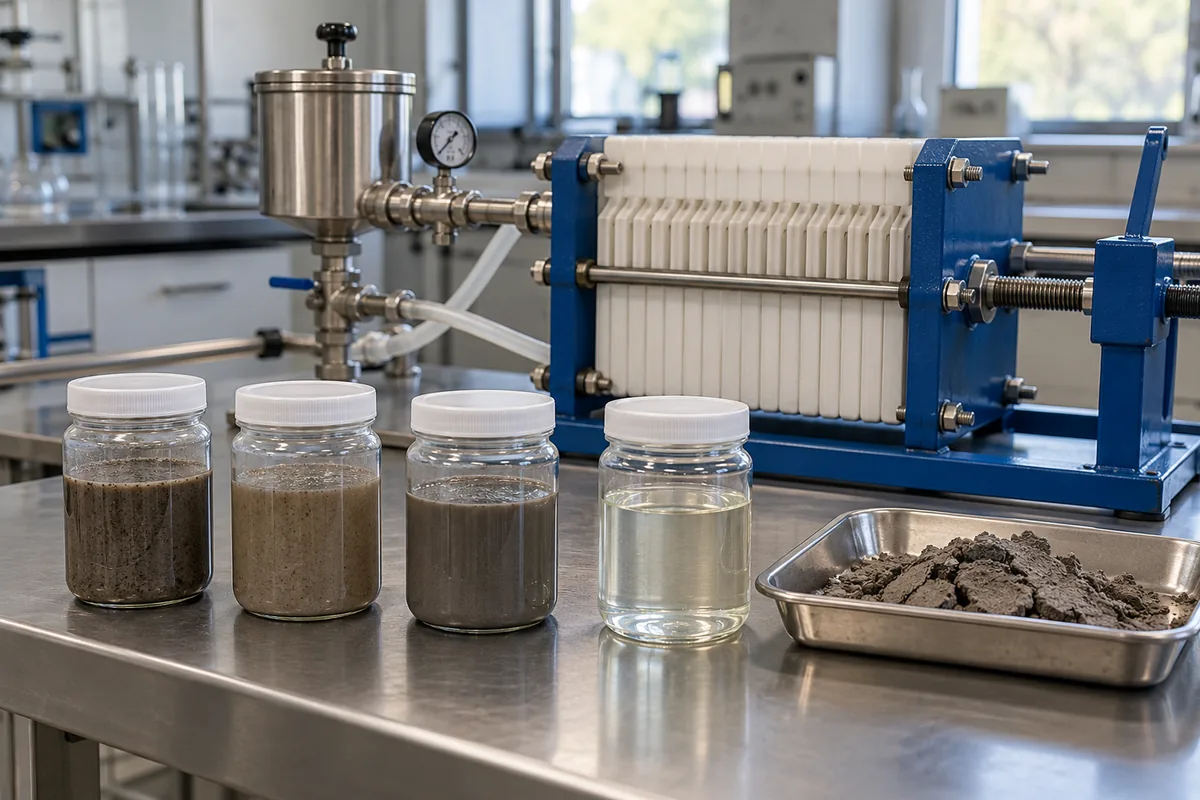
Before buying a full-size press, use a laboratory filter press or a suitable pilot unit to test cake dryness, filtrate quality, cycle time, and cake release. Knowing what the slurry is called won’t tell you how it will filter.
Two streams described as “industrial sludge” can behave very differently. One may form a permeable cake that drains quickly. Another may contain fine, compressible particles that make water removal much slower.
Give the testing team these details:
- Solids concentration by mass, including the normal range and expected peaks.
- Particle size distribution, especially the proportion of fines.
- Slurry density and viscosity at the expected operating conditions.
- pH, salts, solvents, oils, and other constituents that affect filtration or material compatibility.
- Temperatures during normal operation, startup, and cleaning.
- Coagulants, polymers, lime, or filter aids used, with their dosages.
Take samples from normal production and from the difficult conditions your plant reasonably expects. If you send only an unusually easy batch, the equipment recommendation may be too optimistic.
Record how samples were collected and stored, too. Settling, aging, or temperature changes can alter the material before it reaches the lab.
Ask for a Test Report You Can Use
The test report should record the cloth, cake thickness, pressure sequence, feed condition, and chemical dose behind each result. You’ll need those details to judge whether your plant can reproduce it.
Request filtration time, cake solids, filtrate measurements, cake density, and observations about discharge. Include washing or membrane squeezing when those steps are part of the proposed process.
Micronics’ pilot-testing guidance identifies cloth selection, conditioning chemistry, cycle time, cake dryness, and full-scale sizing as testing objectives.
I’d also ask for a video of cake discharge. If someone has to keep removing cake by hand, that time belongs in both the labor estimate and the cycle calculation.
3. Choose the Plate Configuration for Your Process
Use your test results to compare recessed chamber, membrane squeeze, and plate-and-frame designs. The press needs to meet your process targets, and your team needs to be able to maintain it.
Automation is a separate choice. An automatic filter press may use recessed chamber plates or a membrane arrangement; “automatic” describes which operating tasks the equipment performs.
Recessed Chamber: A Starting Point for General Dewatering
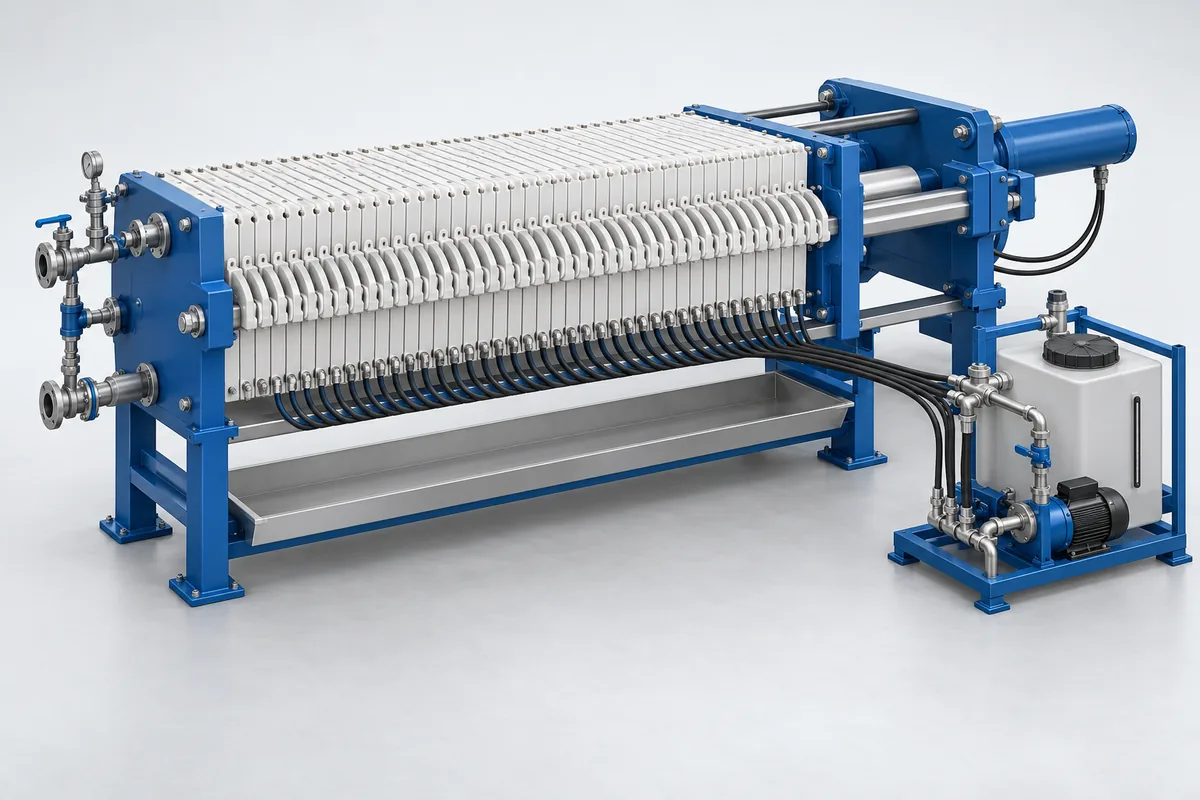
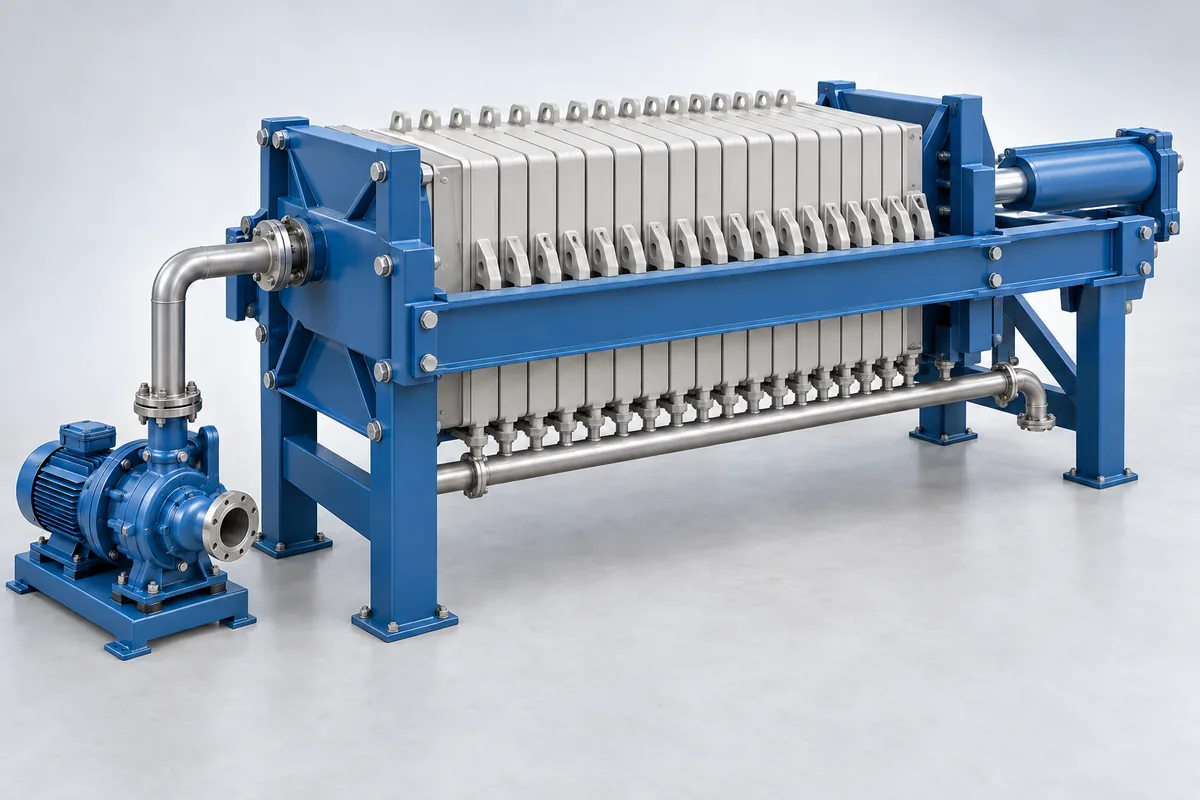
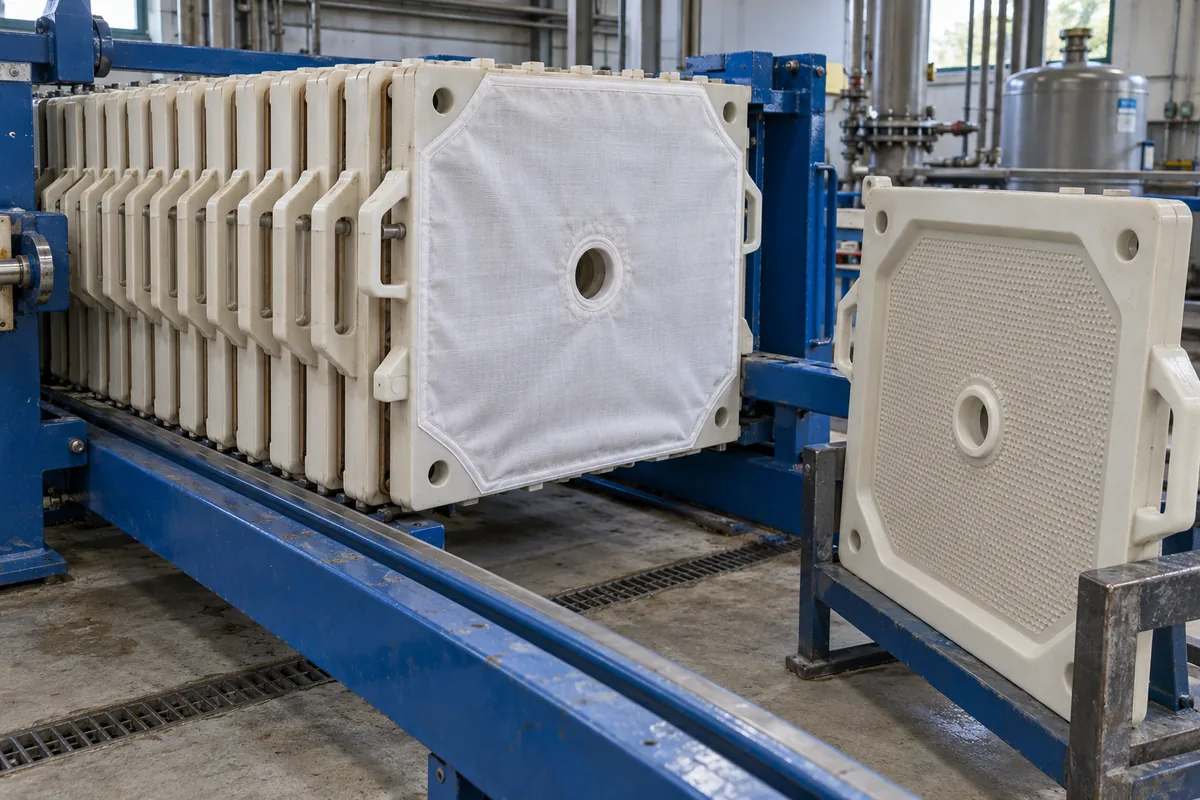
A recessed chamber filter press forms cake between recessed plates and removes liquid through filter cloth under feed pressure. It is a practical starting point for many sludge dewatering and industrial solid-liquid separation applications.
Check the resulting cake, the time per batch, and whether the cake drops cleanly when the plates open. Run that comparison at the proposed chamber depth.
Also discuss gasketed versus non-gasketed arrangements, drip collection, and access for cloth replacement. These details affect daily operation even when the nominal capacity is identical.
Membrane Squeeze: Evaluate the Value of Additional Dewatering
A membrane filter press uses flexible diaphragms to squeeze more liquid from the formed cake. It is worth considering when tests show that the drier cake or shorter complete cycle will pay for the additional equipment and maintenance.
Micronics’ explanation of membrane filter plates describes this additional squeezing stage. The result still depends on the slurry, cake structure, and operating sequence.
Here, “membrane” means a squeezing diaphragm. It doesn’t remove dissolved contaminants, so the name alone tells you nothing about filtrate purity or how well an oily sludge will filter.
Ask the supplier to compare both options using the same feed and acceptance targets. Include squeeze utilities and diaphragm replacement in the cost comparison.
Plate and Frame: Check Specialized Media and Washing Needs
A plate-and-frame filter press uses separate frames to form the cake chambers. Consider this design when your process calls for particular filter media or washing arrangements that it can accommodate.
Check media handling, leakage control, cake discharge, and cleaning time. Other press configurations can wash cake too. Compare the actual washing results when you choose between them.
4. Size the Press From Dry Solids and Complete Cycles
Filter press sizing needs two checks: enough chamber volume to hold the cake, and enough filtration area to process the load in the time available. Use filtration tests to establish how quickly that area can produce cake at the required thickness.
M.W. Watermark’s sizing guidance lists feed quantity, solids percentage, operating schedule, wet cake density, and cake thickness among the necessary inputs.
Using the example in the opening table, assume complete solids capture and no added conditioning solids for this preliminary calculation. For your project, account for actual capture, chemical additions, and recycled streams in the mass balance.
Calculate the Daily Dry Solids Load
Multiply daily slurry volume by slurry density and the feed solids mass fraction to find the daily dry solids load. Use the solids concentration of the stream actually entering the press.
Dry solids mass = slurry volume × slurry density × solids mass fraction
For the example:
100 m³/day × 1,000 kg/m³ × 0.02 = 2,000 kg dry solids/day.
At the same volume and density, a rise to 4% feed solids doubles the dry solids load. The effect on filtration time still needs testing.
If you’re starting from a wastewater plant’s total inflow, first determine how much sludge actually reaches the press. Total plant flow and filter press feed flow are different design inputs.
Convert Dry Solids Into Wet Cake Volume
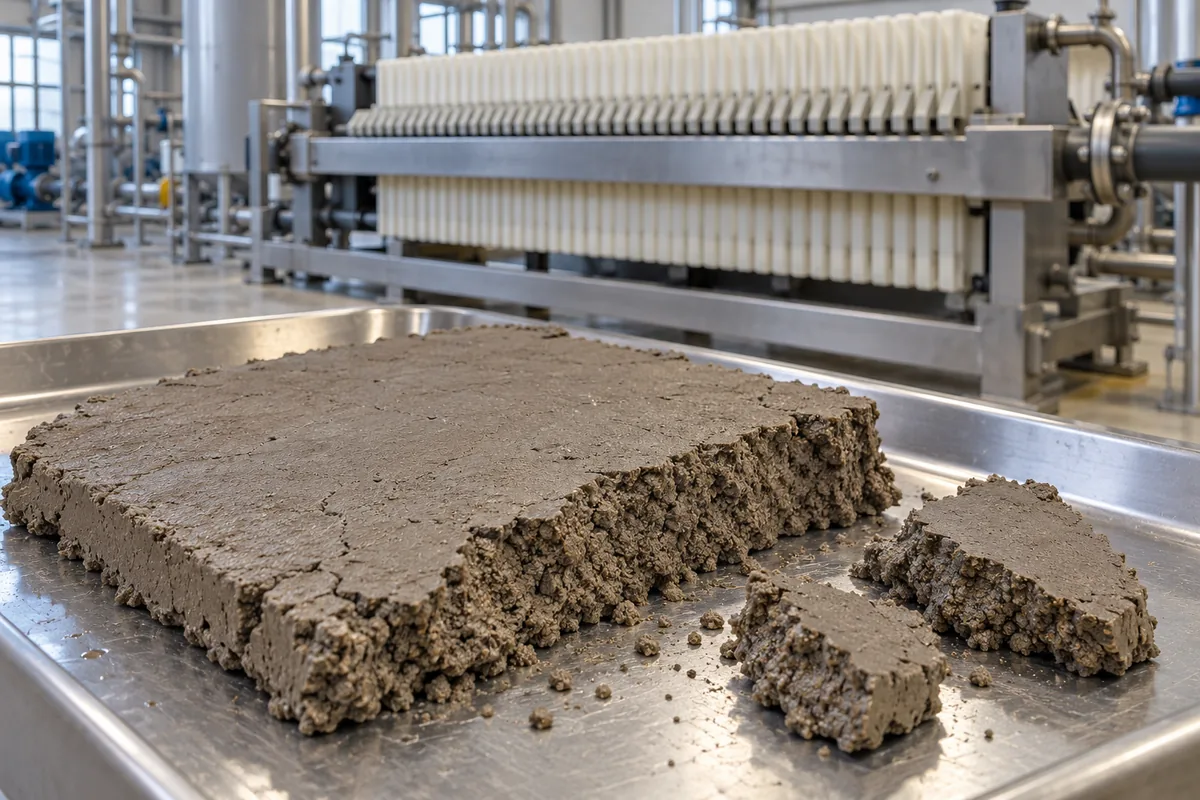
Divide captured dry solids mass by the cake solids mass fraction, then divide the resulting wet cake mass by its measured bulk density. This gives the cake volume the equipment must accommodate.
Wet cake mass = captured dry solids mass ÷ cake solids mass fraction
2,000 kg/day ÷ 0.25 = 8,000 kg wet cake/day.
Wet cake volume = wet cake mass ÷ wet cake bulk density
8,000 kg/day ÷ 1,200 kg/m³ = 6.67 m³ of cake/day, rounded.
Take care with the moisture conversion. A cake at 75% moisture contains 25% solids, so 10 tonnes of dry solids produces 40 tonnes of wet cake, assuming complete capture and no added solids. Divide by 0.25; multiplying by 1.75 gives the wrong wet cake mass.
Allow Time for Every Part of the Batch
Calculate daily cycles from the entire operating sequence, including filling, filtration, optional washing or squeezing, depressurization, opening, discharge, and closure. Counting filtration time alone overstates capacity.
Suppose a 10-hour staffed window leaves eight usable hours after planned cleaning, checks, and operating reserve. If each complete cycle takes two hours, the schedule accommodates four completed cycles.
6.67 m³/day ÷ 4 cycles/day = about 1.67 m³ of cake capacity per cycle.
This is the preliminary capacity before any further allowance for your project. Record what each allowance covers so you account for uncertainty without counting the same downtime twice.
Decide how you’ll handle peak loads. You may need more chamber capacity, longer hours, feed storage, or another press. Check the time requirement before assuming that adding plates will be enough.
Confirm Filtration Area Separately
Use test results at the proposed cake thickness to confirm the filtration area required for the target cycle time. Two presses with similar chamber volumes can have different filtration areas and batch performance.
For an idealized fixed-chamber pack, where the quoted area counts both filtering faces:
Chamber volume ≈ filtration area × cake thickness ÷ 2
At 30 mm cake thickness, 1.67 m³ of chamber volume corresponds to roughly 111 m² of filtration area. This is a geometry check, not a capacity guarantee.
Ask the manufacturer to confirm its usable chamber volume, active area definition, and scale-up method. Membrane movement, plate details, and end chambers can affect the relationship.
5. Match the Cloth, Materials, and Feed Pump
Use the slurry chemistry and test results to select the cloth, wetted materials, and feed pump together. Even a correctly sized press will struggle if the cloth blinds, chemicals attack its parts, or the pump cannot deliver the required feed profile.
Choose Cloth for Retention, Flow, and Cake Release
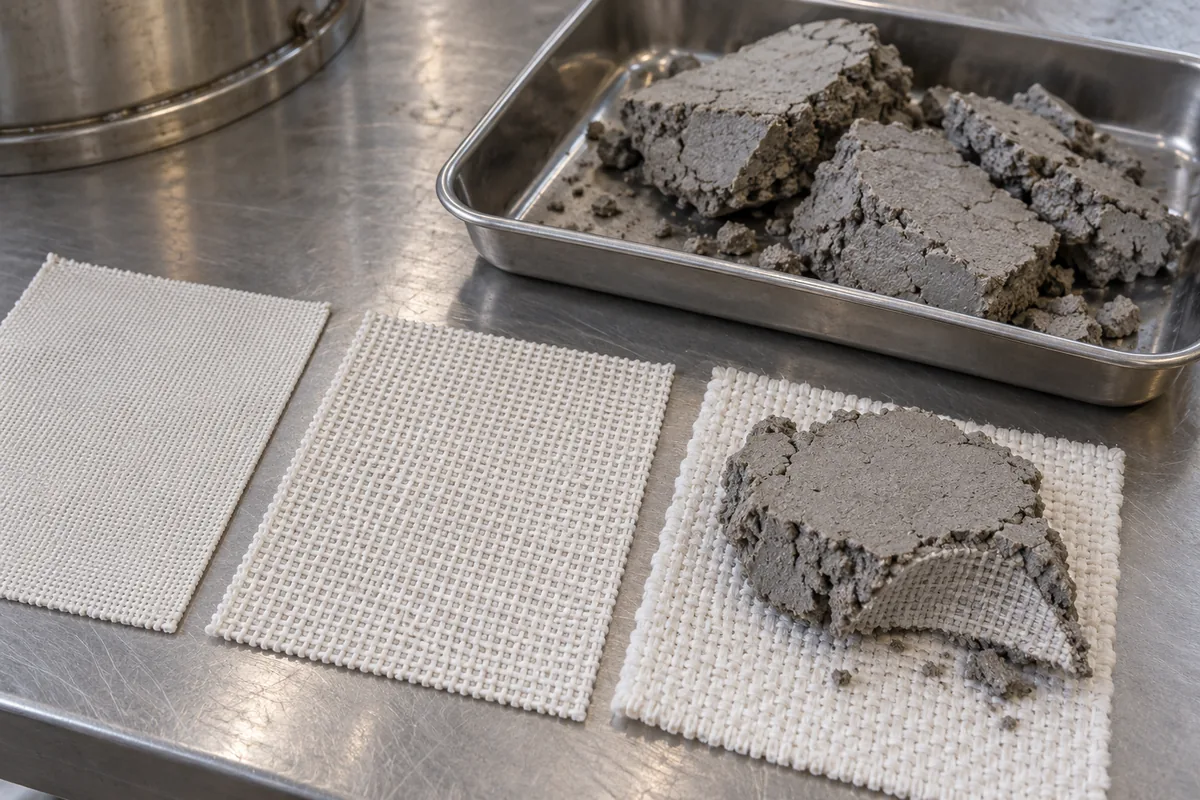
Choose cloth by testing how well it retains particles, passes liquid, resists blinding, and releases cake. A fine-looking weave doesn’t establish that it will perform best on your slurry.
A cloth that captures fines well but blinds quickly may make your cycle too slow. Another may drain faster but require initial filtrate recirculation while the cake forms.
Micronics’ cloth-selection guidance includes chemical resistance, temperature resistance, abrasion, particle retention, and cake discharge among the key considerations.
Consider the fiber, weave, attachment, and cleaning method together. Polypropylene plates don’t require polypropylene cloth in every application. Choose the fabric for its compatibility and tested filtration performance.
Verify Materials and Pressure Limits as a System
Check every wetted component against the full chemical composition, concentration, temperature, and cleaning conditions. That includes plates, diaphragms, seals, piping, valves, and pump parts.
A material name won’t settle the compatibility question. Stainless steel can be unsuitable for some corrosive streams, and pH alone doesn’t capture every chemical risk.
The feed pump must handle the slurry and provide the required flow across the filtration cycle. Flow commonly declines as the cake builds and resistance rises.
Confirm the allowable feed pressure, squeeze pressure, and temperature limits separately. Increasing pressure can compress some cakes and reduce permeability, so establish the useful pressure sequence through testing and manufacturer approval.
6. Automate the Tasks That Limit Production
Choose automation around your batch frequency, staffing, cake release, and cleaning needs. A quick-opening filter press is one option to review, but the quotation still needs to state exactly which tasks the machine performs.
Options may include:
- Plate opening and shifting.
- Cake discharge assistance.
- Cloth washing and drip tray movement.
- Feed, squeeze, and wash sequence control.
- Pressure monitoring, alarms, and interlocks.
A small operation running occasional batches may justify manual or semi-automatic equipment. Frequent batches and limited staffing can make broader automation more valuable.
Ask how the system detects incomplete discharge or abnormal pressure, and what the operator has to do to get it running again.
A plate shifter may work perfectly while sticky cake still needs manual attention. Include that intervention in the labor estimate and throughput calculation; “fully automatic” doesn’t explain how the press handles it.
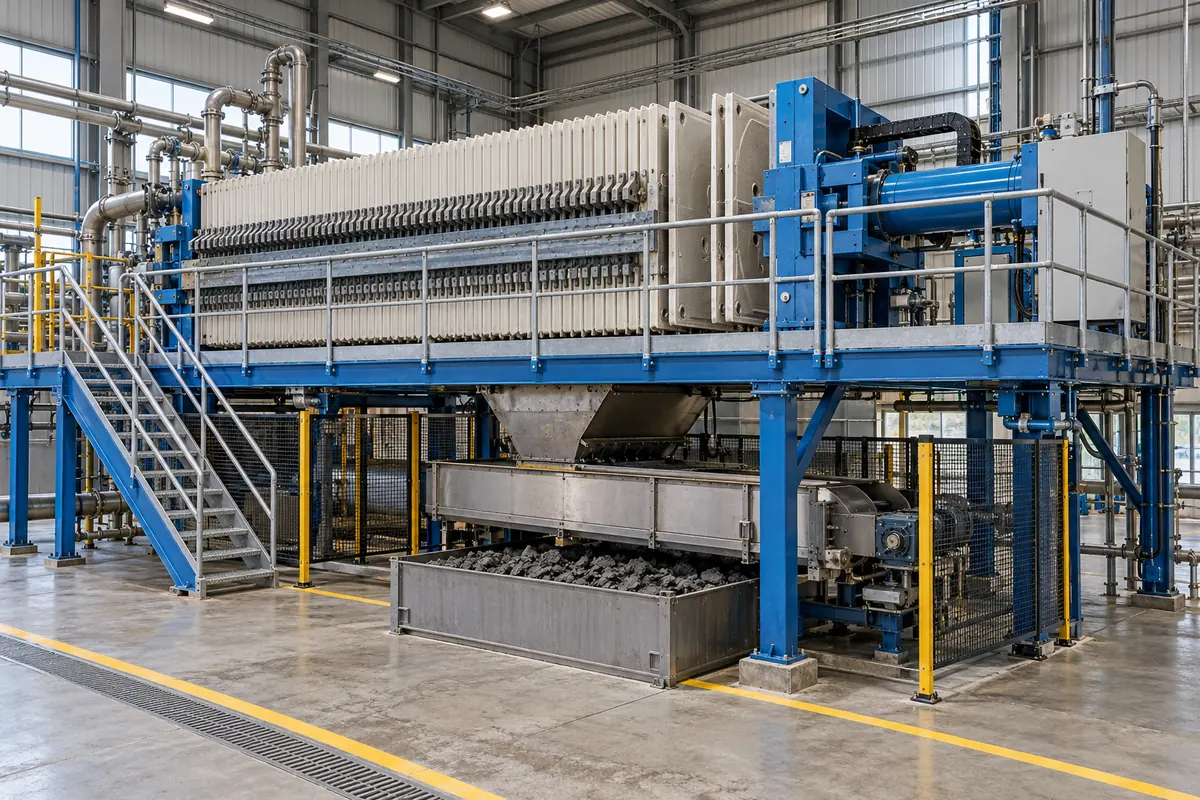
7. Compare Installed Cost and Cost per Tonne
Compare the total installed cost and the operating cost per tonne of dry solids processed. Using dry solids keeps the comparison consistent when the presses produce different amounts of wet cake.
Include the feed tank, pump, pipework, platforms, cake handling, electrical work, commissioning, and utility connections. A press-only quotation can leave a large part of the project unpriced.
Operating costs should cover labor, electricity, compressed air where used, conditioning chemicals, wash water, cloths, replacement parts, maintenance, and disposal.
Put a Value on Drier Cake
Calculate disposal savings from the change in wet cake mass at the same captured dry solids load. Even a modest increase in cake solids can reduce the weight you pay to transport and dispose of.
Using the example’s 2,000 kg of dry solids per day:
- At 25% cake solids: 2,000 ÷ 0.25 = 8.00 tonnes of wet cake/day.
- At 30% cake solids: 2,000 ÷ 0.30 = 6.67 tonnes of wet cake/day.
- Reduction: approximately 1.33 wet tonnes/day, or 16.7%.
At an assumed disposal rate of $90 per wet tonne and 250 operating days per year, the reduction would save approximately $30,000 annually before additional operating costs.
The saving depends on the assumed dryness, disposal rate, and operating days. Replace those figures with your test results and contract terms, including any minimum charges or other fees. The example isn’t a supplier performance claim.
Check the Space Around the Machine
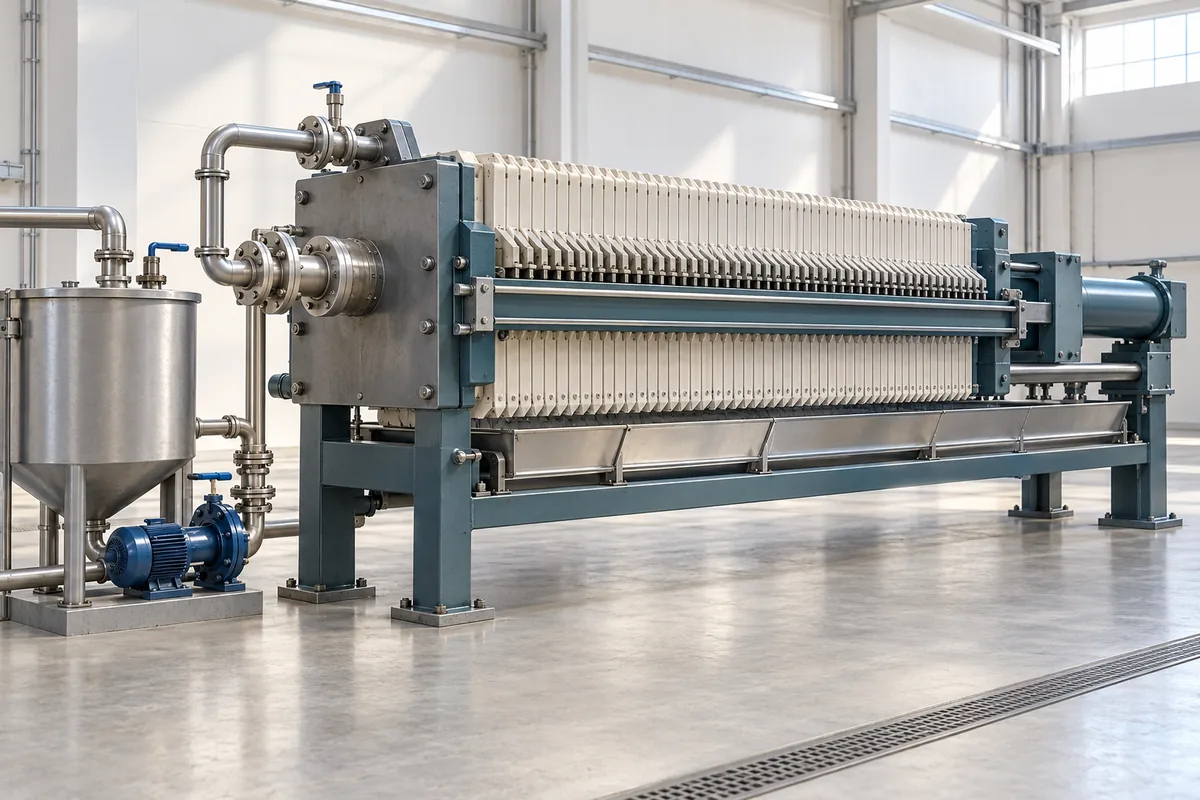
Confirm that the installed layout provides room for plate travel, maintenance, cake removal, and safe operator access. The press’s closed dimensions do not describe its complete working footprint.
Review delivery access, structural loads, lifting needs, wash water supply, drainage, and the space beneath the press for conveyors or containers.
Include guarding, pressure isolation, and lockout provisions in the specification. For a hazardous process, confirm the applicable equipment and site requirements with the responsible engineering team.
Ask about service availability and delivery times for cloths, plates, seals, and controls. Waiting for a routine part can leave the press out of service and eat into any purchase saving.
8. Request Comparable Quotes With Measurable Acceptance Criteria
Send every shortlisted supplier the same feed data, then agree on the operating range their performance commitment covers. You can compare equipment scope and assumptions once everyone is quoting against the same conditions.
When you request a filter press quotation, include:
- Application, process description, and the purpose of separation.
- Average and peak feed volumes, dry solids loads, and operating hours.
- Slurry analysis, variability, conditioning details, and representative test results.
- Required cake solids, filtrate quality, and any washing or recovery targets.
- Proposed chamber volume, filtration area, cake thickness, and complete cycle time.
- Materials, pressure and temperature limits, and required automation functions.
- Site layout, utilities, cake handling, installation, and commissioning scope.
- Consumables, spare parts, training, service response, and performance exclusions.
Define how acceptance will be measured: sampling method, number of runs, feed conditions, analytical methods, and permitted operator intervention. Require throughput, cake quality, and filtrate quality to be achieved together under the agreed conditions.
A long test may produce a very dry cake. A faster run may deliver more throughput with wetter cake. The specification needs to state the combination your plant must achieve.
I’d keep the feed data sheet, test report, and acceptance criteria beside each quotation. Resolve any differences in the assumptions before ordering; those documents should support your answer to how to select a filter press.