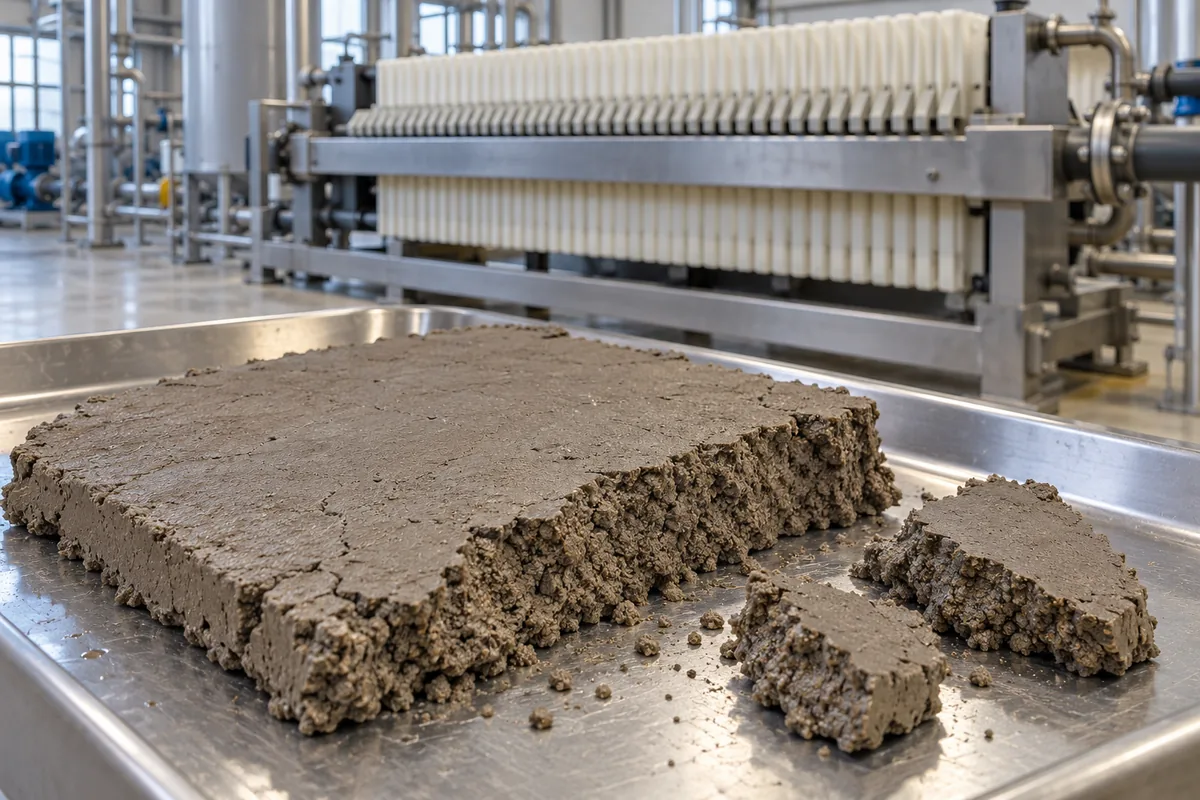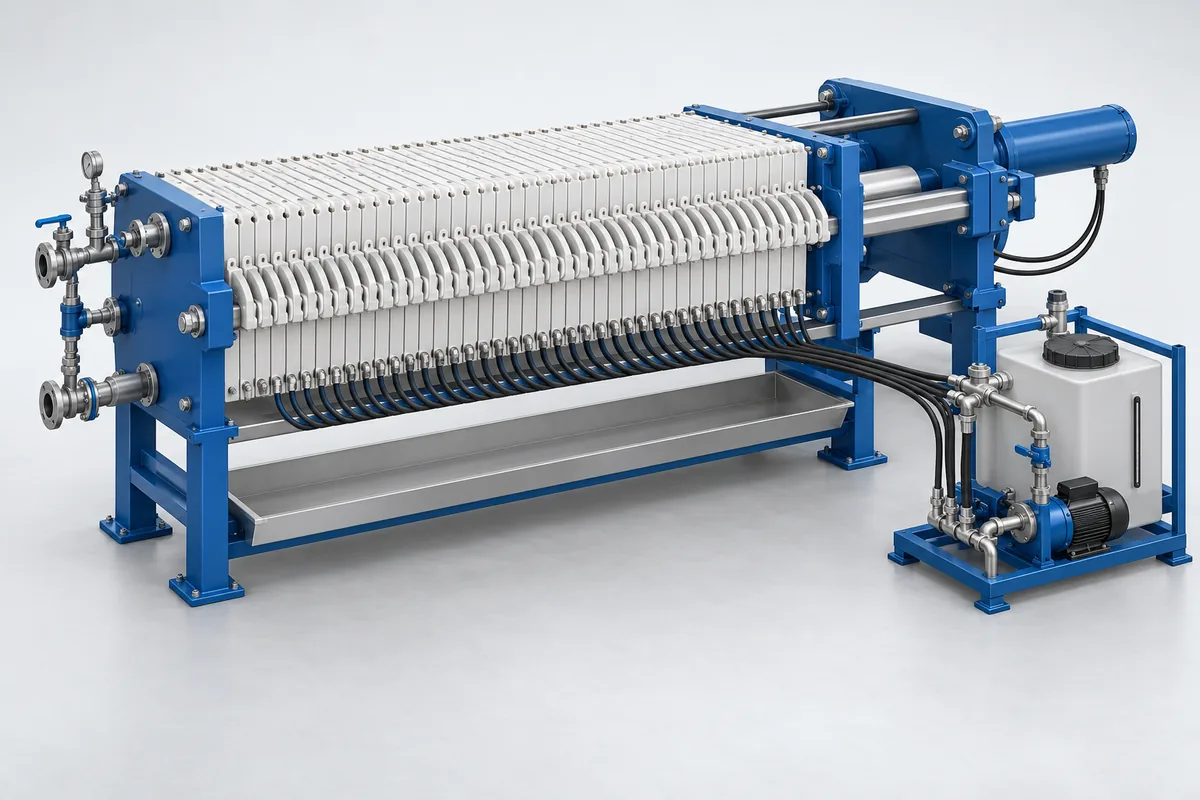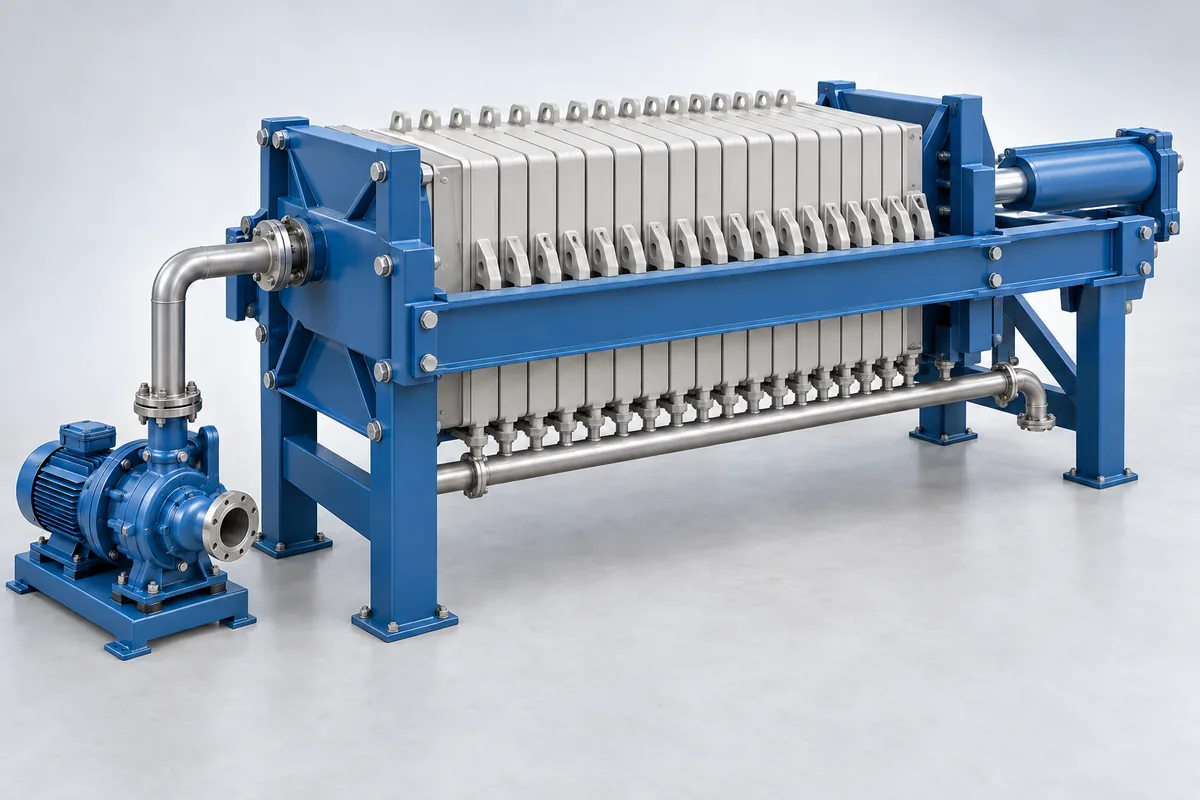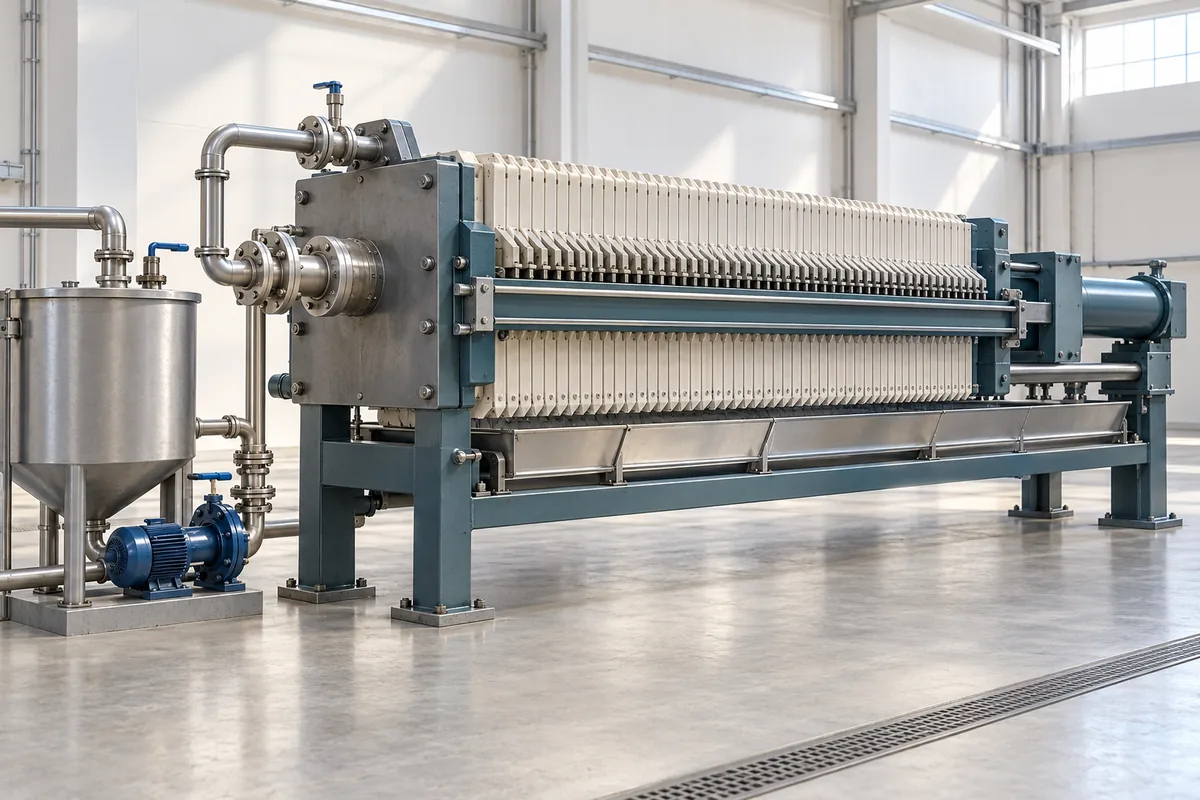
Filter cake washing removes soluble impurities by replacing the liquid trapped between filtered solids with a compatible wash liquid. This guide explains how to choose a washing method, calculate wash demand, and verify product purity without wasting water or solvent.
| Measurement | Record it as | What it tells you |
|---|---|---|
| Residual impurity | mg/kg of dry product solids | Whether the cake meets its purity specification |
| Initial retained liquid | Liters before washing | The starting liquid inventory you need to replace |
| Wash ratio | Liters of wash per liter of initial retained liquid | Wash consumption on a comparable basis |
| Wash flow | Liters per minute | How quickly liquid passes through the cake |
| Differential pressure | kPa or bar across the filtration path | The driving force and changes in flow resistance |
| Product loss | Mass lost per batch or percentage of starting product | Whether washing sacrifices valuable solids |
What Does Filter Cake Washing Actually Remove?
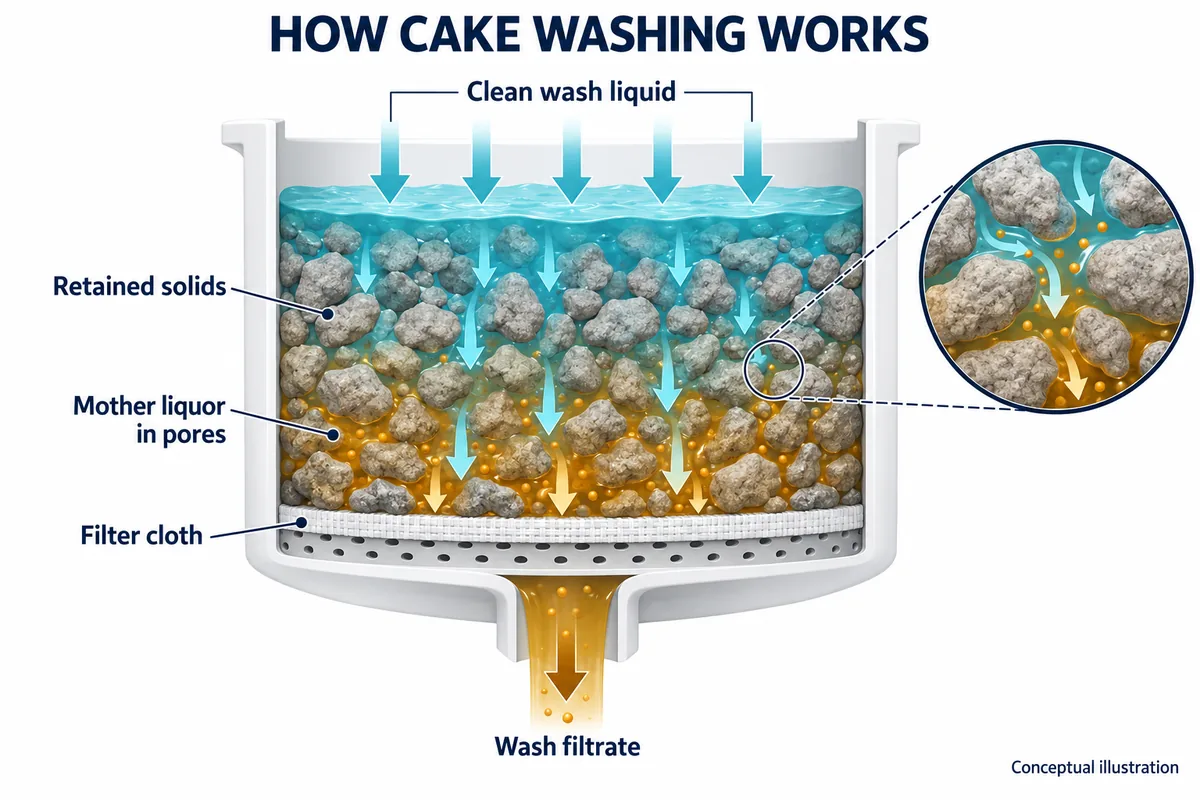
Cake washing mainly removes dissolved material carried in the mother liquor, the process liquid remaining inside the cake after filtration. It can improve the purity of a valuable solid or recover valuable dissolved chemicals from solids you plan to discard.
Think about salt dissolved in the liquid surrounding pigment particles. Filtration captures the pigment, but some salty liquid stays between the particles. Washing replaces that liquid and carries the salt into a separate wash filtrate stream.
The same principle applies to many mineral, chemical, and crystalline products. The details change with the chemistry.
Washing and dewatering have different jobs. Washing changes the composition of the retained liquid. Dewatering reduces how much liquid remains. A thoroughly washed cake can still be wet because clean wash liquid has replaced contaminated mother liquor.
Washing also has limits. Insoluble contaminants mixed into the solids may remain, and impurities adsorbed on surfaces or trapped inside crystals may resist removal. A clean-looking filtrate doesn’t prove those impurities are gone.
Start by identifying what you want to remove and where it sits.
For more on the structure and retained moisture, see our guide to filter press cake formation and dryness.
Choose the Washing Method That Fits Your Cake
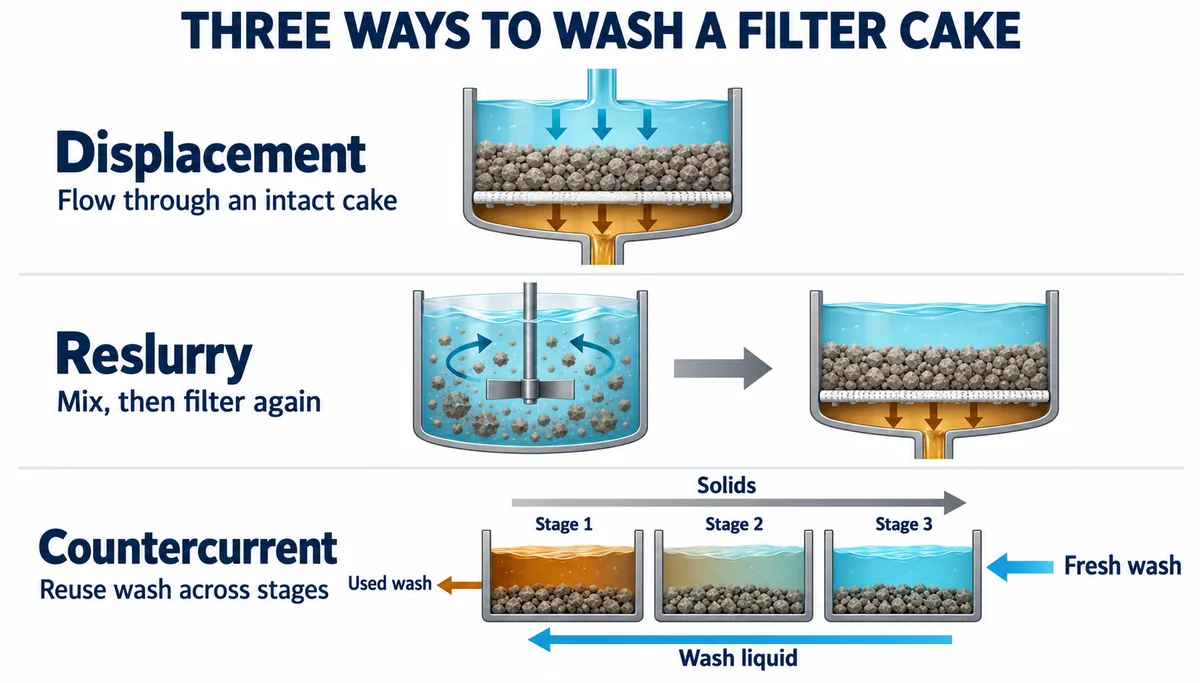
Choose displacement washing for a cake that allows reasonably uniform flow, consider reslurry washing when intact-cake washing leaves unacceptable contamination, and evaluate countercurrent staging when fresh-liquid consumption is a major cost. Confirm the choice with representative trials.
Displacement Washing: Pass Liquid Through the Formed Cake
Displacement washing pushes or draws wash liquid through an existing cake to replace its mother liquor. It works best when liquid reaches the cake evenly and the cake stays intact.
You can use this approach in suitably configured filter presses, vacuum belt filters, and other cake filters. Pressure or vacuum supplies the driving force.
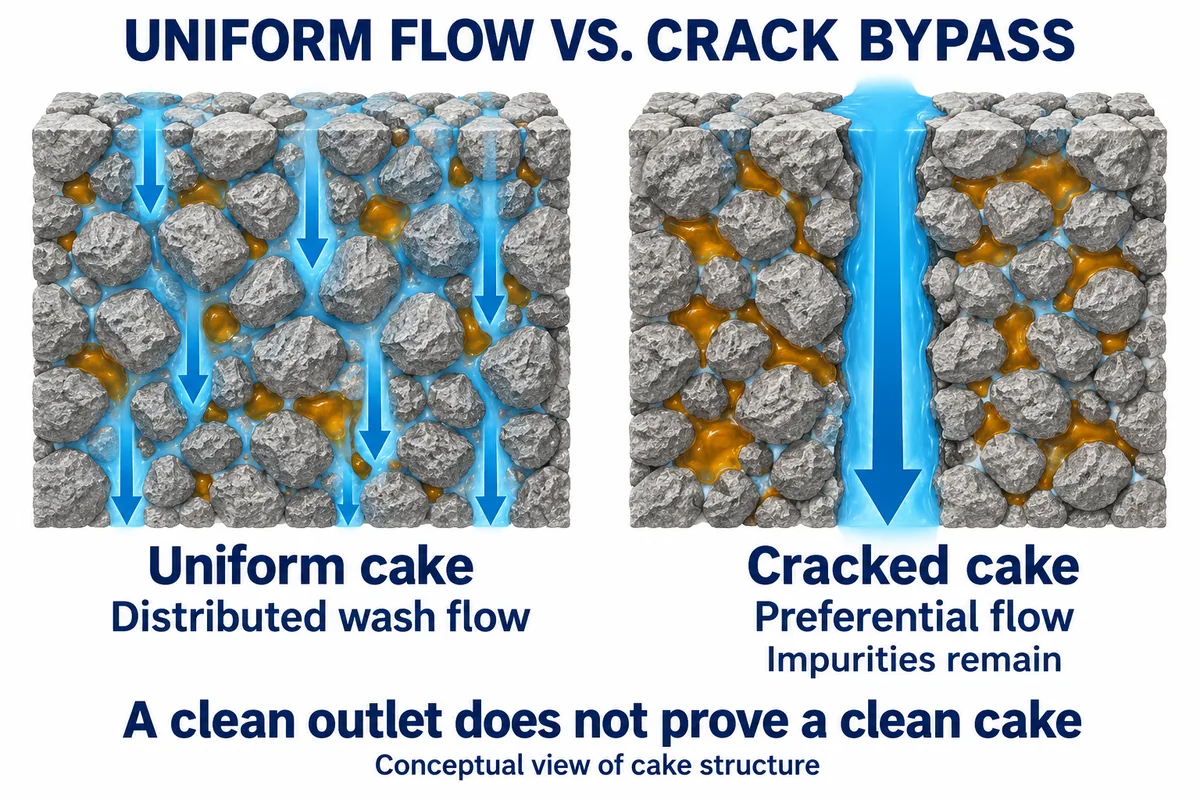
The catch is uneven flow. A crack or gap can give the wash liquid an easier route, leaving nearby solids poorly washed. Good distribution matters as much as the volume you pump.
Reslurry Washing: Mix, Then Filter Again
Reslurry washing disperses the cake in wash liquid and separates the solids again. Mixing gives retained contaminants another opportunity to enter the surrounding liquid.
This can help when displacement washing struggles, but it adds mixing, handling, and another separation step. It can also dissolve product, break fragile particles, or change the particle-size distribution.
For a simple idealized dilution stage, assume complete mixing, impurity-free wash liquid, no adsorption, and the same liquid retention after refiltration. Adding a wash volume equal to the retained liquid leaves half the original dissolved impurity after drainage. Repeating that stage leaves one-quarter.
Those fractions explain the mechanism. They are not guaranteed plant results.
Countercurrent Washing: Reuse Liquid Across Stages
Countercurrent washing sends fresh liquid to the cleanest solids and reuses the resulting wash liquid on progressively dirtier solids. The solids and wash liquid move through the stage sequence in opposite directions.
This arrangement can reduce fresh-liquid demand while preserving a useful concentration difference at each stage. It can be applied to staged displacement or reslurry systems.
Keep stage streams separate and track their impurity levels. Reuse only works when the recycled liquid remains suitable for the stage receiving it.
Calculate Wash Ratio Before Setting a Wash Time
Wash ratio compares the volume of wash liquid used with a defined starting liquid or pore volume in the cake. It lets you compare trials more meaningfully than a timer alone.
For this guide, use the initial retained-liquid basis:
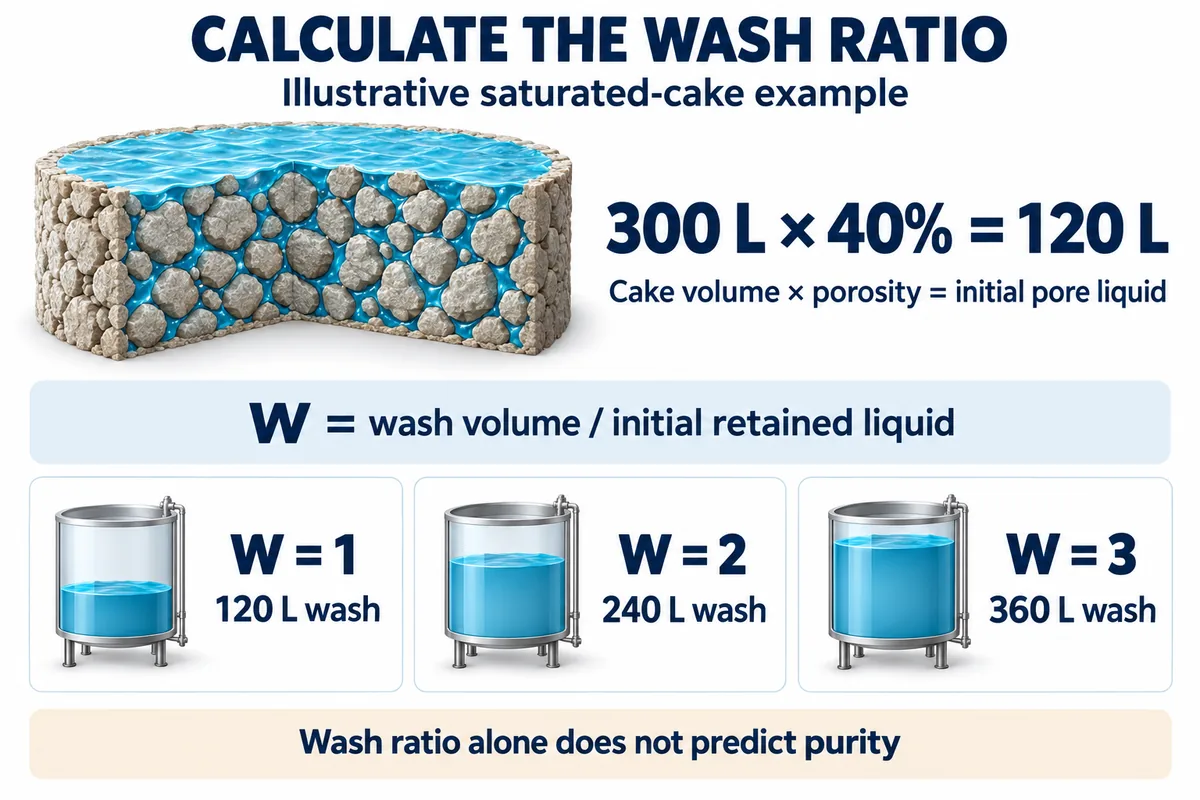
Wash ratio, W = wash-liquid volume ÷ liquid retained in the cake immediately before washing.
The units cancel when both volumes use the same units. A ratio of 2 means you added twice the initial retained-liquid volume.
Some research defines wash ratio using total cake pore volume. These definitions agree for a fully saturated cake. If the cake has already been partly dewatered, record its saturation and state your denominator so you don’t compare different quantities.
Worked Example: Estimate Your Trial Wash Volumes
A fully saturated cake occupying 300 liters with 40% porosity contains 120 liters of pore liquid. These are illustrative assumptions, so replace them with measured values for your material.
The calculation is straightforward:
- Initial pore liquid: 300 L × 0.40 = 120 L.
- A trial at W = 1 uses 120 L of wash liquid.
- A trial at W = 2 uses 240 L.
- A trial at W = 3 uses 360 L.
That gives you a useful test range, not a purity prediction. Real cakes contain different flow paths, stagnant regions, and sometimes cracks. One nominal liquid replacement rarely behaves like perfect plug flow.
Use pilot tests to find the volume that reliably meets your specification. A suitably configured laboratory filter press can support initial trials; confirm that it reproduces the required cake geometry and wash flow path. Then check the result across the feed variation you actually expect in production.
Measure Impurity Remaining in the Cake
The fraction of impurity remaining compares impurity mass after washing with impurity mass before washing. Pair it with wash ratio to build a useful washing curve.
Impurity remaining, X = impurity mass after washing ÷ impurity mass before washing.
Suppose a cake initially contains 1.2 kg of dissolved impurity and a validated cake assay finds 0.024 kg afterward. Then X = 0.02, or 98% removal.
If the cake contains 300 kg of dry product solids, that remaining 24 g equals 80 mg/kg on a dry-solids basis. Whether that passes depends on your product specification. A high removal percentage alone doesn’t establish acceptability.
This is a calculation example, not a reported production trial, and the removal percentage cannot be inferred from wash ratio alone.
Run the Filter Cake Washing Process in 7 Steps
A controlled Filter Cake Washing Process starts with a measurable purity target and ends with evidence that the cake meets it. Keep the cake structure, liquid chemistry, flow conditions, and sampling method consistent enough to compare results.
1. Define a Measurable Purity Target
Specify the impurity, acceptance limit, reporting basis, and analytical method before you run a trial. “Wash until clean” leaves too much room for interpretation.
For example, a trial might target less than 100 mg/kg of a particular impurity on a dry-solids basis. That is an illustrative limit, not a universal recommendation.
Also set acceptable product loss and final moisture. A washing change that improves purity while dissolving valuable product may be a poor trade.
2. Select a Compatible Wash Liquid
Choose a liquid that removes the target impurity while preserving your product and remaining compatible with the filter, seals, and cloth. Water is useful for many water-soluble salts, but it isn’t the right choice for every material.
Check these factors together:
- Impurity solubility and product solubility.
- Compatibility with the retained mother liquor.
- Effects of temperature and pH on the solids.
- Potential for precipitation, swelling, or particle dispersion.
- Recovery, treatment, and disposal requirements.
Warmer liquid may flow more easily because viscosity falls. It may also dissolve more product. Test both effects before treating heat as an easy improvement.
3. Form a Uniform Cake
Build a cake with consistent thickness and structure so wash liquid reaches the solids evenly. Uneven filling, particle segregation, and damaged cloth can undermine washing before the wash starts.
A published study by Sauer and colleagues on fine-particle layers demonstrates why structure matters. In their limestone experiments, mean residence time increased from 57 ± 14 seconds to 193 ± 54 seconds across the compared feed conditions, while impurity-versus-wash-ratio curves were almost identical within measurement accuracy.
The practical lesson: a fine-particle layer can slow washing substantially without producing the same change in performance per unit wash volume. Those laboratory timings are not operating targets for your filter.
Where the equipment permits it, controlled consolidation can help stabilize the cake. Excessive compression can reduce permeability, so validate the sequence instead of assuming that maximum squeeze gives the best wash.
Our membrane vs. chamber filter press comparison explains how the added squeeze stage changes the equipment and operating cycle.
4. Confirm the Wash Flow Path
Verify that your equipment directs wash liquid through the intended cake path and into the correct collection stream. Use the manufacturer’s plate arrangement and operating procedure for your exact filter.
Filter presses can have different porting, manifolds, and wash arrangements. Our guide to how a filter press works explains the roles of the plates, cloths, pump, and drainage system. A valve sequence copied from another press may send liquid along an unintended route.
Keep early wash fractions separate from cleaner later fractions when recovery or reuse requires it. Confirm equipment pressure limits and any allowable pressure difference between membrane squeeze and wash circuits before adjusting settings.
5. Add a Measured Volume at Controlled Conditions
Meter the wash liquid and record cumulative volume, flow, temperature, differential pressure, and elapsed time. Those measurements let you distinguish a chemistry problem from a flow problem.
Avoid assuming that more pressure will always produce more useful flow. Compressible cakes may become less permeable as pressure increases.
Collect labeled wash fractions during trials. Measure the relevant impurity in each fraction so you can estimate how much leaves the cake and where cleaner fractions might be reused.
My recommendation is to change one major variable at a time during initial troubleshooting. It makes the reason for an improvement much easier to identify.
6. Verify the Endpoint With Cake Samples
Establish the endpoint by testing representative cake samples and correlating the results with your process measurements. A low impurity concentration at the outlet can coexist with poorly washed regions inside the cake.
In Ernest Mayer’s membrane filter press analysis, both cake measurements and impurity mass balances are central to detecting nonuniform washing.
Sample suitable locations across the cake and, for a press, across relevant chambers. Use a validated extraction and assay method. Include separate location results when an average could hide an unacceptable pocket.
Conductivity can be a useful indicator for ionic contamination, but temperature and the mixture of dissolved ions affect it. Establish its relationship to your target impurity; it cannot detect every contaminant.
Take physical samples only after the equipment is safely isolated and depressurized under the approved procedure. Once validated, an online signal may support routine control, backed by scheduled cake verification.
7. Dewater and Evaluate the Final Product
After washing, remove retained liquid using the dewatering sequence approved for your material and equipment. Depending on the system, this may involve membrane squeezing, vacuum, or an approved gas blow.
If you are evaluating squeeze equipment, review the membrane filter press configuration and specify the washing circuit separately. A membrane squeeze system does not by itself establish that cake washing is included.
Select the gas for the process chemistry. Air is not automatically suitable for flammable-solvent or oxygen-sensitive service.
Measure final moisture, purity, and product recovery. Record total cycle time too, because a short wash step offers little benefit if the revised sequence makes the overall batch slower.
Troubleshoot the Symptom Before Adding More Wash Liquid
Match poor washing performance to its likely cause before extending the cycle. Additional liquid can help when the wash volume is insufficient, but it won’t necessarily correct bypassing, cake compression, or an unsuitable solvent.
| Symptom | Possible cause | Check first |
|---|---|---|
| Clean outlet liquid, contaminated cake regions | Cracks, edge gaps, or uneven distribution | Samples from different locations, cake condition, and the wash flow path |
| Very slow flow | Fine-particle layer, cloth blinding, high viscosity, or cake compression | Flow and pressure trends, feed changes, temperature, and cloth condition |
| Impurity removal levels off | Slow release from stagnant pores, adsorption, or poor impurity solubility | Cake assays, wash-liquid suitability, and representative alternative-method trials |
| Unexpectedly high product loss | Product dissolution or solids escaping with the wash | Dissolved product and suspended solids in collected fractions |
| Large variation between batches | Changing feed, cake thickness, retained liquid, or wash conditions | Comparable wash ratios and batch records |
A useful washing curve plots impurity remaining against wash ratio, with wash time recorded alongside it. The early region is dominated by displacement; mixing broadens the transition, and slower release from less accessible regions can create a long tail.
That tail deserves investigation. Simply waiting longer doesn’t guarantee proportionate improvement, especially when flow and mass transfer change together.
Reduce Washing Cost Without Sacrificing Purity
Optimize the total cost of producing acceptable solids, including wash liquid, treatment, recovery, energy, cycle time, and product loss. The smallest water bill doesn’t automatically give you the lowest production cost.
Start with three practical opportunities:
- Separate wash fractions. Keep concentrated fractions suitable for recovery apart from dilute fractions considered for reuse.
- Compare trials at the same purity target. Lower liquid consumption only counts as an improvement if the cake still passes.
- Confirm the result across representative feeds. Repeat promising settings on batches with realistic variation in particle size and solids concentration.
For example, reducing fresh wash from 360 L to 240 L saves 120 L per batch in the illustrative case above. Across 20 batches, that is 2,400 L. Treat this as arithmetic, not a promised saving: the lower-volume trial still needs to meet purity and recovery requirements.
Frequently Asked Questions
The right wash volume, sequence, and stopping point depend on cake structure, impurity chemistry, and the required product quality. Use these answers to frame trials rather than adopting a universal recipe.
How Much Wash Water Does a Filter Cake Need?
Determine wash demand from a measured washing curve and the required residual-impurity limit. Initial retained liquid gives you the basis for calculating wash ratio, but it doesn’t tell you how many replacements will be sufficient.
Are Several Small Washes Better Than One Large Wash?
Several stages can improve dilution washing when each stage includes mixing and liquid removal. Splitting the same total volume into pulses through an intact cake does not automatically improve displacement washing; interruptions can also change saturation and flow distribution.
Should You Blow Air Through the Cake Before Washing?
Prewash gas dewatering needs validation because it can reduce mother-liquor inventory while also changing saturation or creating preferential paths. Use the equipment-approved sequence and compare final cake purity, wash demand, and cycle time before adopting it.
Make Your Next Washing Trial Measurable
Start with a defined impurity limit, measure the liquid inventory, and compare wash settings using representative cake assays. Once a setting passes consistently, evaluate its liquid consumption, product recovery, and total cycle time.
You don’t need to guess whether another rinse helped. Record what went in, measure what came out, and verify what remains in the solids. Use those results to build a repeatable operating procedure from this filter cake washing guide.