Filter press maintenance means keeping cloths and sealing surfaces clean, inspecting plates and hydraulics, and checking safety systems on a documented schedule. Check the press each shift and after cake discharge, follow the manufacturer’s service intervals, and budget for wear parts, labor, cleaning, and downtime.
| When to check | Main tasks | What requires attention |
|---|---|---|
| Each shift | Observe leaks, operating readings, filtrate quality, and safety-device status from designated safe positions. | New leakage, abnormal readings, alarms, or defective safeguards. |
| After cake discharge | Under the approved safe-access procedure, inspect cloths, plate faces, and sealing areas; remove retained cake. | Folded cloth, trapped solids, damaged plates, or obstructed ports. |
| Planned weekly review | Review cloth condition, cleaning needs, pump performance, and lubrication tasks due. | Longer cycles, persistent cloudy filtrate, uneven cake, or repeat defects. |
| Planned monthly review | Review hydraulic condition, mechanical wear, maintenance records, and critical spares. | Recurring leaks, declining performance, or unavailable replacement parts. |
| At specified service intervals | Complete oil, filter, component, instrument, and safety-system servicing required by the manufacturer. | Time, cycle-count, operating-hour, or condition limits reached. |
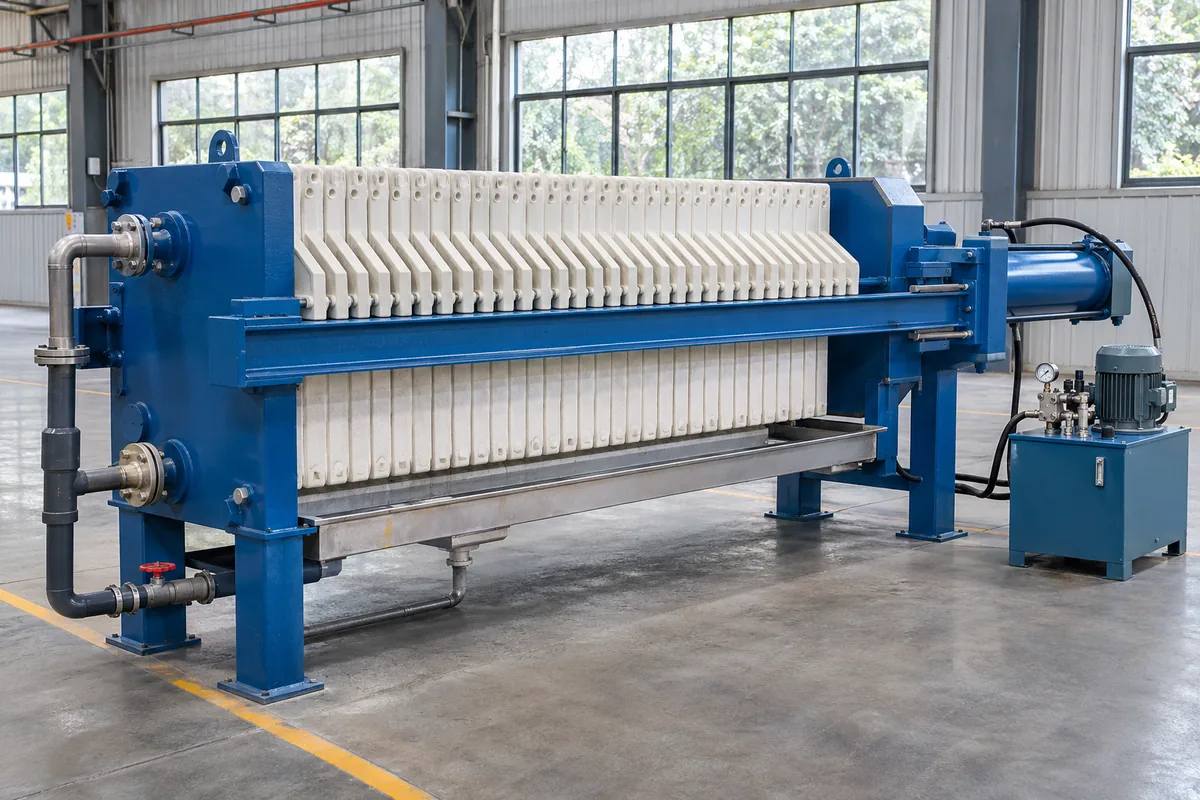
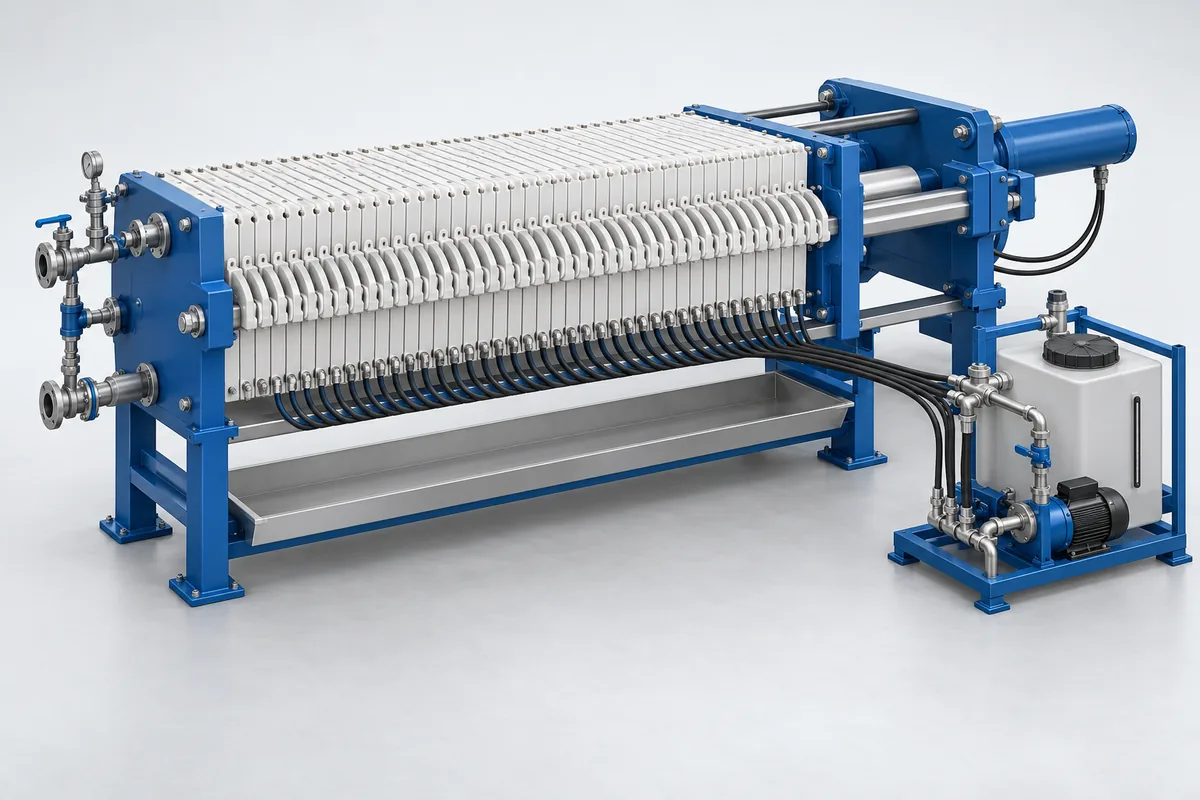
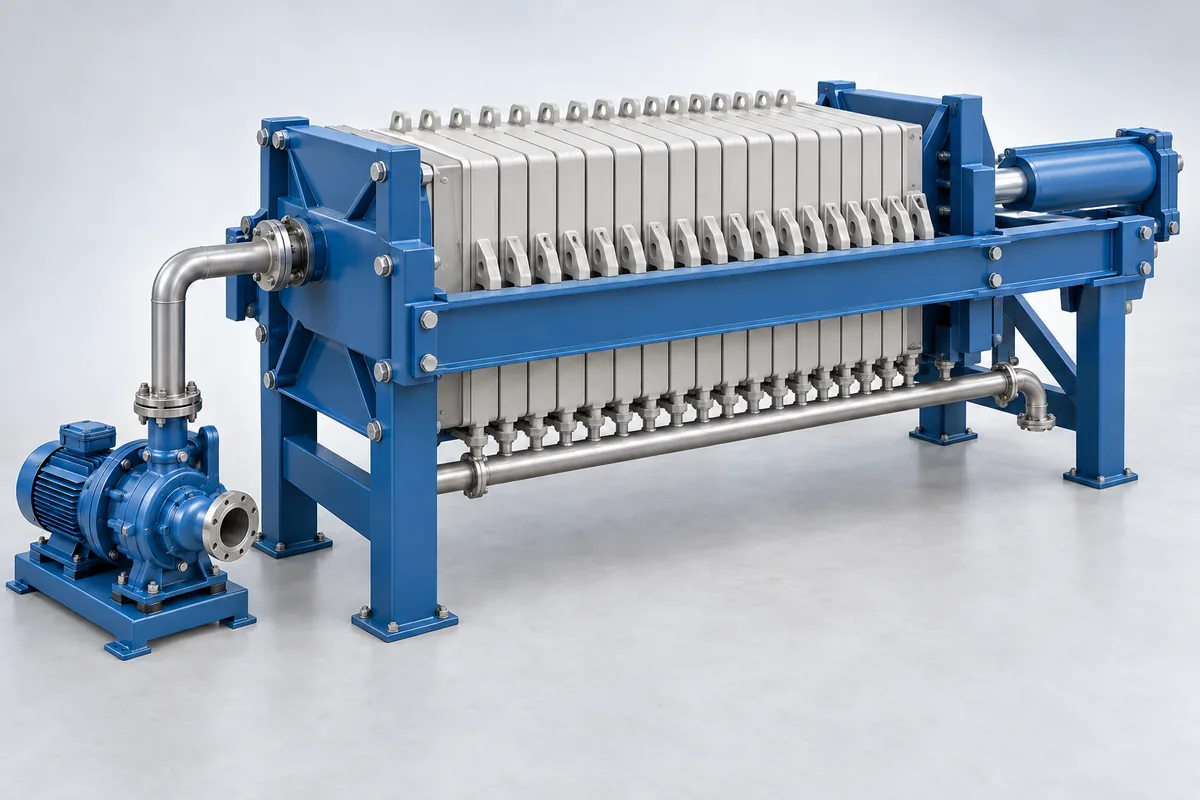
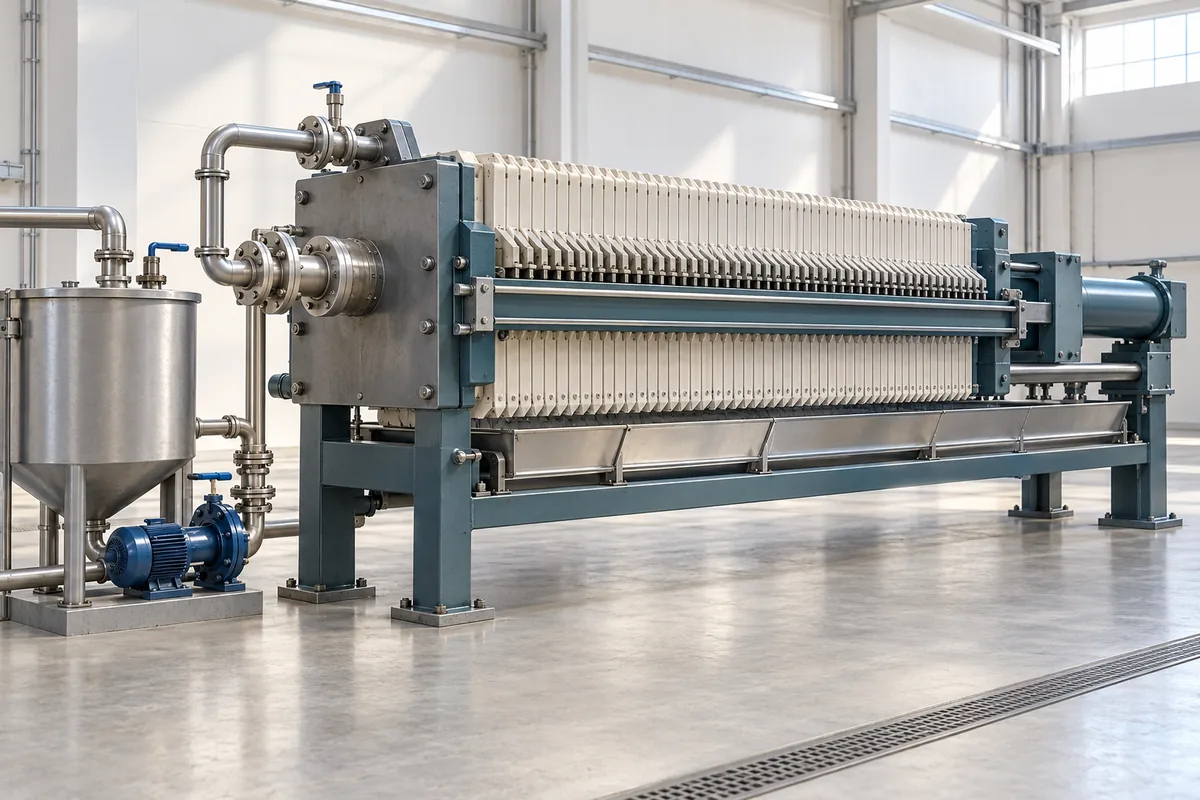
The checks here apply to plate filter presses, including recessed-chamber and membrane designs. If you need to identify your configuration, compare the main filter press types. Belt presses need a different maintenance plan. Your machine’s manual and site procedures determine the settings, service intervals, and rules for safe access.
Make The Press Safe before Touching It
Before hands-on maintenance, authorized personnel must isolate hazardous energy, control stored pressure and movement, and verify that the press is safe to work on. The stop button alone does not isolate the machine.
A stopped press can still hold pressure or move unexpectedly. Depending on the design, energy may remain in accumulators, the feed circuit, membrane chambers, or raised and moving components. The isolation procedure must account for electrical, hydraulic, pneumatic, mechanical, and process-pressure hazards.
In the United States, OSHA’s control of hazardous energy standard requires control of hazardous stored energy and verification of isolation before servicing. Apply the rules relevant to your location alongside the machine-specific lockout/tagout procedure.
For routine checks and repairs:
- Take operating readings from designated safe positions with guards in place.
- Use the approved isolation and safe-access procedure before cleaning, adjusting, or replacing components.
- Never loosen a pressurized fitting, search for a hydraulic leak with your hand, or reach between moving plates.
- Keep a press with defective safeguards out of service until the fault is corrected and the required checks pass.
You may spot a leak during an operating check. To repair it, shut the press down and follow the isolation and maintenance procedure.
Clean and Inspect The Parts That Affect Every Cycle
Start with the cloths, sealing surfaces, plates, and drainage paths. Their condition affects how the press filters and releases cake. If cycles take longer or cake quality changes, check the hydraulics and feed system too.
Clean filter cloths when performance calls for it
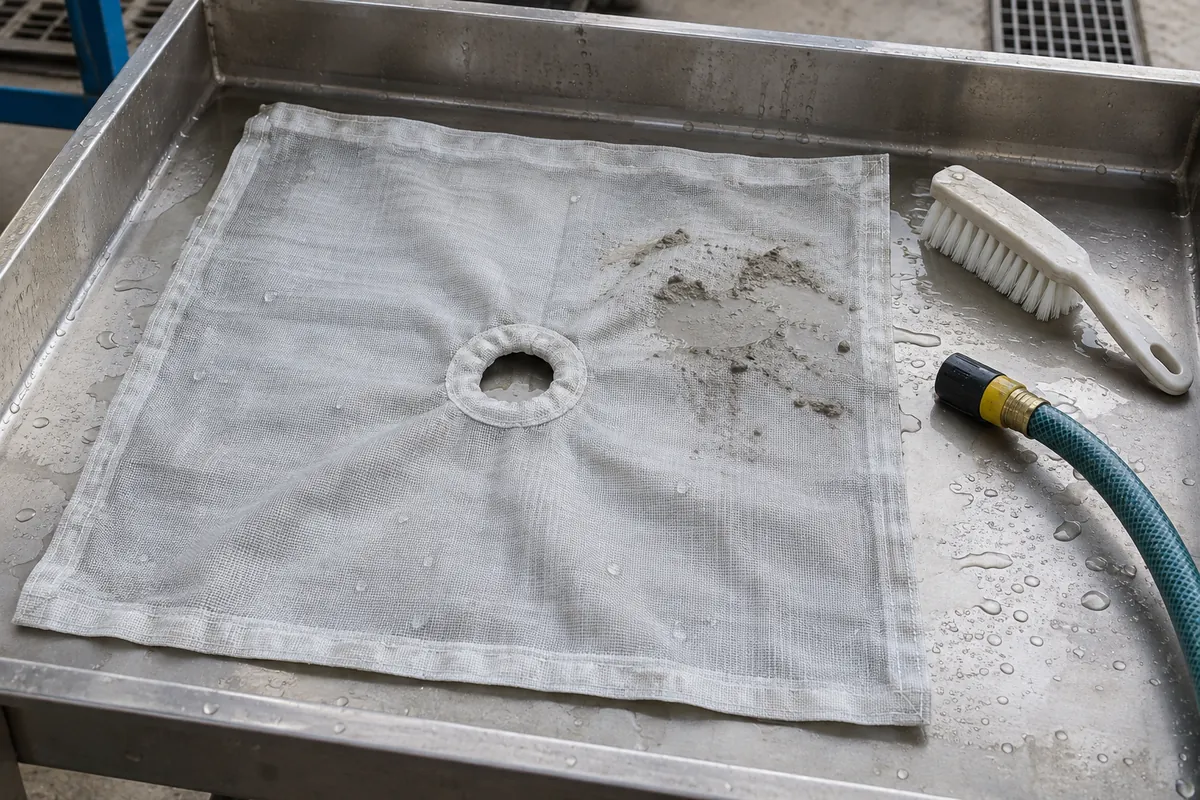
Clean the cloths when buildup restricts drainage, using a method approved for the fabric and application. When particles or deposits block the fabric’s openings, liquid passes through more slowly. This is called blinding.
Longer filtration times, cake that becomes harder to release, or reduced flow under similar feed conditions are reasons to investigate. Check the cloth, but keep other possible causes in mind.
We recommend at least weekly rinsing for the applications it describes and notes that severe applications may need cleaning after every cycle. Set the cleaning interval for your slurry and operating conditions.
For each cleaning job:
- Establish safe access under the approved procedure.
- Remove loose cake with tools suitable for the cloth and plate material.
- Clean the fabric, perimeter sealing areas, and support-contact areas as specified by the manufacturer.
- Inspect for tears, folds, worn seams, and damage around the feed opening.
- Compare performance after cleaning with the previous baseline.
Use the approved wash pressure, nozzle, distance, and water quality. A jet that is too forceful, or a scraper that is too aggressive, can damage a usable cloth. Our filter cloth cleaning guide covers the cleaning sequence in more detail.
Before chemical cleaning, confirm that the cleaner suits the deposits and is compatible with the cloth, plates, and gaskets. Check its safety data sheet and arrange an approved way to handle the wash effluent. OSHA’s safety data sheet requirements identify handling and storage, exposure controls, and stability and reactivity as separate sections to review. Removing scale does not establish that a cleaner is safe for the equipment.
Replace damaged cloths and investigate repeat failures
Replace torn or badly worn cloths using the manufacturer’s procedure. If cleaning fails to restore performance, investigate before ordering another set; a replacement may develop the same fault.
Wear that keeps appearing near the feed opening is a reason to review cloth fit, alignment, and feed conditions with the supplier. When blinding affects much of the cloth, review the slurry chemistry and cloth selection.
Abrasion, chemistry, cleaning, and cycle count all affect cloth life. Record how many cycles each cloth lasts and why it was removed. A fixed replacement date tells you less about the cause of failure.
Keep plate faces, ports, and seals clean
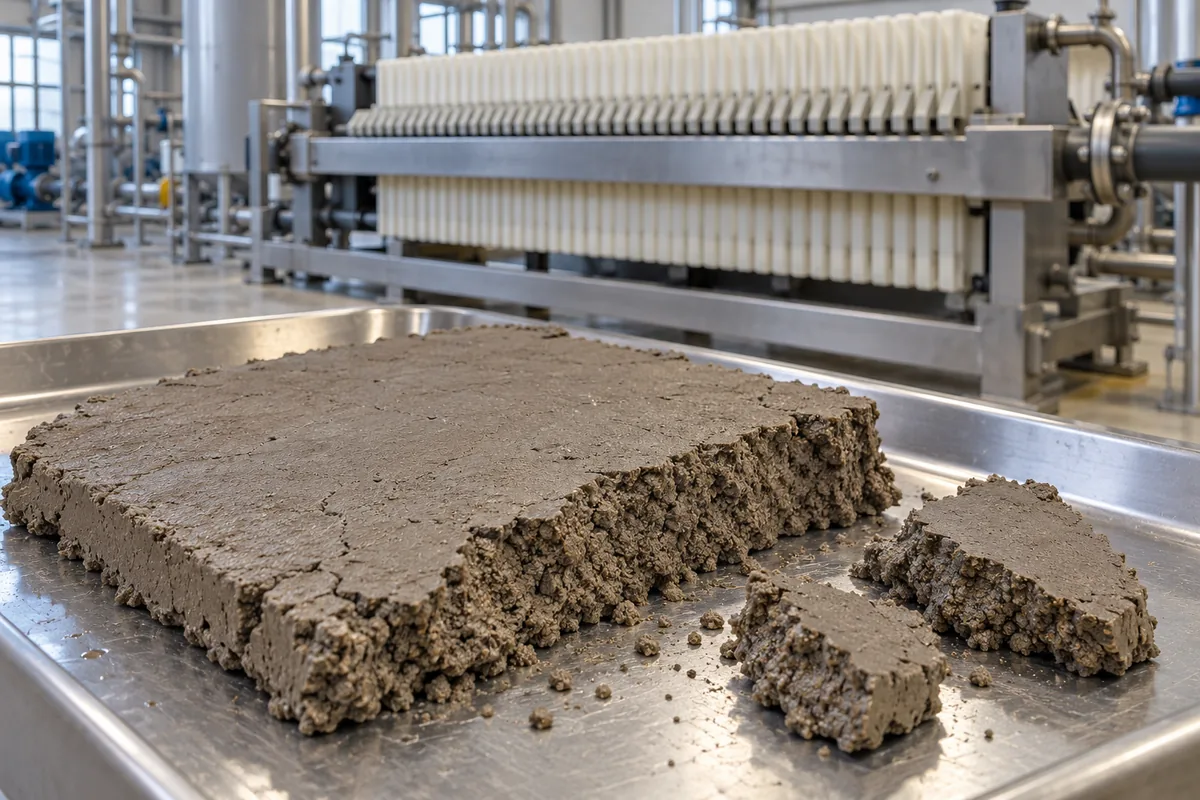
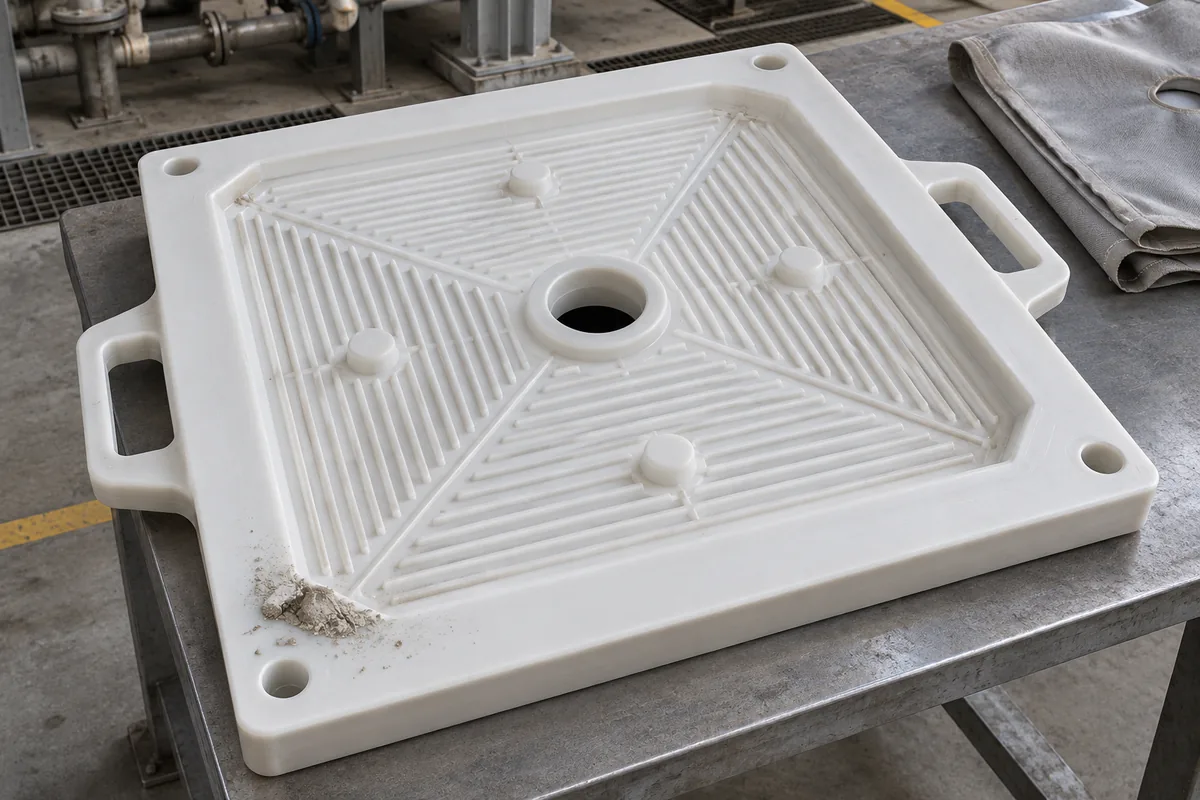
Remove retained cake from sealing surfaces and check plate alignment, drainage features, and cloth seating before returning the press to operation. Trapped solids or a folded cloth can prevent proper sealing and create a leak path.
Once the press is safely isolated, look for cracks, distortion, damaged supports, blocked passages, and worn gaskets where fitted. Use the specified replacement parts and approved handling equipment for heavy plates.
Do not raise closing pressure to compensate for damaged plates or poor sealing. Removing a damaged plate also changes the pack: the plate count, sequence, and pack length must stay within the manufacturer’s approved configuration.
Check hydraulics, the feed pump, and membrane equipment
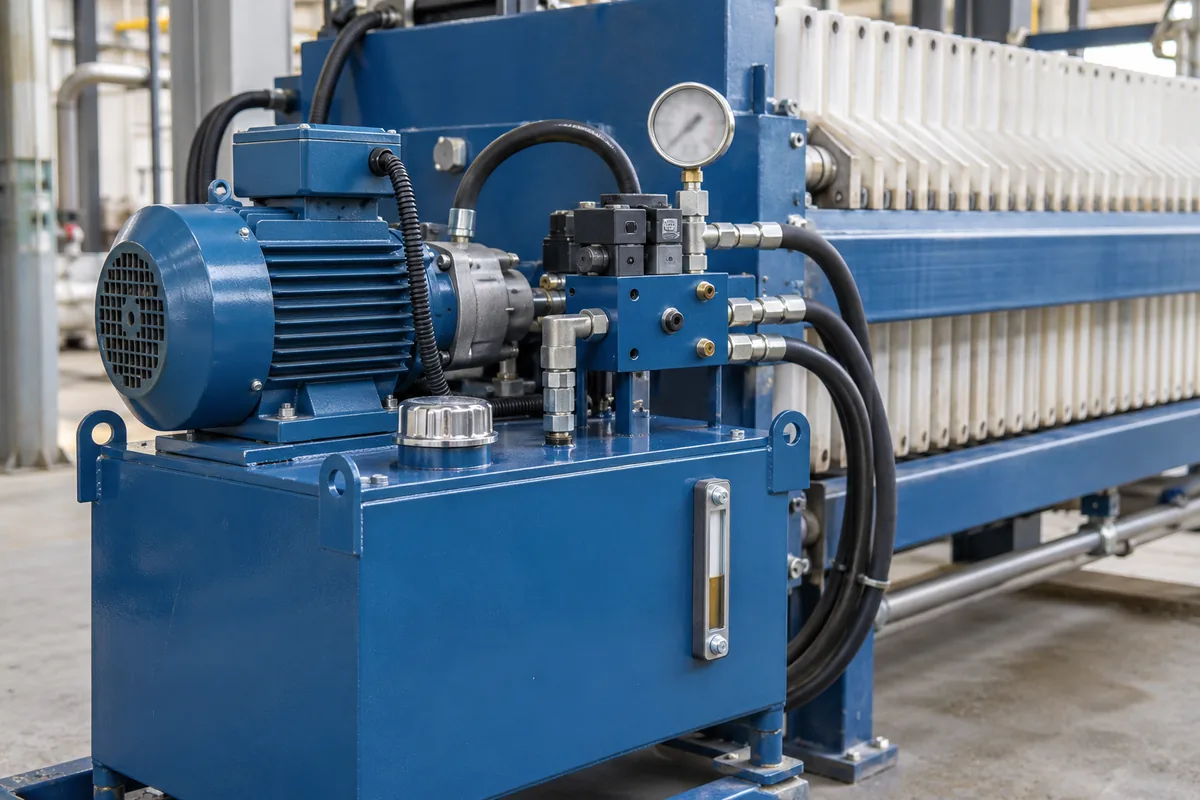
Check hydraulic oil level and temperature, look for leaks and hose damage, and follow the specified fluid and service intervals. Check the manual before choosing an oil grade or setting an annual replacement date.
These three pressures have different jobs:
- Hydraulic closing pressure produces the force that holds the plate pack closed.
- Slurry feed pressure drives liquid through the cloth and developing cake.
- Membrane squeeze pressure, used in a membrane filter press, inflates the membranes to compress the cake.
Record each applicable pressure separately and use its own approved operating limits.
Include pump seals, valves, piping, instruments, and membrane connections in the maintenance plan. Poor feed delivery or a blocked discharge path can look like a cloth problem. A damaged membrane can affect dewatering too, although wet cake alone does not identify the fault.
Use a Filter Press Maintenance Checklist with Clear Ownership
A filter press maintenance checklist should name the person responsible, state the equipment condition required for the task, and explain what to do when a check fails. “Hydraulics checked” leaves the next shift guessing. Record the reading, the limit, and any fault found.
Build the checklist from your machine manual and the faults in your maintenance records. Assign service intervals for your press before using these task groups.
| Task group | What to record | Who acts | Follow-up |
|---|---|---|---|
| Shift observations | Readings and units, alarm status, filtrate appearance, new leaks, unusual sounds | Trained operator | Escalate deviations against approved limits |
| Plate-pack inspection | Plate location, cloth condition, retained cake, sealing-face and port condition | Personnel authorized for safe access | Clean, repair, or replace before restart as required |
| Cloth cleaning | Method, approved settings, cycle count, condition before and after | Trained cleaning or maintenance personnel | Confirm whether filtration performance recovers |
| Mechanical service | Wear findings, lubrication completed, specified fastener checks | Qualified maintenance personnel | Raise a work order for defects outside acceptance limits |
| Hydraulic and pump service | Leakage, fluid condition, filters, hoses, pump wear, relevant measurements | Qualified maintenance personnel | Follow manufacturer service and diagnostic procedures |
| Controls and safeguards | Required functional-test results, defects, corrective action | Authorized competent personnel | Restore and verify safe operation before release |
| Spares review | Part numbers, stock, consumption, lead times | Maintenance planner and purchasing | Reorder against the site’s agreed stock levels |
Record the date, machine ID, work-order number, responsible person, and completion sign-off. Number the plates consistently so “cloth damaged at plate 18” means the same location on every shift.
Give every unresolved defect an owner and a due date. Follow the site’s immediate-response procedure for safety-critical defects; do not leave them in the routine backlog.
Calculate Filter Press Maintenance Cost from Your Records
Filter press maintenance cost depends on what the press handles, how often it runs, its configuration, and what you pay for parts, labor, and service. Calculate direct maintenance spending first. Assess downtime separately to avoid counting the same loss twice.
Use records from one completed accounting period. Include:
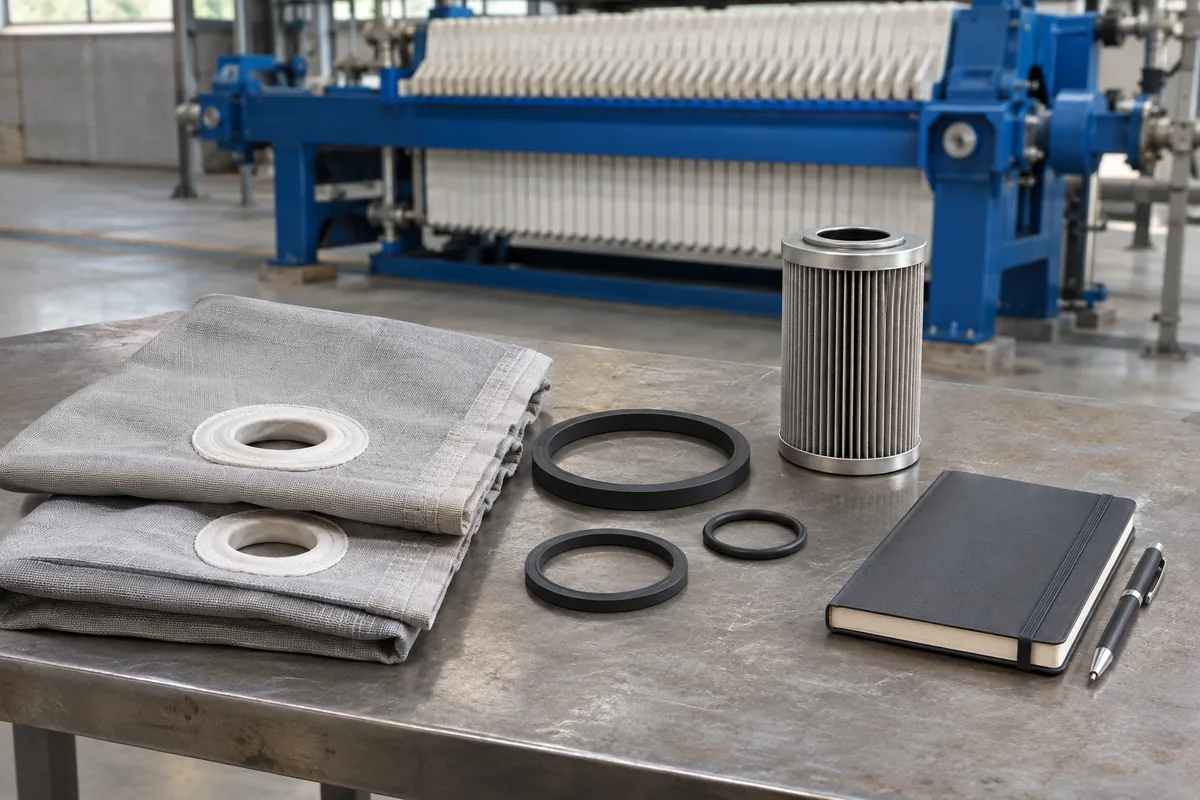
- Replacement cloths, gaskets, seals, membranes, and other wear parts.
- Hydraulic oil, filters, lubricants, and cleaning consumables.
- Internal maintenance labor at the site’s chosen cost rate.
- External service, travel, and relevant inspection costs.
- Cleaning-water and effluent-handling costs where allocated to maintenance.
Give suppliers the machine serial number, plate size, cloth specification, and process conditions when requesting prices. Compare quotes for the same specification; a cheaper cloth material or different membrane assembly may not suit the press.
Work through a transparent budget example
In this hypothetical annual budget, direct maintenance spending comes to $12,100. The amounts are illustrative, not supplier quotations, industry averages, or a forecast for your plant.
| Cost item | Illustrative annual calculation | Amount, USD |
|---|---|---|
| Cloth replacements | 2 sets × $1,800 | $3,600 |
| Other wear parts and service materials | Assumed total | $2,200 |
| Internal maintenance labor | 80 hours × $45 | $3,600 |
| External service | Assumed annual total | $1,800 |
| Cleaning consumables and allocated effluent costs | Assumed annual total | $900 |
| Direct maintenance total | Sum of the five items | $12,100 |
Suppose the same plant records eight hours of unplanned downtime at an incremental business cost of $500 per hour. The extra $4,000 brings the combined maintenance and unplanned-downtime impact to $16,100 in this example.
Agree on how to value downtime, whether through lost contribution margin or additional treatment costs. Gross sales per hour can overstate the loss if production is recovered later. Repair labor already included in the maintenance total should not be added again.
Compare cost per dry tonne processed
Divide maintenance spending by the dry solids processed in the same period to compare costs as workload changes. Wet cake weight includes water, which can distort the comparison.
Using the example above, $12,100 divided by 10,000 dry tonnes equals $1.21 per dry tonne in direct maintenance cost. Both figures must cover the same annual period.
Check downtime and filtrate quality alongside this figure. If overdue cloth changes reduce output or let solids through, a lower maintenance bill has not solved the cost problem.
Troubleshoot Symptoms before Changing Settings
Compare operating trends before inspecting components under the required safe conditions. The same symptom can come from several faults. Changing pressure or swapping parts without a diagnosis can waste time and create more problems.
| Symptom | Possible causes to investigate | Useful next check |
|---|---|---|
| Longer filtration cycle | Cloth blinding, changed slurry properties, restricted passages, feed-pump wear | Compare feed conditions and flow trends; inspect cloths and passages safely |
| Persistent cloudy filtrate | Cloth damage, poor cloth installation, unsuitable cloth selection, process change | Locate the affected outlet where the design allows; inspect the corresponding cloth and plate |
| Leakage between plates | Retained cake, folded cloth, damaged sealing surface, alignment or closing-system fault | Stop safely, isolate, and inspect the plate pack and closing system |
| Wetter or uneven cake | Changed feed solids, uneven filling, poor drainage, squeeze-system fault where fitted | Compare chamber patterns, feed data, drainage, and the approved cycle sequence |
| Poor cake release | Sticky material, incomplete dewatering, cloth fouling, discharge-equipment fault | Review cake condition and inspect cloths and discharge equipment |
Some applications produce cloudy filtrate briefly while the filtering cake develops. Investigate cloudiness that persists or differs from the normal pattern, using your filtrate specification as the reference. For a closer look at recurring symptoms, see our filter press troubleshooting guide.
Suppose filtration time rises from 45 to 60 minutes. That is a 33% increase in filtration time. The effect on throughput depends on the complete cycle, which also includes filling, squeezing, opening, and discharge; it is not automatically a 33% loss.
Compare feed solids, slurry characteristics, pump delivery, and cycle settings before deciding the cloth is at fault. If approved cleaning restores performance under comparable conditions, review the cleaning interval. If it does not, continue the diagnosis.
Track a Few Measurements Consistently
Record cycle stages, cake and filtrate quality, throughput, and faults under comparable operating conditions. These records help separate equipment wear from a process change and show whether a repair worked.
Record these details in the operating log:
- Total cycle time and the time spent in each major stage.
- Feed solids concentration and relevant slurry changes.
- Separate feed, closing, and squeeze-pressure readings where applicable.
- Filtrate quality measured against the site’s requirement.
- Cake moisture or percent solids using a consistent sampling method.
- Dry solids processed, downtime duration, and the reason for each stop.
- Cloth location, installation cycle count, cleaning history, and removal reason.
Plot feed solids concentration alongside filtration time so changes in the feed are visible when you review longer cycles.
When calling for service, provide the machine ID, alarm history, readings with units, affected plate numbers, recent changes, and photographs taken safely. The preventive maintenance visits should combine safety inspections, mechanical and electrical checks, performance evaluation, spares review, and operator training. Have those records ready for the service visit.
Common Maintenance Questions
Use the machine’s instructions and its condition to decide when to service it, replace cloths, or stop for a leak. A calendar alone will not account for changes in slurry or wear.
How often should a filter press be serviced?
Check operating condition each shift and service the press at the manufacturer’s specified intervals. Adjust the schedule through an approved maintenance program when duty or condition calls for it. Abrasive slurry, heavy use, or repeat faults may require more frequent checks.
Include operating hours, cycle counts, oil condition, and required safety tests in the schedule wherever they determine when work is due.
When should filter cloths be replaced?
Replace cloths that are too damaged to use. Also consider replacement when approved cleaning fails to restore acceptable performance after you have checked other causes. Follow the manufacturer’s guidance promptly when you find tears, persistent solids leakage, or severe wear.
If the same location keeps failing, record it and inspect the surrounding plate, cloth installation, and feed conditions before fitting another cloth.
Should you increase pressure to stop a leak?
Do not raise pressure to stop an unexplained leak. Stop the press and follow the approved procedure to check sealing surfaces, cloth installation, plate condition, alignment, and the closing system.
If a setting is incorrect, qualified personnel should restore the documented setting and verify operation. All relevant component pressure limits still apply.
Put the Plan into The Next Shift
Assign the checks to named people, record how the press performs when it is working properly, and resolve the defects your team has already reported. Use the records to schedule cleaning and order compatible spares. Verify each repair before returning the press to service.
Planning a new or replacement filter press?
Send your slurry material, throughput with units, feed solids if known, and project country. For a replacement, include the current model and maintenance problems. We can review your requirements and discuss a suitable configuration and quotation.
At handover, leave the next operator a clear record of changes, completed repairs, and open faults. Make that handover part of routine filter press maintenance.