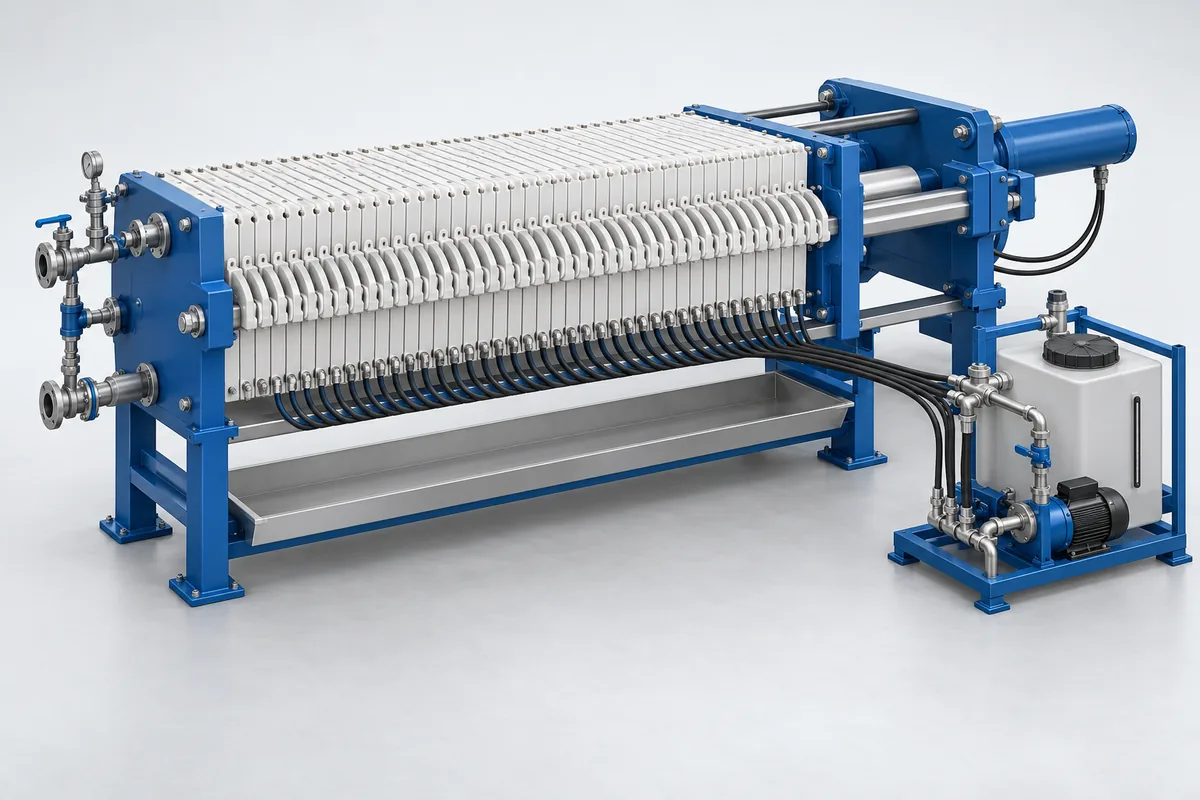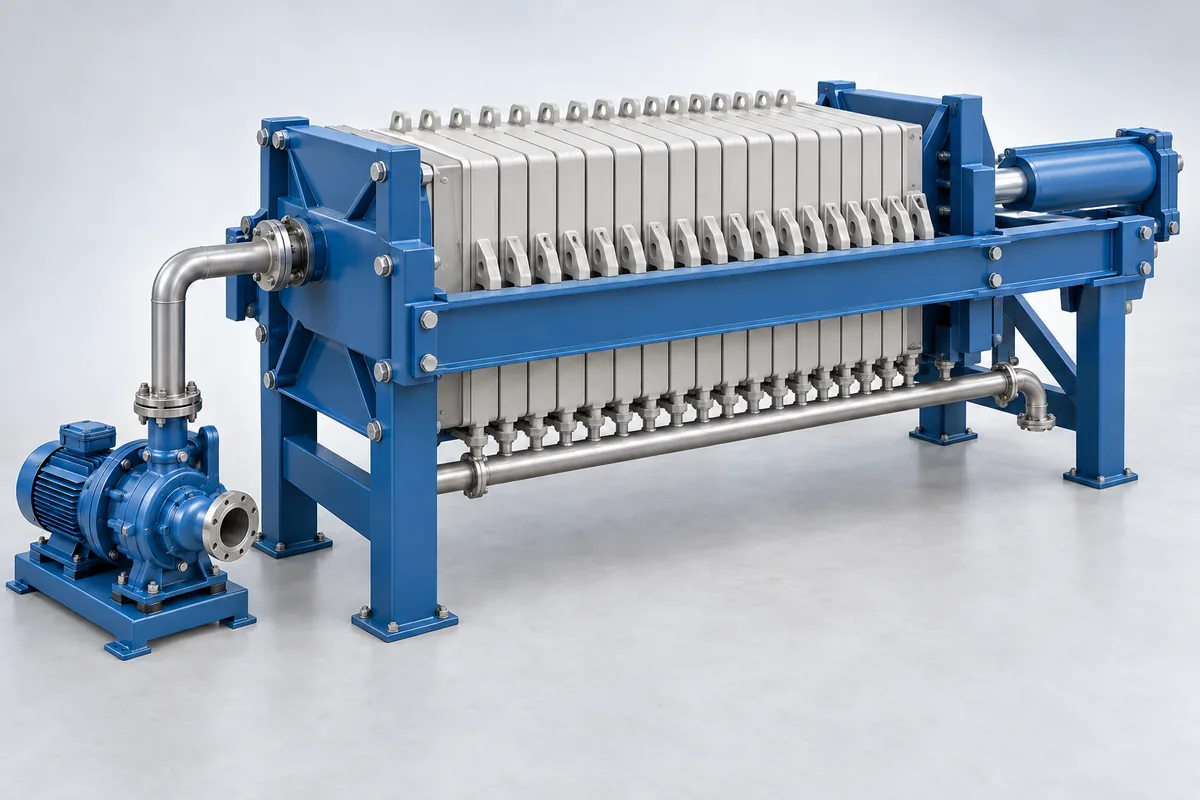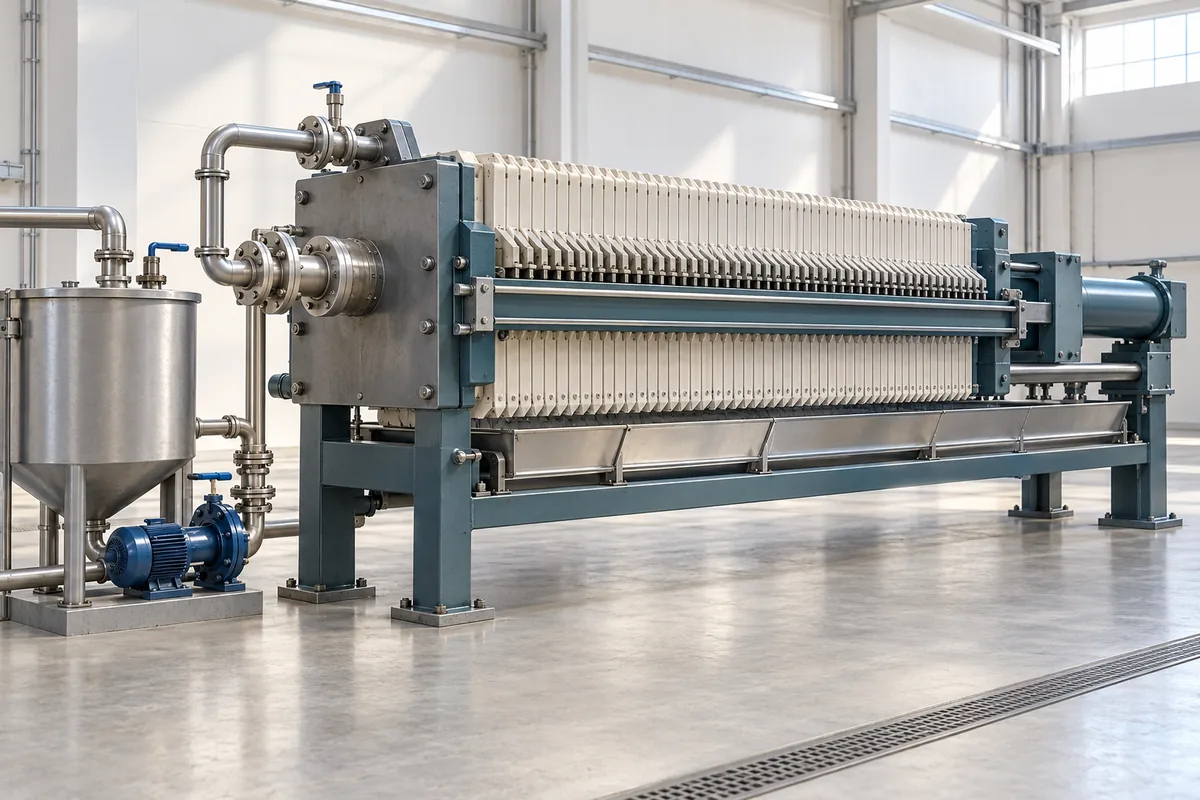
A plate and frame filter press is a batch filtration machine that separates suspended solids from liquid using alternating plates, hollow frames, and filter media. If you’re wondering about plate and frame filter press, the key is simple: a pump pushes liquid through the media while solids collect inside the frames as a filter cake.
| Feature | What it means |
|---|---|
| Operating mode | Batch: fill, filter, discharge, and prepare for the next cycle. |
| Chamber construction | A separate hollow frame sits between cloth-covered plates. |
| Liquid output | Filtrate, collected through drainage channels and outlets. |
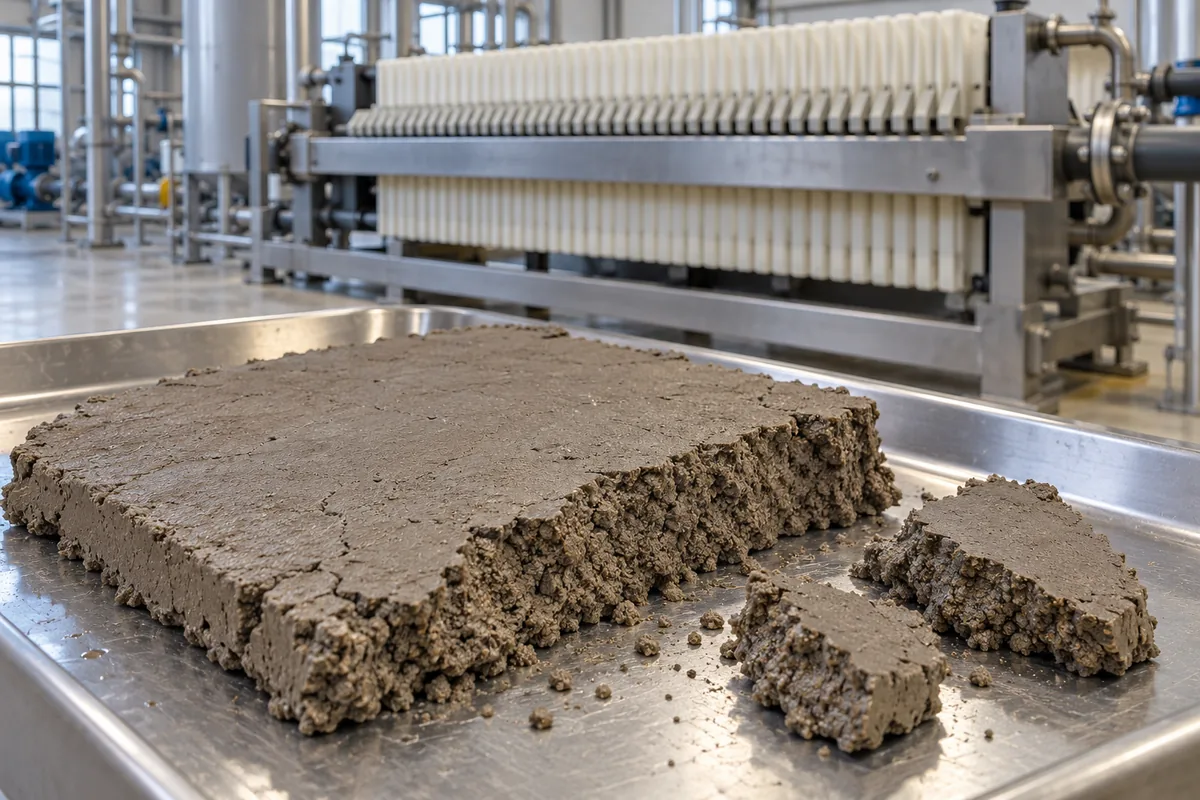
| Solid output | A filter cake that still contains some retained liquid. |
| Cake thickness | Determined primarily by the selected frame thickness. |
| Useful applications | Liquid clarification, selected solids recovery duties, and filtration trials. |
| Pressure and temperature | Equipment-specific ratings; confirm them for the proposed materials and process. |
The practical benefit is control. You can select the filter medium, chamber volume, and operating cycle to suit the material you need to separate.
The important buying detail? “Plate and frame” sometimes gets used loosely for several filter press designs. A true plate-and-frame press has separate open frames. That distinction affects cake removal, media changes, and the suitability of the machine for your process.
How the Plates, Frames, and Filter Cloth Work Together
The plates support the filter media and drain the liquid, while the hollow frames provide space for the retained solids. The machine’s supporting structure keeps this stack aligned and clamped during filtration.
Think of each frame as an empty picture frame with a filtering surface on either side. Slurry enters that space. Liquid moves outward through the media, and solids accumulate between the surfaces.
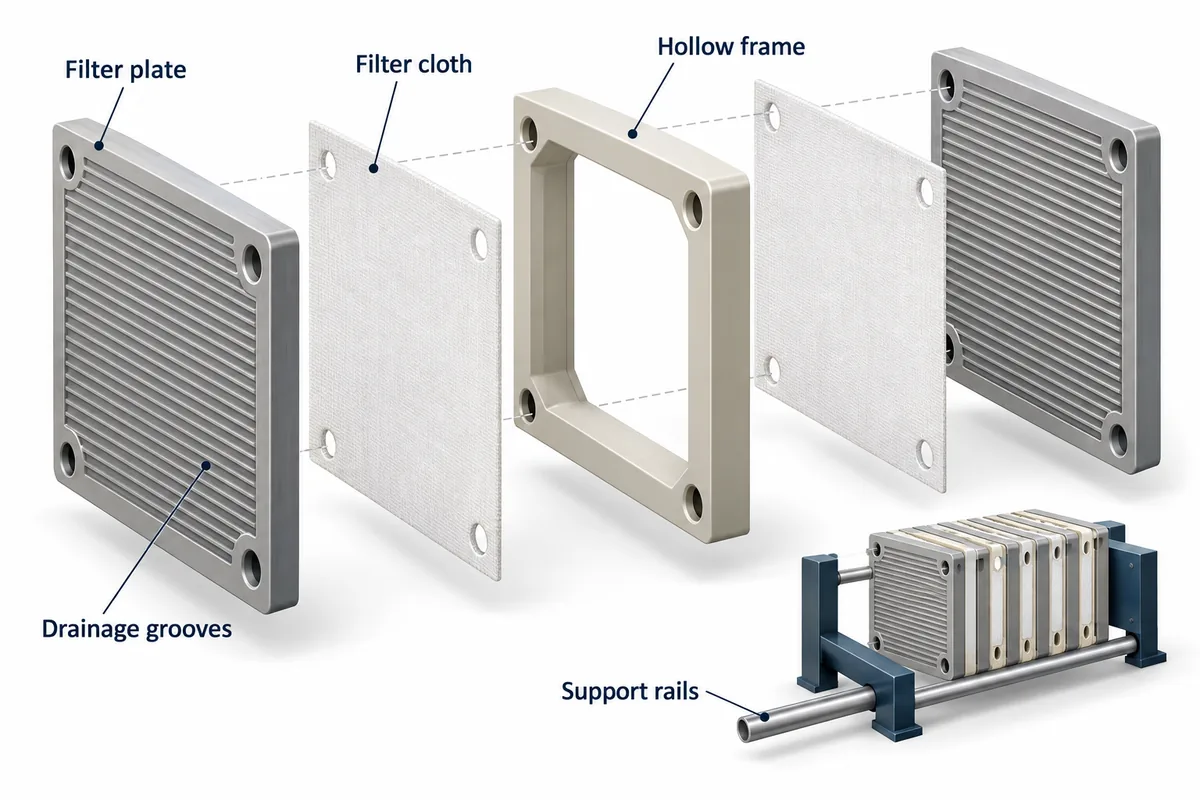
The main components have distinct jobs:
- Filter plates: Support the cloth and contain drainage paths for filtrate.
- Hollow frames: Define the spaces where the filter cakes form.
- Filter media: Retain particles while allowing liquid to pass. Depending on the application, the setup may use cloth or supported filter paper.
- Closing mechanism: Applies the clamping force needed to hold the stack together.
- Feed pump and pipework: Deliver slurry and establish the pressure difference that drives filtration.
Polypropylene is a common plate material, according to M.W. Watermark’s comparison of plate-and-frame and recessed-chamber presses. Other materials may be appropriate, but selection depends on chemical compatibility, temperature, and mechanical loading.
The closing system and feed pump do different jobs. The closing system holds the stack shut. The feed pump provides the process pressure that moves liquid through the filter media and cake.
Plate and Frame Filter Press Working Principle
The operating principle is pressure-driven filtration: liquid passes through porous media while suspended solids remain behind. As those solids build into a cake, the cake itself becomes part of the filtering layer.
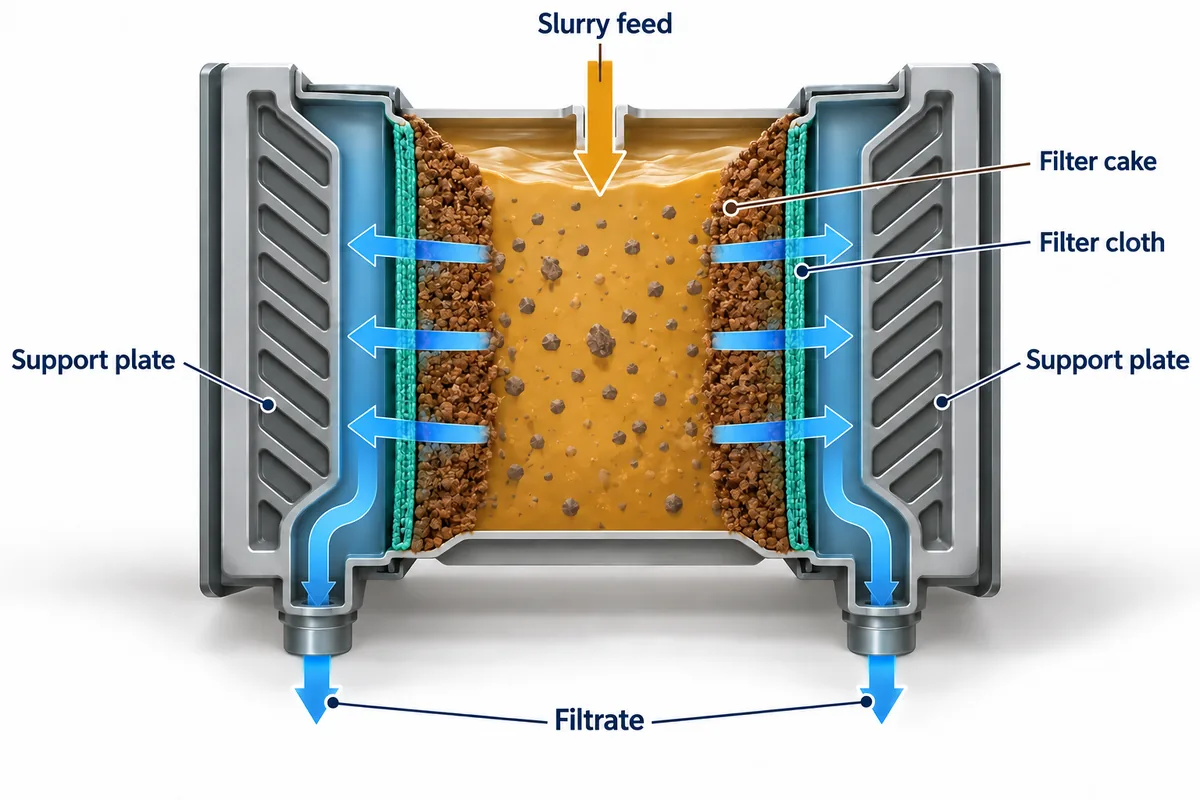
Here’s how a complete operating cycle works.
1. Close the Press and Feed the Slurry
The press is inspected, correctly assembled, and clamped before slurry enters through its feed passages. In traditional designs, these passages commonly run through corner ports in the plate-and-frame stack.
Correct cloth placement matters. A fold, damaged sealing surface, or blocked port can cause leakage or uneven filling.
2. Collect Filtrate and Build the Cake
Liquid passes through the media into the plates’ drainage channels, while retained particles build a cake inside each frame. The filtrate then leaves through the designated outlets.
Early filtrate may contain fine particles before an effective cake layer develops. Where the process allows, operators can return that initial filtrate to the feed system until it meets the required clarity specification.
As the cake thickens, resistance usually increases. Filtrate flow often slows, so the endpoint should follow a validated operating procedure using suitable pressure, flow, time, or volume criteria.
3. Complete Any Approved Washing or Air-Blow Stage
Cake washing or air blowing can be added when the press is specifically equipped for those operations. Washing helps displace residual process liquid; an approved air-blow stage may remove additional liquid.
These are optional process steps. Their effectiveness depends on cake permeability, equipment configuration, and the required product quality.
If purity is the priority, the filter cake washing guide explains how to compare washing methods, estimate trial wash volumes, and check the remaining impurities.
Increasing hydraulic closing pressure does not turn a conventional press into a membrane squeeze press. Membrane squeezing requires plates designed with flexible squeezing surfaces and a separate squeeze system.
4. Depressurize, Open, and Discharge
Feeding stops and all relevant stored pressure must be safely relieved before the press opens. The cakes are removed, the media and sealing surfaces are inspected or cleaned, and the stack is prepared for another batch.
Follow the manufacturer’s shutdown and isolation procedure. Never loosen a press or clear a blockage while the affected system remains pressurized.
Automation can shorten handling time, but the filtration process still operates in cycles.
What is Plate and Frame Filter Press Used for?
A plate and frame filter press is used for liquid clarification, recovery of suspended solids, and selected dewatering applications. It is particularly useful when filter-media flexibility or access to the collected cake matters.
The first question to settle is which output has value: the liquid, the solids, or both.
Clarifying Food, Beverage, and Process Liquids
Suitable plate-and-frame systems can remove suspended particles from products such as oils, syrups, and beverages. In these applications, the desired product is often the clarified liquid.
Consider an oil-processing operation removing fine suspended residue. The priorities may be filtrate clarity, product yield, and media compatibility, rather than the lowest possible cake moisture.
M.W. Watermark notes that traditional plate-and-frame presses have a particular role in polishing applications, where feed solids can be well below 1% by weight. That is an application example, not a universal limit for every press.
Food-contact suitability also requires appropriate materials, seals, cleaning methods, and documentation. A stainless-steel appearance alone does not establish hygienic suitability.
For U.S. food operations covered by the rule, 21 CFR § 117.40, reproduced by Cornell Law School, requires adequately cleanable equipment and corrosion-resistant, nontoxic food-contact surfaces suited to their intended use and cleaning procedures.
When comparing a stainless steel plate and frame filter press, check its contact materials and cleaning provisions alongside filter area and chamber volume.
Recovering Chemical Solids and Washing Cakes
Plate-and-frame filtration can recover suspended products such as pigments, crystals, or catalysts when the slurry is filterable and the equipment is compatible. A configured washing stage may help remove residual mother liquor from the cake.
For example, a pigment producer may need both acceptable moisture and low residual soluble contamination. Those are separate performance targets, so the trial should measure both.
Pharmaceutical duties require additional process and cleaning validation. Ordinary particle filtration does not, by itself, establish sterility or product purity.
Evaluating Sludge, Minerals, and New Processes
Plate-and-frame presses can handle selected sludge and mineral slurries, and they can support laboratory or pilot filtration work. For substantial daily solids loads, compare them with recessed-chamber and membrane equipment before selecting the design.
An industry label is only a starting point. Two slurries from the same industry can behave very differently because their particle sizes, chemistry, and compressibility differ.
Plate and Frame vs. Recessed-Chamber vs. Membrane Presses
The main difference is how each design forms the cake chamber and whether it adds a separate squeezing stage. That difference influences handling, operating limits, and the cost of achieving the required result.
| Design | Chamber arrangement | Reason to consider it | Main tradeoff |
|---|---|---|---|
| Plate and frame | Separate hollow frames between supporting plates. | Accessible media and selectable frame thickness in compatible configurations. | Cake removal may require more manual handling; small feed ports can block. |
| Recessed chamber | Opposing plate recesses create the chamber. | Commonly used for solids dewatering, with configurations that support easier cake discharge. | Cake thickness is set by plate geometry. |
| Membrane | Flexible plate surfaces squeeze the cake after filling. | Potential improvements in cake dryness or cycle performance. | Additional equipment, controls, and plate maintenance. |
These are design tendencies, not guarantees. For example, a membrane system may improve a specific slurry’s dewatering result, but you need test data to establish whether the gain justifies the extra cost.
The membrane vs. chamber filter press comparison explores those differences in cake dryness, complete-cycle output, and ownership cost.
Also separate automation level from plate design. “Automatic” describes how tasks are controlled; it does not identify the chamber geometry.
What Determines Filtration Speed and Cake Dryness?
Particle characteristics, liquid viscosity, filter media, cake thickness, and the operating pressure profile all affect performance. A press cannot deliver a universal cake moisture percentage across unrelated materials.
Fine or compressible solids can create a cake with high resistance. A more viscous liquid is generally harder to move through the same filtering structure. Media that retain particles effectively may also impose more resistance or become blinded.
That makes “more pressure” an incomplete solution. Some cakes compress as pressure rises, reducing permeability and limiting the expected flow improvement.
Measure dry solids and total cycle time together. A slightly drier cake may be valuable, but the extra filtration time could reduce daily output.
A Simple Cake-Mass Example
A mass balance shows how feed solids and final cake solids determine the amount of wet cake produced. The following numbers are illustrative assumptions, not test results or a performance promise.
Assume a batch contains 1,000 kg of slurry at 5% solids by mass, all of those solids are captured, and the resulting cake contains 35% solids by mass. Ignore washing, evaporation, and equipment hold-up for this simplified calculation.
- Dry solids entering the press: 1,000 × 0.05 = 50 kg.
- Wet cake leaving the press: 50 ÷ 0.35 = about 143 kg.
- Liquid separated as filtrate: 1,000 − 143 = about 857 kg.
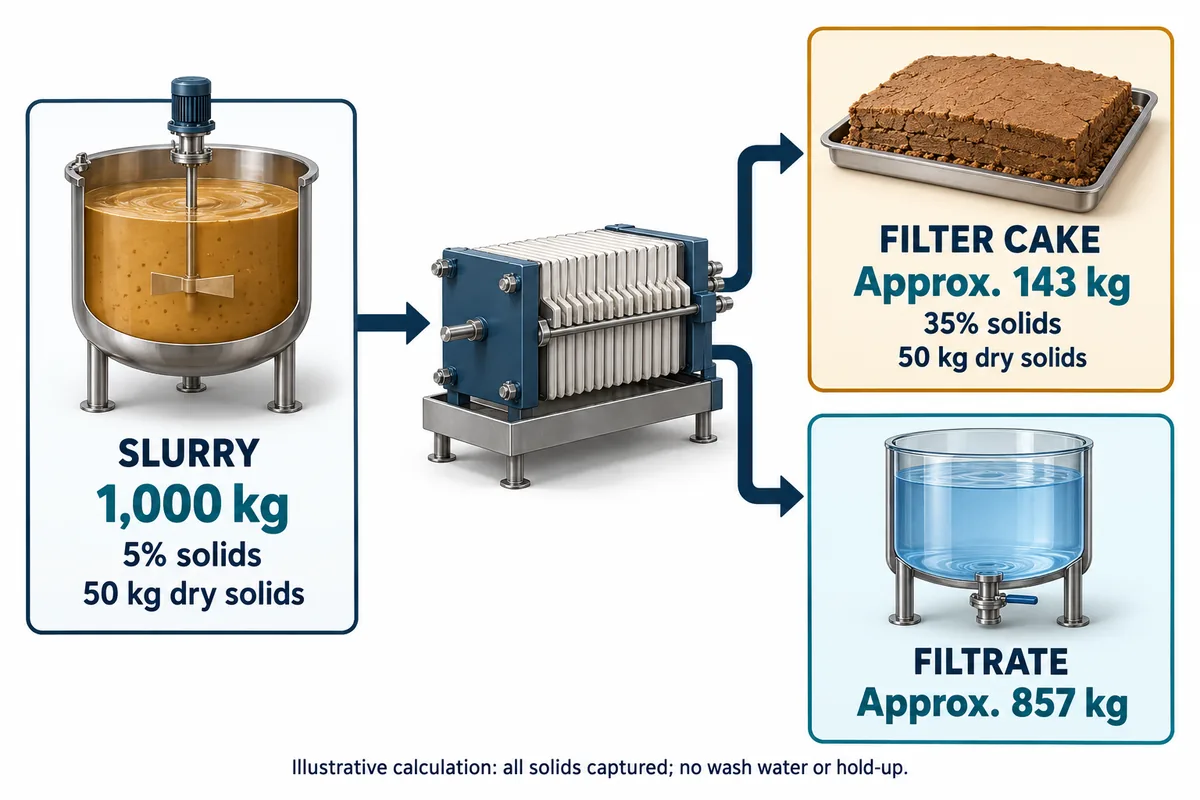
The cake still contains approximately 93 kg of liquid. A cake that holds its shape can retain substantial moisture.
This calculation helps estimate handling loads. It does not tell you how quickly the press will achieve that separation. Filtration testing supplies the missing performance data.
Plate and Frame Filter Press Price: What Drives the Cost?
The price of a plate-and-frame filter press depends on the required filtration area, cake capacity, construction materials, automation, and supplied accessories. A useful budget therefore starts with a defined duty and a written scope of supply.
A small manually handled unit and a system with hydraulic closing, controls, wash equipment, and installation support are different purchases. Comparing their headline prices tells you very little.
The main cost drivers include:
- Size: Required filter area, chamber volume, and number of plates and frames.
- Materials: Compatibility with the slurry, cleaning chemicals, and operating temperature.
- Handling and controls: Closing equipment, plate movement, guarding, and instrumentation.
- Process accessories: Feed pump, tanks, piping, wash systems, drip collection, and cake handling.
- Delivery scope: Freight, installation, commissioning, training, and spare parts.
The technical references linked here do not establish a comparable installed price range. Obtain current supplier quotations for the same specified duty, currency, delivery location, and included equipment.
To request a filter press quotation, include your slurry composition, batch volume, feed solids concentration, and target filtrate quality. That gives the supplier a useful basis for a recommendation.
Compare cost per acceptable batch or per tonne of dry solids processed. Include operator time, media replacement, cleaning, utilities, maintenance, and waste handling.
For a simple illustration, assume one configuration requires 30 extra minutes of labor per cycle. At four cycles per day and an assumed labor cost of $30 per hour, that adds $60 per operating day, or $15,000 over 250 operating days.
Those are hypothetical inputs. Replace them with your own figures to see how handling time changes the purchase decision.
How to Choose and Size the Right Press
Choose the press from representative slurry tests, the required separation quality, and the output needed within your available operating hours. Plate dimensions alone do not establish usable process capacity.
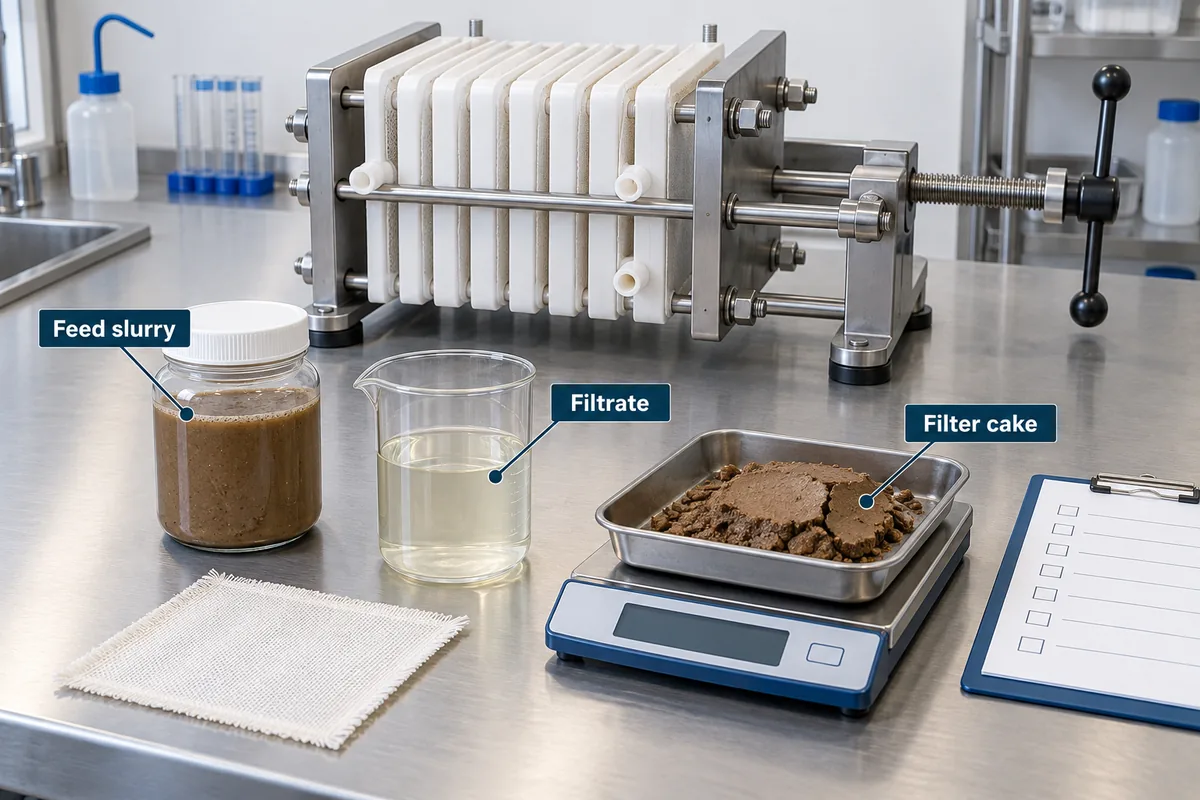
Micronics’ filter press sizing guidance identifies slurry composition, pH, temperature, solids percentage, specific gravity, daily volume, and operating hours as important selection inputs.
Use this sequence to turn those inputs into a specification:
- Define success. Set the required filtrate quality, cake solids content, solids recovery, and daily throughput.
- Characterize the feed. Provide representative samples and the expected range of slurry conditions.
- Test the filtration. Compare suitable media, pressure profiles, cake thicknesses, and any required washing stages.
- Check area and volume separately. Filtration area affects liquid processing capacity; frame volume limits how much cake the press can hold.
- Calculate complete-cycle output. Include filling, filtration, washing, depressurization, opening, discharge, and cleaning.
- Confirm the installation. Allow space for plate movement, maintenance, cake collection, and safe operator access.
Here’s a capacity example: a press that collects 100 kg of dry solids in a complete 75-minute cycle averages 80 kg of dry solids per hour while repeating those cycles.
If filtration alone takes 45 minutes, using only that stage would suggest about 133 kg per hour. That would overstate the achievable repeating-cycle output because it excludes handling and preparation.
Allow for the expected operating schedule, variability, and downtime when converting trial results into daily capacity. Micronics’ pilot-testing guidance describes testing cloth selection, treatment chemistry, cycle time, cake dryness, and scale-up.
For recessed-plate wastewater applications, the U.S. EPA’s recessed-plate filter press fact sheet likewise recommends representative bench testing and an economic analysis when comparing membrane and fixed-volume presses. Its equipment scope differs from a traditional separate-frame press, so its operating figures should not be transferred directly to your machine.
The step-by-step guide to choosing filter press size expands the dry-solids, chamber-volume, and full-cycle calculations used in this selection process.
Common Problems and the Checks That Matter
Leakage, cloudy filtrate, and slow filtration often point to media condition, assembly, flow restrictions, or changing feed characteristics. Diagnose the cause before changing the pressure setting.
- Cloudy filtrate: Check for damaged or incorrectly fitted media, bypass paths, and inadequate retention of fine particles. Distinguish startup cloudiness from a persistent problem.
- Slow filtration: Check feed consistency, cloth blinding, blocked drainage paths, pump performance, and cake thickness.
- Leakage between components: Check cleanliness, cloth folds, sealing surfaces, component damage, and the specified closing conditions.
- Uneven or incomplete cakes: Investigate blocked feed passages, uneven filling, changing solids concentration, and the cycle endpoint.
- Difficult cake release: Review cloth selection, cake consistency, and the approved discharge method.
Record feed conditions alongside pressure, filtrate flow, cycle duration, and cake measurements. A trend across several batches is often more useful than one isolated reading.
If excess moisture is the recurring problem, use the guide to why filter press cake is too wet to work through pressure, drainage, conditioning, and cycle-time checks in sequence.
Perform hands-on inspections and blockage removal only after the required shutdown, pressure relief, and isolation steps. Pressurized liquid and moving plates require trained operation.
Frequently Asked Questions
A conventional plate-and-frame press is a batch separator for suspended solids. Its limits become clearer when you separate particle removal, moisture reduction, and continuous plant operation.
Does It Remove Dissolved Salts?
Ordinary cloth filtration does not remove dissolved salts simply by trapping particles. Dissolved contaminants generally pass with the liquid unless another treatment first converts or captures them in a removable form.
Clear filtrate therefore needs appropriate testing before reuse or discharge. Appearance alone does not establish water quality.
Can It Run Continuously?
An individual conventional press must interrupt filtration to discharge and prepare for its next cycle. Buffer storage or multiple presses can help a wider process maintain flow while each press operates in batches.
How Long Does a Filtration Cycle Take?
Cycle time depends on the slurry, filter area, cake thickness, pressure profile, and handling steps. Establish it through representative testing and include every stage when calculating production capacity.
Choose Around the Separation You Need
A plate-and-frame press is worth evaluating when its media flexibility, cake access, and batch operation match your process. The best choice follows from measured slurry behavior, a realistic full-cycle capacity calculation, and a complete supplier quotation.
Start by defining the liquid quality and solids output you need. Those requirements turn a basic definition into a useful equipment decision—and give practical meaning to what is plate and frame filter press.