Remove more water after filter press operation comes down to two stages: remove more liquid with an approved membrane squeeze or cake ai r blow while the press is closed, then consider thermal drying if discharged cake is still too wet. Clean cloths, steady feed conditions, and appropriate sludge conditioning help the next batch leave the press drier.
In this guide, as a professional filter press manufacturer, I will explain how to identify where the water remains, measure cake solids consistently, and test approved membrane squeezing or cake air blow while the press is closed. It also covers core blow, filter cloth and plate drainage, sludge conditioning, feed and filtration adjustments, and thermal drying when mechanical dewatering reaches its practical limit.
| Cake dry solids | Cake moisture | Final cake mass | Water removed from starting cake |
|---|---|---|---|
| 30% (starting condition) | 70% | 1,000 kg | 0 kg |
| 35% | 65% | 857.1 kg | 142.9 kg |
| 40% | 60% | 750 kg | 250 kg |
| 50% | 50% | 600 kg | 400 kg |
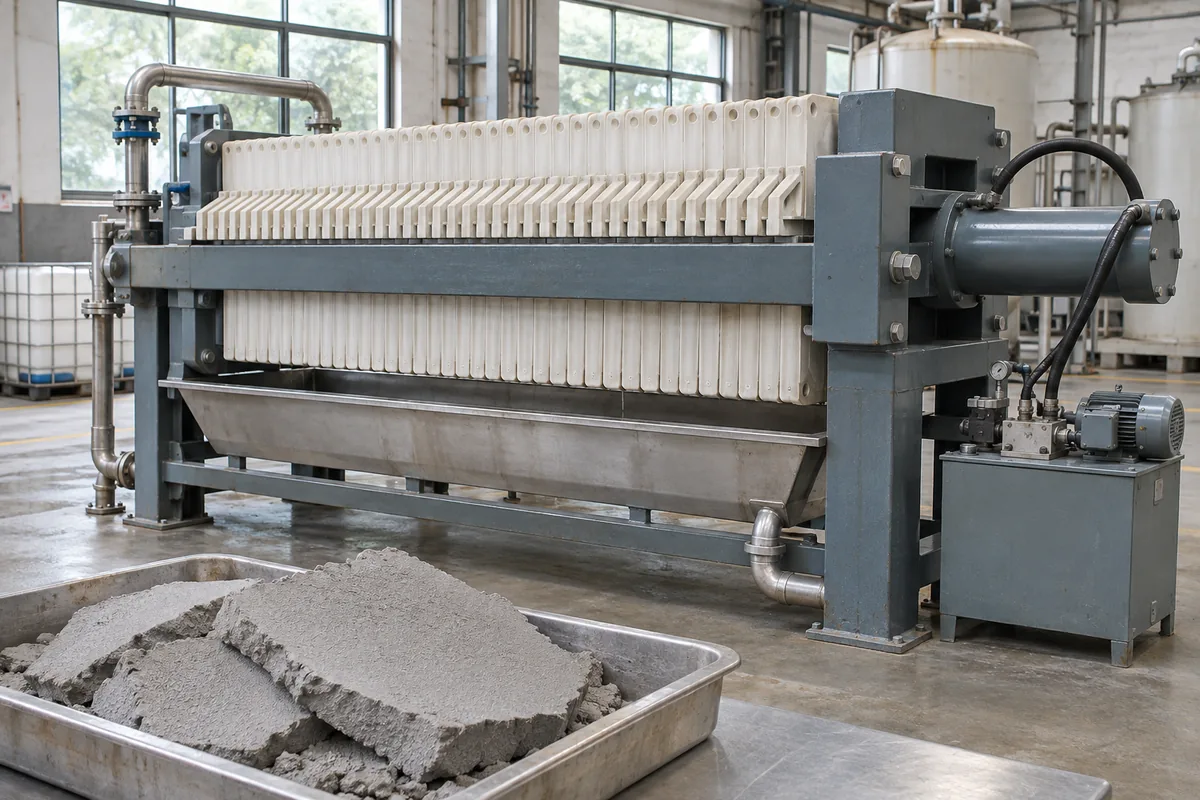
Even a modest rise in cake solids can mean hundreds of kilograms less water to haul per batch. The job is to find a change that removes that water reliably and costs less than it saves.
The methods below apply to recessed chamber and membrane plate filter presses handling mineral slurries, industrial sludge, or wastewater sludge.
How to Remove More Water After Filter Press Operation?
1. Identify Where the Remaining Water Is
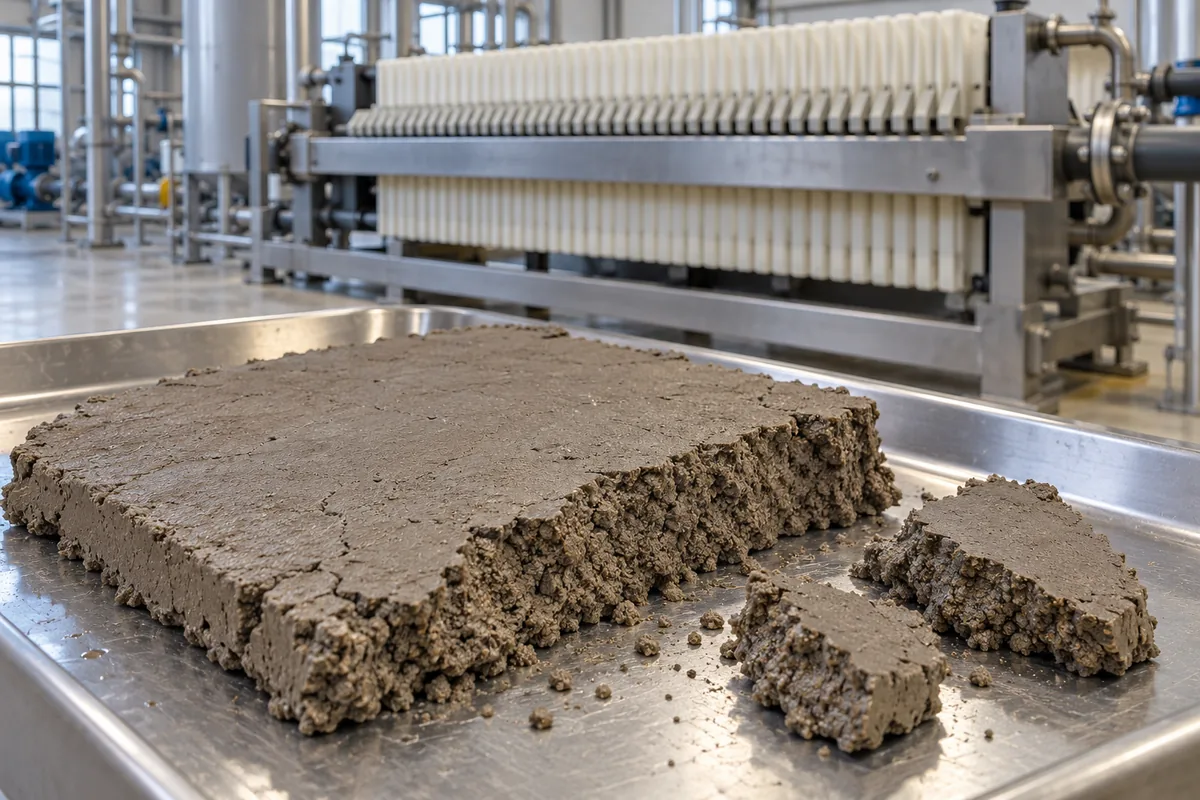
Find out where the water remains before choosing a treatment. Water inside the formed cake needs a different approach from wet slurry trapped in the feed channel or cake already sitting in a collection bin.
During pressure filtration, liquid passes through the filter cloth while retained solids build a cake. The U.S. EPA describes recessed-plate filtration as producing a non-liquid cake. That cake can still hold plenty of water.
Water remains in connected pores between particles, while fine particles and organic material can hold it more tightly. Leftover slurry in the feed passage adds another source of moisture at discharge.
Use this distinction when troubleshooting:
- If the cake is wet throughout, check filtration performance, then evaluate membrane squeezing or cake air blow.
- A firm cake with a wet streak near the feed hole calls for a check of residual core slurry and the core-clearing system.
- If only a few chambers are unusually wet, inspect distribution, cloth condition, plate arrangement, and drainage in those locations.
- For cake already in the collection bin, evaluate downstream drying and prevent additional wetting during storage.
Membrane squeezing and cake air blow normally happen after slurry feeding stops, while the cake remains enclosed in the clamped press. They are not treatments you can apply to an open plate stack or loose cake in a skip.
2. Measure Cake Moisture Before Changing Settings
Measure cake dry solids, cycle time, and dry solids processed per hour before adjusting the press. A cake that feels firmer is encouraging, but it tells you little about whether the whole process has improved.
Sample the same designated chambers near the head, middle, and tail of the press each time. Include material from the cake interior; a dry-looking surface can hide a wetter center.
When investigating uneven performance, keep each location’s sample separate. Mixing them together can hide one poorly draining section.
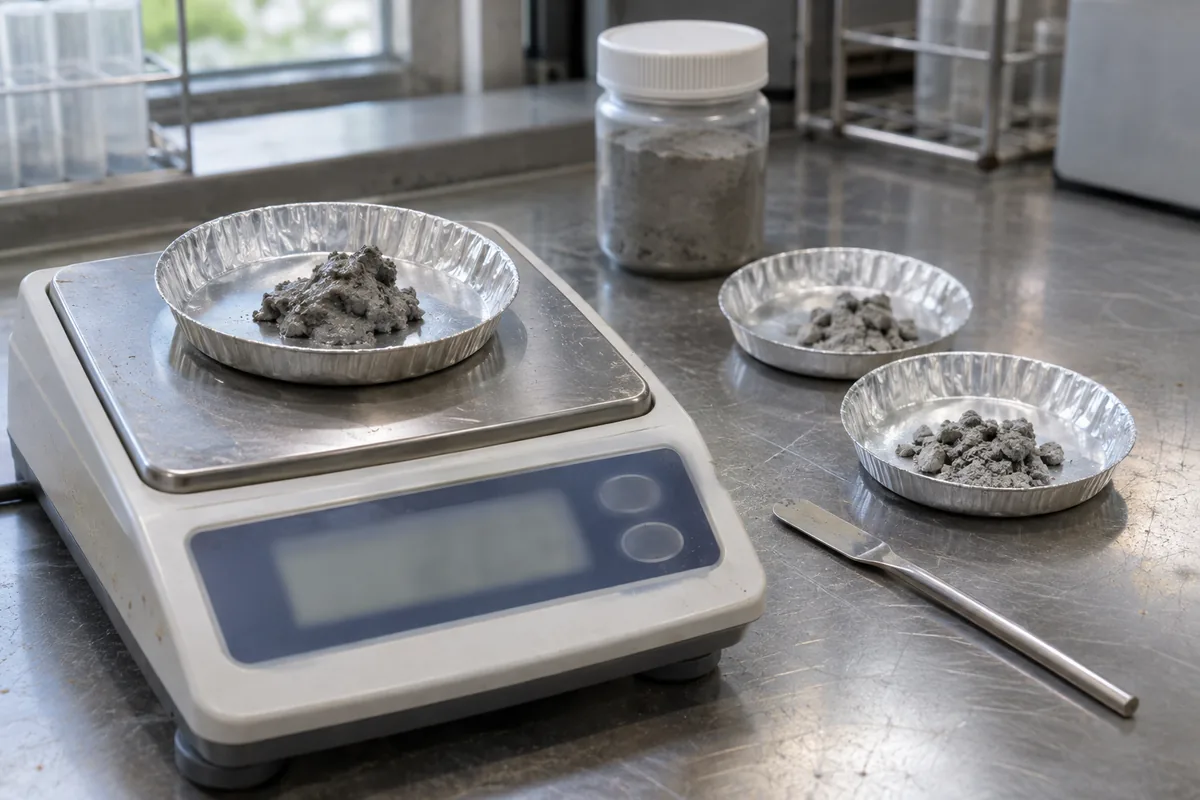
Calculate Dry Solids and Moisture on the Same Basis
Calculate dry solids as dry sample mass divided by wet sample mass, multiplied by 100. For a suitable water-based sample, moisture percentage is 100 minus dry solids percentage.
Dry solids (%) = dry sample mass ÷ wet sample mass × 100
Moisture (%) = 100 − dry solids (%)
For example, a 200 g wet sample leaving 70 g of dry residue contains 35% dry solids and 65% moisture. Both sample masses exclude the container.
The weighing method and how particle size and composition affect the result. Use your laboratory’s validated method for the material. Volatile compounds or thermal decomposition can make weight loss different from water loss.
Record feed solids concentration, conditioning dose, operating pressures, stage durations, and filtrate quality alongside the moisture result. If the feed changes between batches, a difference in cake dryness may have little to do with the setting you adjusted.
3. Use Membrane Squeezing to Remove Additional Pore Water
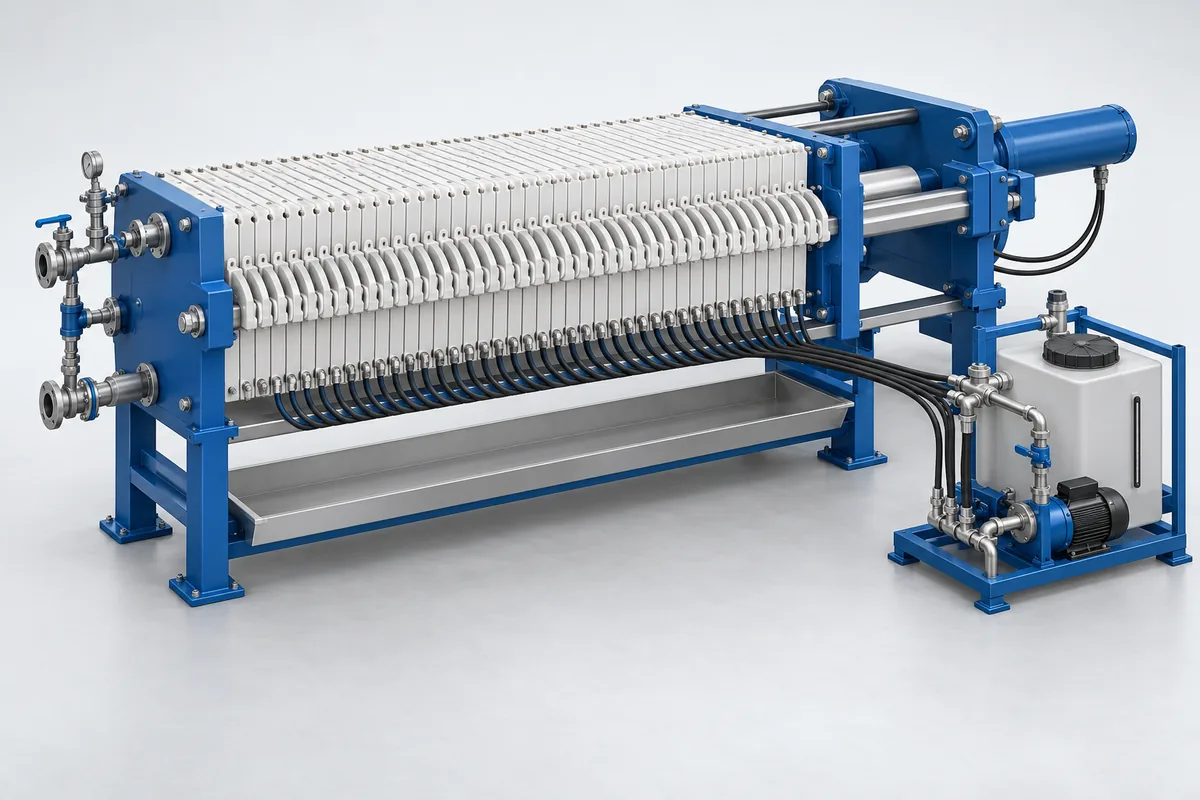
A membrane filter press can remove more liquid after filtration by expanding flexible membranes against the formed cake. The press must be equipped and approved for this squeeze stage.
Depending on the design, water or compressed air pressurizes the space behind the membrane. The membrane compresses the cake, and displaced liquid leaves through the filtrate drainage system.
How much extra water comes out depends on cake compressibility and drainage. Some cakes release more liquid as they compress; others reach their practical limit quickly.
The describes membrane squeezing is a separate stage for improving cake dryness. It also distinguishes this stage from cake washing and air blowing.
Before extending the squeeze, check whether the extra time produces more filtrate and measurably lowers final moisture. Once that gain levels off, holding the press longer can reduce daily throughput.
When comparing equipment, use the membrane vs chamber filter press guide to weigh that extra squeeze against its equipment and operating costs.
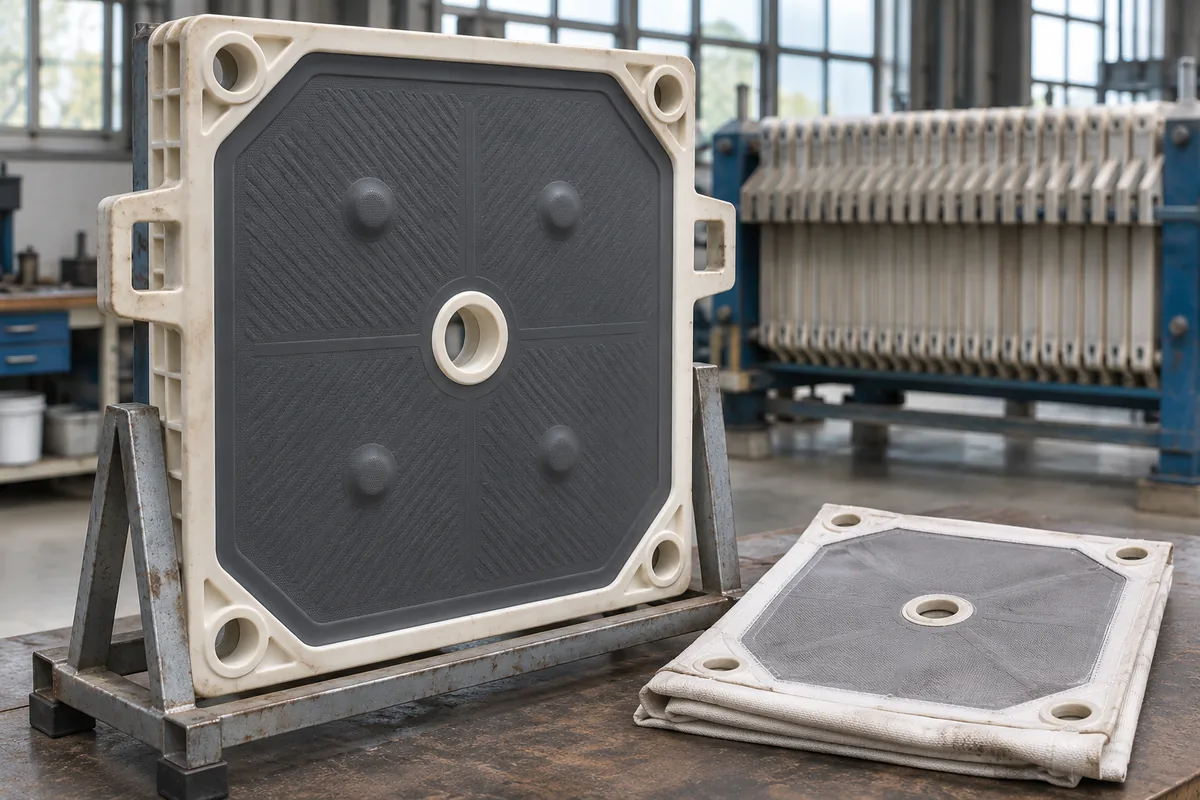
Confirm Compatibility Before Retrofitting Membrane Plates
A membrane retrofit needs manufacturer or qualified engineering approval for the complete press assembly. Plate dimensions alone do not establish compatibility.
The review should cover the plate pack, frame and closure system, permitted filling conditions, squeeze supply, valves, controls, and drainage arrangement. An unsuitable configuration can damage equipment or create uneven loading.
Keep slurry feed pressure, hydraulic closing pressure, and membrane squeeze pressure distinct. They serve different purposes and have different limits.
Do not increase hydraulic closing pressure as a shortcut to squeeze the cake. Use the specified closing setting and the approved squeeze circuit.
Considering a membrane press for wetter cake?
Send us your slurry type, current press model, and cake moisture target. Include throughput and project location so we can discuss a suitable configuration and quotation.
4. Optimize Cake Air Blow and Check Core Blow Separately
Cake air blow removes additional liquid by passing compressed air through a permeable cake while the press remains closed. It works only when the plates, piping, and valve sequence provide the intended route through the cake.
Air follows the easiest path. If it escapes through cracks, leaks, or an incorrect valve arrangement, blowing for longer may remove little extra water.
Check these items before adding time:
- Confirm that the machine has a cake-blow function and the correct plate porting.
- Verify the approved valve sequence and unobstructed filtrate outlets.
- Check available air pressure and flow while the blow is running.
- Inspect the air supply for moisture or contamination that could affect the process.
- Compare final cake moisture at approved blow durations using similar feed batches.
The cake blow is not intended to dry cake completely. Required air volume and pressure depend on the system and application.
Set the blow duration from trials on your sludge. Stop extending it when repeated measurements show that the small moisture gain no longer pays for the extra air and lost cycle capacity.
Use Core Blow to Prevent Wet Slurry from Mixing with Dry Cake
Core blow clears residual slurry from the feed passage before discharge. Cake air blow pushes air through the cake itself. If the feed channel still contains slurry, even a firm cake can fall into a wet mixture when the press opens.
Clearing the core prevents that remaining slurry from falling into the cake collection area.
If the wet material appears mainly around the feed hole, inspect the core-clearing system before increasing the cake-blow duration. Follow the procedure for your machine’s actual configuration.
5. Restore Filter Cloth and Plate Drainage
Clean cloths and clear drainage passages can improve cake dryness on subsequent cycles when fouling is restricting filtrate flow. Check them before assuming the press needs more pressure.
Filter cloth blinding occurs when particles or deposits obstruct the cloth’s flow paths. Common clues include longer cycles, falling filtrate flow, sticky cake, or pressure rising unusually early.
After safely isolating the machine, inspect the cloth face and the area behind it, along with plate drainage grooves, discharge ports, and sealing surfaces. Surface cleaning can leave a blockage underneath the cloth.
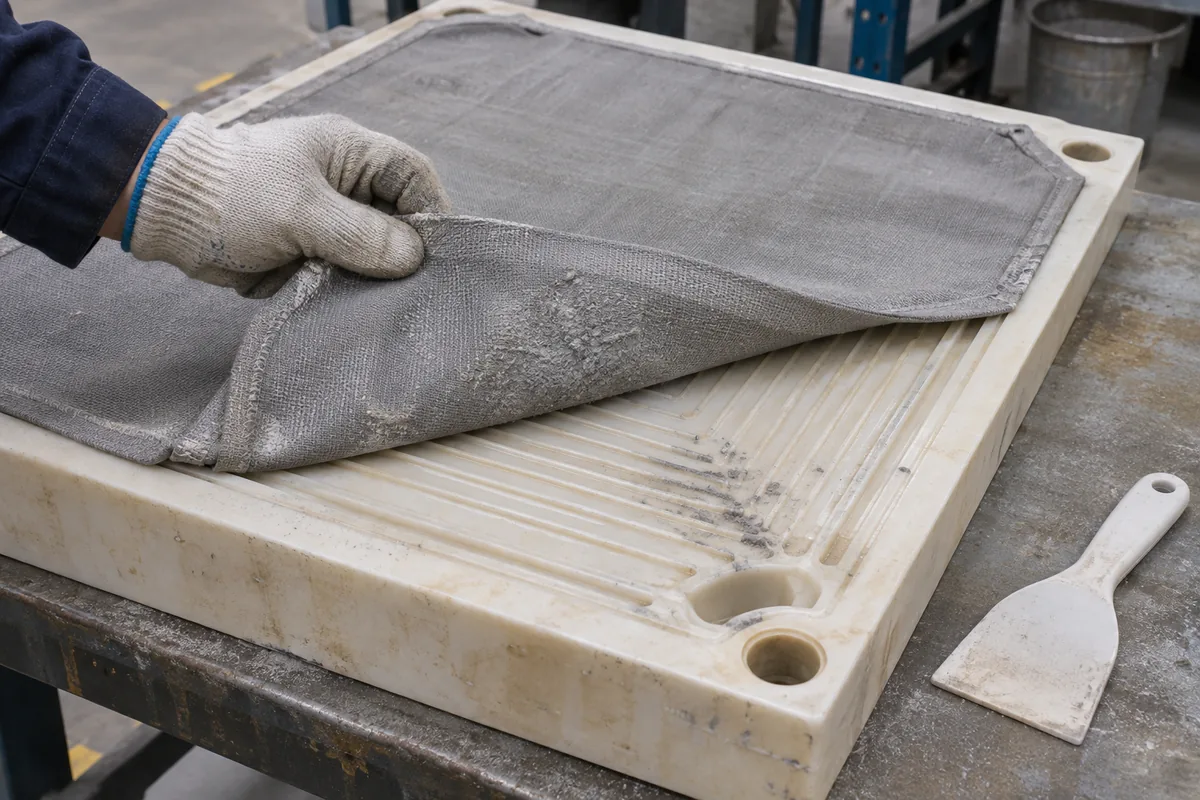
Use the cleaning method specified for the cloth, plate material, and deposit. Wash pressure, nozzle distance, chemical concentration, and contact time all matter. An acid rinse is not a universal remedy, and an aggressive spray can damage the weave.
If cleaning does not restore performance, review cloth selection. The application determine the fabric, weave, and finishing treatment.
A tighter weave is not automatically an upgrade. The choice must balance solids retention, permeability, cake release, and chemical compatibility. Watch filtrate clarity during any trial so a seemingly drier cake does not come at the expense of lost solids.
6. Improve Sludge Conditioning and Chamber Filling
Steady feed conditions and suitable conditioning help the next batch form a cake that releases water more readily. Make these changes upstream of the press; they won’t remove water from cake already discharged.
Check what enters the press. Settling in the feed tank, changing solids concentration, pH shifts, or different production waste can alter dewatering even when every press setting stays the same.
Where conditioning is needed, polymers and coagulants can help fine particles form larger aggregates, or flocs. The right choice depends on the slurry; some mineral applications may not need polymer at all.
Test Polymer Type and Dose Instead of Automatically Adding More
Select conditioning chemicals through bench testing followed by controlled press trials. Both insufficient and excessive dosing can impair solid-liquid separation.
Keep sample volume, mixing conditions, polymer preparation, and evaluation methods consistent. Compare a suitable range of doses around the current setting, with an untreated control where appropriate.
We recommend representative samples, dose comparisons, and confirmation at the press. Settling behavior alone cannot establish the best dose for pressure filtration.
Assess final cake solids, filtrate clarity, release behavior, and cycle time together. Record dose as active chemical per unit of dry feed solids where possible, so changes in slurry concentration do not distort the comparison.
Match Feed Pressure and Filtration Time to Actual Performance
Adjust the feed profile within the manufacturer’s limits and use pressure, flow, and cake results together to judge completion. A pressure reading alone does not prove that every chamber has filled properly.
Blocked cloths or feed passages can produce high pressure with poor cake formation. Extending the cycle will not repair those restrictions.
Once drainage is sound, test approved changes to the filling profile or filtration endpoint. Extra filtration time can remove more water, but gains usually diminish as cake resistance increases.
Track dry solids processed per hour as well as cake dryness per batch. A small moisture improvement may cost too much if the longer cycle leaves you unable to treat the daily volume. The filter press sizing guide explains how the complete cycle and chamber volume affect capacity.
7. Evaluate Thermal Drying When Mechanical Dewatering Plateaus
A downstream sludge dryer evaporates water from discharged cake after mechanical dewatering reaches its practical limit. The EPA’s heat-drying fact sheet describes this use of direct or indirect heat to remove water from wastewater solids.
Paddle, screw, disc, and other dryer designs handle different materials and operating requirements. Pairing a dryer with a filter press and the heat and agitation support moisture removal.
Base dryer selection on trials with your actual cake. Feed consistency, stickiness, starting moisture, required final solids, and available heat all affect performance.
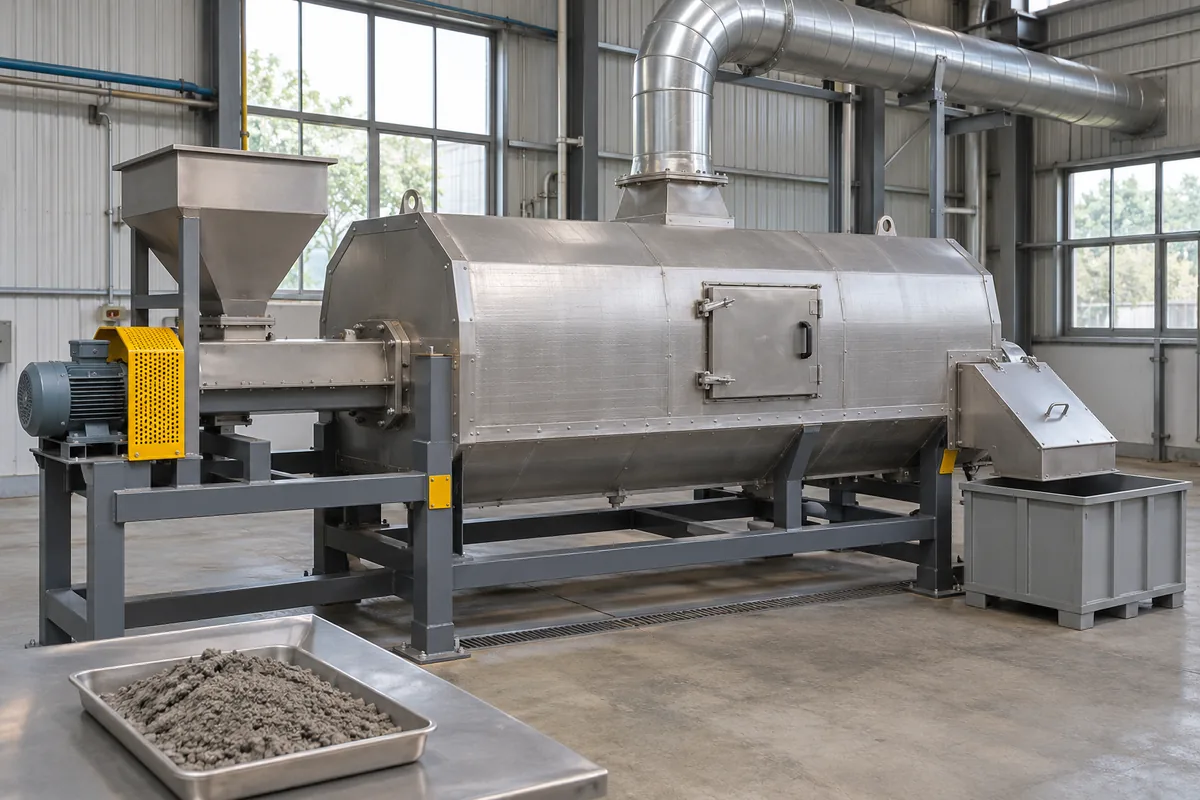
Ask the supplier to establish:
- The required water evaporation rate and achievable final moisture.
- Energy demand and whether useful waste heat is available.
- Cake feeding, mixing, and discharge requirements.
- Vapor, odor, dust, and condensate management.
- Material-specific temperature limits and fire or explosion controls where relevant.
Drying reduces water content, but it does not automatically make the residue suitable for unrestricted disposal or reuse. Confirm the acceptance criteria for the intended destination.
Calculate Savings Using a Fixed Dry-Solids Mass
Calculate the change in wet cake mass while holding dry solids constant to estimate how much water you remove. You can then compare the hauling saving with the cost of treatment.
Take the opening table’s hypothetical batch: 1,000 kg of cake at 30% dry solids contains 300 kg of solids and 700 kg of water.
If a treatment raises it to 40% dry solids:
Final cake mass = 300 kg ÷ 0.40 = 750 kg
Water removed = 1,000 kg − 750 kg = 250 kg
The wet cake weighs 25% less in this example. Whether a membrane, air blow, or dryer can reach that result needs to be established by testing.
If disposal cost were a hypothetical $120 per metric tonne, the gross weight-based saving would be $30 per batch. Subtract energy, chemicals, maintenance, and any throughput penalty before calling it a saving.
The calculation assumes no solids loss or addition. If conditioning adds substantial solids, account for that separately. Volume reduction also depends on bulk density and cannot be inferred from mass reduction alone.
8. Run a Controlled Trial Before Changing the Standard Cycle
Change one major variable at a time, then repeat the trial with comparable feed. That makes it easier to tell whether an adjustment worked or the next batch was simply easier to dewater.
A laboratory filter press can help compare media and cake formation if its configuration and operating range suit the test. Specify a membrane squeeze separately if you need to test that stage.
- Record the baseline: cake solids, feed solids, cycle duration, filtrate quality, and dry-solids output.
- Correct damaged cloths, restricted drains, uneven filling, leaks, and malfunctioning valves before testing a process change.
- Trial an approved adjustment to squeezing, cake blow, conditioning, or filtration.
- Repeat the comparison, sampling the same chamber locations with the same laboratory method.
- Check energy use, chemical cost, maintenance, and daily throughput before choosing the setting.
- Document the selected settings, acceptable feed range, and conditions that call for another review.
A spreadsheet plot of cake moisture against treatment time can reveal where additional minutes stop paying off. Keep the original measurements so operators can distinguish a genuine performance change from sampling variation.
Maintain the specified clamp condition during approved pressure stages. Before opening the press, complete the manufacturer’s depressurization sequence and verify that process and squeeze circuits are safe. Apply the site’s isolation and lockout procedure before maintenance, and never bypass an interlock to shorten a trial.
Frequently Asked Questions About Drier Filter Cake
Your material, machine configuration, and required final moisture determine which treatment is worth testing. An extra dewatering stage is useful only if the press supports it and the result meets your process needs.
What Is the Fastest Way to Remove More Water After Feeding Stops?
An approved membrane squeeze or cake air blow is the most direct additional treatment when the cake remains inside a compatible press. Check that the cake has formed correctly and the drainage routes are clear before changing either stage.
Can I Just Run the Press Longer?
Longer filtration can help while useful liquid removal continues, but the benefit decreases as the cake becomes harder to drain. Compare moisture reduction with the added cycle time; extended operation cannot correct a blocked outlet or damaged cloth.
What Moisture Content Should My Filter Cake Reach?
Set the target through testing on your actual slurry and the requirements for transport, disposal, or reuse. Particle size, mineral composition, organic content, conditioning, and equipment design make a single universal target unreliable.
Will Cake Washing Make the Cake Drier?
Cake washing primarily removes soluble impurities or recovers liquid components by introducing wash liquid. It is not a drying step; the approved process must remove the remaining wash liquid afterward.
Choose the Next Change from Your Measurements
Start with a moisture measurement and clear drainage paths. Trial membrane squeezing or cake air blow while the press is closed, clear residual core slurry separately, and consider thermal drying if discharged cake still needs more treatment.
Need a quote for your dewatering project?
Share your slurry, required throughput, target cake moisture, and project location. If you have test results or equipment photos, include them so we can review the duty and prepare a quotation.
Keep the setting that repeatedly meets your moisture target at the required throughput and cost. Record the trial results so the next shift can use them when deciding how to remove more water after filter press operation.