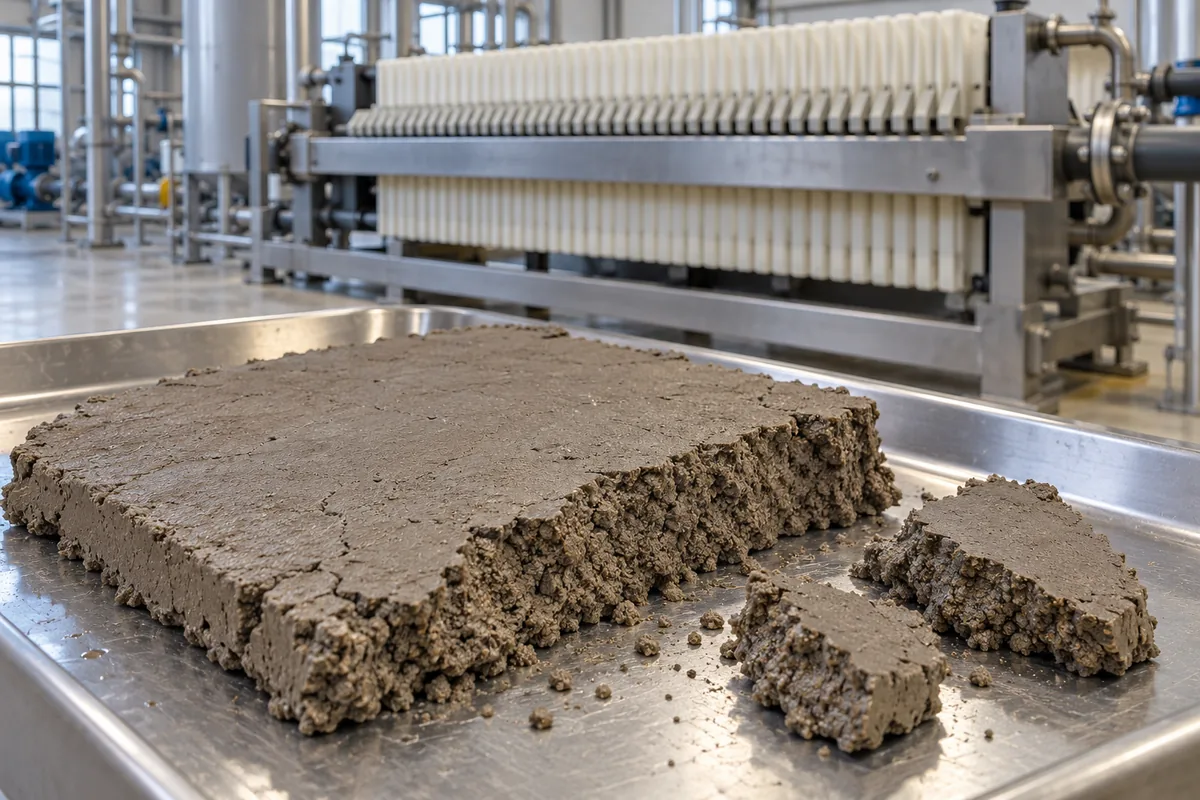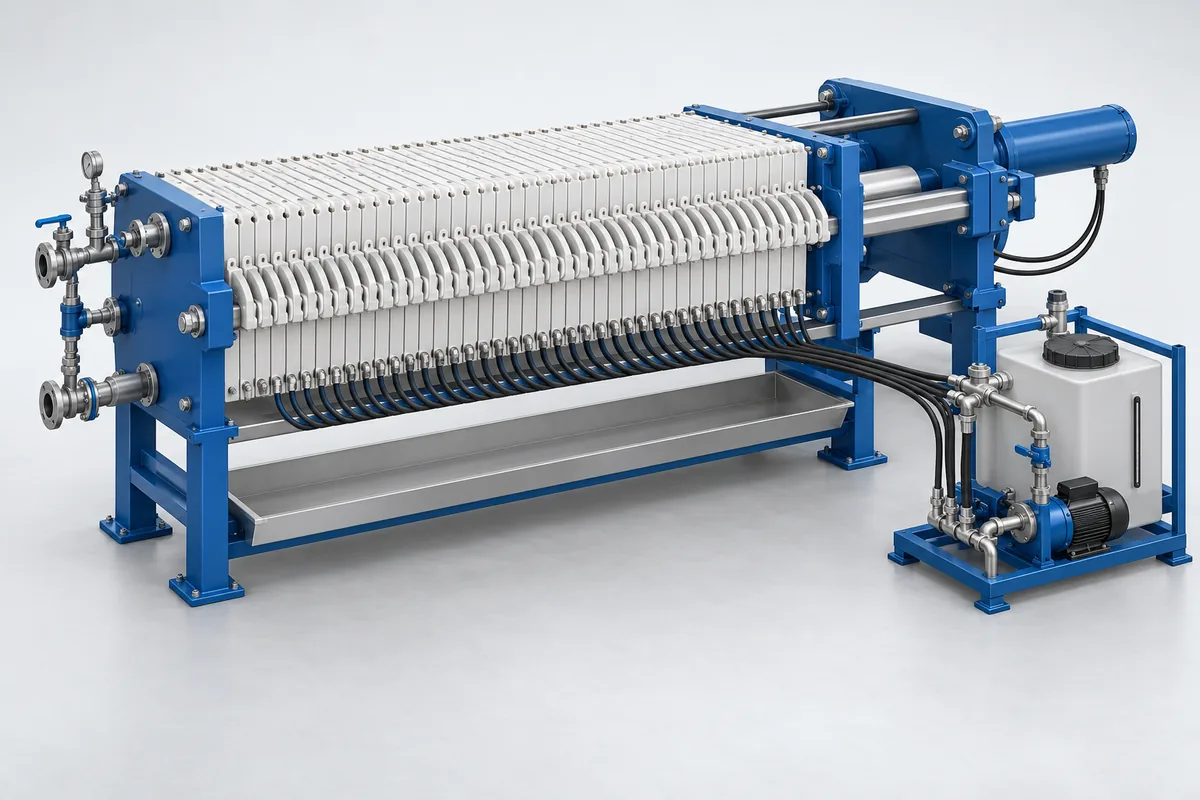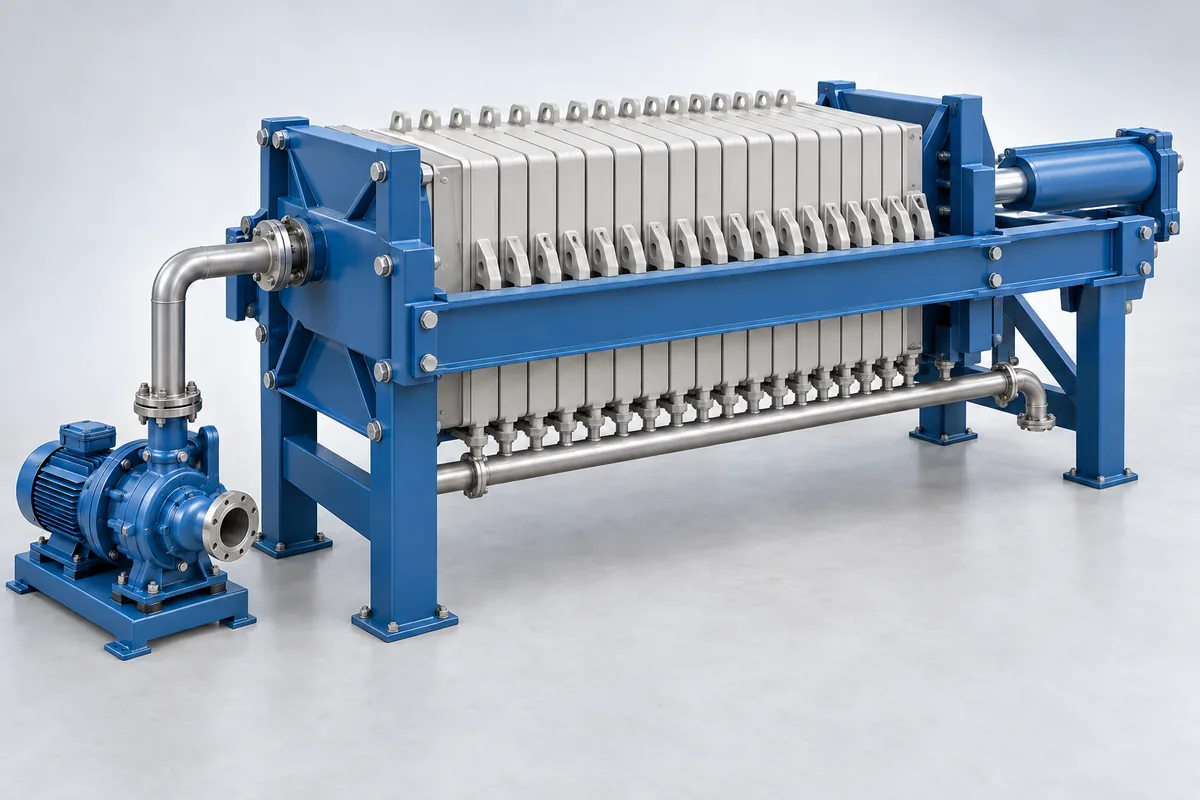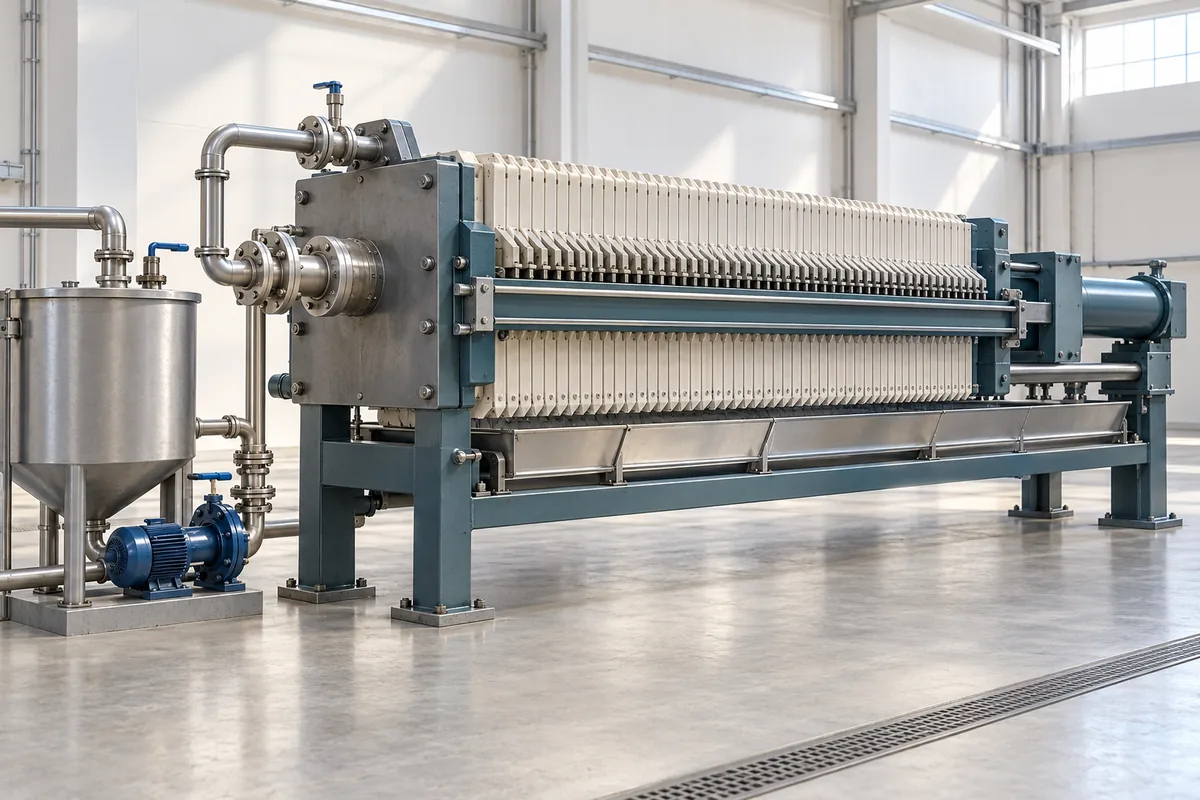
A high pressure filter press uses elevated slurry feed pressure to separate suspended solids from liquid in batches. If you’re asking “what is a high pressure filter press”, picture a row of sealed, cloth-lined chambers that collect solids as cake while the separated liquid, or filtrate, drains away.
| Feature | What it means |
|---|---|
| Material entering the press | Slurry: a mixture of liquid and suspended solid particles |
| Products leaving the press | Dewatered filter cake and separated liquid, or filtrate |
| Pressure examples | McLanahan describes 125–225 psi (about 8.6–15.5 bar) for many high-pressure applications; Matec specifies 21 bar for its Megalith HPT system |
| Operating mode | Batch cycles: close, fill, filter, depressurize, and discharge |
| Common applications | Mineral tailings, concentrates, clay, and suitable industrial sludges |
| Basis for selection | Tests on the actual slurry, required throughput, cake moisture, and filtrate quality |
The pressure examples describe particular equipment and applications; they are not operating settings for another press.
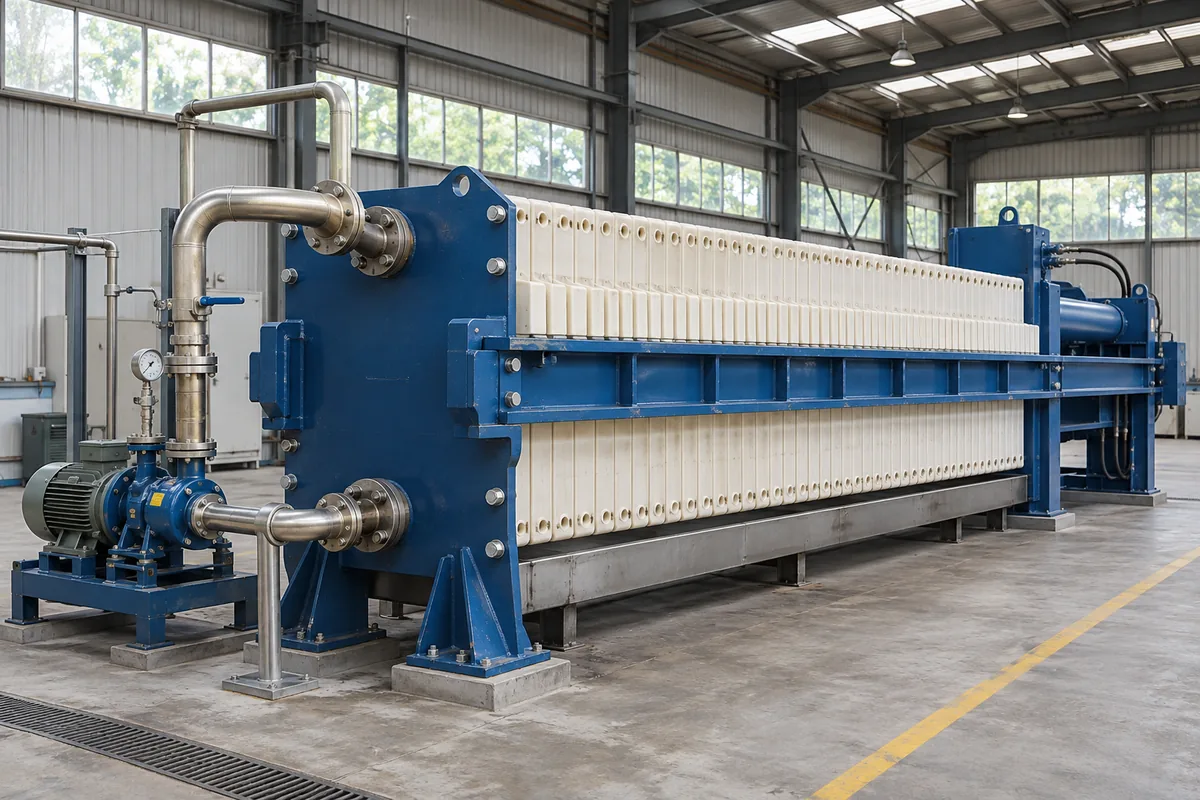
What makes a filter press “high pressure”?
Manufacturers use “high pressure” for presses with different filtration ratings. When you compare equipment, check the documented slurry feed pressure, plate design, and operating temperature.
A supplier might describe a machine operating around 15 bar as high pressure. Another may use the term for a 21-bar system. For the models on this website, the high pressure filter press product page lists the published RFP specifications and the details to confirm before ordering.
Three pressure readings need separate attention:
- Slurry feed pressure drives liquid through the growing cake and filter cloth.
- Hydraulic closing pressure acts inside the hydraulic system to generate the force that keeps the plate pack closed.
- Membrane squeeze pressure, on a membrane press, expands flexible surfaces against the formed cake.
A high number on the hydraulic gauge does not establish the allowable slurry feed pressure. Cloth-washing pressure is another separate specification.
The frame, plates, feed system, seals, and controls must suit the specified duty. Changing the pump alone does not turn a standard machine into a high pressure press.
Note: Do not feed a press above its rated pressure. Check the operating manual and obtain the manufacturer’s written approval for any proposed change in operating duty.
How does a high pressure filter press work?
A feed pump pushes slurry into closed chambers, where solids accumulate and liquid escapes through the filter media. The machine then releases the cake and starts another batch.
The basic cycle has six stages:
- Close and clamp the plates. A hydraulic cylinder or another closing mechanism holds the plate pack together. The recessed spaces between adjacent plates form the filtration chambers.
- Fill the chambers. The feed pump introduces slurry through the feed passages. Flow and pressure follow the machine’s specified filling sequence.
- Build the filter cake. Suspended particles collect against the cloth. As this layer grows, the cake itself helps capture additional particles.
- Continue dewatering. The pump maintains the selected filtration conditions while liquid drains through the cake and cloth. Flow generally decreases as resistance builds.
- Complete any optional treatment. Depending on the design, the cycle may include membrane squeezing, cake washing, air blowing, or clearing residual slurry from the feed core.
- Depressurize and discharge. After the required pressure-release sequence, the press opens. The plates separate so the cakes can drop into a hopper, conveyor, or collection area.
In a recessed chamber press, the rigid plates stay in position throughout filtration. The closing cylinder holds the chambers sealed; the feed pump supplies the filtration pressure.
A slow cycle could come from a blocked cloth, a change in the slurry, or a feed problem. Increasing hydraulic closing pressure will not correct those faults.
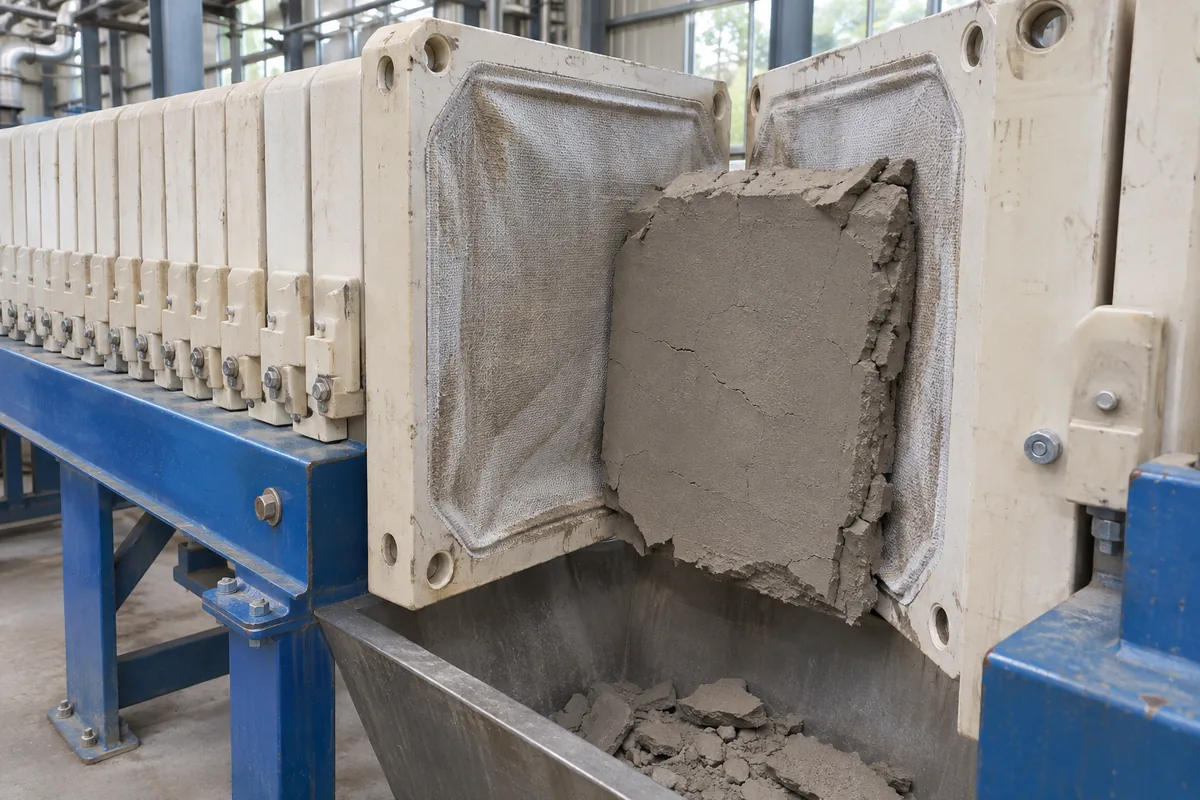
Recessed chamber or membrane: which design fits?
A recessed chamber press dewaters through feed pressure, while a membrane press adds a separate squeeze stage after cake formation. Both designs can handle demanding filtration duties when properly specified.
With recessed plates, the chamber volume stays essentially fixed during filtration. This design can be suitable when feed pressure alone achieves the required cake quality and cycle time.
Membrane plates have flexible surfaces. Water or compressed air, according to the equipment design, expands those surfaces and compresses the cake while the plate pack remains clamped.
The extra stage can remove more liquid from a cake that responds to compression. It also adds equipment, controls, and membrane maintenance.
Ask for a comparison using your slurry. Measure the moisture reduction against the extra cycle steps and operating costs. For wastewater solids, the EPA’s recessed-plate filter press fact sheet recommends representative bench testing and an economic analysis when comparing membrane and fixed-volume presses.
Our membrane vs. chamber filter press comparison explains the extra equipment and maintenance involved. Automation is a separate choice: either design may include automatic plate shifting, cloth washing, and cycle control.
Why more pressure does not guarantee a drier cake
Cake moisture depends on particle size, cake structure, liquid properties, conditioning, and filtration time as well as pressure. Some slurries release water readily; fine or compressible materials can be much harder to dewater.
Water needs a path through the cake. As particles pack closer together, those paths become more restrictive. With difficult fine solids, each increase in pressure may remove less additional water.
The feed density, particle size, cloth design, chamber thickness, and slurry composition are factors affecting performance. It recommends testing representative material at different feed pressures to establish the actual benefit.
A larger chamber holds more solids per batch, but a thicker cake can take longer to fill and dewater.
Compare dry solids processed per hour at an acceptable moisture level. A small improvement in dryness may be expensive if it significantly extends every cycle.
Check how the moisture result is reported. A cake containing 30% water by total wet mass contains 70% dry solids. That percentage is different from moisture reported relative to dry solids mass, so every test report should state its basis.
What is a high pressure filter press used for?
A high pressure filter press is used to recover suspended solids, reduce the water carried in waste or products, and collect liquid for possible reuse or further treatment. Suitability depends on how the specific slurry behaves during testing.
Mining, mineral processing, and aggregates
Presses dewater mineral concentrates, fine tailings, and wash-plant slurries so operators can handle solids more easily and recover process water. They are often installed after a thickener that increases the feed solids concentration.
For a sand-washing operation, this can mean turning clay slurry into a cake that equipment can move. Tailings storage still requires engineering assessment: a cake’s appearance alone does not establish its stability or suitability for stacking.
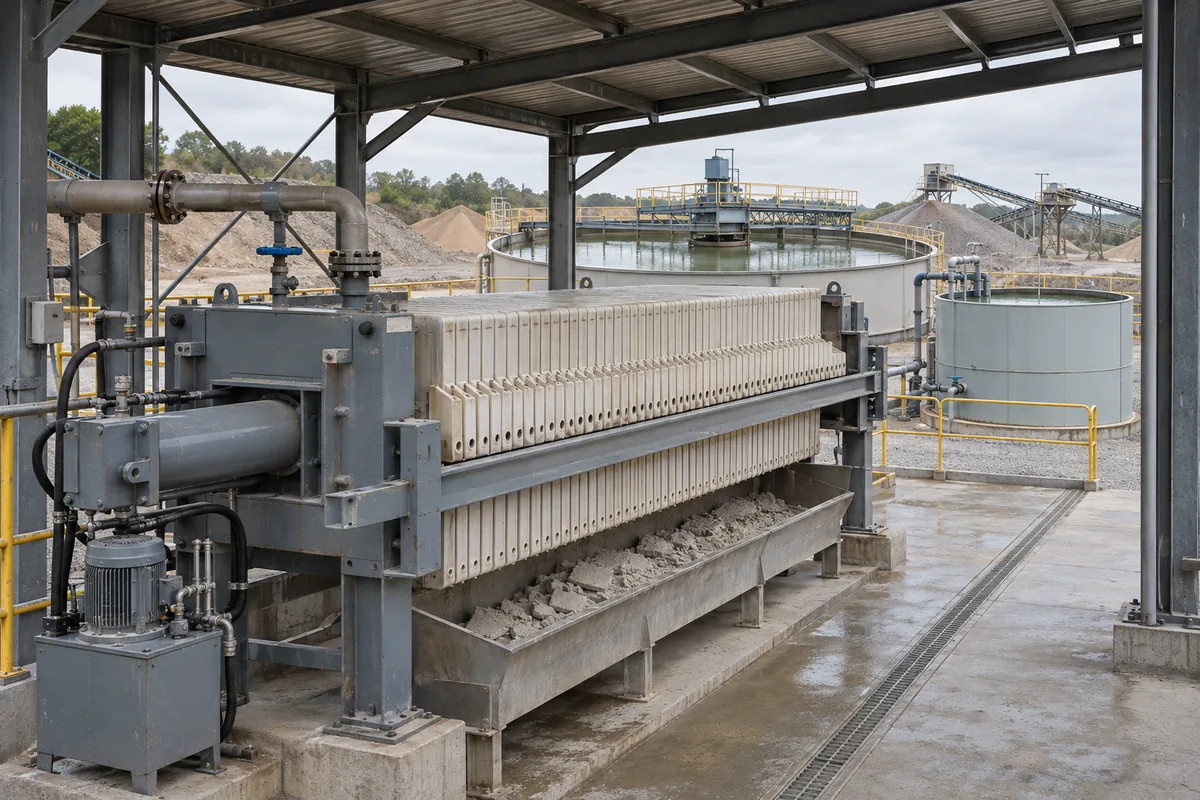
Clay and ceramic production
Clay processing uses pressure filtration to remove water before handling or forming operations. Kaolin and other fine clays can hold water tightly, so test both the slurry preparation and the pressure cycle.
A cake that is too wet may add work downstream. A cake that varies across the batch can also make production harder to control. Test for the moisture consistency the next process needs.
Industrial wastewater and sludge treatment
Filter presses reduce the liquid carried with suitable industrial sludges, including precipitated solids from treatment processes. Less retained water can lower the wet mass sent for transport and disposal.
Filtration captures suspended material. Dissolved salts and other contaminants can remain in the filtrate, so clear-looking liquid still needs testing against reuse requirements or discharge limits. The EPA’s water reuse guidance explains that treatment and monitoring requirements depend on the water source and its intended use.
Chemical and product recovery
Presses can separate crystals, precipitates, and other solid products from process liquids when the materials and equipment are compatible. Some applications also need cake washing to remove retained process liquor.
Corrosive, hot, or hazardous mixtures require application-specific materials and containment. Food and pharmaceutical duties add hygiene, cleaning, and product-quality requirements that a general industrial press may not meet.
Find a press for your slurry
Tell us what you need to filter, your processing rate, and the cake condition you want. We can help you compare configurations before you request a quotation.
What benefits can you measure?
Removing more liquid can reduce wet cake mass, ease solids handling, and cut downstream drying. Recovered liquid may also be suitable for reuse. The financial value depends on your disposal charges, water balance, product requirements, and operating costs.
Example: calculate the effect on hauling weight
Removing more water reduces the mass you transport even when the amount of dry solids stays unchanged. The following is an illustrative calculation, not a measured filter press result.
Assume you must handle 1,000 kilograms of dry solids:
- At 40% moisture by wet mass, the cake is 60% solids. Wet cake mass is 1,000 ÷ 0.60 = approximately 1,667 kilograms.
- At 30% moisture by wet mass, the cake is 70% solids. Wet cake mass is 1,000 ÷ 0.70 = approximately 1,429 kilograms.
The difference is about 238 kilograms per batch, or a 14.3% reduction in wet cake mass.
That is not automatically a 14.3% reduction in your invoice. Minimum collection charges, truck capacity, waste classification, and disposal contracts affect the financial result. Pressure alone also does not guarantee the assumed moisture improvement.
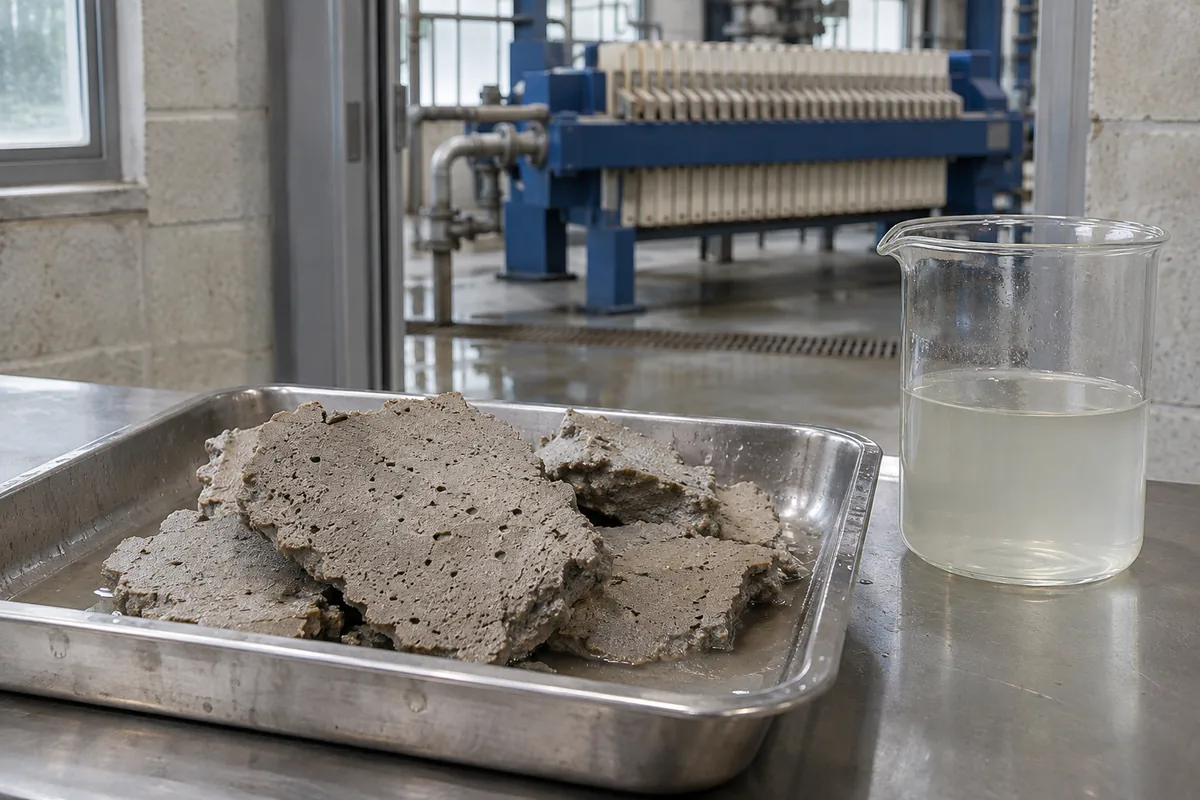
Case study: recovering water at a silica operation
MS Industries recovered about 96% of its process water for reuse with a thickener and filter press system. The operation needed to manage clay removed from silica sand while limiting the space occupied by settling ponds. The reported system produced manageable clay cake and reduced the need for large ponds.
The 96% figure is a supplier-reported result for the complete installation, including its thickener and water circuit. It is not a universal recovery rate or a measurement of the benefit from higher pressure alone. Evaluate those parts of your own system together.
How to choose a press for your operation
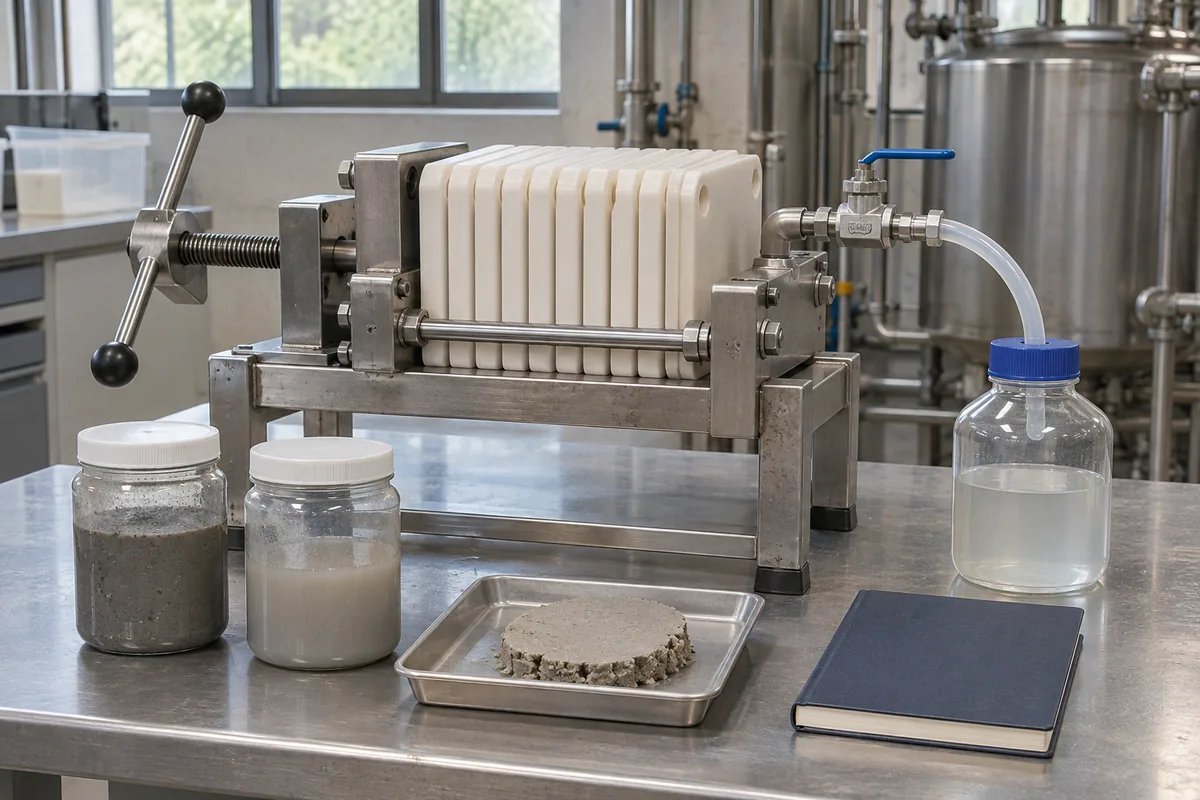
Start with representative slurry testing and a defined production target. The supplier needs both to size the press; a pressure rating alone gives too little information.
I’d start with the material that gives your operators trouble, then test the variations you expect between batches. An easy sample can make a proposal look better than it will perform in production.
Use this sequence:
- Characterize the feed. Record solids concentration by mass, particle-size distribution, temperature, and relevant chemistry. Include expected variation and any upstream conditioning.
- Set the required outputs. Specify dry solids throughput, acceptable cake moisture, filtrate quality, and any washing requirement. State how each will be measured.
- Test the filtration conditions. Compare suitable cloths, chamber thicknesses, feed pressures, and optional membrane squeezing. Record the entire cycle, including discharge and cleaning time.
- Check the surrounding process. Allow for feed storage, pumping, cake removal, and filtrate collection. A batch press serving a continuous plant often needs buffer capacity.
- Compare total cost. Include installation, power, conditioning chemicals where needed, cloths, pump wear, labor, maintenance, and waste handling. Lower purchase cost can be offset by a longer cycle or more operator work.
- Agree on acceptance criteria. Ask the supplier to document the feed conditions, performance targets, test method, and responsibilities if the installed system misses those targets.
Request a graph of filtrate flow against time alongside the cake moisture results. Use it to judge whether the extra water removed is worth a longer batch. Our guide to choosing a filter press size connects dry solids loading, chamber volume, and complete cycle time.
What maintenance and operating checks matter?
Clean cloths, sound plate seals, and a feed system in good condition help the press produce consistent results. Check the safeguards too, following the manufacturer’s procedures and your site’s operating requirements.
Track cycle time, final pressure, cake moisture, and filtrate clarity. If those readings drift, investigate before the problem costs you a shift.
Check for:
- Cloth blinding that restricts liquid flow.
- Damaged cloth that allows solids into the filtrate.
- Residue on sealing surfaces that contributes to leaks.
- Pump wear or feed changes that alter chamber filling.
- Uneven cakes that indicate filling, drainage, or slurry-distribution problems.
Never open a press with trapped process pressure. Follow its verified depressurization sequence, including membrane and compressed-air circuits where fitted. Maintenance also requires the appropriate isolation and lockout procedure.
A timer reaching zero is not proof that stored pressure has been released.
Frequently asked questions
The press rating sets the allowable pressure; slurry tests establish the dryness and cycle time you can expect. Those are also the starting points for assessing an equipment upgrade.
What pressure should a high pressure filter press run at?
Run it at the setting established for your process, within the manufacturer’s allowable limits. Published examples vary, and pressure requirements can change with the slurry, temperature, plates, and operating sequence.
Use the equipment documentation and test results to establish settings. A pressure quoted in another supplier’s brochure is not permission to increase yours.
Does it produce completely dry solids?
No. Mechanical dewatering leaves residual moisture in the cake, and the amount varies with the material and cycle. A cake that handles well can still contain enough water to require thermal drying for a particular product specification.
Can you upgrade an existing press with a stronger pump?
Only after the manufacturer evaluates and approves the complete system for the proposed duty. The assessment needs to cover the frame, plates, closing force, piping, valves, and controls. A pump’s ability to generate pressure does not prove the press can safely contain it.
Decide with a slurry test and a cost comparison
A high pressure filter press is worth considering when tests show it can meet your cake moisture, filtrate quality, and throughput targets at an acceptable total cost. Compare measured results for your slurry across the proposed operating conditions.
Bring a representative sample, your daily dry-solids load, and your current handling costs to that discussion. Ask the supplier to demonstrate the achievable moisture level, full cycle time, and maintenance requirements.
Request a quote for your process
Send your material, throughput with units, project location, and target cake moisture. Include test results if you have them; if a value is unknown, tell us what you know.
Before ordering, check that the proposal states the feed conditions, performance targets, and acceptance method.